
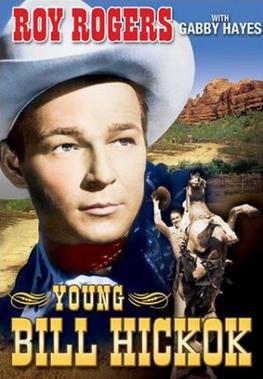
Roy Rogers had not yet reached his title as “The King of the Cowboys” when he appeared in Young Bill Hickok. This was a lean B western made in the time when Republic Pictures was still shaping him. At that time, Gene Autry was a big presence at the studio.
In these early years, Roy often did the same setup. He played a young version of a real Old West figure, but the character was not truly historical. He worked with director Joseph Kane, a long time veteran. George “Gabby” Hayes also showed up as the sidekick.
The plots used a well known name. After that, the films changed most of the details. They kept only the hint of the famous person and then built the rest from scratch.
The real Wild Bill Hickok never fought foreign agents plotting to seize California during the Civil War, never guarded Pony Express relay stations from stagecoach raiders, and certainly never sang four separate musical numbers while doing it — one IMDb reviewer put it bluntly, noting the plot bears “no semblance to Hickok’s life” whatsoever. That’s entirely beside the point. This is a singing-cowboy programmer built for Saturday matinee audiences who wanted Roy Rogers, Gabby Hayes, some clever stunt work, and just enough historical name recognition to make the poster interesting — and by that measure, it delivers reliably. It’s in the public domain, and you can watch it free right now.
Young Bill Hickok 1940 — Movie Overview Table
| Detail | Information |
|---|---|
| Title | Young Bill Hickok |
| Release Year | 1940 (released October 21, 1940) |
| Country | United States |
| Runtime | 59–64 minutes (sources vary) |
| Genre | Western, Musical, Drama, Civil War Adventure |
| Language | English |
| Format | Black & White |
| Director | Joseph Kane |
| Screenplay | Olive Cooper, Norton S. Parker |
| Cinematography | William Nobles |
| Film Editing | Lester Orlebeck |
| Associate Producer | Joseph Kane |
| Production Company / Distributor | Republic Pictures |
| Historical Basis | Loosely borrows the name of Wild Bill Hickok; the plot itself is entirely fictional |
| Notable Stunt Work | Features stunts by Yakima Canutt |
| Series Context | One of several early Roy Rogers vehicles casting him as a young version of a real Old West figure, alongside Days of Jesse James (1939) and Young Buffalo Bill (1940) |
| IMDb Rating | 5.8/10 |
| Public Domain | Yes — freely available to watch and download |
Full Cast Table — Young Bill Hickok (1940)
| Actor | Role |
|---|---|
| Roy Rogers | “Wild” Bill Hickok |
| George “Gabby” Hayes | “Gabby” Whitaker |
| Julie Bishop (billed as Jacqueline Wells) | Louise Mason |
| John Miljan | Nicholas Tower |
| Sally Payne | Calamity Jane Canary |
| Archie Twitchell | Phillip |
| Monte Blue | Marshal Evans |
| Hal Taliaferro | Morrell |
| Ethel Wales | Mrs. Stout |
| Jack Ingram | Henchman Red Burke |
| Monte Montague | Charlie Majors |
Roy Rogers Before He Was “The King of the Cowboys”
Roy Rogers was born Leonard Slye. At eighteen, he moved to California. He worked for a while with Western music groups, including the Hollywood Hillbillies, the Rocky Mountaineers, and the Texas Outlaws. In 1934, he helped start the Sons of the Pioneers. The group went on to make songs that people still remember today, like “Cool Water” and “Tumbling Tumbleweeds.”
In 1937, he went out on his own. The next year, he got his first feature role as the lead. By 1940, he had already made several films under a Republic deal. That contract later grew into close to a hundred movies.
What’s genuinely useful context for Young Bill Hickok is exactly where Rogers stood in the studio pecking order at this point. One retrospective explains it plainly: “during the first half-dozen years that Roy was at Republic, Gene Autry was king of the studio,” and Autry’s films carried the bulk of the musical numbers, while Rogers’s early pictures — “well orchestrated by veteran director Joe Kane” — leaned more heavily on action, with singing kept comparatively modest. It wasn’t until Autry entered military service in 1942 that Rogers’s own films fully transformed into the elaborate singing-cowboy showcases he’d eventually become famous for. Young Bill Hickok captures him squarely in that earlier, action-forward phase — and, notably, the same year he also took a supporting role in Republic’s prestige A-picture Dark Command, starring John Wayne and directed by Raoul Walsh.
Playing Fast and Loose With History — On Purpose
Young Bill Hickok was one of several Republic pictures built around the same basic formula: cast Rogers as a young, fictionalized version of a genuine Old West figure, borrow the name for marquee value, and invent an entirely new adventure plot around it. He’d play the same trick as “Young Buffalo Bill” the same year, and had already done it the year before as “Jesse James” in Days of Jesse James. One retrospective reviewer, watching purely for entertainment rather than historical accuracy, summarized the approach candidly: the plot is “all a lot of nonsense about Bill tracking down some Confederate raiders and their unknown leader,” conceding plainly that “none of it seemed to bear any semblance to Hickok’s life.”
That’s fully by design rather than a failure of research. Republic’s B-western machine wasn’t interested in biography — it was interested in giving audiences a recognizable historical name attached to a familiar, dependable genre plot: foreign spies, stagecoach raids, mistaken identity, a wedding at the end. Viewers looking for a serious account of the real Wild Bill Hickok’s life will find nothing of the sort here; viewers looking for a competently made 1940 singing-cowboy adventure get exactly what the poster promises.
Full Plot Summary — Young Bill Hickok (1940)
An agent of an unspecified foreign power, Nicholas Tower (John Miljan), plots to seize control of California amid the chaos of the American Civil War. To prevent news from reaching the East and keep the region isolated, Tower deploys Morrell (Hal Taliaferro) and his Overland Raiders to rustle stagecoach and Pony Express horses from relay stations along the communication line, cutting off the flow of information entirely. Bill Hickok (Roy Rogers) is dispatched to one of these relay stations, tasked with keeping the ponies safe from the raiders.
Calamity Jane, Gabby, and a Rekindled Romance
Calamity Jane (Sally Payne) and Gabby (George “Gabby” Hayes), horse traders for the relay stations, arrive with their Indian helpers just as Bill finishes off the last of an attacking raider party — though he’s badly wounded in the process, prompting the pair to stick around while he recovers. During this recovery, Bill’s old fiancée, Louise Mason (Julie Bishop), shows up hoping to reconcile after their engagement broke off over her Confederate sympathies clashing with his loyalty to the North. The two agree to set the war aside and are soon planning a wedding — but Marshal Evans (Monte Blue), head of the communication lines, needs Bill to personally escort a shipment of gold east to support the Federal war effort.
A Decoy Plan That Backfires
Recognizing the gold shipment is too dangerous to carry himself, Bill sends it with Gabby and Calamity instead while pretending to transport it personally as a decoy. The plan collapses when Louise, worried for Bill’s safety, tells Tower that Bill isn’t actually carrying the gold — unaware she’s confiding in the very man behind the raids. The Raiders promptly attack Gabby’s party and make off with the gold. When Bill notices the raiders never came after him as expected, he grows suspicious and returns to town to investigate, only to find Marshal Evans demanding answers about what went wrong.
Framed, Jailed, and a Daring Escape
While Bill investigates, Tower convinces the assembled townsmen that Bill himself is secretly leading the Raiders and was fleeing to escape justice. Gabby overhears the scheme and rides out to warn Bill, who manages to evade capture temporarily but is caught when he returns to search Tower’s office directly. Gabby helps engineer his escape from jail, and the two witness Tower fleeing town with the stolen gold and his Raiders in tow. Riding back to rally the pursuing posse, Bill convinces the skeptical Marshal to follow the fleeing gang. With Tower and the Overland Raiders finally captured and the Civil War at its end, Bill and Louise are at last free to marry.
Gabby Hayes, Sally Payne’s Calamity Jane, and a Genuinely Clever Jailbreak
As with most of Rogers’s early Republic pictures, George “Gabby” Hayes’s comic sidekick work draws consistent praise even from reviewers otherwise lukewarm on the film as a whole — one reviewer specifically called out “Hays [sic] is quite funny in support” as one of the picture’s few genuinely memorable elements, alongside a jailbreak sequence the same reviewer singled out as “very clever” and worth watching for on its own merits. Sally Payne’s Calamity Jane rounds out the central trio, giving the film its comic energy while Julie Bishop’s Louise Mason handles the film’s romantic-conflict subplot, bickering with Bill over the ongoing war in a dynamic more than one review flags as a nice bit of texture for an otherwise straightforward genre picture.
The film also benefits from behind-the-scenes talent that elevates it slightly above the era’s rock-bottom Poverty Row product: one review specifically credits “some fine Yakima Canutt stunts” among the picture’s assets, tying it to the same legendary stuntman whose work anchors numerous other B-westerns of the period, including several other titles in this same catalog.
Hal Taliaferro’s Morrell gets a nod for being “suitably seedy and menacing,” but not all the way cold. One reviewer also adds that there is a bit of warmth in him. Still, as the movie moves into the back half, attention seems to slide toward John Miljan’s Tower. At that point, Morrell’s role feels less central.
Where to Watch Young Bill Hickok (1940) Free Online
Young Bill Hickok is in the public domain. People can find it on many sites for free.
| Platform | Format | Cost |
|---|---|---|
| Internet Archive | Stream + Download (multiple formats) | Free |
| YouTube | Stream | Free |
| Amazon Prime Video | Stream | Free with Prime / SVOD |
Young Bill Hickok (1940) on Internet Archive:
Is Young Bill Hickok (1940) in the Public Domain?
Yes. Young Bill Hickok is in the public domain in the United States, and you can legally stream, download, share, and screen it without restriction or cost. It’s freely distributed by the Internet Archive and other archival platforms.
Critical Reception — Then and Now
On IMDb, the movie sits at about 5.8 out of 10. That seems about right for a dependable, straightforward kind of genre film. It is not a true breakout.
One review in the style of Rotten Tomatoes said it has more substance than many other entries in Rogers’s run. Another reviewer pointed out that the story brushes up against real moments in U.S. history. They mentioned the closing of the Civil War and Lincoln’s assassination as background pieces. Because of that, the film feels a touch heavier than the average Republic release from that time. Still, the main plot is made up.
The consistent verdict across reviews, then and now, is that this is a perfectly solid entry for existing Rogers fans and a fair introduction for newcomers, even if it won’t convert anyone skeptical of B-westerns generally. One reviewer, watching a complete Rogers film for the first time despite having grown up on his television show, called it simply “a passable B western,” a modest but accurate summary that’s echoed almost universally across the picture’s reception: competent, entertaining, historically nonsensical, and exactly what a Saturday matinee audience in 1940 would have wanted from an hour with Roy Rogers.
Frequently Asked Questions — Young Bill Hickok 1940
Q: What is Young Bill Hickok (1940) about?
A foreign agent plots to seize California during the American Civil War by cutting off communication lines through stagecoach and Pony Express raids. Bill Hickok (Roy Rogers) is sent to protect a relay station, and later helps expose the agent’s true identity after a gold shipment is stolen and Hickok is falsely accused of the theft.
Q: Is Young Bill Hickok (1940) in the public domain?
Yes. Young Bill Hickok is in the public domain in the United States and is freely available on the Internet Archive, YouTube, and other public domain film platforms.
Q: Is Young Bill Hickok historically accurate?
No. The film borrows Wild Bill Hickok’s name but tells an entirely fictional story with no basis in his actual life, in keeping with several other Roy Rogers vehicles of the era that similarly fictionalized real Old West figures.
Q: Who stars in Young Bill Hickok?
Roy Rogers stars as Bill Hickok, with George ‘Gabby’ Hayes as his sidekick, Julie Bishop as his love interest Louise Mason, and Sally Payne as Calamity Jane.
Q: How long is Young Bill Hickok?
Sources list the runtime between approximately 59 and 64 minutes.
Q: Does Roy Rogers sing in Young Bill Hickok?
Yes. The film includes several musical numbers performed by Rogers, including ‘When the Shadows Fall Across the Rockies’ and ‘A Cowboy Wedding,’ though singing plays a smaller role here than in his later, more musically elaborate films.
Q: What did critics say about Young Bill Hickok?
Critics generally describe it as a solid, entertaining B-western, praising George ‘Gabby’ Hayes’s comic support and a clever jailbreak sequence, while noting the plot bears little resemblance to the real Wild Bill Hickok’s life.
Q: Where can I watch Young Bill Hickok (1940) for free?
Young Bill Hickok is freely available on the Internet Archive and YouTube, and can also be streamed through Amazon Prime Video. All public domain versions are legal to stream and download.
Related Free Classic Westerns
If Young Bill Hickok (1940) drew you into singing-cowboy westerns or Roy Rogers’s early Republic Pictures work, these are the natural titles to explore next:
- The Dawn Rider (1935) Full Movie Review, Plot, Cast & Free John Wayne B-Western Classic
- Tombstone Canyon (1932) Full Movie Review, Plot, Cast & Free Western Mystery Classic
- Bad Man of Deadwood (1941) Full Movie Review, Plot, Cast & Free B-Western Classic
- Public Domain Movies List – All Free Classic Films (Complete Guide)