
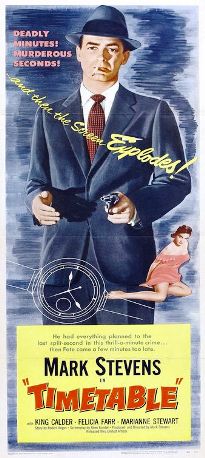
The theft in Timetable runs like clockwork for exactly one reason: the man solving it is the man who planned it. Here’s the harder story tucked behind that bit of showmanship— the director doing the part, Mark Stevens, was one of those former 20th Century-Fox leading men, his whole star thing had already gone sour by 1956, and he used his own thinning money to write, produce, direct, and also appear in a picture about a comfortably placed, admired professional who just kind of lets go then turns around and leaves the entirety of his life behind.
Stevens told the Los Angeles Times that same year, almost bluntly, “I don’t like to act, I’m not a very good actor and I’m not kidding myself about it.” The Timetable is a B-picture, but it’s also pretty much a visible version of autobiography, made by someone basically practicing his own departure, wrapped up in a genre thriller mask— and weirdly it’s the same film that put 22-year-old Felicia Farr and 26-year-old Jack Klugman into two of their first screen gigs. It’s in the public domain. You can watch it for free right now, no problem.
Time table 1956 — Movie Overview Table
| Detail | Information |
|---|---|
| Title | Timetable (also released as Time Table) |
| Release Year | 1956 |
| Country | United States |
| Runtime | 80 minutes |
| Genre | Film Noir, Crime, Heist Thriller |
| Language | English |
| Format | Black & White |
| Director | Mark Stevens (also lead actor and producer) |
| Screenplay | Aben Kandel, based on a story by Robert Angus |
| Cinematography | Charles Van Enger |
| Music | Walter Scharf |
| Producer | Mark Stevens |
| Production Company | Mark Stevens Productions |
| Distributor | United Artists |
| Setting | Arizona train robbery; manhunt extends to Tijuana, Mexico |
| Notable Early Appearances | Felicia Farr (early lead role); Jack Klugman (one of his earliest film roles) |
| Stevens’s Other Director-Star Noirs | Cry Vengeance (1954) |
| Copyright Status | Registration renewal not filed — lapsed into the public domain |
| IMDb Rating | 6.6/10 |
| Public Domain | Yes — freely available to watch and download |
Full Cast Table — Time table (1956)
| Actor | Role |
|---|---|
| Mark Stevens | Charlie Norman |
| King Calder | Joe Armstrong |
| Felicia Farr | Linda Brucker |
| Marianne Stewart | Ruth Norman |
| Wesley Addy | Dr. Paul Brucker |
| Alan Reed | Al Wolfe |
| Rodolfo Hoyos Jr. | Lt. Castro |
| Jack Klugman | Frankie Page |
| John Marley | Bobik |
Mark Stevens — A Fading Leading Man Directing Himself Into a Confession
Mark Stevens’s career had followed a genuinely enviable early trajectory. Signed by 20th Century-Fox and rechristened at Darryl Zanuck’s suggestion, he’d been voted one of exhibitors’ “stars of tomorrow” in 1946, played the FBI man in The Street With No Name (1948) opposite Richard Widmark, and held his own as Olivia de Havilland’s steady husband in The Snake Pit (1948). By the early 1950s that momentum had stalled. He bounced through mid-budget work at Columbia and Universal, took the lead in television’s Martin Kane, Private Eye, and eventually moved behind the camera out of necessity as much as ambition, producing and directing himself in low-budget noirs for Allied Artists and, with Timetable, United Artists.
Contemporary coverage still found the multitasking impressive — New York Times critic Milton Esterow called Stevens “the latest Hollywood triple-threat” for handling directing, acting, and television work simultaneously. But the film itself tells a quieter story than the trade-press framing suggests. Charlie Norman, the insurance investigator who turns out to be his own case’s mastermind, is a man who has built exactly the life 1950s America told him to want — a good job, a devoted wife, a planned vacation — and secretly can’t stand any of it. Stevens plays him with what one retrospective assessment called “bitter quietude,” a “strangled monotone,” a performance that reads, in hindsight, like a man devouring his own leading-man charisma on camera. Within a decade, Stevens would leave Hollywood outright for Majorca, running a restaurant and writing pulp novels instead of acting.
Felicia Farr and Jack Klugman — Two Careers Just Getting Started
Felicia Farr arrived on Timetable fresh off a seven-year Columbia Pictures contract signed in 1955, initially billed as “Randy Farr” before reverting to her own name. She was still building the western-ingenue reputation that Delmer Daves would cement a year later with 3:10 to Yuma (1957) and Jubal (1956), and the femme fatale role of Linda Brucker in Timetable — a woman entangled with both a disgraced doctor and the investigator secretly in love with her — sits early in that build. Farr would go on to marry Jack Lemmon in 1962 and appear in his sole directorial feature, Kotch (1971), decades after this modest noir.
Jack Klugman, playing the small role of Frankie Page, was in what most reference sources now count among his earliest film appearances — a decade before he became half of television’s most famous odd couple. Watching him here, in a supporting role in a Poverty Row-adjacent programmer, is the same kind of pleasure the format’s fans return for again and again: seeing a soon-to-be-familiar face before anyone involved knew it would become one.
Full Plot Summary — Time table (1956)
A man calling himself Dr. Sloane boards a train passing through Arizona. He’s actually Paul Brucker (Wesley Addy), a physician whose license was revoked for alcoholism, traveling with a “patient” and the patient’s “wife” — who is really Brucker’s own wife, Linda (Felicia Farr). The arrangement is a cover: Brucker gains access to a physician’s black bag stored in the baggage car, uses it to blow the safe, and steals a $500,000 railroad payroll. He then claims his fictitious patient has polio — a manufactured public-health emergency urgent enough to justify leaving the train early — and the trio escapes by ambulance to a remote hospital far from any scheduled stop. Railroad officials don’t discover the theft until the train reaches Phoenix, hours after the thieves are gone.
The insurance company assigns its best investigator, Charlie Norman (Mark Stevens), to the case, forcing him to postpone a long-planned Mexico vacation with his wife, Ruth (Marianne Stewart). Norman is paired with Joe Armstrong (King Calder), the railroad’s own investigator and an old friend. Evidence surfaces that the thieves abandoned the ambulance and fled by rented helicopter — proof of a heist planned with genuine precision, built around a strict timetable that gives the film its title.
The Reveal — Investigating His Own Crime
As Norman and Armstrong dig deeper, it becomes clear that Norman himself is the case’s secret architect. He had fallen in love with Linda Brucker months earlier while investigating an unrelated insurance claim her husband had filed, and the entire robbery — the fake polio diagnosis, the ambulance, the helicopter, the perfectly sequenced escape — was his own design, built to fund a new life with her far from his marriage and his career. The investigation Norman is nominally leading is, in practice, an elaborate act of self-sabotage he’s trying to outrun.
Tijuana and the Unraveling
As American and Mexican authorities close in, Norman attempts one last clean escape. But his wife Ruth — attempting what she believes is a harmless practical joke — makes a duplicate key to his locked attaché case and swaps his travel documents for vacation magazines, only to discover the stolen $500,000 inside. She anonymously returns the money to the railroad, unknowingly destroying Norman’s escape plan at the exact moment he needs it most. The pursuit reaches its climax in Tijuana, where Linda is fatally shot in the back by a Mexican policeman as she and Norman try to flee up the side of a building — the “perfect crime” undone not by the investigators he was supposedly helping, but by the ordinary, devoted wife he was trying to leave.
Ruth Norman — The Film’s Quiet Second Center
One detail critics have specifically praised about Timetable is its refusal to treat Marianne Stewart’s Ruth Norman as a disposable obstacle. It would have been easy for the film to shove the “plain-faced” jilted wife aside in favor of the glamour built around Linda Brucker. Instead, the screenplay by Aben Kandel gives Ruth’s heartbreak real weight as she watches, in slow motion, the collapse of a marriage and a life she believed was stable — a sensitive dimension that critics have identified as lifting the film’s craftsmanship above the merely competent, and one that makes the film’s final twist land as tragedy rather than simple irony.
Where to Watch Timetable (1956) Free Online
Timetable is in the public domain and legally available across multiple platforms at no cost.
| Platform | Format | Cost |
|---|---|---|
| Internet Archive | Stream + Download (multiple formats) | Free |
| YouTube | Stream | Free |
| Tubi | Stream (with ads) | Free |
| Public Domain Movies | Stream | Free |
| Fawesome | Stream (with ads) | Free |
Timetable (1956) on Internet Archive:
Is Time table (1956) in the Public Domain?
Sure, the timetable thing has this mandatory 1955 copyright notice from United Artists Corporation, but somehow no renewal registration was filed to keep the protection going past 1983, like the old copyright law asked for. Because of that, the film basically dropped into the public domain in the United States, and now it’s free to stream, download, and share around without limits or payment.
Critical Reception — A Small Film Critics Keep Rediscovering
The film holds a 6.6 out of 10 on IMDb, respectable for a Poverty Row-adjacent programmer, and its reputation has only grown among noir specialists in the decades since. Critic Dennis Schwartz praised it directly, describing Norman’s arc as combining two classic noir themes — the respected professional gone wrong, and the mid-life collapse of a man who throws away a devoted wife and a comfortable, empty middle-class existence for a woman he desires — and calling it “a taut thriller with a fine script and acting.”
A 2013 retrospective assessment went further, framing Timetable and Stevens’s earlier Cry Vengeance (1954) as a matched pair of “self-lacerating works” in which the director cast himself as morally compromised men fleeing an America that had already discarded them — describing the films as made “when his acting career was in decline,” with Stevens playing his characters’ obsession “with bitter quietude.” That reading treats the film’s low budget and modest scale not as limitations but as part of the point: a nearly anonymous production made by a man whose real subject was his own diminishing stardom.
The most accurate summary of the film’s appeal is this: eighty minutes of tightly plotted, hour-by-hour heist mechanics, anchored by a director-star giving one of the more genuinely melancholy lead performances in Poverty Row noir, supported by a wife’s storyline the script refuses to shortchange, and populated with two future television and film stalwarts — Felicia Farr and Jack Klugman — years before anyone knew their names. Watch it for the mechanics of the heist. Stay for what it reveals about the man who built it.
Frequently Asked Questions — Timetable 1956
Q: What is Timetable (1956) about?
An insurance investigator is assigned to solve a meticulously planned $500,000 train payroll robbery in Arizona, working alongside a railroad detective friend. As the investigation proceeds, it becomes clear that the investigator himself secretly masterminded the heist, planning to escape to Mexico with the wife of the man he framed for the crime.
Q: Is Timetable in the public domain?
Yes. Timetable’s 1955 United Artists copyright was never renewed, and the film has lapsed into the public domain in the United States. It is freely available on the Internet Archive, YouTube, Tubi, Public Domain Movies, and Fawesome.
Q: Who directed Timetable?
Mark Stevens directed, produced, and starred in Timetable as insurance investigator Charlie Norman. Stevens was a former 20th Century-Fox leading man whose film stardom had declined by the mid-1950s, leading him to write, produce, direct, and star in a handful of low-budget noirs, including this one and Cry Vengeance (1954).
Q: Is this one of Felicia Farr’s early roles?
Yes. Timetable is among Felicia Farr’s earliest screen credits, arriving shortly after she signed a seven-year contract with Columbia Pictures in 1955. She plays Linda Brucker, the wife entangled in both the crime and the lead investigator’s affections, a year before her better-known western roles for director Delmer Daves.
Q: Is Jack Klugman in Timetable?
Yes. Jack Klugman appears as Frankie Page in what most reference sources count among his earliest film roles, roughly two decades before he became famous on television in The Odd Couple and Quincy, M.E.
Q: Why does Mark Stevens both direct and star in Timetable?
By the mid-1950s, Stevens’s career as a Hollywood leading man had cooled considerably. Rather than continue accepting shrinking roles, he moved into producing and directing his own low-budget films, casting himself in the lead. He would later say publicly that he did not particularly enjoy acting and did not consider himself especially skilled at it.
Q: How does the train robbery actually work in the film?
A disgraced physician poses as a doctor aboard the train, uses his medical bag to access and blow open the baggage car’s safe, and then invents a fake polio diagnosis for a fictitious patient to justify an early, unscheduled departure by ambulance — allowing the thieves to escape with the stolen payroll hours before the theft is even discovered.
Q: How does the robbery ultimately get uncovered?
Charlie Norman’s wife, Ruth, intending a harmless practical joke, makes a duplicate key to his locked attaché case and swaps his documents for travel magazines — only to discover the stolen $500,000 inside. She anonymously returns it to the railroad, unraveling her husband’s escape plan without realizing what she has actually exposed.
How long is Timetable?
The film runs approximately 80 minutes.
Q: Where can I watch Timetable (1956) for free?
Timetable is freely available on the Internet Archive, YouTube, Tubi, Public Domain Movies, and Fawesome. All versions are legal to stream and download under public domain status.
Related Free Classic Noir and Crime Films
If Timetable (1956) drew you into public domain film noir and heist thrillers, these are the natural titles to explore next:
- Public Domain Cartoons
- Public Domain Horror Movies – Free Classic Scary Films Online
- The Limping Man (1953) Full Movie Review, Plot, Cast & Free Film Noir Thriller
- Public Domain Movies List – All Free Classic Films (Complete Guide)
Movie Tags
Timetable 1956, Time Table full movie, watch Timetable free, Timetable public domain, Mark Stevens actor director, Mark Stevens Hollywood decline, Felicia Farr early film role, Jack Klugman early film role, King Calder actor, Wesley Addy actor, train robbery film noir, insurance investigator heist film, United Artists 1956 noir, Charles Van Enger cinematography, Aben Kandel screenplay, Arizona train heist, Tijuana Mexico manhunt, self-directed noir actor, free classic 1950s film noir online, public domain crime thriller