
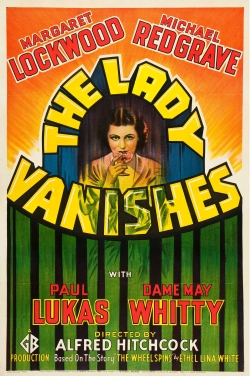
In October 1937, Alfred Hitchcock read a script that wasn’t his, for a film that had already been cancelled, about a director he was replacing. The script was an adaptation of Ethel Lina White’s 1936 novel The Wheel Spins, originally called The Lost Lady, originally assigned to Irish director Roy William Neill, and abandoned when Yugoslav authorities discovered that an advance crew’s background footage was for a script that depicted their country unfavorably and ordered everyone out. Edward Black at Gainsborough had this dormant thing going on, you know, a script from Sidney Gilliat and Frank Launder , and Hitchcock also had a contract obligation he really needed to get through. So he read it, made a few alterations maybe here and there, and then he started filming in March of 1938.
Only five weeks later , he was done with what became, by the time it premiered in London in October 1938, the most successful British film up to that point. It even got named Best Picture of 1938 by The New York Times, and it also earned him the New York Film Critics Circle Award for Best Director. After that, it was that same film that kicked off the contract with David O. Selznick, and that launch really turned into his Hollywood career, basically.The film is in the public domain. It is 97 minutes. The fictional country where it begins is called Bandrika, and Hitchcock and his writers invented a complete fictional language for it. The cricket statistics have, alas, been lost.
The Lady Vanishes 1938 — Movie Overview Table
| Detail | Information |
|---|---|
| Title | The Lady Vanishes |
| Original Working Title | The Lost Lady |
| London Premiere | October 7, 1938 |
| U.S. Release | November 1, 1938 |
| Country | United Kingdom |
| Runtime | 97 minutes |
| Genre | Mystery, Thriller, Spy Film |
| Languages | English, German, French, Italian; fictional Bandrikan language |
| Format | Black & White |
| Director | Alfred Hitchcock |
| Producer | Edward Black (Gainsborough Pictures) |
| Screenplay | Sidney Gilliat, Frank Launder; additional dialogue: Alma Reville |
| Based On | The Wheel Spins (1936 novel) by Ethel Lina White |
| Cinematography | Jack E. Cox |
| Editor | R. E. Dearing |
| Music | Louis Levy; Charles Williams |
| Art Direction | Alex Vetchinsky, Maurice Carter, Albert Jullion |
| Production Companies | Gainsborough Pictures; Gaumont-British Picture Corporation |
| UK Distributor | Metro-Goldwyn-Mayer |
| U.S. Distributor | Twentieth Century-Fox |
| Budget | £104,904 |
| Filming Locations | Islington Studios, London; Lime Grove Studios, Shepherd’s Bush; Longmoor Military Camp and Railway, Hampshire |
| Filming Dates | March 1938 — completed in approximately five weeks |
| Awards | New York Film Critics Circle Award for Best Director (Hitchcock, 1938); New York Times Best Picture of 1938 |
| Hitchcock Cameo | Victoria Station near the film’s end — black coat, cigarette |
| IMDb Rating | 7.7/10 |
| Public Domain | Yes — freely available to watch and download |
Full Cast Table — The Lady Vanishes (1938)
| Actor | Role |
|---|---|
| Margaret Lockwood | Iris Henderson |
| Michael Redgrave | Gilbert Redman (musicologist; film debut) |
| Dame May Whitty | Miss Froy (spy) |
| Paul Lukas | Dr. Egon Hartz (villain) |
| Basil Radford | Charters |
| Naunton Wayne | Caldicott |
| Cecil Parker | Mr. Todhunter (barrister traveling with his mistress) |
| Linden Travers | “Mrs.” Todhunter (actually Todhunter’s mistress) |
| Mary Clare | The Baroness |
| Googie Withers | Blanche |
| Catherine Lacey | The Nun |
| Philip Leaver | Signor Doppo (magician) |
| Emile Boreo | Hotel Manager |
| Selma Vaz Dias | Signora Doppo |
| Alfred Hitchcock | Traveler at Victoria Station (cameo; uncredited) |
The Film Hitchcock Didn’t Initiate — The Road from Yugoslavia to Islington
Hitchcock is credited with so many of the films he directed that it is easy to forget he spent the first half of his career at the mercy of other people’s choices. The Lady Vanishes is the clearest example in his filmography of a great film that happened to him rather than one he initiated — and the specific chain of events that produced it is one of the stranger production stories in British film history.
Sidney Gilliat and Frank Launder — who would go on to form one of British cinema’s most successful writing-directing partnerships — had read Ethel Lina White’s 1936 novel The Wheel Spins and recognized its film potential immediately. They pitched it to Edward Black at Gainsborough, who bought it and assigned direction to Roy William Neill. A production crew was sent to Yugoslavia for background footage. The Yugoslav police, discovering what the script said about their country, objected and expelled the crew. Black shelved the project entirely.
In October 1937, Hitchcock read the script to fulfill a contract obligation to Black. He recognized in Gilliat and Launder’s screenplay something that could be shaped into exactly the kind of film he did best. He worked with the writers — and with his wife Alma Reville, who contributed additional dialogue — to tighten the opening and ending, add speed, and clarify the spy mechanics. Filming started in March 1938 and was complete in approximately five weeks. Gainsborough’s Islington Studios provided the main interiors; Lime Grove Studios in Shepherd’s Bush provided additional stage work; and Longmoor Military Camp in Hampshire — specifically the Longmoor Military Railway — provided the exterior shooting for the forest gunfight that closes the film.
The MGM Deal — How an American Deal Briefly Interrupted Production
The Lady Vanishes was the first film produced under a distribution agreement between Gaumont-British and MGM, in which Gaumont provided MGM with Gainsborough films for UK release and MGM agreed to pay half the production costs if they decided to release the film in the United States. The agreement was interrupted almost immediately by an electricians’ strike that briefly halted production. The eventual U.S. distribution went not through MGM but through Twentieth Century-Fox — a complication in the deal that the film’s commercial success rendered academic.
Full Plot Summary — The Lady Vanishes (1938)
A snowstorm strands a group of British travelers in a hotel in Bandrika — a fictional European country whose language Hitchcock and his writers invented specifically for the production, the hotel manager’s staff conversations delivering it most prominently. Among the travelers is Iris Henderson (Margaret Lockwood), a wealthy socialite heading home to England for a marriage she appears mildly unenthusiastic about. Also stranded are Charters and Caldicott (Basil Radford and Naunton Wayne), two cricket-obsessed Englishmen whose entire focus is on whether they will make it back to England in time for a Test match. And in the room directly above Iris’s, a musicologist named Gilbert Redman (Michael Redgrave) is conducting field research with excessive volume and insufficient consideration for neighboring guests.
On the train the following day, Iris meets Miss Froy (Dame May Whitty) — a pleasant elderly governess with an open manner and the specific warmth of someone who has been making herself agreeable to strangers for a long professional life. They share tea in the dining car. Iris is struck on the head by a flower pot that falls from a bridge — whether accidentally or deliberately is not immediately clear — and is briefly unconscious. When she wakes on the train and goes looking for Miss Froy, she discovers the woman has vanished.
The Conspiracy of Denial — Everyone Claims Miss Froy Never Existed
The film’s central mechanism is gaslighting on a collective scale. Every passenger Iris approaches claims not to have seen Miss Froy. The Italian magician Signor Doppo (Philip Leaver) and his wife deny it. The Baroness (Mary Clare) denies it. Mr. Todhunter (Cecil Parker) — a barrister traveling with his mistress under the pretense of a legitimate marriage — denies it with the particular urgency of a man who cannot afford public attention of any kind. Dr. Hartz (Paul Lukas), the distinguished physician who takes on Iris’s care after the blow to her head, suggests with gentle clinical authority that she is concussed and imagining things.
Gilbert, whose hotel room quarrel with Iris makes him an unlikely ally, is initially skeptical but becomes convinced when Iris finds evidence: Miss Froy’s name written in the condensation on the dining car window, preserved long enough to be seen and significant enough to confirm what Iris knows to be true.
Miss Froy’s Secret — The McGuffin and What It Actually Is
Miss Froy is not, it transpires, a retired governess. She is a British agent carrying a coded musical phrase in her memory — the film’s “McGuffin,” Hitchcock’s term for the object everyone in a thriller is pursuing whose specific nature is irrelevant to the film’s emotional logic. The coded phrase is real information that the British government needs. Miss Froy has been substituted on the train by an impostor — the Nun (Catherine Lacey), whose sensible shoes Iris notices are the wrong kind for a woman of genuine religious vocation.
Before she disappears, Miss Froy hums the musical phrase to Gilbert — ensuring its transmission regardless of her own fate. In The Wheel Spins, Miss Froy is innocent, not aware, not really taking in what she knows. In Hitchcock’s film, she becomes a planned, professional spy, like she knows exactly what she’s carrying , right there in her hands. That change kind of flips the vibe, from pure mystery mode into something more like an espionage thriller and well, it also locks in those endgame stakes for the final act.
The Gunfight — Charters and Caldicott Prove Their Worth
The train is stopped in a forest by agents of Bandrika. Dr. Hartz reveals himself as the film’s villain — the orchestrator of Miss Froy’s substitution and the force trying to prevent her message from reaching Britain. What follows is the film’s climactic sequence: a gunfight in which the passengers, armed with the pistols the train was carrying, hold off the Bandrikan agents.
Charters and Caldicott — who have spent the entire film obsessing about cricket and treating the surrounding intrigue as an inconvenience — participate in the gunfight with the competent practicality of men who, when finally required to be useful, simply are. Their turn is one of the film’s best jokes executed with perfect timing. Mr. Todhunter, whose cowardice throughout the film has been a running source of contempt, makes his own choice in the final sequence — a moment that Hitchcock stages with characteristic economy: one action, no commentary, more dignity than the character has earned.
Gilliat and Launder — The Writers Who Made the Film Before Hitchcock Arrived
The considerable critical attention The Lady Vanishes has received over eighty-five years has been allocated almost entirely to Hitchcock. The people who actually wrote the film — Sidney Gilliat and Frank Launder — are rarely mentioned in the same breath. This is a significant omission. The TCM assessment states directly: “Ironically, although it was one of his biggest hits, The Lady Vanishes was the only major Hitchcock film that he didn’t initiate himself.”
Gilliat and Launder created Charters and Caldicott — who do not appear in White’s novel — as their own invention, not Hitchcock’s. The double-consciousness of the comic cricket pair that makes them the film’s most beloved supporting characters is Launder and Gilliat’s work. The film’s structural wit, the layers of secrets among the passengers, the invention of Bandrika’s language — these are screenplay decisions made before Hitchcock read the script.
Gilliat and Launder would go on to a producing and directing partnership that generated some of British cinema’s most successful films across the 1940s and 1950s — the St. Trinian’s series and the Launder-directed The Happiest Days of Your Life (1950) among them. Their contribution to The Lady Vanishes is the structural foundation on which Hitchcock built one of his best films.
Michael Redgrave — A Cambridge Graduate Playing Himself
Michael Redgrave’s film debut as Gilbert Redman carries an unusual biographical resonance. Gilbert is a musicologist — a Cambridge-educated academic who studies music scientifically. Redgrave had attended Cambridge University. Gilbert had a musical background from earlier in his career. Redgrave had been a member of a chorus earlier in his. The character is not a self-portrait, but the parallels between the actor and the role give Redgrave’s performance a quality of unforced authenticity that casting a less closely matched actor would not have produced.
Redgrave and Hitchcock really never had this kind of fully harmonious working relationship. Like Redgrave wanted extra rehearsal time with the cast before filming, almost the way he was used to from theatre, while Hitchcock leaned toward spontaneous performance, he felt that too much rehearsal would make the end result seem kind of mechanical on film. So that tension between these approaches is noticeable in the final film mostly in the way Redgrave’s carefully arranged, intellectual restraint is sitting next to Lockwood’s more instinctive way of acting, not really in open conflict though , more like in a productive contrast that still kind of works.
Charters and Caldicott — The Supporting Characters Who Outlasted the Film
Basil Radford and Naunton Wayne’s portrayal of Charters and Caldicott — two cricket-obsessed English gentlemen whose commitment to the sporting scores back home is absolute regardless of surrounding geopolitical crisis — became one of the most beloved character pairings in British film history. Their creation by Gilliat and Launder for this film produced an entirely unanticipated cultural phenomenon: the demand for more Charters and Caldicott was immediate and sustained.
The pair returned in Night Train to Munich (1940) — another Launder and Gilliat script, directed by Carol Reed — in Crook’s Tour (1941), and in Millions Like Us (1943). In 1985, a BBC television series brought them back again with Robin Bailey and Michael Aldridge playing the roles, like really, it just sort of restarted the whole thing. Back in 1979 remake, Arthur Lowe , and Ian Carmichael took the parts. The characters durability, kind of leans on a particular comic dynamic, where you get the sight of total English imperturbability being laid over situations of real danger and somehow it turns into humor not because anyone is a coward, but through a sort of reversed heroism—men whose priorities are so stubbornly fixed on cricket that mortal threat is treated like a minor scheduling problem .
Hitchcock’s Cameo and Bandrika’s Language
Hitchcock appears in his customary cameo near the film’s end at Victoria Station — wearing a black coat and smoking a cigarette. The appearance is brief and easy to miss on first viewing, as his cameos typically are. For viewers tracking his appearances across his filmography, the Victoria Station shot is among the more clearly staged: he walks through frame without attempting concealment.
The fictional country of Bandrika — standing in explicitly for a Germany whose political direction in 1938 was unmistakable to any European audience — has its own invented language. Hitchcock, Gilliat, and Launder created enough of the Bandrikan language to sustain the hotel manager’s scenes convincingly. The political allegory is never labored: the film is a thriller, not a tract. But the choice to set the story in a fictional totalitarian state rather than naming a real one gives it a specific quality — the threat is real but deniable, which was, in 1938, a politically accurate description of the European situation the film was commenting on.
Where to Watch The Lady Vanishes (1938) Free Online
The Lady Vanishes is in the public domain in the United States and legally available across multiple platforms at no cost.
| Platform | Format | Cost |
|---|---|---|
| Internet Archive | Stream + Download (includes 720p HD restored version) | Free |
| YouTube | Stream (multiple uploads including restored versions) | Free |
| Tubi | Stream (with ads) | Free |
| Plex | Stream (with ads) | Free |
| Public Domain Movies | Stream | Free |
The Lady Vanishes (1938) — Restored 720p HD on Internet Archive:
Is The Lady Vanishes (1938) in the Public Domain?
Sure. The Lady Vanishes 1938, is considered public domain in the United States. So you can stream it , download it , share it, and even screen it without any real limits or extra payment. There’s also a 720p restored version floating around on the Internet Archive, together with the usual public domain copies , so you can pick what works best for you, and not worry too much about it.
Critical Reception — Then and Now
The movie has a 7.7 out of 10 on IMDb ,which is the highest rating across the whole public domain series ,from a big voter group that keeps basically agreeing on its value for over eighty five years now. It was also named Best Picture of 1938 by the New York Times ,and it won Hitchcock the New York Film Critics Circle Award for Best Director . Plus it shows up in Leonard Maltin’s top 100 Must-See Films of the 20th Century, so yeah ,it’s not just remembered, it’s sort of reaffirmed too.
The TCM take lands on the film’s more specific sort of achievement ,saying: “It also gave film scholars a healthy helping of those traits that would distinguish his films: deceptive appearances, sly humor, a tangled international plot and what he called ‘The McGuffin.'” Meanwhile the Criterion Collection calls it “a vertiginous blend of comedy and suspense, wit and genuine menace.” It’s like they’re pointing at the same engine but from different angles.
Even the IMDb consensus puts it in the right place within Hitchcock’s career ,making note of it as his final British masterpiece before Hollywood: “For what turned out to be his last masterpiece in the United Kingdom before leaving for Hollywood, Alfred Hitchcock went back to a familiar theme of someone being innocently caught up in intrigue.” And the David O. Selznick contract that sprang out of the film’s success led to Rebecca (1940), Spellbound (1945), and it also helped set the stage for Hitchcock’s Hollywood identity. The Lady Vanishes is the one that made all of that possible ,and its reputation has basically never let go of that fact.
Frequently Asked Questions — The Lady Vanishes 1938
Q: What is The Lady Vanishes (1938) about?
A British socialite on a trans-European train discovers that an elderly woman she befriended has vanished, and every other passenger denies the woman ever existed. With the help of an initially skeptical musicologist, she investigates and uncovers a spy conspiracy — Miss Froy is a British agent carrying a coded musical message in her memory that enemy forces are determined to suppress.
Q: Is The Lady Vanishes (1938) in the public domain?
Yes. The Lady Vanishes is in the public domain in the United States. A 720p restored version is available on the Internet Archive alongside standard prints. You can legally stream, download, and share it for free.
Q: Who wrote The Lady Vanishes?
Sidney Gilliat and Frank Launder wrote the screenplay, based on Ethel Lina White’s 1936 novel The Wheel Spins. Hitchcock’s wife Alma Reville contributed additional dialogue. Charters and Caldicott — the film’s most beloved supporting characters — were Launder and Gilliat’s own invention and do not appear in White’s novel.
Q: Why was The Lady Vanishes originally cancelled?
The film was originally called The Lost Lady and assigned to director Roy William Neill. A production crew sent to Yugoslavia for background footage was expelled after Yugoslav authorities discovered the script contained an unflattering portrayal of their country. Edward Black shelved the project until Hitchcock accepted it to fulfill a contract obligation approximately a year later.
Q: Was The Lady Vanishes Michael Redgrave’s film debut?
Yes. The Lady Vanishes was Michael Redgrave’s first film. His character Gilbert Redman is a Cambridge-educated musicologist — Redgrave himself attended Cambridge and had a choral background earlier in his career. Redgrave and Hitchcock reportedly did not get along well during filming, disagreeing about rehearsal methodology.
Q: Who are Charters and Caldicott?
Charters (Basil Radford) and Caldicott (Naunton Wayne) are a pair of cricket-obsessed English gentlemen created by Launder and Gilliat for the film — they do not appear in the source novel. Their popularity was so immediate that the characters returned in Night Train to Munich (1940), Crook’s Tour (1941), Millions Like Us (1943), and a 1985 BBC television series. The 1979 remake cast Arthur Lowe and Ian Carmichael in the roles.
Q: Does Hitchcock appear in The Lady Vanishes?
Yes. Hitchcock makes his customary cameo appearance near the film’s end at Victoria Station — wearing a black coat and smoking a cigarette. The appearance is brief and can be missed on first viewing.
Q: What is the McGuffin in The Lady Vanishes?
The McGuffin — Hitchcock’s term for the object everyone is pursuing whose specific nature is irrelevant to the film’s emotional logic — is a coded musical phrase that Miss Froy carries in her memory and is transporting to the British government. She hums it to Gilbert to ensure its transmission regardless of her own fate. The ‘what’ of the message is unimportant; the ‘that’ of its existence drives the entire plot.
Q: How did The Lady Vanishes lead to Hitchcock’s Hollywood career?
The film’s commercial success — it was the most successful British film to that point on its October 1938 release — and its critical recognition (New York Times Best Picture of 1938; New York Film Critics Circle Best Director) attracted the attention of producer David O. Selznick. Selznick offered Hitchcock a contract that brought him to Hollywood, where he made Rebecca (1940), Spellbound (1945), and the bulk of his most celebrated work.
Q: Where can I watch The Lady Vanishes (1938) for free?
The Lady Vanishes (1938) is freely available on the Internet Archive (including a 720p restored version with download option), YouTube, Tubi, Plex, and Public Domain Movies. All versions are legal to stream and download under public domain status.
Related Free Classic Mystery and Thriller Films
If The Lady Vanishes (1938) sent you into classic British thrillers and public domain mystery cinema, these are the natural titles to explore next:
- And Then There Were None (1945) — Agatha Christie’s Chilling Whodunit | Full Free Classic Film Online
- Sherlock Holmes and the Secret Weapon (1943) — Basil Rathbone Battles Nazis | Free Classic Film Online
- The Strange Love of Martha Ivers (1946) — Kirk Douglas Debut, Barbara Stanwyck Noir | Free Classic Film
- Public Domain Movies List – All Free Classic Films (Complete Guide)
Movie Tags
The Lady Vanishes 1938, The Lady Vanishes full movie, watch The Lady Vanishes free, The Lady Vanishes public domain, Alfred Hitchcock British films, Alfred Hitchcock last British film, Margaret Lockwood actress, Michael Redgrave film debut, Dame May Whitty spy film, Basil Radford Naunton Wayne Charters Caldicott, Sidney Gilliat Frank Launder screenplay, Edward Black producer, Jack E Cox cinematography, Gainsborough Pictures 1938, train mystery film, spy thriller 1938, Bandrika fictional country Hitchcock, McGuffin Hitchcock Lady Vanishes, New York Critics Best Director 1938, free classic British thriller online