
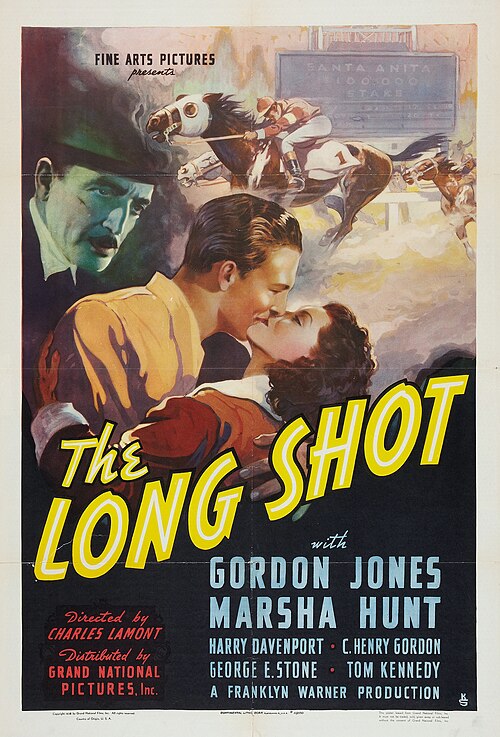
In 1939, Marsha Hunt was a 21-year-old actress freshly cut loose by Paramount, freelancing at Poverty Row studios and hoping for one more shot at a real career. She’d remember it decades later without much sentiment: no rehearsals, no second takes, bring your own wardrobe, if nothing broke on set — print it. The Long Shot, made for the perpetually cash-strapped Grand National Pictures, is exactly that kind of picture. It’s also, unremarked upon by almost anyone at the time, one small rung on the ladder that eventually got Hunt into MGM’s Andy Hardy pictures that same year and, within twelve months, into Pride and Prejudice opposite Laurence Olivier — a career that would rise all the way to the cover of Life magazine before McCarthy-era blacklisting cut it off overnight.
The Long Shot itself is a 69-minute racetrack melodrama about a ruined stable owner who fakes his own death to protect his last good horse from a rival determined to marry his niece into ownership. It’s unpretentious, formulaic, and unmistakably a product of the era’s B-movie assembly line — Grand National would be bankrupt within a year of releasing it. What keeps it watchable today is the same thing that kept it watchable in 1939: a reliably charming Harry Davenport, a young Marsha Hunt doing what she could with a thin part, and, by more than one account, a horse with more screen presence than the human lead. It’s in the public domain, and you can watch it free right now.
The Long Shot 1939 — Movie Overview Table
| Detail | Information |
|---|---|
| Title | Long Shot (also known as The Long Shot) |
| Release Year | 1939 (released January 6, 1939) |
| Country | United States |
| Runtime | 69 minutes |
| Genre | Drama, Romance, Horse Racing |
| Language | English |
| Format | Black & White |
| Director | Charles Lamont |
| Screenplay | Ewart Adamson |
| Story | Harry Beresford and George Callaghan |
| Cinematography | Arthur Martinelli |
| Film Editing | Bernard Loftus |
| Producer | Franklyn Warner (Franklyn Warner Productions) |
| Distributor | Grand National Pictures |
| Setting | Santa Anita Park racetrack |
| IMDb Rating | 5.9/10 |
| Public Domain | Yes — freely available to watch and download |
Full Cast Table — Long Shot, The (1939)
| Actor | Role |
|---|---|
| Gordon Jones | Jeff Clayton |
| Marsha Hunt | Martha Sharon |
| C. Henry Gordon | Lew Ralston |
| George Meeker | Dell Baker |
| Harry Davenport | Henry Sharon |
| George E. Stone | Danny Welch |
| Frank Darien | Zeb Jenkins |
| Tom Kennedy | Mike Claurens |
| Emerson Treacy | Henry Knox |
| Gay Seabrook | Helen Knox |
| Benny Burt | Joe Popopopolis |
| Jimmy Robinson | Tucky |
| Denmore Chief | Certified Check (the horse) |
| Joe Hernandez | Racing Announcer |
| James Keefe | Racing Announcer |
Also appearing uncredited: Wilson Benge, Dorothy Fay, Earle Hodgins, Wilbur Mack, Carl Meyer, Lee Phelps, Norman Phillips Jr., Jason Robards Sr., and Claire Rochelle.
Marsha Hunt in 1939 — A Career on the Way Up, Years Before It Would Be Cut Down
1939 was a pivotal, chaotic year for Marsha Hunt. She’d arrived in Hollywood at seventeen, signed by Paramount, and spent several years as a contract ingenue — including romancing John Wayne in Born to the West (1937) — before the studio declined to renew her deal in 1938. What followed was a scramble through Poverty Row: Fine Arts, Monogram, Republic, and pictures like The Long Shot, made fast and cheap, six-day weeks, no direction beyond “come through that door, sit there, stand up now.”
That same year, Hunt landed a one-day bit in MGM’s The Hardys Ride High, then broke out properly opposite Lana Turner in These Glamour Girls. She was, by her own account, chasing her way back inside a major studio gate, and 1939 is the year it worked — within months she’d be under long-term MGM contract, and by 1940 she’d be playing Mary Bennet opposite Laurence Olivier’s Mr. Darcy in Pride and Prejudice. She’d go on to be dubbed “Hollywood’s Youngest Character Actress” for her range, appear in the Best Picture nominees Blossoms in the Dust (1941) and The Human Comedy (1943), and grace the cover of Life magazine — before the House Un-American Activities Committee and the blacklist publication Red Channels ended her thriving career almost overnight in the early 1950s, after she refused to recant her opposition to HUAC. She never fully returned to the A-list, working instead in television and stage for decades, and became one of the last living members of the Committee for the First Amendment before her death in 2022 at age 104.
Seen against that arc, The Long Shot is a small but genuine artifact: one of the unglamorous Poverty Row rungs Hunt climbed on her way to a stardom that history would later, unjustly, interrupt.
Harry Davenport — The Reliable Character Actor Who Carries the Picture
If Hunt’s presence gives The Long Shot its historical footnote, Harry Davenport’s gives it its actual charm. One contemporary-minded retrospective review put it bluntly: the film is “no great shakes,” but it has “the reliable charm of Harry Davenport” to lean on — a description that captures exactly what Davenport specialized in throughout a decades-long career as one of Hollywood’s most dependable character actors. He plays Henry Sharon, the financially ruined stable owner whose fake death sets the entire plot in motion, and he brings a warmth and gravity to the role that the rest of the cast, working from a script one reviewer flatly called “muddled,” doesn’t always match.
Even critics unimpressed by the picture as a whole tended to carve out an exception for how director Charles Lamont used his cast. Lamont — an experienced hand at fast, efficient B-comedies and dramas throughout the 1930s — is credited by at least one assessment with taking “a bog-standard script” and pushing real life into it, largely on the strength of an interesting supporting bench that also included C. Henry Gordon, George Meeker, George E. Stone, and Tom Kennedy. It’s a film that survives on the depth of its character actors rather than the strength of its screenplay — a common enough Poverty Row survival strategy, and one that works here about as well as it ever did.
Full Plot Summary — Long Shot, The (1939)
Henry Sharon (Harry Davenport) is a stable owner on the edge of financial ruin, engineered largely by his rival, Lew Ralston (C. Henry Gordon). Ralston’s scheme is deliberately cruel: bankrupt Sharon, then offer financial salvation in the form of a marriage between himself and Sharon’s niece, Martha (Marsha Hunt) — a match Martha has no interest in, but one Ralston hopes desperation will force.
The Fake Death and the Inherited Horse
Rather than let Ralston win, Sharon checkmates him with a drastic move: he fakes his own death, willing his sole remaining horse, Certified Check, jointly to Martha and his ailing friend Jeff Clayton (Gordon Jones). With Sharon believed gone, Martha and Jeff take over training and racing the horse — but Certified Check, despite his pedigree, is a consistent loser on the track, and neither of them can figure out why.
The answer comes from an unlikely source: the “ghost” of Sharon — very much alive and secretly watching over the operation — tips off stablehand Tucky (Jimmy Robinson) that Certified Check simply cannot race from a rail position. Moved to an outside post, the horse transforms, and Certified Check begins winning consistently, putting him on a legitimate path toward the season’s biggest event: the Santa Anita Handicap.
Ralston’s Sabotage and the Race to Hide the Horse
Ralston isn’t finished. Once Certified Check’s outside-post winning streak makes him a genuine threat at Santa Anita, Ralston and his henchman Dell Baker (George Meeker) scheme to sabotage the horse before the big race — up to and including, in some tellings of the plot, pressuring the trainers to throw the race outright. Martha, Jeff, and jockey Danny Welch (George E. Stone) respond by going to elaborate lengths to keep Certified Check hidden and safe, recruiting a truck driver, a moving company, and a sympathetic sheriff to smuggle the horse out of Ralston’s reach in the days before the race.
The film builds to the Santa Anita Handicap itself, where Certified Check — the titular long shot, given little chance by anyone outside his small circle of protectors — gets his outside post and his legitimate shot at redeeming Sharon’s ruined stable, closing out the picture’s romance-and-underdog-triumph structure in exactly the way the genre promises.
Certified Check — The Horse With More Charisma Than the Leading Man
The horse playing Certified Check was performed by an animal actor credited as Denmore Chief, and by more than one account, he’s the film’s real star. One retrospective review went so far as to credit the film’s watchability to “an extremely fine-looking horse, possessing infinitely more charisma than the lead actor,” concluding dryly that sometimes that’s all a picture like this needs. It’s a reminder that horse-racing pictures of this era lived or died on the quality of their equine casting nearly as much as their human leads — coordinating a horse actor through racing sequences presented its own production challenges, distinct from anything the human cast dealt with, and Lamont’s team gets meaningfully more mileage out of Certified Check’s screen presence than the thin script otherwise earns.
Where to Watch Long Shot, The (1939) Free Online
Long Shot is in the public domain and legally available across multiple platforms at no cost.
| Platform | Format | Cost |
|---|---|---|
| Internet Archive | Stream + Download (multiple formats) | Free |
| YouTube | Stream | Free |
| Public Domain Movies | Stream | Free |
Long Shot, The (1939) on Internet Archive:
Is Long Shot, The (1939) in the Public Domain?
Yes. Long Shot (1939) is in the public domain in the United States, having entered public domain status due to lapsed copyright. You can legally stream, download, share, and screen it without restriction or cost, and it’s freely distributed by archival platforms including the Internet Archive.
Critical Reception — Then and Now
The film holds a 5.9 out of 10 on IMDb, and reviews across the decades have landed on a remarkably consistent verdict: unremarkable script, elevated somewhat by its cast. One IMDb reviewer, noting the “muddled” screenplay credited to Ewart Adamson, gave credit instead to director Charles Lamont for having “taken a bog-standard script and pushed a little life into it” using an interesting supporting cast. A Letterboxd review reached a nearly identical conclusion from the opposite direction, dismissing the picture as “a cheap horse racing movie distributed through the soon-to-be-bankrupt Grand National Pictures,” while still crediting Davenport’s reliable charm and the horse’s screen presence as reasons enough to watch.
That’s the throughline across nearly every assessment of Long Shot: nobody argues it’s a lost classic, but nobody dismisses it as unwatchable either. It’s a modest programmer that does exactly what Grand National needed it to do — fill a bill, feature a likable cast, and get out in a little over an hour — and its reputation today rests less on its own merits than on the later careers of the people who made it, particularly Marsha Hunt.
Frequently Asked Questions — Long Shot, The 1939
Q: What is Long Shot (1939) about?
A financially ruined stable owner, Henry Sharon (Harry Davenport), fakes his own death to protect his last good horse, Certified Check, from a rival who is scheming to force Sharon’s niece into marriage. The niece and a family friend inherit and train the horse, eventually racing him toward the Santa Anita Handicap while fending off sabotage from the rival stable owner.
Q: Is Long Shot (1939) in the public domain?
Yes. Long Shot is in the public domain in the United States and is freely available on the Internet Archive, YouTube, and other public domain film platforms.
Q: Who stars in Long Shot (1939)?
The film stars Gordon Jones, Marsha Hunt, Harry Davenport, and C. Henry Gordon, with a supporting cast including George Meeker, George E. Stone, and Tom Kennedy. The horse Certified Check is played by an animal actor credited as Denmore Chief.
Q: Is Long Shot (1939) an early Marsha Hunt film?
Yes. Long Shot was made during a transitional period in Marsha Hunt’s career, shortly before she signed with MGM and went on to appear in Pride and Prejudice (1940), Blossoms in the Dust (1941), and The Human Comedy (1943). Hunt’s career later stalled during the 1950s Hollywood blacklist.
Q: Who directed Long Shot?
Charles Lamont directed Long Shot. He was an experienced director of fast-paced B-movie comedies and dramas throughout the 1930s.
Q: How long is Long Shot (1939)?
The film runs approximately 69 minutes.
Q: What studio released Long Shot?
Long Shot was produced by Franklyn Warner Productions and distributed by Grand National Pictures, an independent studio that went bankrupt shortly after the film’s release.
Q: What do critics say about Long Shot?
Critics generally describe Long Shot as a modest, formulaic B-movie with an unremarkable script, elevated by Harry Davenport’s reliable charm and a strong horse-actor performance. It’s considered a minor but watchable entry in the 1930s horse racing genre.
Q: Where can I watch Long Shot (1939) for free?
Long Shot is freely available on the Internet Archive, YouTube, and Public Domain Movies. All versions are legal to stream and download under public domain status.
Related Free Classic Drama and Romance Films
If Long Shot (1939) drew you into modest but charming Poverty Row dramas of the era, these are the natural titles to explore next:
- His Double Life (1933) Full Movie Review, Plot, Cast & Free Comedy-Drama Classic
- Bad Man of Deadwood (1941) Full Movie Review, Plot, Cast & Free B-Western Classic
- The Hoodlum (1951) Full Movie Review, Plot, Cast & Free Film Noir Crime Classic
- Public Domain Movies List – All Free Classic Films (Complete Guide)
Movie Tags
Long Shot 1939, The Long Shot full movie, watch Long Shot free, Long Shot public domain, Marsha Hunt early career, Marsha Hunt blacklist, Harry Davenport actor, Charles Lamont director, Grand National Pictures 1939, Santa Anita Handicap movie, Certified Check horse, 1930s horse racing film, Gordon Jones actor, C. Henry Gordon villain, Poverty Row drama classic, free classic 1930s romance drama online, fake death plot film, racetrack melodrama