
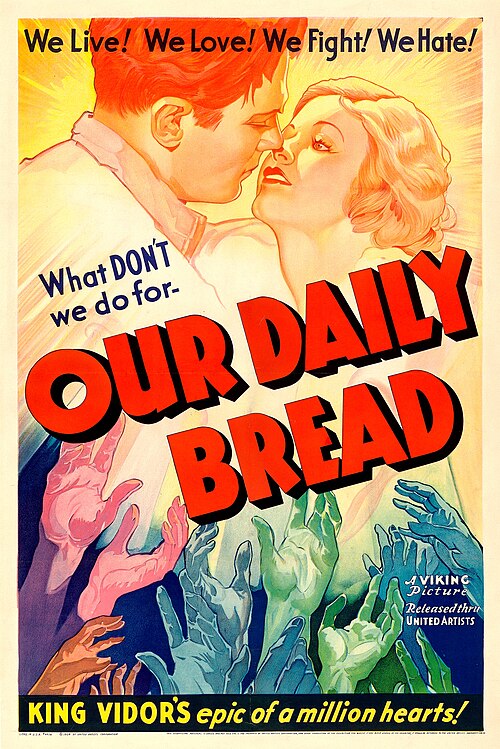
Our Daily Bread is an American drama movie, produced in 1934, which portrays the resilience of the quite devastating Great Depression. Directed by the legendary King Vidor, the film is a story of hope against all odds, community, determination and more, in the field of the public domain.
The movie features the participation of Karen Morley, Tom Keene, and John Qualan in a strong story that is still relevant today. Following on the heels of another silent film by Vidor titled The Crowd (1928) with immense success, this movie is a monument to the human spirit in one of the darkest economic eras in the history of America.
Movie Background
Our Daily Bread (1934) was produced on its own by King Vidor when Irving Thalberg of MGM rejected the project. Thalberg rejected this Depression-era follow-up even after giving the go-ahead button to the original The Crowd, with Vidor self-financing and releasing the film through United Artists.
The film was a very good ensemble with a cast plus it was also a reissue title Hells crossroads. Although the film did not have a huge commercial success in the box office, it became a significant figure in the history of American cinema as it revealed the spirit that united people to survive the Great Depression.
Director King Vidor worked directly to react to the economic crisis that had millions of Americans in its grip in making a film that was an advent in favoring cooperation over competition and hard work over financial speculation.
Movie Cast Table
| Actor | Role |
|---|---|
| Karen Morley | Mary Sims |
| Tom Keene | John Sims |
| Barbara Pepper | Sally |
| Addison Richards | Louie Fuente |
| John Qualen | Chris Larsen |
| Lloyd Ingraham | Uncle Anthony |
| Sidney Bracey | Rent Collector |
| Henry Hall | Frank (the Carpenter) |
| Nellie V. Nichols | Mrs. Cohen |
| Frank Minor | Plumber |
| Bud Ray | Stonemason |
Full Plot Summary
Our Daily Bread is a tale of a young couple John and Mary Sims struggling to make ends meet during the great depression. Having no opportunities in the city, they resolve to relocate to a farm they inherently have hoping that they can earn their living there.
Both John and Mary are not farmers and they soon know that they are over their head. However, as other desperate individuals start flocking to their farm, people living in the city, tradesmen, and families start to appear trying to find an opportunity to survive.
This collective community is a group of diverse people in the farm. Every individual offers his or her own expertise- carpenters, plumbers, stonemasons and laborers and all these labored with the same aim of achieving self-sufficiency.
The society experiences the most difficult situation when they are threatened by a serious drought that is going to wipe out their harvests. Their hard work will end up being futile without water. Instead of giving up, the group devises a grand scheme of excavating the irrigation ditch of almost two miles long by hand.
They jointly work hard with a will to channel water flowing in a nearby creek to their fields which are drought stricken. The end of the film shows the community in a frenzy when water is flowing through the channel dug by hand, which rescues their crops and their lives.
The last scene shows people delivering their harvesting home as a representation of what dedication and determination may achieve.
Genre and Key Themes
Our Daily Bread (1934) is mainly a drama movie having a good social and political overture. The film belongs to the Great Depression film genre, tracking down challenges and aspirations of common Americans in the economic downfall.
The movie discusses a number of strong themes. At the core is community cooperation- people of diverse backgrounds united in order to coexist. The novel underlines the importance of being independent of collapsing systems rather than relying on them and the poverty of dishonest work.
King Vidor depicts a political allegory, infusing rapacious finance capitalism with doubt and encouraging collective action and common resources. The movie is not an instructional one but it demonstrates how individuals can do amazing things when they unite and are driven towards a common purpose.
The story contains three main themes which show how people invent solutions to tough problems and how urban life differs from rural life and how manual work creates healing benefits. The irrigation project uses drought as a metaphor to demonstrate how human creativity and teamwork make it possible to achieve what seems impossible.
Our Daily Bread (1934) Full Movie Watch and Download
Watch Our Daily Bread (1934) on Internet Archive:
🏛️ See Also
Woody Woodpecker in Pantry Panic (1941) – Classic Winter Survival Cartoon Full Movie
Popeye for President (1956) – Classic Election-Day Cartoon Full Movie
The Lost World (1925) – Silent Dinosaur Adventure Classic | Watch Free
The Floorwalker (1916) – Charlie Chaplin’s First Mutual Comedy | Watch Free
Movie Review
Our Daily Bread is a powerful and inspirational watching experience that has been relevant even decades after it was released. The direction of King Vidor makes the setting of the Depression age realistic without overwhelming the audience with misery.
The performance of all the actors is strong, and Karen Morley and Tom Keene deliver the credible representation as the main couple. Their transformation to able farm leaders as opposed to innocent urbanites is true and deserved. The supporting cast, led by John Qualen, brings complexity and comedy to the cast and makes the community of different characters believable.
The narration of the storyline by Vidor keeps the film flowing given the small budget used in filming. It specially includes the climactic irrigation scene that is executed in a really good manner with the tension and excitement of the situation when the community is in a rush to save their crops. The lunatic party into which the water finally pours over the ditch gives a satisfying payoff on an emotional scale.
The movie is most effective as an inspiring allegory, as opposed to a realistic documentary. A few agricultural details are skipped over, however, this does not lessen the emotional appeal or the essence of the message which is human stamina and collaboration.
The black-and-white cinematography is useful in capturing the dusty and desperate mood of America of the Depression era. Musical scenes, folk songs and so on, such as Oh! Susanna” and Camptown Races, are a warm, and real touch to the community scenes.
Although the film did not perform well at the box office in 1934, it has been realized with time as a significant piece of history and as an entertaining movie. The viewers of the modern world are able to watch Our Daily Bread full movie and be inspired by its immortal message regarding what people can do together.
Movie Tags
King Vidor, Great Depression drama, 1934 classic film, public domain movie, Karen Morley, Tom Keene, collective farming, irrigation story, Depression-era film, free classic movie, American drama, social commentary film, vintage cinema, community cooperation, 1930s film, drought survival, public domain full movie, classic Hollywood, United Artists, historical drama
Our Daily Bread (1934) will always be a significant masterpiece of American cinema that demonstrates the strength of the community and willpower in difficult situations. It is a classic of an entire century of popular domain that provides a modern audience with a glimpse into the struggles of the Depression years and provides a positive message that cuts across time. It is a King Vidor production that can attract anyone be it a classic film lover or just a person who seeks a good story to get motivated.