
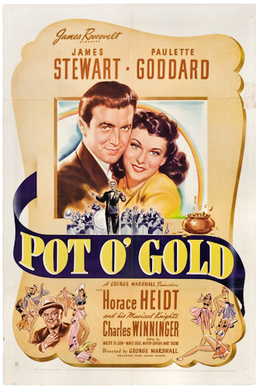
Pot o’ Gold (1941) is a light, old‑Hollywood romantic musical comedy where a music‑loving nice guy gets stuck between a music‑hating uncle and a noisy Irish family band next door. Today, Pot o’ Gold full movie is a popular free classic movie and public domain movie, often streamed and shared as a James Stewart–Paulette Goddard “comfort watch.”
Movie Background Table
Movie Cast Table
| Actor | Role |
|---|---|
| James Stewart | James Hamilton “Jimmy” Haskell |
| Paulette Goddard | Molly McCorkle |
| Horace Heidt | Himself |
| Charles Winninger | Charles “C.J.” Haskell |
| Mary Gordon | Mom McCorkle |
| Frank Melton | Jasper Backus |
| Jed Prouty | J.K. Louderman |
| Charles Arnt | Parks, the butler |
| Dick Hogan | Willie McCorkle |
| James Burke | Police Lt. Grady |
| Donna Wood | Donna McCorkle |
| Larry Cotton | Larry Cotton, vocalist |
Full Plot Summary
Jimmy Haskell loves music. He runs a small music shop, plays the harmonica, and would much rather live around bands and songs than big business. Unfortunately, his store fails, and he finally gives in to pressure from his rich uncle C.J. Haskell, a health‑food tycoon who has always wanted Jimmy to join the family factory.
There is one big problem: C.J. hates music. His health‑food plant sits across the alley from the McCorkle boarding house, home to a large Irish family and Horace Heidt’s orchestra, which rehearses constantly in the yard. The McCorkles’ brass and drums drive C.J. crazy, and he’s been feuding with them for ages—calling the police, making complaints, doing anything he can to shut them up.
On his way to report for work, Jimmy stumbles into the middle of this feud. He hears the band playing behind the factory, wanders over, and is instantly drawn to the McCorkles’ warmth and love of music. When C.J. storms out to yell at them again and tries to use the police to stop the band, Jimmy reacts on instinct and throws a tomato—meant for nobody in particular—that accidentally splats on his uncle.
The McCorkles, who have never met C.J.’s nephew and don’t know Jimmy’s last name, cheer his “courage” in standing up to the health‑food tyrant. They pull him into the house, feed him, and treat him as a hero. Molly McCorkle, the spirited daughter, is especially taken with him. A romance begins, even though neither of them realizes he’s part of the enemy family.
Jimmy reluctantly takes a job at the Haskell plant, where his uncle runs a bland but successful radio show to promote his health food. When C.J. can’t make one broadcast, Jimmy is forced to substitute for him on the air. Molly’s brother Willie and bandleader Horace Heidt are in the studio that day. Hearing his full name and seeing him at the microphone, they put two and two together and realize this “Jimmy” is C.J. Haskell’s nephew.
Instead of exposing him right away, Willie and Horace see an opportunity. They dislike C.J.’s anti‑music crusade and convince Jimmy to help get the old man out of the way for a while. Together they cook up a scheme to make C.J. think he’s losing his mind: they secretly pipe music into his office in such a way that only he hears it. Convinced he’s cracking up, and on a doctor’s advice, C.J. agrees to take an extended “rest” vacation.
While C.J. is gone, Jimmy takes over the business and the radio program. Free of his uncle’s music ban, he invites Horace Heidt and the McCorkles’ band to play live on the show. The broadcast is an instant hit. Ratings climb, sponsors show new interest, and the Haskell program suddenly becomes lively instead of dull.
The enjoyable moments stay only for a short duration. Molly learns Jimmy’s actual identity which causes her to feel extreme betrayal. From her point of view he is the nephew of the man who has made their lives difficult which he has hidden while he won their family and radio audience. She enters the studio during a live broadcast to reveal that the Haskell program will give away $1,000 every week which serves as a replica of the actual Pot o’ Gold radio show gimmick that inspired the film.
The promise electrifies listeners and sponsors. Jimmy, not wanting Molly to get in trouble, claims on air that the giveaway was his idea. That puts him in a tight spot. A federal investigator, Mr. Samson, arrives at the studio and reminds Jimmy that he cannot run an illegal lottery or raffle over the air. The money must be given away in a way that doesn’t violate gambling laws.
Faced with fines, possible jail time, and the risk of ruining his uncle’s company, Jimmy scrambles for a legal method. After brainstorming with Samson, he hatches a plan to use phone books and a roulette‑style spinning wheel—choosing a directory, then a page, then a line at random to select distant winners, much like the real Pot o’ Gold radio format. It’s just enough to keep the show within the law.
The new version of the Haskell show, with live band music and weekly $1,000 giveaways across the country, quickly becomes a sensation. Ratings soar, fan mail floods in, and lucrative advertising contracts line up. C.J., still away, learns that his “health‑food” show has turned into a musical giveaway program but can’t deny that it’s making a lot of money.
The success of the show leads to a forced peace agreement between the conflicting parties. The Haskells discover that the McCorkles and Heidt’s band have saved their business while the McCorkles acknowledge Jimmy’s positive intentions despite his failings in timing and honesty. The families reach reconciliation after the feud subsides which enables Jimmy and Molly to marry as their new partnership between music and health food and radio and real life begins.
Genre and Key Themes
Pot o’ Gold is a romantic musical comedy, very much in the screwball tradition of early 1940s Hollywood. It blends family feud, mistaken identity, and radio‑show satire with band numbers and light romance.
Key themes include:
- Music vs. money
Jimmy stands for passion and music, while C.J. stands for business and silence. The film suggests that success really comes when you mix both—turning the health‑food program into a musical giveaway show. - Family feuds and reconciliation
The Haskells and McCorkles start as sworn enemies divided by taste and noise, but the younger generation and the radio program eventually bring them together. - Power of mass media
The story mirrors the real Pot o’ Gold radio program, showing how a simple cash giveaway and live music can explode into a national craze and transform a failing show. - Identity and honesty
Jimmy hides who he is to avoid judgment, but the lie complicates both his romance with Molly and his efforts to help the band. The film gently nudges toward the idea that trust matters as much as chemistry.
Pot o’ Gold (1941) Full Movie Watch and Download
Watch Pot o’ Gold (1941) on Internet Archive:
🏛️ See Also
Woody Woodpecker in Pantry Panic (1941) – Classic Winter Survival Cartoon Full Movie
The Last Time I Saw Paris (1954) – Elizabeth Taylor Romantic Drama Classic | Free Public Domain Full Movie
Sabotage (1936) – Alfred Hitchcock London Terror Thriller | Free Public Domain Full Movie
Love Laughs at Andy Hardy (1946) – Mickey Rooney Postwar College Romance | Free Public Domain Full Movie
Movie Review
Pot o’ Gold 1941 film is often remembered more as an interesting James Stewart curio than as a top‑tier classic, but it has easygoing charm. Stewart plays Jimmy Haskell with his usual likable sincerity, playing harmonica and leaning into the idea of a guy who can’t quite let go of music even when business is calling. Paulette Goddard, with songs dubbed by Vera Van, brings brightness and spark to Molly, even if the script mostly gives her “hurt then forgiving” emotional beats.
Horace Heidt essentially plays himself, leading his Musical Knights through numbers like “Pete the Piper,” “A Knife, a Fork and a Spoon,” and “Do You Believe in Fairy Tales?” that break up the plot with bandstand energy. Charles Winninger gives C.J. Haskell the right mix of bluster and eventual softening, making his anti‑music stance broad enough to be funny rather than mean‑spirited.
Director George Marshall maintains a quick pace through theatrical elements of his film. The movie establishes its foundation in radio shows through its depiction of four locations which include the alley and boarding house and factory and radio studio. The film maintains a cheerful atmosphere although its pacing becomes irregular because some musical sections extend too long and the legal lottery investigation subplot develops too quickly.
Critics and Stewart himself have been tough on the film; he reportedly called it the worst movie he ever appeared in. From a career‑highlight perspective, Pot o’ Gold is minor Stewart, especially compared with his other 1940s work. But as a friendly, low‑stakes musical comedy and a snapshot of radio‑show culture, it remains enjoyable. The film’s use of the real Pot o’ Gold concept, adapted into a fictional giveaway scheme, also makes it an interesting piece of media history.
Because Pot o’ Gold full movie is treated as a public domain movie, it’s easy to find in multiple uploads and editions, some restored with good sound and picture. For viewers exploring free classic movie musicals or looking for a lighter side of James Stewart between bigger dramas, it’s a pleasant, tuneful diversion.
Movie Tags
Pot o’ Gold full movie, Pot o’ Gold 1941 film, James Stewart musical comedy, Paulette Goddard Pot o’ Gold, public domain movie, free classic movie, old Hollywood romantic musical, radio show giveaway plot, Horace Heidt and His Musical Knights, United Artists 1940s film, Irish family band comedy, family feud romance, classic black and white musical