
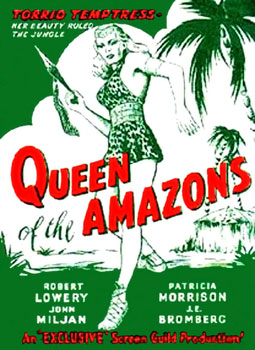
The woman playing Jean Preston in this poverty row jungle picture is, at the time of filming, one year away from Broadway immortality. Patricia Morison would originate the lead in Cole Porter’s Kiss Me, Kate in 1948 — the role that defined her career and ran for nearly 1,500 performances — and would later step in as Anna Leonowens opposite Yul Brynner when Gertrude Lawrence died during The King and I.
She was one of the last living actors from Hollywood’s Golden Age when she died in 2018 at 103. What she’s doing in Queen of the Amazons is carrying a sixty-minute Screen Guild adventure picture on sheer screen presence, opposite a cast that includes a man who will play Batman and a man who will be destroyed by HUAC.
J. Edward Bromberg plays Gabby, the comic relief safari cook who recites “Three Fishers” to his pet monkey. Four years after this film, Bromberg refused to name names before the House Un-American Activities Committee, moved to London when he could get no work in the United States, and died of a heart attack at 47. His memorial service was the event that got Lee Grant blacklisted for the next twelve years. He is playing a man who recites Victorian sea poetry to a monkey, and he does it with more craft than the material requires, and he is dead within five years of the camera rolling.
The film itself is a sixty-minute double-feature programmer from Edward Finney and Robert L. Lippert — stock footage of wildlife stitched together with studio interiors, a plot that relocates from India to Africa mid-picture because the footage demanded it, and a genuine Amazon queen played by Amira Moustafa who the promotional materials promised offered “ecstasy and death.” It runs the full arc of what 1947 poverty row adventure cinema was: quickly made, honestly budgeted, and carrying within it two cast members whose subsequent stories are more interesting than anything the screenplay manages.
Queen of the Amazons 1946 — Movie Overview Table
| Detail | Information |
|---|---|
| Title | Queen of the Amazons |
| Copyright Date | 1946 (MCMXLVI — Screen Art Pictures Corp., expired) |
| Release Date | January 15, 1947 (United States) |
| Country | United States |
| Runtime | 60–61 minutes |
| Genre | Adventure, Jungle Picture, Exploitation |
| Language | English |
| Format | Black & White, Sound |
| Director / Producer | Edward F. Finney |
| Executive Producer | Robert L. Lippert |
| Screenplay / Story | Roger Merton |
| Cinematography | Robert Pittack |
| Editor | John F. Link Sr. |
| Music | Lee Zahler |
| Production Company | Screen Art Pictures Corporation / Edward F. Finney Productions |
| Distributor | Screen Guild Productions Inc. (US); Exclusive Films (UK) |
| IMDb Rating | 3.7/10 |
| Public Domain | Yes — copyright expired, freely available to stream and download |
Full Cast — Queen of the Amazons (1946)
| Actor | Role |
|---|---|
| Robert Lowery | Gary Lambert (Safari Guide) |
| Patricia Morison | Jean Preston |
| J. Edward Bromberg | Gabby (Safari Cook) |
| John Miljan | Narrator / Colonel Jones |
| Amira Moustafa | Zita, the Amazon Queen |
| Keith Richards | Wayne Monroe |
| Bruce Edwards | Greg Jones |
| Wilson Benge | The Professor |
| Jack George | Commissioner |
| Cay Forrester | Sugi |
| Vida Aldana | Tondra |
| Hassan Khayyam | Moya |
| Darby Jones | Native Chief (uncredited) |
Edward Finney, Robert L. Lippert, and the Poverty Row Machine
Edward Finney had been making low-budget westerns and adventure pictures since the mid-1930s, mostly at the lower end of the independent market — the kind of product that filled the bottom half of double bills at regional theatres that needed programming and couldn’t afford studio product. His westerns starred Tex Ritter for years. Queen of the Amazons represents a move sideways into the jungle picture cycle that was running steadily through the 1940s, feeding off the same audience that had made the Tarzan series profitable for MGM.
The executive producer, Robert L. Lippert, was one of the more significant figures in postwar poverty row cinema — a theatre chain owner turned producer who ran Screen Guild Productions as a distribution outlet and churned out cheap programmers across multiple genres through the late 1940s and 1950s. The Lippert model was simple: keep the budget below the line where a picture became a financial risk, cast recognisable faces who were between studio contracts, use as much stock footage as the editor could integrate, and get it to the double-feature market fast.
The shift from India to Africa in the middle of the picture is pure Lippert economics. The opening scenes establish the story in Akbar, India. The action then relocates to Africa — where the jungle footage, the wildlife shots, and the Amazon tribe all reside. The Derek Winnert review caught this directly: the action “suddenly switches to Africa, no doubt just to take in the studio stock footage.” That kind of geographic flexibility, driven entirely by what footage was available rather than what the story required, is characteristic of how this tier of filmmaking actually worked.
Full Plot Summary — Queen of the Amazons (1946)
Jean Preston (Patricia Morison) arrives in Akbar, India, determined to find out what happened to her fiancé, Greg Jones (Bruce Edwards), who went on safari and hasn’t come back. She’s travelling with Greg’s father Colonel Jones (John Miljan), a man named Wayne Monroe (Keith Richards), and a vaguely defined academic called the Professor (Wilson Benge). The hotel clerk at their first stop pretends to know nothing about Jones — and then immediately makes a suspicious phone call the moment the group leaves the lobby.
Tondra, Moya, and the Information That Gets Someone Killed
A local woman named Tondra (Vida Aldana) has been watching the group and knocks on Jean’s door with information: her husband Moya (Hassan Khayyam) knows something about a safari and a tiger attack. Jean pays Tondra to fetch Moya, who arrives and identifies Greg from a photograph — and tells Jean that Greg went not with the doomed tiger-attack safari but with ivory hunters heading to Africa. Before Moya can say anything further, a pistol shot comes through the window and kills him. The group leaves for Africa.
Gary Lambert and Gabby — The Guide and the Cook
In Africa, Jean needs a guide. Gary Lambert (Robert Lowery) doesn’t take women on safari, has no interest in doing so, and says this plainly. Jean responds by demonstrating marksmanship precise enough to change his mind on the spot. They pick up Gabby (J. Edward Bromberg) — a safari cook of some local reputation, known for reciting the Victorian sea poem “Three Fishers” to his pet monkey and telling meandering stories about escaping his wife. The cook is functionally the film’s comic relief, and Bromberg plays him with a timing and warmth that repeatedly elevates material that doesn’t require the effort.
The District Commissioner informs Lambert that Greg Jones was actually on an undercover mission to bust ivory poachers, and asks Lambert to continue the operation. Lambert agrees. The expedition moves deeper into the jungle. Something is working against them from inside the group — an unknown saboteur who is feeding information to the ivory operation and contributing to deaths along the way.
The She-Devils in the Jungle — and What Happened to Greg
Rumours reach the expedition from local guides: a tribe of white women lives deep in the jungle, descendants of shipwreck survivors from years back, led by a queen. They are making the native guides refuse to go further. The group presses on. When Greg Jones is finally located, it becomes clear why he hadn’t come back: he fell for Zita (Amira Moustafa), the Amazon queen. The promotional materials promised “ecstasy and death.” What the film delivers is a saboteur revealed, an ivory operation dismantled, and a man who needed to be retrieved from a woman considerably more interesting than the life he left behind.
Patricia Morison — One Year Before Kiss Me, Kate Changed Everything
Patricia Morison’s film career in the mid-1940s was the record of a woman Hollywood kept casting in the wrong things. She was genuinely talented — a mezzo-soprano trained at the Neighborhood Playhouse, with dance training from Martha Graham and a face the Masterworks Broadway profile described as made for close-ups. The Hollywood Reporter obituary noted she “radiated a sophisticated sex appeal” and possessed what one critic called “the most sensual mouth of any lady in the movies.” Studios cast her consistently as villains, femmes fatales, and secondary romantic interests.
The same year as Queen of the Amazons, Morison shot what was reportedly some of her best screen work as a rape and suicide victim in the film noir Kiss of Death (1947) — opposite Victor Mature and Richard Widmark. The censors cut her entire performance from the final print. Her name is still in the credits. The performance doesn’t exist on screen.
In 1948 she walked away from Hollywood to rehearse Kiss Me, Kate on Broadway. Cole Porter had heard her sing while in Hollywood and decided she was the only person for the role. The production ran for nearly 1,500 performances. When Gertrude Lawrence died partway through the original run of The King and I, Morison stepped in, to play Anna Leonowens opposite Yul Brynner. She is one of the last people in film history who showed up in a poverty row jungle picture within the same year and then originated a canonical Broadway role the very next. Queen of the Amazons is the document from the year before the pivot.
J. Edward Bromberg — The Man Reciting Poetry to a Monkey, Four Years Before HUAC
J. Edward Bromberg, was pretty much a big deal in American theatre and film from the early 1930s, you know. He was one of the founding members in the Group Theatre in New York, which is also that same company that kind of launched Elia Kazan, Clifford Odets, and Lee Strasberg. He also showed up in Jesse James (1939). Then, The Mark of Zorro (1940) and later Phantom of the Opera (1943), again. By 1946 he had roughly forty film credits.
In 1951, Kazan — by then one of the most powerful directors in Hollywood — named Bromberg as a Communist before HUAC. Bromberg testified, refused to name anyone, denounced the committee as a witch hunt, and lost his career in the United States overnight. He moved to London to find work. In December 1951, nineteen days before his forty-eighth birthday, he died of a heart attack. The eulogy at his memorial service, delivered by the young actress Lee Grant, criticised the HUAC investigations. Grant’s remarks were made public. Her name went on the blacklist. She was unable to get work in film or television for the next twelve years.
The Mount Hebron Cemetery essay on Bromberg recorded that actor Theodore Bikel said simply: “He died of a broken heart.” The Peekskill Film Festival documentary on Bromberg noted that of the 320 people blacklisted during the HUAC period, not one was ever convicted of a crime.
In Queen of the Amazons, Bromberg plays Gabby with a light, specific comic timing that demonstrates precisely what all his credits suggest: he was a genuinely skilled character actor who gave more to a role than the material required. That he was doing it in a sixty-minute jungle programmer in 1946, four years from the events that ended his career and his life, is the kind of fact that watching public domain cinema makes visible.
Robert Lowery — The Guide Who Would Play Batman
Robert Lowery plays Gary Lambert as a standard-issue adventure hero: competent, reluctant to take women into the field, won over by demonstration rather than argument. The character doesn’t ask for much more than that, and Lowery delivers exactly as required. He was a reliable leading man in B-pictures through the 1940s — a Kansas City native who came up through the kind of supporting roles that poverty row used to build its second-tier male leads.
Three years after Queen of the Amazons, Lowery played Batman in the 1949 Columbia serial Batman and Robin — one of the camped-up, pre-television serial productions that kept the character alive between the 1943 serial and the 1966 television series. It is not a distinguished Batman. It is, like most things in this tier of 1940s cinema, a product made quickly for an audience that would consume it and move on. Lowery died in Hollywood in December 1971. He was 58.
Where to Watch Queen of the Amazons (1946) Free Online
Queen of the Amazons is in the public domain and legally available across multiple platforms at no cost. Print quality varies across uploads — the Film Detective has produced a restored version.
| Platform | Format | Cost |
|---|---|---|
| Internet Archive | Stream + Download (multiple formats) | Free |
| YouTube | Stream (multiple uploads; quality varies) | Free |
| Tubi | Stream (with ads) | Free |
| Public Domain Movies | Stream | Free |
| The Film Detective | Restored version — higher quality presentation | Free / Subscription |
Queen of the Amazons (1946) on Internet Archive:
Is Queen of the Amazons (1946) in the Public Domain?
Yes, Queen of the Amazons kind of is in the public domain in the United States. The copyright, which was registered in 1946 by Screen Art Pictures Corp., (MCMXLVI) has already expired. The whole film is basically free to stream, download, share , and also show on screen without any restriction or payment, no hassle. The Internet Archive carries the most complete and consistent version for downloading and reuse.
Critical Reception — Then and Now
The film holds a 3.7 out of 10 on IMDb, which accurately reflects what it is: a sixty-minute poverty row programmer built around stock footage, a thin screenplay, and a cast that collectively deserved better material. The Derek Winnert two-star review put the assessment fairly: “The script is quite bad but the actors give it much more than it is worth, and Finney keeps it shifting along, with enough action.” That’s the honest case for the film — not that it’s a hidden masterpiece, but that the people in it show up with professional effort regardless.
The IMDb viewer who noted that “what made for excitement in 1947 is merely amusing, boring, or fascinating depending on your attitude” identified the actual range of responses the film generates in 2026. The production values are what they are. The geographic continuity is what it is. What the film doesn’t do is waste Patricia Morison or J. Edward Bromberg — both of them are present, both of them are working, and both of them carry a retrospective weight that the movie itself never earned but the cast entirely provides.
Frequently Asked Questions — Queen of the Amazons (1946)
Q: What is Queen of the Amazons (1946) about?
A woman travels from New York to India and then Africa to find her missing fiancé, who went on safari and never returned. She hires a reluctant safari guide, picks up a comic relief cook, uncovers an ivory smuggling operation, survives a saboteur within the expedition, and eventually finds her fiancé — who has fallen for the queen of a tribe of women living deep in the jungle. The film runs 60 minutes.
Q: Is Queen of the Amazons in the public domain?
Yes. Queen of the Amazons is in the public domain in the United States. The copyright was registered in 1946 by Screen Art Pictures Corp. and has since expired. The film is freely available to stream, download, and share. The Internet Archive, YouTube, Tubi, and The Film Detective all carry it at no cost.
Q: Who directed Queen of the Amazons?
Edward F. Finney directed and produced the film. Finney was a poverty row filmmaker known for low-budget westerns and adventure pictures, working primarily for Screen Guild Productions and its associated companies. Robert L. Lippert served as executive producer. The screenplay was written by Roger Merton.
Q: What happened to Patricia Morison after Queen of the Amazons?
Morison left Hollywood in 1948 to star in Cole Porter’s Kiss Me, Kate on Broadway — the role that defined her career. She played Lilli Vanessi for nearly 1,500 performances on Broadway and in London. She later stepped in as Anna Leonowens in The King and I following the death of Gertrude Lawrence. She was one of the last living actors from Hollywood’s Golden Age when she died in 2018 at 103.
Q: What happened to J. Edward Bromberg after this film?
Bromberg was blacklisted after refusing to name associates before the House Un-American Activities Committee in 1951. He moved to London when he could get no work in the United States, and died of a heart attack at 47 in December 1951. His memorial service, at which actress Lee Grant delivered a eulogy critical of HUAC, resulted in Grant herself being blacklisted for the following twelve years. None of the 320 people blacklisted during this period was ever convicted of a crime.
Q: Who plays the Amazon queen Zita?
Amira Moustafa plays Zita, the queen of the Amazon tribe. The promotional materials described the character as offering ‘ecstasy and death.’ The Amazons in the film are descendants of women who survived a shipwreck years earlier and have built their own community in the jungle, making their native guides refuse to enter their territory.
Q: Why does the film switch from India to Africa mid-story?
The location shift — from the India-set opening to the Africa-set jungle sequences — was driven by available stock footage rather than narrative logic. Poverty row productions like Queen of the Amazons built their stories around pre-existing wildlife and location footage, which in this case was African. The screenplay relocated the action to wherever the budget’s footage library could support it.
Q: What did Robert Lowery do after Queen of the Amazons?
Robert Lowery played Batman in Columbia’s 1949 serial Batman and Robin — one of two theatrical serials made with the character before the 1966 television series. He continued working in B-pictures and television through the 1950s and 1960s and died in Hollywood in December 1971 at 58.
Q: Who was Robert L. Lippert and what was his role in the film?
Robert L. Lippert was the executive producer of Queen of the Amazons and one of the central figures in postwar poverty row cinema. He ran Screen Guild Productions as a distribution outlet for low-budget programmers, building his production model around tight budgets, stock footage, and recognisable faces between studio contracts. He produced and distributed dozens of pictures through the late 1940s and 1950s across multiple genres.
Q: Where can I watch Queen of the Amazons (1946) for free?
Queen of the Amazons is freely available on the Internet Archive, YouTube, Tubi, and Public Domain Movies. A restored version is available through The Film Detective. All free versions are legal to stream and download under the film’s public domain status in the United States.
Related Free Classic Adventure and Jungle Films
If Queen of the Amazons (1946) sent you further into public domain adventure and 1940s B-pictures, these are the natural places to keep going:
- Public Domain Cartoons
- Public Domain Horror Movies – Free Classic Scary Films Online
- Bird of Paradise (1932) Full Movie Review, Plot, Cast & Free Classic Romance Film
- Public Domain Movies List – All Free Classic Films (Complete Guide)
Movie Tags
Queen of the Amazons 1946, Queen of the Amazons 1947, Queen of the Amazons full movie, watch Queen of the Amazons free, Queen of the Amazons public domain, Patricia Morison actress, Patricia Morison before Kiss Me Kate, J. Edward Bromberg actor, J. Edward Bromberg blacklist, Robert Lowery actor, Robert Lowery Batman, Amira Moustafa Amazon queen, Edward Finney director, Robert L. Lippert producer, Screen Guild Productions, poverty row adventure film, 1940s jungle picture, public domain adventure movie, free classic adventure film online, Screen Art Pictures Corporation