
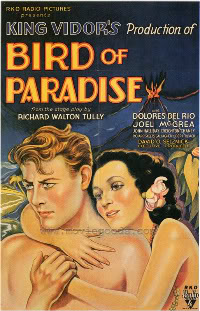
David O. Selznick had not read the play. King Vidor had — and told Selznick it would make a terrible film. Selznick was not interested in this assessment. He told Vidor: “Just give me three wonderful love scenes. I don’t care what story you use so long as you call it Bird of Paradise and del Rio jumps into the volcano at the end.” Vidor, attracted by that freedom and the chance to film Polynesian culture in Hawaii, agreed.
What he put out in 1932, was kind of this pre-Code South Seas romance thing, with Dolores del Río and Joel McCrea as leads, and it’s visually gorgeous but sort of loosely put together, with Max Steiner scoring it, plus choreography credited to an unlisted Busby Berkeley which later on basically became part of the legend. On release it stirred up a scandal, mostly because of a skinny-dipping scene, then it kinda broke even at the box office on a $752,000 budget.
Ever since then people have been arguing it pretty hard, not just about how beautiful it looks, but also about its racial politics, like for years. It slid into the public domain in 1960, so now you can watch it free online, right this moment. And yeah, it still counts as one of the most purely seen, purely visual films that RKO ever released.
Bird of Paradise 1932 — Movie Overview Table
| Detail | Information |
|---|---|
| Title | Bird of Paradise |
| Release Date | August 12, 1932 |
| Country | United States |
| Runtime | 80 minutes |
| Genre | Adventure, Romance, Drama |
| Language | English |
| Format | Black & White |
| Director | King Vidor |
| Producers | David O. Selznick, King Vidor |
| Screenplay | Wells Root, Wanda Tuchock, Leonard Praskins |
| Based On | The Bird of Paradise — 1912 play by Richard Walton Tully |
| Cinematography | Lucien Andriot, Edward Cronjager, Clyde De Vinna |
| Music | Max Steiner |
| Editor | Archie Marshek |
| Choreography | Busby Berkeley (uncredited) |
| Art Direction | Carroll Clark |
| Studio / Distributor | RKO Radio Pictures |
| Filmed On Location | Hawaii; also Catalina Island and RKO backlot |
| Budget | $752,000 |
| Box Office | $753,000 |
| IMDb Rating | 6.0/10 |
| Public Domain | Yes — entered public domain in 1960 |
| Blu-ray / DVD | Kino Lorber (April 2012), David O. Selznick Collection |
Full Cast Table — Bird of Paradise (1932)
| Actor | Role |
|---|---|
| Dolores del Río | Luana |
| Joel McCrea | Johnny Baker |
| John Halliday | Mac |
| Richard “Skeets” Gallagher | Chester |
| Bert Roach | Hector |
| Lon Chaney Jr. (as Creighton Chaney) | Thornton |
| Wade Boteler | Skipper Johnson |
| Arnold Gray | Walker |
| Reginald Simpson | O’Fallon |
| Napoleon Pukui | The King |
| Agostino Borgato | Medicine Man |
| Sofia Ortega | Mahumahu |
The Story Behind the Film — Selznick’s One Instruction
When David O. Selznick arrived at RKO as head of production in late 1931, he inherited a property nobody particularly wanted: a 1912 stage play by Richard Walton Tully called The Bird of Paradise. The play had been a genuine success in its day — it made Laurette Taylor a star and helped popularize Hawaiian music and culture at a time when the mainland had almost no exposure to either. By 1931, it was out of fashion.
Selznick invited King Vidor — then one of MGM’s most respected directors, loaned to RKO for the project — to read the play and consider a film adaptation. Vidor read it and told Selznick it was unfilmable. Selznick, who admitted he hadn’t read it himself, made his now-famous reply: “Just give me three wonderful love scenes. I don’t care what story you use so long as you call it Bird of Paradise and del Rio jumps into the volcano at the end.”
Vidor agreed — drawn by the creative freedom and the opportunity to explore Polynesian culture on location in Hawaii, a subject that interested him in the same ethnographic spirit that had driven his earlier Hallelujah! (1929). The script was written partly after filming had already begun in Hawaii, with Vidor and writer Wells Root shooting background footage while they waited for del Río and McCrea to finish other commitments. Vidor later called the finished film “a potboiler.” He was not wrong. He was also not entirely right.
Full Plot Summary — Bird of Paradise (1932)
An American yacht glides into a South Pacific archipelago. the local islanders paddle out in those pontoon boats, to greet ’em, and then it’s this thing where they dive for the little trinkets the crew kind of tosses overboard. A shark shows up, real quick, and basically clears the water of nearly everyone. in all that chaos, Johnny Baker (Joel McCrea) somehow steps into a rope loop that’s hooked to a harpoon set up with shark bait. The shark snaps onto the bait. The rope tightens round Johnny’s ankle, and yanks him overboard into the deep water.
Luana (Dolores del Río) — the chief’s daughter — dives in right after. She swims to where he’s stuck, pulls out a knife, cuts the rope loose, and gets him back up to the surface. and that’s how it starts, their whole thing: a man saved by a woman, whose whole world he can’t yet even start to understand. plus she can’t yet speak his language, and still she’s already promised to someone else.
The Romance — Pre-Code and Unrestrained
The film was made before the Production Code was strictly enforced, and it shows in every scene Vidor shoots between del Río and McCrea. Luana doesn’t speak a word of English until well past the halfway point — her entire courtship of Johnny is conducted through gesture, expression, and the particular quality of physical presence that del Río brought to everything she appeared in. The underwater swimming scene between them became one of the most talked-about sequences in a year already full of pre-Code provocations.
Luana has been promised to a prince on a neighboring island by her father. An elaborate wedding ceremony — with dance sequences choreographed by Busby Berkeley, though his name appears nowhere in the credits — ends when Johnny breaks through a circle of burning fire to claim her. They escape to a distant island and attempt to build a life together: a thatched house, fruit from the surrounding jungle, fishing from rocky outcroppings and beneath the sea. The film lingers in this idyll longer than its eventual ending would suggest is wise.
Pele Rumbles — The Ending Selznick Demanded
The volcano begins to erupt. The islanders have kept track of Luana since her escape — and the eruption of Pele, the volcano god, is understood by the community as a direct consequence of her abandonment of her sacred obligations. She alone can appease the mountain’s appetite. Luana confesses this to Johnny, who has been incapacitated by a spear wound and slips into delirium.
While Johnny is unconscious, Luana leaves him. She walks to the volcano’s mouth and throws herself in — voluntarily, to save her people from the god her love affair with an outsider has angered. Johnny wakes to find her gone. The film ends there. Selznick got his volcano. Vidor got his ethnographic observation. Neither of them got something that doesn’t carry uncomfortable weight when viewed through a modern lens.
Dolores del Río — The Performance That Holds the Film Together
Dolores del Río was, by 1932, one of Hollywoods more genuinely luminous screen presences. A Mexican actress who managed that transition from silent films to sound with more success than a lot of her contemporaries, she brought to Luana this kind of quality that sort of slides past the movies limits, with absolute conviction that the character emotional world is real, not just staged.
The film asks her to communicate a complete inner life — desire, joy, fear, obligation, grief — largely without dialogue in a language she doesn’t speak. She does it. The pantomime sequence where Luana mimics a bird in flight to explain her prior obligation to Johnny is one of the more purely cinematic moments in early sound film — a silent performance inserted into a talkie because del Río understood that the emotional content demanded it.
David Thomson, writing in his 1992 biography of Selznick, admitted the films problems pretty straight, calling it hokum, but also saying—almost like he couldn’t help himself—what keeps it around. Like, he points to the exact bits that linger even now: “Del Rio’s laugh, her winged eyelashes, the peril with which flowers cling to her breasts, and the suggestiveness of the dialogue are still arousing.” Yeah, the wording is awkward , maybe even a little too blunt. Still, it names something that feels true. Del Río s performance really is the reason this movie keeps getting watched.
Joel McCrea — Physical Presence as Dramatic Method
Joel McCrea’s Johnny Baker is not really a complex figure—he is a strong, athletic, decent American man, and he ends up falling for a woman from a world he cant fully grasp, and then he realizes kinda late what it costs, for that mismatch. McCrea handles the role with that same kind of unforced physical ease he usually brought to most of his work in this phase, you feel it on camera as if it’s natural not something staged or theatrical.
The film requires him to be credibly reckless in the early sequences, credibly devoted in the middle, and credibly destroyed in the ending. McCrea achieves all three without apparent effort — which is, of course, the most demanding kind of screen acting. His chemistry with del Río is the film’s structural load-bearing wall. If it didn’t work, nothing else would. It works.
Max Steiner’s Score and Busby Berkeley’s Uncredited Choreography
Max Steiner scored Bird of Paradise with an operatic sort of quality, and it’s like, the films visual romance really seems to need that kind of glow. Steiner was pretty much right at the beginning of the time period people later treat as his defining stretch , because King Kong (1933) was still a year away, and still his music here gives the whole story an emotional peak that the otherwise fairly straightforward plot cant quite hold on its own. The soundtrack really lifts the last sequence in particular. Luana’s walk to the volcano plays differently with Steiner’s music,than it would if it was just quiet.
Busby Berkeley choreographed the native dance sequences and received no credit for it. The arrangements — filmed in Hollywood using boom shots that Berkeley was already developing as his signature technique — have the visual organization of his more famous musical sequences without the elaborate staging that Broadway productions gave him to work with. Knowing he’s responsible makes the dance sequences considerably more interesting to watch than they appear to be on their own terms.
The Pre-Code Scandal — Dolores del Río and the Skinny-Dipping Scene
Bird of Paradise came out in August 1932, like two years before that Production Code got truly clamped down in 1934. The gap between the start of sound and 1934 basically gave us this surprisingly vivid run of American films that were willing to poke at sex, violence, and moral uncertainty, in ways that later would just not be allowed once Will Hays standards kicked in fully, and it’s not a small change.
Bird of Paradise leaned into that opening window. The skinny-dipping bit drew real public controversy — there’s del Río in the water with McCrea, and the whole moment felt unlike most mainstream American cinema was doing back then. And no, it wasn’t tossed in as mere showboating in the movie’s logic: it supports the movie’s central point, that social custom is kind of irrelevant when two people are actually in genuine love. Still, it was charged enough to pull in the sort of newspaper attention that, yeah, helped push things toward the Production Code getting enforced hard, two years later.
Now films from that era often come with a familiar tag, “pre-Code,” which tells modern viewers what kind of imaginative latitude they’re about to meet. Bird of Paradise is one of the most talked about cases from that stretch. If you’ve been checking out pre-Code cinema already, through other titles maybe, then this one… it kinda belongs on your list too.
Lon Chaney Jr. — Listed as Creighton Chaney
The cast has a young Lon Chaney Jr. — you can see him here under his birth name, Creighton Chaney, sort of how he did back in the day in his early career. At that time, his father’s name was still becoming professionally useful, and also not just a complication, if you know what I mean. His job as Thornton, is kind of a supporting bit that doesn’t ask much, but his overall presence in the movie still feels like a legitimate point of interest , especially for anyone following his career from the start right through to The Wolf Man (1941) and then past that.
The Racial Politics — What the Film’s Ending Actually Says
No real honest account of Bird of Paradise can truly sidestep this, not even a bit. The movie shows pretty much a doomed interracial romance, and it finishes with the non-white woman kind of choosing her own erasure—like on purpose, for love, for her folks—while the white man ends up walking out alive. Selznick’s insistence on the volcano ending was mostly about spectacle and emotion, not so much about ideology though. But the way that ending lands, in 1932, and even when you look at it today, it somehow ends up feeling like it carries an anti-miscegenation signal, which critics have been noticing again and again since the film was rediscovered.
King Vidor was aware of that tension, you can feel it. His pull toward the ethnographic dimension of Polynesian culture was genuine—the same broad impulse that also drove Hallelujah!—but the machinery he had to work with narrowed what he was able to do. The movie treats Polynesian culture like mood or backdrop, not like a thing with full subject-status. Luana’s world is undeniably gorgeous, and her faith is not empty, but the camera keeps putting Johnny in the role of the film’s moral center, with Luana more like something to be encountered, rather than something fully understood.
And no, these pressures don’t make Bird of Paradise unwatchable. They make it complicated, which honestly is kinda its own flavor of interesting, maybe even more interesting than a film that pretends it has no issues at all. To engage with it honestly means keeping both the visual beauty and the structural assumptions in your peripheral vision at the same time. Most films from 1932 ask viewers the very same kind of thing.
The Public Domain Story and the Kino Lorber Restoration
In 1960, Bird of Paradise entered the public domain when its copyright claimants failed to renew registration in the required 28th year after publication. The failure preserved the film’s accessibility — without it, Bird of Paradise might have become difficult to see outside of archival screenings.
In April 2012, Kino Lorber released the film on Blu-ray and DVD, as part of the David O. Selznick Collection—an authorized edition, sourced from the George Eastman House archive produced with the cooperation of the Selznick estate. It’s kind of the best, highest quality viewing experience you can get right now, because the restored print gives Floyd Crosby and his fellow collaborators’ location photography that sort of clarity it really deserves. The free public domain version you can find online is, well, watchable as a document. But the Kino Lorber release is the definitive one, no question.
Where to Watch Bird of Paradise (1932) Free Online
Bird of Paradise is in the public domain and legally available across multiple platforms at no cost.
| Platform | Format | Cost |
|---|---|---|
| Internet Archive | Stream + Download (multiple formats) | Free |
| YouTube | Stream | Free |
| Public Domain Movies | Stream | Free |
| Kino Lorber Blu-ray / DVD | Physical media — highest quality restoration | Paid |
Bird of Paradise (1932) on Internet Archive:
Is Bird of Paradise (1932) in the Public Domain?
Yea, Bird of Paradise came into the public domain around 1960, because the people who claimed the copyright did n’t renew the registration in that required 28th year after it was published, under the older pre-1978 U.S. rules. So, in educational stuff you can legally stream it, download it, share it and screen the film, with no extra limits or payment. Also just watch for this bit: the Kino Lorber restoration from 2012 is kind of its own separately made commercial edition, but the actual movie itself stays public domain.
Critical Reception — Then and Now
The film gets a 6.0 out of 10 on IMDb — which seems to sit right in that place where people either enjoy it or kinda move on, fast. Viewers who watch it mainly as a kind of visual experience often rate it pretty high; viewers who go in expecting something more story-driven usually say it feels a bit thin. Honestly, both reactions make sense.
What keeps coming up in the stronger praise is del Río’s performance, Max Steiner’s score, and the Hawaiian location photography. The cinematography, shared across three directors of photography, makes the Pacific island setting feel textured in a way that most studio-bound productions of the era just couldn’t pull off. One IMDb reviewer even calls it “one of the most visually beautiful films ever made.” It’s still an exaggeration, but it isn’t that embarrassing sort of exaggeration.
The main, most repeated complaints point at the racial framing of the interracial romance and the volcano ending, and yeah that ending lands in a very different way now compared to how it would’ve for 1932 audiences. Pre-Code scholarship has treated those issues seriously, and the best of those discussions has produced some of the most practical writing about what the film is actually doing versus what it seems to believe it’s doing.
King Vidor’s own dismissal of the whole thing as “a potboiler” feels too blunt. The film is flawed, sure, but also visually extraordinary, politically uncomfortable, and genuinely affecting as a romantic melodrama , from one of the more transitional stretches in American cinema. Not exactly a typical potboiler, if you ask me.
Frequently Asked Questions — Bird of Paradise 1932
Q: What is Bird of Paradise (1932) about?
An American sailor falls in love with Luana, the daughter of a Polynesian island chief, after she rescues him from a shark attack. Their romance defies her family’s arranged marriage plans and the island’s sacred obligations — culminating in a volcanic eruption that forces Luana to choose between her love and her duty to her people.
Q: Is Bird of Paradise (1932) in the public domain?
Yes. The film entered the public domain in 1960 when its copyright claimants failed to renew registration in the required 28th year. You can legally stream, download, and share it for free. The 2012 Kino Lorber Blu-ray restoration is a separately produced commercial edition — the underlying film remains freely available.
Q: Who directed Bird of Paradise (1932)?
King Vidor directed the film, loaned from MGM to RKO for the production. David O. Selznick produced. Vidor later called it ‘a potboiler’ — though he agreed to direct after Selznick offered him complete creative freedom over the story, requiring only that del Rio jump into a volcano at the end.
Q: What was Selznick’s famous instruction to King Vidor?
Selznick told Vidor: ‘Just give me three wonderful love scenes. I don’t care what story you use so long as you call it Bird of Paradise and del Rio jumps into the volcano at the end.’ Neither Selznick nor Vidor had fully read the original 1912 play when production began.
Q: Is Bird of Paradise a pre-Code film?
Yes. Released in August 1932 — two years before the Production Code was strictly enforced in 1934 — the film made full use of the creative freedom of the pre-Code era. A skinny-dipping sequence featuring Dolores del Río caused genuine public controversy on release and is one of the reasons Bird of Paradise remains one of the most discussed pre-Code titles.
Q: Who choreographed the dance sequences in Bird of Paradise?
Busby Berkeley choreographed the native dance sequences, filmed in Hollywood using the boom-shot technique he was developing during this period. He received no screen credit for the work. The uncredited contribution is confirmed by multiple production histories of the film.
Q: Who composed the score for Bird of Paradise (1932)?
Max Steiner composed the score. His work gives the film an operatic emotional scale — particularly in the final volcano sequence — that the relatively simple narrative might not otherwise sustain. Steiner was in the early stages of his defining period as a Hollywood film composer; King Kong (1933) followed one year later.
Q: Is Lon Chaney Jr. in Bird of Paradise?
Yes. Lon Chaney Jr. appears in a supporting role as Thornton, credited under his birth name Creighton Chaney — the name he used in his early career before his father’s name became an asset rather than a complication.
Q: What is the source material for Bird of Paradise?
The film is based on The Bird of Paradise, a 1912 stage play by Richard Walton Tully. The play made actress Laurette Taylor a star in its day and helped popularize Hawaiian music and culture on the American mainland. David O. Selznick inherited the property when he arrived at RKO in late 1931 — he had not read the play when he decided to make the film.
Q: Where can I watch Bird of Paradise (1932) for free?
Bird of Paradise (1932) is freely available on the Internet Archive, YouTube, and Public Domain Movies. All versions are legal to stream and download under public domain status.
Related Free Classic Romance and Adventure Films
If Bird of Paradise (1932) drew you into pre-Code Hollywood and public domain classic romance, these are the natural titles to explore next:
- Beyond Tomorrow (1940) — Three Ghosts and a Christmas Romance | Full Free Classic Film Online
- Public Domain Horror Movies – Free Classic Scary Films Online
- Guest in the House (1944) – Anne Baxter Film-Noir Drama | Full Public Domain Classic Movie Online Free
- Public Domain Movies List – All Free Classic Films (Complete Guide)
Movie Tags
Bird of Paradise 1932, Bird of Paradise full movie, watch Bird of Paradise 1932 free, Bird of Paradise public domain, King Vidor director, Dolores del Rio 1932, Joel McCrea 1932, David O Selznick RKO, Max Steiner film score, Busby Berkeley uncredited choreography, Lon Chaney Jr early career, pre-Code Hollywood film, pre-Code romance, interracial romance 1932 film, South Seas adventure film, Polynesian romance classic film, RKO Radio Pictures 1932, Kino Lorber Selznick collection, free classic romance movie online, 1930s adventure film public domain