
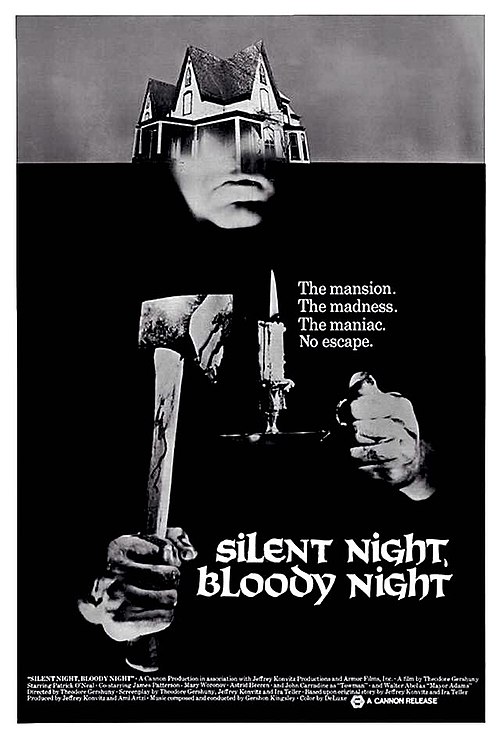
Three years before Halloween set the template, one year before Black Christmas formalized the holiday slasher, Silent Night, Bloody Night was already haunting a Gothic Revival mansion in Oyster Bay, New York — and nobody was particularly paying attention. The film was shot in November and December 1970, sat unreleased for two years, drifted through drive-in theaters under multiple titles, and eventually found its audience decades later when Elvira played it on Movie Macabre. The director was married to his leading actress. The associate producer was a young Lloyd Kaufman, making his first film before going on to co-found Troma Entertainment. The flashback sequences were populated by Andy Warhol’s Factory superstars — Candy Darling, Ondine, Susan Rothenberg — playing escaped asylum inmates in a film that has no business being as atmospherically effective as it occasionally is. It never registered a copyright. It is completely, irrevocably public domain. And it is one of the stranger things you will watch this Christmas season.
Silent Night, Bloody Night 1974 — Movie Overview Table
| Detail | Information |
|---|---|
| Title | Silent Night, Bloody Night |
| Also Released As | Night of the Dark Full Moon (1972); Death House (1981 re-release) |
| Filmed | November–December 1970, Oyster Bay, New York |
| First Release | November 15, 1972 (as Night of the Dark Full Moon) |
| Theatrical Release | 1974 (as Silent Night, Bloody Night) |
| Re-Released | 1981 horror boom (as Death House) |
| Country | United States |
| Runtime | 83 minutes |
| Genre | Horror, Slasher, Mystery, Thriller |
| Language | English |
| Format | Black & White with sepia flashback sequences |
| Director | Theodore Gershuny |
| Producers | Jeffrey Konvitz, Ami Artzi; Associate Producers: Frank Vitale, Lloyd Kaufman |
| Screenplay | Theodore Gershuny, Jeffrey Konvitz, Ira Teller |
| Story By | Jeffrey Konvitz, Ira Teller |
| Cinematography | Adam Giffard |
| Music | Gershon Kingsley |
| Editor | Tom Kennedy |
| Art Director | Henry Shrady |
| Production Companies | Armor Films Inc.; Cannon Productions; Jeffrey Konvitz Productions; Zora Investments Associates |
| Distributor | Cannon Films |
| Estimated Budget | ~$225,000 |
| IMDb Rating | 5.4/10 |
| Public Domain | Yes — never registered with the U.S. Copyright Office |
| Remake Announced | 2011 — Silent Night, Bloody Night: The Homecoming (North Bank Entertainment, UK) |
Full Cast Table — Silent Night, Bloody Night (1974)
| Actor | Role |
|---|---|
| Patrick O’Neal | John Carter |
| James Patterson | Jeffrey Butler |
| Mary Woronov | Diane Adams |
| Astrid Heeren | Ingrid |
| John Carradine | Charlie Towman |
| Walter Abel | Mayor Adams |
| Fran Stevens | Tess Howard |
| Walter Klavun | Sheriff Bill Mason |
| Philip Bruns | Wilfred Butler (1929) |
| Staats Cotsworth | Wilfred Butler (voice) |
| Ondine | Asylum inmate (flashback) |
| Candy Darling | Asylum inmate (flashback) |
| Tally Brown | Asylum inmate (flashback) |
| Susan Rothenberg | Asylum inmate (flashback) |
| Jack Smith | Asylum inmate (flashback) |
The Real Story Behind Silent Night, Bloody Night — How This Film Actually Got Made
In late 1970, Theodore Gershuny needed a sort of Gothic mansion for the horror film he was putting together on a budget of about $225,000. The Gothic Revival estate he located in Oyster Bay, New York — a sprawling place built in the 1800s, and sprawled across 35 acres — belonged to the Geygerson family, and they absolutely had no real intention of letting a film crew step onto the property, not even for a little while.
Gershuny wrote the family a letter explaining how the production would create local employment. More strategically, he identified Andrew Geygerson — an aspiring filmmaker among the family’s grandsons — and hired him as an assistant director. Andrew convinced his family to allow the shoot. The Gothic mansion that dominates the film’s atmosphere, the location that makes its horror sequences work as well as they do, was secured through a letter and a job offer to the right grandson. Andrew Geygerson received his assistant director credit. The Geygerson estate became the Butler mansion. The film would never have existed without either of those facts.
Lloyd Kaufman’s First Film — Before Troma
Lloyd Kaufman was sort of an associate producer on Silent Night, Bloody Night — and honestly it was the first time he’d done it in that kind of role. After that, he would later co-found Troma Entertainment, the independent production studio behind The Toxic Avenger (1984) and one of the more recognizable groups of low-budget horror-comedy in American movie history. The vibe that becomes “Troma” later on — like cheerful disregard for the usual rules, real warmth toward the disreputable side of genre making, and a readiness to let the seams show a little — is already kind of in the air when you look at how this film was put together.
If you know Kaufman produced it, and you know he went on to build Troma, then the film’s tone starts to click into place. Silent Night, Bloody Night isn’t polished or slick at all. It’s an earnest, sometimes surprisingly inspired, structurally strange horror piece made by folks who were figuring out how to craft horror pictures, while they were actively crafting this one. That same sort of circumstance gives the movie its particular atmosphere, you can feel it even when things get a bit loose.
Mary Woronov Was Married to the Director
Theodore Gershuny and Mary Woronov tied the knot in 1970, like the exact year principal photography for Silent Night, Bloody Night started. And, honestly casting your wife, as the female lead in some low budget horror movie is a choice that can veer off in a few different directions at once. Here, it produces the film’s most consistent performance: Woronov brings a quality of genuine intelligence to Diane Adams that distinguishes the character from the passive victim position many horror films of the period assigned to women.
Woronov was already a veteran of Andy Warhol’s Factory — a world that rewarded a specific kind of cool, watchful, ironic presence in front of a camera. That quality transfers directly to the horror genre. Diane Adams is not frightened in the conventional ways. She observes. She analyzes. She acts on what she sees rather than reacting to what happens to her. That makes her considerably more interesting than the film around her sometimes deserves.
Full Plot Summary — Silent Night, Bloody Night (1974)
The film opens in 1950. Wilfred Butler runs out of his mansion on fire. He collapses in the snow, is believed dead, and the house passes to his heirs. Years later — the timeline is deliberately vague — lawyer John Carter (Patrick O’Neal) arrives in a small Massachusetts town representing Jeffrey Butler, Wilfred’s grandson.
So, Jeffrey is trying to sell the Butler mansion for $50,000, by noon the next day, like, that s the goal. Meanwhile the town s leading folks, meaning Mayor Adams, Tess Howard the telephone operator, Sheriff Bill Mason, and Charlie Towman, they are honestly not super thrilled about this whole idea. Their reasons are kinda there… but not really, not in a way you can grasp right away. It s confusing, you know, like something s missing, and you can almost feel it even if you can’t place it.
Carter and his assistant Ingrid spend the night at the mansion. They are being watched. They are killed. The killer telephones the police and identifies herself as Marianne.
The Town’s Secret — The Asylum and Its Inmates
Diane Adams (Mary Woronov) — the mayor’s daughter — becomes the film’s investigative center when a man arrives claiming to be Jeffrey Butler (James Patterson). He found the sheriff’s abandoned car at the cemetery, the sheriff’s grave disturbed, and he and Diane begin piecing together what the town’s respected citizens are actually hiding.
The Butler mansion was an asylum. Wilfred Butler had an incestuous relationship with his daughter Marianne; Jeffrey was the result. Wilfred committed Marianne to the asylum he created within the mansion, then regretted it and released the inmates. The inmates killed the doctors, killed Marianne, and dispersed — with four of them staying behind in the town to become its most respected citizens. Mayor Adams, Tess Howard, Sheriff Mason, and Charlie Towman are all former asylum inmates who have spent decades protecting the secret of what happened in that house.
The Flashback Sequences — Where the Warhol Superstars Appear
The film’s most visually distinctive sequences are the extended flashbacks to the asylum period — shot in sepia tones and populated by members of Andy Warhol’s Factory. Ondine, Candy Darling, Tally Brown, Susan Rothenberg, Jack Smith, and others play the asylum inmates whose liberation becomes the central trauma the entire present-day story is built around.
The decision to populate the asylum flashbacks with Warhol superstars is the film’s most genuinely interesting creative choice. These are not trained horror actors performing lunacy. They are Factory figures whose actual performative identities — transgressive, boundary-dissolving, existing outside conventional social frameworks — give the asylum sequences an authenticity that casting from central would never have produced. The inmates look like people who actually unsettled the world around them. That’s exactly right for what the film is doing.
The Ending — Wilfred Butler’s Revenge
The “Marianne” making the calls was Wilfred Butler himself — not dead, using his daughter’s identity to destroy the four former inmates who caused her death. Jeffrey was being used as a decoy. Mayor Adams and Jeffrey kill each other in a Mexican standoff, each convinced the other is the murderer. Diane, the only surviving principal, shoots Wilfred Butler. A year later, she watches the Butler mansion demolished. The film ends as it began: with the house.
The Castle Keep Connection — Patrick O’Neal, James Patterson, and Astrid Heeren
The film’s three principal non-Woronov cast members — Patrick O’Neal, James Patterson, and Astrid Heeren — had all appeared together the previous year in Sidney Pollack’s Castle Keep (1969), a surrealist war film that shares the same quality of deliberate narrative disorientation. That reunion is not incidental: all three performers were comfortable operating in films where the story’s logic is elliptical rather than conventional, which is exactly what Silent Night, Bloody Night requires from its cast.
Patrick O’Neal, in particular, brings a quality of urban sophistication to John Carter that makes him immediately distinct from the small-town setting — a man from outside who doesn’t understand the rules of the place he’s entered, and dies for it within the first act.
John Carradine — Third Appearance in This Series
John Carradine plays Charlie Towman — one of the four former asylum inmates who became Iverstown’s respected citizens. It is, at this point in tracking Carradine’s public domain filmography, a familiar position: the experienced professional in a production that would be considerably less watchable without him, playing a character with a dark secret and doing so with exactly the controlled intelligence the role requires.
Towman’s death — stabbed in the eyes, discovered by the man he was supposed to be deceiving — is one of the film’s more violent sequences, and Carradine sells the character’s vulnerability in the moments before it with the same professional commitment he brought to everything. By this point in his career, Carradine had developed a specific skill for making small roles in B and C pictures feel larger than their page count. Towman is another example.
A Proto-Slasher Before the Rules Were Written
Silent Night, Bloody Night is consistently cited in horror scholarship as an early proto-slasher — a film that arrived at several of the genre’s defining elements before Black Christmas (1974) and Halloween (1978) codified them into a template. The POV killer shots, the holiday setting weaponized as atmosphere, the isolated location as trap, the telephone as instrument of menace — all of it is here, assembled from different directions and without the benefit of a genre framework to organize them.
What makes the film interesting rather than simply anticipatory is precisely that the rules hadn’t been written yet. The narrative takes turns that a post-Halloween slasher would never permit: the first-billed actor dies in the first act, the mystery structure is genuinely complex, and the twist regarding Wilfred Butler requires retroactive reinterpretation of the entire film. These are not slasher conventions. They’re Gothic mystery conventions, applied to material that would later become slasher territory. The combination is genuinely unusual.
Elvira and the Cult Rescue — How the Film Found Its Audience
Silent Night, Bloody Night sort of played at drive in theaters and then, well it kind of vanished into near total obscurity through the late 1970s. By 1981 it got a re-release as Death House— you know, riding on that early 1980s slasher boom — and that did stir up a little renewed curiosity , but it didn’t really end up with any big audience.
The rescue came from Cassandra Peterson. In the mid-1980s, Peterson’s character Elvira featured the film on Movie Macabre — her horror host television program — and the exposure began building the cult following that the film has maintained ever since. Elvira’s endorsement operated as a specific kind of quality signal for horror fans: films she chose to champion were typically genuine oddities with real atmosphere rather than straightforward bad movies. Silent Night, Bloody Night qualified on both counts.
The Public Domain Story — A Copyright That Was Never Filed
The public domain status of Silent Night, Bloody Night is unusual even within the already-unusual world of public domain cinema. The film was attributed to Zora Investments Associates — but it was never registered with the United States Copyright Office. No copyright was ever filed. The film entered the public domain not through expiration or non-renewal but through simple failure to assert ownership in the first place.
This means it is one of the most legally unambiguous public domain horror films available — there is no copyright to lapse, no renewal to check, no complexity around which version is covered and which isn’t. It is free to watch, download, and share in its entirety.
Where to Watch Silent Night, Bloody Night Free Online
Silent Night, Bloody Night is in the public domain and legally available across multiple platforms at no cost.
| Platform | Format | Cost |
|---|---|---|
| Internet Archive | Stream + Download (including widescreen uncut version) | Free |
| YouTube | Stream | Free |
| Tubi | Stream (with ads) | Free |
| Plex | Stream (with ads) | Free |
| Public Domain Movies | Stream | Free |
Silent Night, Bloody Night on Internet Archive:
Is Silent Night, Bloody Night in the Public Domain?
Yes — and more definitively than most films on this site. Silent Night, Bloody Night was never registered with the United States Copyright Office. No copyright exists to expire or lapse. The film is fully and permanently in the public domain. You can legally stream, download, share, and screen it without restriction or payment in any context.
Critical Reception — Horror Fans Who Found It Late
That film gets a 5.4 out of 10 on IMDb, which is kind of notably higher than a few other things in this series. It feels like it’s benefitted from a more sympathetic little crowd of horror devotees, people who showed up for it on purpose, not by accident. On Letterboxd the reviews seem to group together around real appreciation for its atmosphere, plus that proto slasher kind of historical weight , but there is also a fair note in the replies about how its structure stays a bit loosely put together .
Mary Woronov ,when they asked her about the film, said it in a sort of very direct way: “They handed us this strange script, and Ted did try to liven it up. He aimed to turn it into an artistic statement ,you know, but it didn’t quite land. Honestly, it didn’t even add up very well.” That assessment, from the film’s own leading actress, is both more honest and more interesting than most contemporary reviews managed. It also undersells what the film actually achieves in its best sequences — the asylum flashbacks, the mansion’s exterior at night, and the telephone scenes, which generate genuine unease from minimal resources.
The strongest critical case for the film rests on its historical position. Viewing it as a document of the moment just before the slasher genre coalesced — when its elements were available but the template hadn’t been locked — makes it considerably more interesting than viewing it as a failed conventional horror film. It isn’t a failed conventional horror film. It’s an unconventional one that almost works, and the distance between almost and actually is more interesting than success would have been.
Frequently Asked Questions — Silent Night, Bloody Night 1974
Q: What is Silent Night, Bloody Night about?
A lawyer arrives in a small Massachusetts town to sell the Butler mansion — a former insane asylum — on behalf of the deceased owner’s grandson. A series of murders follows, driven by a killer using the identity of a long-dead woman. The film’s central mystery reveals that the town’s most respected citizens are all former asylum inmates protecting a shared secret about what happened in that mansion decades earlier.
Q: Is Silent Night, Bloody Night in the public domain?
Yes — definitively so. The film was never registered with the United States Copyright Office. No copyright was ever filed, meaning it entered the public domain immediately and permanently. You can legally stream, download, and share it without restriction.
Q: What are the alternate titles for Silent Night, Bloody Night?
The film was first released in November 1972 under the title Night of the Dark Full Moon by Cannon Films. It was subsequently released as Silent Night, Bloody Night. In 1981, capitalizing on the slasher boom, it was re-released under the title Death House.
Q: Who directed Silent Night, Bloody Night?
Theodore Gershuny directed the film. He co-wrote the screenplay with Jeffrey Konvitz and Ira Teller, and was married to lead actress Mary Woronov at the time of production. The film was his most significant directorial credit.
Q: Why are Andy Warhol superstars in Silent Night, Bloody Night?
Mary Woronov was a veteran of Andy Warhol’s Factory, and the connection brought several Factory figures — Ondine, Candy Darling, Tally Brown, Susan Rothenberg, Jack Smith — into the film’s extended asylum flashback sequences, where they appear as inmates. Their actual transgressive screen presences give those sequences an authenticity that conventional casting wouldn’t have produced.
Q: Was this Lloyd Kaufman’s first film?
Yes. Lloyd Kaufman served as associate producer on Silent Night, Bloody Night — his first film in a producing capacity. He subsequently co-founded Troma Entertainment, the independent production company responsible for The Toxic Avenger (1984) and one of the most distinctive bodies of low-budget genre filmmaking in American cinema.
Q: How did Silent Night, Bloody Night get its cult following?
The film played drive-in theaters and then largely disappeared. In the mid-1980s, Cassandra Peterson (Elvira) featured it on her horror host program Movie Macabre, which generated the cult following that the film has maintained since. Elvira’s endorsement served as a quality signal for horror fans seeking genuine oddities.
Q: Is Silent Night, Bloody Night a slasher film?
It’s widely considered a proto-slasher — a film that arrived at several genre conventions (POV killer shots, holiday setting, isolated location, telephone menace) before Black Christmas (1974) and Halloween (1978) codified the slasher template. Its mystery-thriller structure makes it formally distinct from later slasher films that prioritized kill sequences over narrative complexity.
Q: Where was Silent Night, Bloody Night filmed?
The film was shot in November and December 1970 in Oyster Bay, New York, primarily at a Gothic Revival mansion owned by the Geygerson family. Director Gershuny secured the location by hiring Andrew Geygerson — an aspiring filmmaker and the family’s grandson — as assistant director, who then convinced his family to allow the shoot.
Q: Where can I watch Silent Night, Bloody Night for free?
The film is freely available on the Internet Archive (including a 16:9 widescreen uncut version), YouTube, Tubi, Plex, and Public Domain Movies. All versions are completely legal to stream and download.
Related Free Classic Horror Films
If Silent Night, Bloody Night (1974) sent you deeper into public domain horror and cult cinema, these are the natural titles to explore next:
- Public Domain Cartoons
- Public Domain Horror Movies – Free Classic Scary Films Online
- Bird of Paradise (1932) Full Movie Review, Plot, Cast & Free Classic Romance Film
- Public Domain Movies List – All Free Classic Films (Complete Guide)
Movie Tags
Silent Night Bloody Night 1974, Silent Night Bloody Night full movie, watch Silent Night Bloody Night free, Silent Night Bloody Night public domain, Night of the Dark Full Moon 1972, Death House 1981, Theodore Gershuny director, Lloyd Kaufman first film, Troma Entertainment producer, Mary Woronov horror film, Patrick O’Neal actor, John Carradine 1974, Andy Warhol superstars horror, Candy Darling film, Ondine Warhol actor, proto-slasher film 1970s, Christmas horror film public domain, pre-Halloween slasher, Elvira Movie Macabre film, Oyster Bay New York filming location