
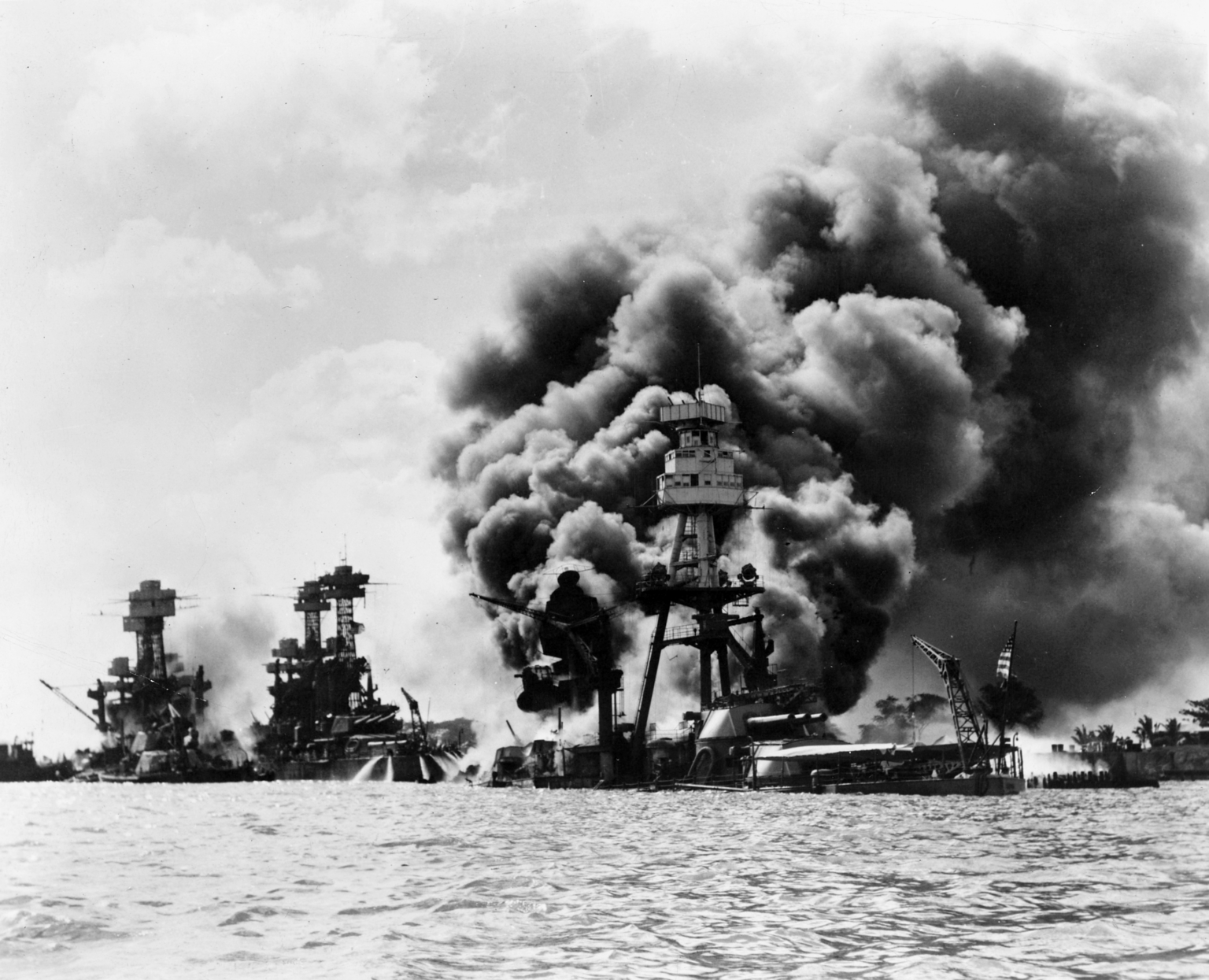
On December 7, 1941, around 7:55 in the morning, Hawaii time, the very first wave of Japanese planes crossed Oahu’s shoreline. In roughly two hours, 2,403 Americans were dead, 1,178 wounded, four battleships had gone down, four more took serious damage, and the United States Army Air Forces had lost nearly 200 aircraft … basically wiped away right on the ground, before any pilot could really reach them. The whole attack lasted 110 minutes.
Its consequences lasted the rest of the century. This short black-and-white film from the Prelinger Archives is one of dozens of pieces of historical footage documenting the Pearl Harbor attack and its immediate aftermath — military film and newsreel material preserved, digitized, and made available to anyone with an internet connection. It runs just over two minutes. It is completely free to watch. And it connects you directly to December 7, 1941, through the cameras of people who were there.
Pearl Harbor — Historical Film Overview Table
| Detail | Information |
|---|---|
| Title | Pearl Harbor |
| Format | Black & White, Sound |
| Runtime | ~2 minutes 14 seconds |
| Type | Historical military film / archival footage |
| Subject | World War II: General; World War II: Japan; World War II: Army Air Forces |
| Collection | Prelinger Archives |
| Internet Archive Added | March 1, 2007 |
| Internet Archive Views | 66,859+ |
| Internet Archive Favorites | 140+ |
| Country | United States |
| Language | English |
| Public Domain | Yes — Prelinger Archives, freely available |
| Available Formats | 512KB MPEG4, H.264, Hi-Res MPEG4, MPEG2, OGG Video, MP3 audio |
What Is the Prelinger Archives — And Why Does It Matter?
Before you watch any film from this collection, it helps to understand what the Prelinger Archives actually are. Rick Prelinger founded the Archives in 1982 in New York City with a specific mission: to preserve what he calls “ephemeral” films — sponsored films, educational films, government productions, industrial films, and amateur home movies that were produced for specific purposes at specific times and were never intended to survive the moment they served.
Most of these films were never commercially distributed. They were made to train soldiers, inform the public, serve government communication needs, or fulfill corporate obligations — and once that purpose was done, they were simply stored, lost, or destroyed. Prelinger spent two decades collecting, cataloguing, and preserving them before anyone else thought they were worth saving.
In 2002, the Library of Congress picked up the physical collection — by then it was roughly 60,000 finished films and more than 30,000 cans of unedited footage. The digitized copies went up to the Internet Archive, and today they’re basically open to the public for viewing, downloading, and reuse. Roughly sixty five percent of what’s there is already in the public domain, either because the copyrights ran out or because the films were produced without the proper notice, which kind of matters a lot.
The Pearl Harbor film inside this collection is the sort of work that Prelinger seemed to be chasing his whole career for saving: a brief military or government production that captured a single historical instant for a very particular wartime reason. And it still exists, as direct visual proof, of what December 7, 1941 actually looked like to the folks who were filming in real time.
December 7, 1941 — The strike that turned everything
The Imperial Japanese Navy sent about 353 aircraft in two rounds from six carriers, hovering roughly 230 miles north of Oahu. The whole thing was meant to put the United States Pacific Fleet out of action. Japanese strategists basically thought that fleet was the biggest obstacle in the background to their larger ambition, namely pushing deeper into Southeast Asia and then across the Pacific.
First wave, 183 aircraft, hit at 7:55 a.m. and went for the airfields at Hickam, Wheeler, Bellows, and Ewa. The idea was to break American aviation capability before the second wave turned toward the ships. When the assault wrapped up around 9:55 a.m., the whole Pacific War situation had already been reshaped. The United States had lost:
- 4 battleships sunk — USS Arizona, USS Oklahoma, USS California, USS West Virginia
- 4 battleships damaged — USS Nevada, USS Tennessee, USS Maryland, USS Pennsylvania
- 3 cruisers damaged
- 3 destroyers sunk or damaged
- 188 aircraft destroyed — primarily on the ground at Army Air Forces fields
- 2,403 Americans killed — 1,178 more wounded
The following morning, President Franklin D. Roosevelt addressed a joint session of Congress and described December 7 as “a date which will live in infamy.” Congress declared war on Japan within hours. Three days later, Germany and Italy declared war on the United States. America’s entry into the Second World War — the event that would determine the war’s outcome — had begun.
The Army Air Forces Connection — What Was Lost at Pearl Harbor
The Prelinger Archives film is specifically tagged under “World War II: Army Air Forces” — which is basically the branch of the U.S. military whose losses at Pearl Harbor were among the more strategically significant, and yes also the most deliberately targeted.
Japan’s planners seem to have understood that if American air power stayed intact, then any strike on the Pacific Fleet would be met right away from the sky. So the first wave of Japanese aircraft went after the Army Air Forces fields at Hickam Field (right next to Pearl Harbor), Wheeler Field (the main fighter base) , Bellows Field, and Ewa Marine Corps Air Station before the naval bombardment got to full intensity.
The results were devastating. At Hickam Field alone, 189 men were killed and 303 wounded in the first hours. At Wheeler, American P-40 fighters were lined up wingtip-to-wingtip — parked to prevent sabotage rather than dispersed for defense — and were destroyed almost entirely before pilots could reach them. Of the roughly 231 Army aircraft stationed in Hawaii, 188 were destroyed or damaged. American air superiority in the Pacific, which would have been the primary defense against further Japanese attack, was effectively neutralized in the opening minutes of the war.
The Army Air Forces rebuilt. By 1944, it had become the largest air force in history — but the men killed on Hickam Field on December 7, 1941, and the aircraft destroyed on the ground at Wheeler and Ewa, represent a catastrophe that shaped the entire first year of the Pacific War.
Why So Little Footage of the Attack Survived — The Scarcity Problem
One of the persistent ironies of Pearl Harbor documentary history is that despite the attack’s enormous historical significance, remarkably little genuine film footage of the event itself survived. The attack came without warning, on a Sunday morning, when most cameras were not running and most cameramen were not on duty.
The most significant genuine footage came from Al Brick — a veteran Fox Movietone newsreel cameraman who happened to be at sea with the Pacific Fleet in 1940–41 and filmed the attack as it happened. His footage, shot with a Bell and Howell Eyemo camera, was immediately classified by the U.S. Navy. It wasn’t released to the public until December 7, 1942 — exactly one year after the attack — when Fox Movietone News released it under the title Now It Can Be Shown!, narrated by Lowell Thomas.
The U.S. government, recognizing the propaganda value and the documentary gap, commissioned multiple reconstructions and compilation films in the first years after the attack. John Ford’s December 7th (1943) was first a sort of full length documentary, that the Navy said was too honest about American failures, so they ordered it cut down to 34 minutes, and in the end it turned into the main visual source later documentaries kept using.
Then Frank Capra’s Prelude to War (1942) also folded Pearl Harbor footage into his Why We Fight series, like it was a quiet kind of bridge between everything.The Army Air Forces produced their own training and informational films documenting what had happened to their people and their aircraft.
The Prelinger Archives film sits within this production context — a short government or military film produced in the years immediately following the attack, using footage that was captured at the time or compiled shortly thereafter for military documentation purposes.
How to Watch Pearl Harbor (Prelinger Archives) Free Online
The Pearl Harbor film from the Prelinger Archives is freely available on the Internet Archive in multiple formats, including high-resolution MPEG4 for the best viewing quality.
| Platform | Format | Cost |
|---|---|---|
| Internet Archive | Stream + Download (512KB MPEG4, H.264, Hi-Res MPEG4, MPEG2, OGG) | Free |
| YouTube | Various Pearl Harbor Prelinger footage uploads | Free |
Pearl Harbor (Prelinger Archives) on Internet Archive:
Related Pearl Harbor Documentary Films in the Public Domain
The Prelinger Archives pearl harbor film is basically one of dozens of related historical movies you can watch free online. It is a bit like a small nest of documents, all connected. These are the more significant public domain titles, that tell the attack and its larger context in different ways:
| Film | Year | Notes |
|---|---|---|
| December 7th (John Ford) | 1943 | Oscar-winning Navy documentary; available on Internet Archive |
| Prelude to War (Frank Capra) | 1942 | First of the Why We Fight series; includes Pearl Harbor footage |
| Now It Can Be Shown! | 1942 | Fox Movietone newsreel — Al Brick’s genuine attack footage, narrated by Lowell Thomas |
| Since Pearl Harbor | 1943 | American Red Cross wartime activities report; preserved by Academy Film Archive |
| Pearl Harbor December 7, 1941 | 1953 | 30-minute dramatic reconstruction; freely available |
| Combat America | 1943 | Army Air Forces B-17 documentary narrated by Clark Gable; in color |
Is This Pearl Harbor Film in the Public Domain?
Yeah, ok. The Pearl Harbor film, from the Prelinger Archives, is pretty much freely available, under the Prelinger Archives public domain dedication. Now, the government produced military and documentary films from World War II, they’re usually in the public domain here in the United States . Because they were made with public funds, they really weren’t ever under private copyright to begin with, not in the first instance. So you can legally stream the footage, download it, share it, and also use it for studying, personal projects, or creative work, no restriction, no payment, kind of straight forward like that.
The Importance of Archiving This Footage — Why Preservation Matters
The Prelinger Archives project operates on a principle that the mainstream film preservation community took decades to accept: ephemeral films are historical documents, not disposable artifacts. The short military films, newsreels, and government productions that documented World War II for operational, propaganda, and informational purposes are often the only visual evidence that survives of specific events, specific places, and specific moments.
Pearl Harbor is one of the most documented events in American history in terms of written records, oral testimony, and photographic stills. It is, paradoxically, one of the most scarcely documented in genuine moving image — precisely because the attack came without warning and there was almost no one in position to film it when it began. Every piece of surviving footage from that morning, and every military film produced in the immediate aftermath, represents irreplaceable historical evidence.
The fact that this Prelinger Archives film has accumulated over 66,000 views on the Internet Archive — most of them from people searching for authentic historical footage rather than Hollywood reconstructions — demonstrates exactly why Rick Prelinger’s preservation work matters. These are not films anyone would have thought to save in 1945. They survive because one archivist spent twenty years collecting what everyone else was discarding.
Frequently Asked Questions — Pearl Harbor Prelinger Archives Film
Q: What is the Pearl Harbor Prelinger Archives film?
A short black-and-white historical film from the Prelinger Archives collection documenting the Pearl Harbor attack of December 7, 1941, with particular focus on World War II Army Air Forces material. The film runs approximately 2 minutes 14 seconds and has accumulated over 66,000 views on the Internet Archive since being digitized and uploaded in 2007.
Q: Is the Pearl Harbor Prelinger Archives film in the public domain?
Yes. The film is part of the Prelinger Archives collection and is freely available under their public domain dedication. U.S. government-produced military and documentary films from World War II are generally in the public domain. You can legally stream, download, and reuse this footage without restriction.
Q: What are the Prelinger Archives?
The Prelinger Archives were founded by Rick Prelinger in 1982 to preserve ephemeral films — sponsored films, educational films, government productions, and industrial films that were produced for specific purposes and never intended to survive commercially. In 2002, the Library of Congress acquired the physical collection. Digitized versions are freely available on the Internet Archive.
Q: Why is there so little genuine footage of the Pearl Harbor attack?
The attack came without warning on a Sunday morning when most cameras were not running and most cameramen were not on duty. The most significant genuine footage — shot by Fox Movietone newsreel cameraman Al Brick — was immediately classified by the U.S. Navy and not released publicly until December 7, 1942, a full year after the attack.
Q: What happened to the Army Air Forces at Pearl Harbor?
The first wave of Japanese aircraft deliberately targeted U.S. Army Air Forces fields at Hickam, Wheeler, Bellows, and Ewa before attacking the naval fleet — destroying American air power on the ground to prevent retaliation. Of roughly 231 Army aircraft stationed in Hawaii, 188 were destroyed or damaged. At Hickam Field alone, 189 men were killed and 303 wounded in the opening hours.
Q: What is the best Pearl Harbor documentary in the public domain?
John Ford’s December 7th (1943) — the Oscar-winning Navy documentary that Ford initially refused to cut from its full length because the shorter version downplayed American failures — is the most significant Pearl Harbor documentary in the public domain. Frank Capra’s Prelude to War (1942) and the Fox Movietone newsreel Now It Can Be Shown! (1942), narrated by Lowell Thomas with Al Brick’s genuine attack footage, are also essential viewing.
Q: How many people died in the Pearl Harbor attack?
2,403 Americans were killed and 1,178 were wounded in the Japanese attack on Pearl Harbor on December 7, 1941. The attack lasted approximately two hours, from 7:55 a.m. to 9:55 a.m. Hawaiian time.
Q: What ships were sunk at Pearl Harbor?
Four battleships were sunk: USS Arizona, USS Oklahoma, USS California, and USS West Virginia. Four more battleships were damaged: USS Nevada, USS Tennessee, USS Maryland, and USS Pennsylvania. Three cruisers and three destroyers were also sunk or damaged. The USS Arizona remains on the harbor floor as a memorial — the ship still contains the remains of 1,102 of its crew.
Q: Where can I watch the Pearl Harbor Prelinger Archives film for free?
The film is freely available on the Internet Archive at archive.org/details/PearlHarbor, in multiple formats including streaming and downloadable Hi-Res MPEG4. No account is required.
Q: Can I use Prelinger Archives Pearl Harbor footage in my own projects?
Yes. Prelinger Archives films available under the public domain dedication can be used freely in any medium, including derivative works, for both personal and commercial purposes. The metadata and descriptions provided by Prelinger Archives are jointly copyrighted and may be quoted for educational purposes but not reproduced commercially without permission.
Related Free Classic WWII Films and Documentaries
If the Pearl Harbor Prelinger Archives film sent you into WWII public domain cinema, these are the most significant related titles available free online:
- Public Domain Cartoons
- Public Domain Horror Movies – Free Classic Scary Films Online
- Bird of Paradise (1932) Full Movie Review, Plot, Cast & Free Classic Romance Film
- Public Domain Movies List – All Free Classic Films (Complete Guide)
Movie Tags
Pearl Harbor film public domain, Pearl Harbor Prelinger Archives, Pearl Harbor December 7 1941 footage, Pearl Harbor Army Air Forces film, WWII documentary public domain, Prelinger Archives World War II, Rick Prelinger archive films, Pearl Harbor historical footage free, Internet Archive WWII films, Pearl Harbor attack footage, Army Air Forces Pearl Harbor losses, Hickam Field December 7, USS Arizona public domain, John Ford December 7th documentary, Frank Capra Why We Fight Pearl Harbor, Al Brick newsreel Pearl Harbor, WWII ephemeral films archive, free Pearl Harbor documentary online, Pearl Harbor public domain footage download, WWII military film Prelinger