
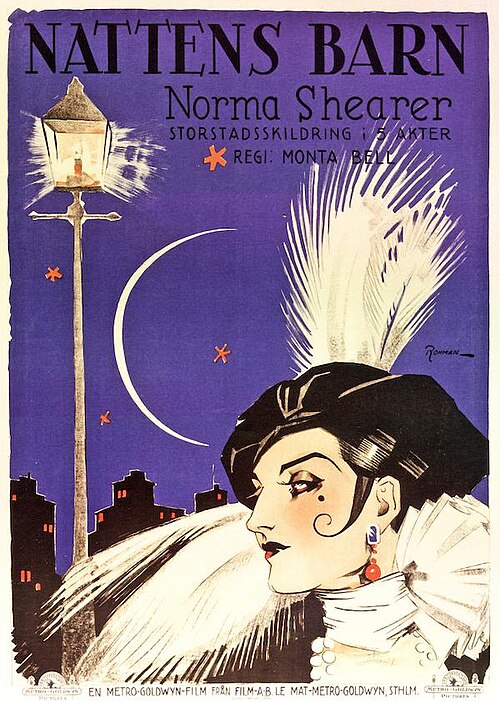
Somewhere in the final reels of Lady of the Night (1925), when Molly and Florence finally appear on screen together, the woman playing the back of Norma Shearer’s head is Lucille Le Sueur — a nineteen-year-old recent MGM addition who would shortly rename herself Joan Crawford and spend the next three decades locked in one of Hollywood’s most famous rivalries with the woman whose body she was doubling. This is Crawford’s first screen appearance. Shearer, meanwhile, is giving the performance that made her a top MGM star.
They are already, even at this distance of a century, the most interesting people in the room. Lady of the Night is a six-reel 1925 silent romantic drama built around a dual-role technical challenge — two women from opposite sides of society both loving the same inventor — and it is considerably more accomplished than its modest reputation suggests. It is in the public domain. You can watch it free online. And the backstory behind a single hug scene is one of the great footnotes in Hollywood history.
Lady of the Night 1925 — Movie Overview Table
| Detail | Information |
|---|---|
| Title | Lady of the Night |
| Release Date | February 23, 1925 |
| Country | United States |
| Runtime | 62 minutes (6 reels) |
| Genre | Silent Romantic Drama |
| Language | Silent (English intertitles) |
| Format | Black & White, Silent |
| Director | Monta Bell |
| Producer | Louis B. Mayer |
| Story By | Adela Rogers St. Johns |
| Scenario | Alice D.G. Miller |
| Cinematography | André Barlatier |
| Editor | Ralph Dawson |
| Studio / Distributor | Metro-Goldwyn-Mayer (MGM) |
| Box Office | $326,000 total ($235,000 domestic; $91,000 foreign) |
| Profit | $96,000 |
| IMDb Rating | 6.7/10 |
| Notable | Joan Crawford’s film debut (as uncredited body double for Shearer) |
| Public Domain | Yes — freely available to watch and download |
Full Cast Table — Lady of the Night (1925)
| Actor | Role |
|---|---|
| Norma Shearer | Molly Helmer / Florence Banning (dual role) |
| Malcolm McGregor | David Page |
| George K. Arthur | “Chunky” Dunn |
| Fred Esmelton | Judge Banning |
| Dale Fuller | Miss Carr (Florence’s spinster aunt) |
| Lew Harvey | Chris Helmer (Molly’s father) |
| Gwen Lee | Molly’s Friend |
| Betty Morrissey | Gertie (Molly’s friend) |
| Joan Crawford | Molly — body double for Shearer (uncredited; film debut) |
| Carlton Griffin | Dance Hall Lothario (uncredited) |
| Julian Rivero | Uncredited bit |
| Constantine Romanoff | Uncredited bit |
| Aryel Houwink | “The Sharpie” (uncredited) |
Why Lady of the Night 1925 Is Worth Your Time — A Century Later
Released on February 23 , 1925, Lady of the Night was the film that sort of raised Norma Shearer from MGM’s promising young lead to its true kind of star. She had already shown up in He Who Gets Slapped (1924) with Lon Chaney and John Gilbert, in MGM’s first big production, and also in The Snob (1924) with the same director, Monta Bell, like, earlier than you’d expect.
But this was the film where the technical ambition matched the performance — where playing two roles required a quality of separation and specificity that Shearer delivered so completely that a 2004 screening at the San Francisco Silent Film Festival, with live piano accompaniment, reportedly left audiences cheering.
The movie pulled in $326,000 against its actual production costs, and it turned out to be a profit of $96,000, which is pretty respectable numbers for a 1925 MGM release, in other words a decent commercial sort of confirmation of what the critical response was already implying, ya know . It felt like, Shearer had finally stepped into place, and Lady of the Night was the proof, the evidence of it, all right.
Monta Bell — The Director Who Shaped Norma Shearer
Monta Bell kinda had this not so straight line to directing. He was born in 1891, and he basically started off as a newspaper man , then he drifted into the stage, and after that moved into film. Along the way, he acted for a bit then became a director. His way into the early Hollywood inner circle came through Charlie Chaplin. Bell worked on Chaplin’s The Pilgrim (1923) as an actor , and later edited A Woman of Paris (1923). That Chaplin film was more serious and dramatic, and it still counts as one of the most formally sophisticated pictures from the silent era.
Bell later joined MGM and, well he made six films with Shearer in total. He also sort of fell for her during their collaboration— or at least that is what happened , but she never really returned the feeling. Still, his biographer Gavin Lambert said it was obvious, like you could see it in every single film they made together. Bell’s admiration for his leading actress shaped the way he directed in a particular kind of way: he pushed her relentlessly, pulled out her humor, nudged closeness with the camera, and he discouraged those big theatrical poses silent film actors always seemed to retreat into when they weren’t sure.
As Lambert wrote, Bell “extended her technique, tapped her humor and inventiveness, encouraged her to be intimate with the camera, discouraged theatrical poses.” Lady of the Night is their finest achievement together — the film where Bell’s direction and Shearer’s performance meet at their highest point. Bell died in 1958, forgotten, indigent, and crippled by arthritis. His contribution to Shearer’s stardom is rarely acknowledged by anyone who writes about her career.
Full Plot Summary — Lady of the Night (1925)
Chris Helmer is sentenced to twenty years in prison by Judge Banning for a theft. He leaves behind a wife and a baby girl. By coincidence, Judge Banning also has a daughter approximately the same age. The opening establishes the film’s structural irony immediately: two baby girls, born within days of each other, whose entire futures will diverge according to which father they happened to be born to.
Eighteen years later, both mothers are, finally dead. Florence Banning (Norma Shearer) finishes an exclusive private school—sort of refined, kept safe, used to privilege. Molly Helmer (also Norma Shearer) graduates from a reform school , tougher and self reliant, already knowing how the world treats women when there are no ties or connections. Both are eighteen. Both are motherless. And both, as the film will discover, are essentially the same person shaped by different circumstances.
Molly’s World — The Dance Hall and David Page
Molly and her two friends become taxi dancers — women paid by the dance at commercial dance halls, one of the period’s more ambiguous occupations. When a stranger at the dance hall forces his attentions on her, her boyfriend “Chunky” Dunn (George K. Arthur) tries to intervene and gets knocked down. She is rescued by Chunky’s friend David Page (Malcolm McGregor) — an inventor of genuine talent — and falls completely in love with him on the spot.
David, with the obliviousness common to inventors in romantic fiction, sees Molly entirely as a pal. The more perceptive Chunky sees exactly what’s happening and grows increasingly jealous — not incorrectly. David perfects a device that can open any safe. Chunky, true to type, immediately suggests selling it to criminals he knows. Molly, equally true to hers, tells David that crime doesn’t pay. David takes the invention to a bank for legitimate sale — Judge Banning being one of the directors who approves the purchase.
Florence’s World — And the Collision
As David leaves the bank meeting, he literally bumps into Florence Banning. She falls for him as immediately and completely as Molly did — which the film presents not as a coincidence but as a natural consequence of both women being fundamentally the same person. They begin dating, to the considerable displeasure of Florence’s spinster aunt Miss Carr (Dale Fuller), whose view of appropriate behavior is both consistent and losing the argument.
The collision the film has been building toward happens when Florence encounters Molly by accident at David’s workshop. Florence is the daughter of a judge. Molly is the daughter of a man that judge sent to prison. They look identical. And Florence, with the specific perceptiveness of someone who has never had to be hard, immediately understands that Molly loves David in a way that has a prior claim — not legal or social, but moral and emotional.
The Ending — Sacrifice and the Limousine
Florence breaks up with David and tells him Molly has the greater claim. Then she gets into her limousine — and finds Molly already waiting inside. Molly, who has arranged this meeting specifically, urges Florence to marry David instead. Her argument is not about herself. It’s entirely about David’s happiness and what she believes Florence can give him that a reform school graduate cannot.
To make the sacrifice irreversible — to prevent David from choosing her out of pity once he discovers what she’s done — Molly accepts Chunky’s standing marriage proposal. The ending is bittersweet in the precise way the best silent melodramas are: two women who are essentially the same person choosing differently, one for love and one for something that looks remarkably like love expressed as renunciation.
Norma Shearer — Playing Both Roles and Making Both Real
The dual role is the film’s technical centerpiece, and Shearer’s management of it is what separates Lady of the Night from lesser dual-role pictures of the period. The technical challenge — split-screen photography, double-exposure effects, and the strategic use of a body double in the scenes where the two characters physically share the same frame — was well within early 1920s MGM’s capabilities. The acting challenge was harder.
Shearer solves it through bearing. Molly carries herself with the compact, slightly defensive physicality of someone who has learned to take up exactly the amount of space she needs and no more. Florence occupies space with the unconsidered ease of someone who has never been told to make herself smaller. Both are intelligent — the script is careful to make them equally smart, just differently formed by their circumstances. But their relationship to their own bodies, their own presence in a room, is completely distinct. Shearer makes that distinction visible from her first scene as each character and never collapses it.
Contemporary reviews praised her specifically for the portrait shots — Bell’s direction gave her extended close-ups where the camera simply stays on her face and lets her think. Those shots are the film’s most striking sequences: a performance of interiority in a medium that had not yet found its voice.
Joan Crawford — The Body Double Who Would Become the Rival
This is the part of the film’s history that makes it genuinely remarkable as a Hollywood document. When the scenes required both Molly and Florence to appear in the same frame simultaneously — the limousine scene in particular — a body double was needed for Shearer to play one character while Shearer herself played the other. MGM’s solution was a recent addition to the studio’s roster: a young woman appearing under her real name, Lucille Le Sueur, who had just arrived in Hollywood from Kansas City.
Le Sueur would soon rename herself Joan Crawford. This body double assignment — appearing from behind, showing only her back and profile in the scenes where Molly and Florence are together — is her first film appearance. She was approximately nineteen years old. In one brief moment during the embrace between the two characters, Crawford can be briefly seen made-up as Molly from the front — the only glimpse of her face in the film.
The rivalry that would define both women’s MGM careers — and that would eventually find its way into What Ever Happened to Baby Jane? mythology — begins here, in a limousine scene, with Joan Crawford playing the back of Norma Shearer’s head in 1925. The San Francisco Silent Film Festival audience’s reported reaction when the hug scene played — everyone cheering — suggests that the weight of what those two women’s relationship became makes even this brief, uncredited appearance carry an enormous retrospective charge.
Crawford went on to other bit parts in 1925 — Pretty Ladies, The Merry Widow, Old Clothes — before her breakthrough playing Lon Chaney’s love interest in The Unknown (1927). She and Shearer would spend the better part of the next decade competing for the same roles at the same studio, with Shearer holding the institutional advantage as the wife of MGM production chief Irving Thalberg.
The Double-Exposure Photography — How the Dual Role Was Achieved
For the silent-era dual-role scenes, people used this kind of mix of methods that sort of forced you to plan ahead and then execute it exact. Like split screen photography where the frame got physically divided and both halves were exposed separate, and then there was double exposure, where the same strip of film goes through the camera twice while different parts are masked, so it lines up right in the end. Also there was strategic staging , using a body double for the beats when both characters really needed to be close in the same physical space, kind of in contact.
Cinematographer André Barlatier handled the technical dimension of the Shearer dual role with enough skill that contemporary viewers found the composite shots convincing. The dissolves that merge the two Shearers in transition — a technique used throughout the film to signal the parallel structure before the characters actually meet — are particularly well-executed: images that blur from one character to the other with a smooth continuity that serves the film’s thematic argument about the essential sameness of its two protagonists.
For the scenes requiring actual physical contact — the hug, the shared space of the limousine — Crawford’s presence solved a technical problem that double-exposure alone couldn’t. Two bodies in contact cannot be split-screened without visible seams. A body double allowed Shearer to be in the same physical space as herself.
Where to Watch Lady of the Night (1925) Free Online
Lady of the Night is in the public domain and legally available across multiple platforms at no cost.
| Platform | Format | Cost |
|---|---|---|
| Internet Archive | Stream + Download (multiple formats) | Free |
| YouTube | Stream | Free |
| Public Domain Movies | Stream | Free |
Lady of the Night (1925) on Internet Archive:
Is Lady of the Night (1925) in the Public Domain?
Yeah, Lady of the Night (1925) is in the public domain here in the United States. For All American films made before 1928 , if their copyrights were never renewed under the older pre-1978 U.S. copyright rules , they’re now available without any limits. So you can legally stream , grab the file, share it, and show it for educational purposes , with no extra payment or restrictions.
Critical Reception — Then and Now
The film holds a 6.7 out of 10 on IMDb — one of the stronger ratings in this public domain collection — from viewers who largely came to it through Shearer’s career or through Crawford completism and stayed because the film itself rewarded the visit. Letterboxd reviews are notably warmer than the film’s modest historical reputation might suggest, with multiple reviewers expressing genuine surprise at how accomplished it is.
The pretty consistent critical observation across a century of occasional viewing is like this : Molly is the more alive of the two characters, and Shearer’s performance as Molly is considerably more interesting than her Florence, honestly. Florence is the film’s nominal good girl — educated, privileged, ultimately sacrificing her love for someone else’s happiness — but Molly is its actual moral center. The reform school graduate who chooses to lose rather than let the man she loves be unhappy is a far more complex figure than the judge’s daughter who does the same thing, and Shearer’s physical specificity as Molly makes that complexity visible in every scene.
The 2004 San Francisco Silent Film Festival screening — with live piano accompaniment, as all silent films deserve — reportedly produced the reaction that serious silent film audiences reserve for genuine rediscoveries. That reaction, and the film’s 100th anniversary in 2025, make this the right moment to seek it out.
Frequently Asked Questions — Lady of the Night 1925
Q: What is Lady of the Night (1925) about?
Two women born on the same day to very different fathers — one a convict, one a judge — grow up in opposite social worlds and both fall in love with the same inventor. The film follows their parallel stories to a bittersweet conclusion driven by renunciation rather than conventional romantic resolution. Norma Shearer plays both women in a dual role.
Q: Is Lady of the Night (1925) in the public domain?
Yes. The film entered the public domain when its copyright was not renewed under the pre-1978 U.S. copyright system. You can legally stream, download, and share it for free.
Q: Was Lady of the Night Joan Crawford’s first film?
Yes. Joan Crawford — then still using her real name Lucille Le Sueur — makes her first film appearance in Lady of the Night as an uncredited body double for Norma Shearer. She appears from behind in the scenes where Molly and Florence share the frame, with one brief glimpse of her face made up as Molly during the characters’ embrace.
Q: Who directed Lady of the Night (1925)?
Monta Bell directed the film for MGM. Bell was a former newspaper man and stage professional who became one of Norma Shearer’s most important early directors — they made six films together. He had previously edited Charlie Chaplin’s A Woman of Paris (1923) and acted in Chaplin’s The Pilgrim (1923). Bell died in 1958, largely forgotten despite his significant contribution to Shearer’s career.
Q: Who wrote the story for Lady of the Night?
Adela Rogers St. Johns wrote the original story. Alice D.G. Miller wrote the scenario (screenplay). St. Johns was one of early Hollywood’s most significant female writers and journalists, whose work appeared across multiple studios throughout the silent era.
Q: How did Lady of the Night achieve the dual-role effect?
The film used a combination of split-screen photography, double-exposure techniques, and strategic staging with a body double — Joan Crawford — for the scenes where both characters needed to be in physical contact simultaneously. Cinematographer André Barlatier executed the composite sequences with enough precision that contemporary viewers found the effect convincing.
Q: Was Lady of the Night a financial success?
Yes. The film grossed $326,000 total — $235,000 domestically and $91,000 from foreign markets — generating a profit of $96,000 for MGM. It was commercially solid for a 1925 release and contributed directly to Shearer’s elevation to top-star status at the studio.
Q: Has Lady of the Night been shown at film festivals?
Yes. A restored print was screened at the San Francisco Silent Film Festival in July 2004 with live original piano accompaniment — the format all silent films deserve. The screening reportedly produced enthusiastic audience response, particularly for the scenes where Shearer’s two characters appear together on screen.
Q: Where can I watch Lady of the Night (1925) for free?
Lady of the Night is freely available on the Internet Archive, YouTube, and Public Domain Movies. All versions are legal to stream and download under public domain status.
Q: What other films did Norma Shearer make with Monta Bell?
Shearer and Bell made six films together at MGM. Their collaboration began with Broadway After Dark (1924) at Warner Brothers, before Bell joined MGM. He Who Gets Slapped (1924) and The Snob (1924) preceded Lady of the Night, which was their finest achievement together and the film that established Shearer as MGM’s leading female star.
Related Free Classic Silent Films and Public Domain Drama
If Lady of the Night (1925) sent you into classic silent film and early Hollywood history, these are the natural titles to explore next:
- Public Domain Cartoons
- Public Domain Horror Movies – Free Classic Scary Films Online
- Bird of Paradise (1932) Full Movie Review, Plot, Cast & Free Classic Romance Film
- Public Domain Movies List – All Free Classic Films (Complete Guide)
Movie Tags
Lady of the Night 1925, Lady of the Night full movie, watch Lady of the Night free, Lady of the Night public domain, Norma Shearer dual role, Norma Shearer 1925 silent film, Joan Crawford first film debut, Joan Crawford Lucille Le Sueur 1925, Joan Crawford body double Shearer, Monta Bell director, MGM silent film 1925, Louis B. Mayer producer, Adela Rogers St Johns screenplay, André Barlatier cinematography, split screen silent film, dual role silent era, 1925 romantic drama public domain, free silent movie online, classic MGM silent film, Shearer Crawford rivalry origin