
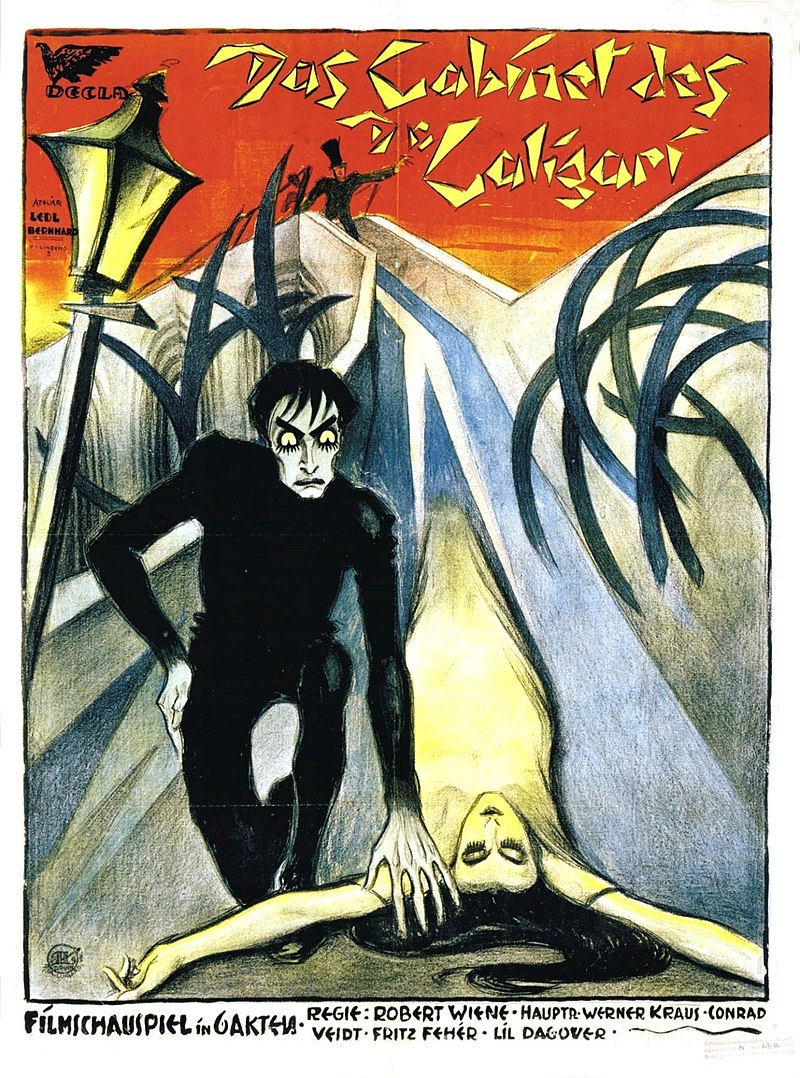
The phrase “German Expressionist films” refers to the kind of films which are deliberately distorted in their presentation of reality, and The Cabinet of Dr. Caligari is the most prominent among them. It is not only regarded as a film but also has been perceived as a shock that redirected the whole industry towards a new position. The movie, which came out in 1920, was directed by Robert Wiene; it not only opened the door for horror but also pre-shaped the genre. A lot of people still consider it the first authentic horror film, and to be honest, that assertion does not seem to be an overstatement at all.
The story twists through distorted streets, jagged sets, and a tale that keeps tilting your sense of what’s true. You’ll get a rundown of the plot, some background on how it came to be, and a look at the symbols that hide under its crooked shadows. There’s even a direct MP4 download so you can watch this odd, mythic thing without hunting for it.
🎬 Movie Details:
| Category | Details |
|---|---|
| Title | The Cabinet of Dr. Caligari |
| Original Title | Das Kabinett des Doktor Caligari |
| Year | 1920 |
| Genre | Horror, Fantasy, Silent, German Expressionism |
| Director | Robert Wiene |
| Writers | Hans Janowitz, Carl Mayer |
| Language | Silent (German intertitles) |
| Download Format | MP4 |
| Source | Internet Archive (Public Domain) |
Watch or Download for Free
📥 Download the Film
- Watch or Download: The Cabinet of Dr. Caligari – Archive.org (MP4)
Because the film is in the public domain, you can watch or download it for free from trusted sources.
🎬 Click here to watch on Archive.org
Format: MP4 | Length: ~75 minutes | Language: Silent (English intertitles available)
🧠 Plot Summary
The movie is presented as Francis describes a horrifying story of his early years. Together with his friend Alan, they attend a fair, where they meet Dr. Caligari, who is a sinister person and who presents a sleepwalker named Cesare who has the ability to foretell about the future. Cesare prophesies the death of Alan and Alan is actually killed by dawn.
As his doubts grow, Francis digs deeper and discovers that Dr. Caligari is tied to the murders — and that he also runs a nearby mental asylum. But then the story takes a shocking turn, suggesting that Francis himself may actually be a patient there, throwing everything we’ve seen into question.
🎭 Cast Highlights
- Werner Krauss – Dr. Caligari
- Conrad Veidt – Cesare, the somnambulist
- Friedrich Feher – Francis
- Lil Dagover – Jane
- Hans Heinrich von Twardowski – Alan
🎨 Style & Themes
This film’s most iconic trait is its Expressionist set design—twisted buildings, distorted shadows, and painted lights—all reflecting a disturbed psychological reality.
Key Themes:
- The danger of blind obedience to authority
- The fine line between sanity and madness
- The manipulation of reality
- War trauma and authoritarian critique
📚 Behind the Scenes
The movie unfolds through Francis as he retells a story that still crawls under his skin. He remembers tagging along with his friend Alan to a fair, a loud place with crooked lights and that odd tension you feel before something goes wrong. They stumble into Dr. Caligari’s act. The man looks off, a bit sharp around the eyes, and he shows off a sleepwalker named Cesare, who claims to see the future. Cesare mutters a prediction about Alan’s death, and by dawn, Alan’s gone. The air tightens after that.
Francis starts digging on his own. I think he moves with that jittery determination you get when you’re half-scared, half-angry. He finds out Caligari isn’t just tied to the killings. He runs an asylum close by, which sends Francis into a small spiral. Then the story swerves. The final stretch hints that Francis might be a patient inside that same asylum, which scrambles everything you thought you understood and leaves you hanging a bit.
🎥 Why It Matters
- Recognized as a precursor to horror and film noir
- Called the first cult film by critic Danny Peary
- Influenced filmmakers from Hitchcock to Tim Burton
- Symbolized the cultural anxiety of post-war Germany
The Cabinet of Dr. Caligari (1920) isn’t just another old silent film — it’s where horror cinema really began. This German classic introduced a dark, psychological, and deeply unsettling way of storytelling that was totally new at the time and still feels eerie today.
It is said to be one of the most significant movies ever made even over 100 years later.
What Makes It So Special?
This film didn’t just tell a scary story—it redefined how films looked and felt. Here’s what makes it iconic:
- One of the first horror films in history
- Features an unforgettable twist ending
- Uses surreal, distorted sets to reflect madness
- A clever commentary on power and control in society
It was ahead of its time—and that’s why it’s still talked about today.
The Story (No Big Spoilers)
The film takes place in a small town of Germany, where a peculiar man known as Dr. Caligari comes with his sleeping assistant Cesare. He displays Cesare who is able to foresee the future at a local fair. However, following one of the terrifying predictions, there is a sequence of killings.
A young man called Francis suspects Caligari and begins investigating. However, as he approaches the truth, dark and unexpected turns, and the movie ends with one of the most iconic endings in the history of the movie industry.
Expressionism at Its Finest
The visual style of the film is one of the most remarkable ones. Nothing seems to be real, buildings are distorted, shadows are painted and the whole world is out of tune.
This was not only to look good, but it depicted the internal mess of the characters and the distorted reality they were in. This visual art was one of the major elements of the German Expressionist movie and influenced the filmmakers worldwide.
Main Characters Kabinett Caligari
- Dr. Caligari – A mysterious showman with dark secrets
- Cesare – The somnambulist (sleepwalker) under Caligari’s control
- Francis – The curious young man searching for the truth
- Jane – Francis’s love interest, caught in the middle
The actor who played Cesare, Conrad Veidt, would later go on to play roles that inspired villains like The Joker and even characters in classic noir films.
Hidden Messages in the Film
A lot of people feel that the film is not merely horror it is a lesson of power and domination. Dr. Caligari is an embodiment of a leader who compels other people to blindly obey, and Cesare is the poor man who was the subject of such pressure.
This is why, as film critics have proposed, it was the early form of Germany to show fear of dictatorships, way before World War II.
Influence on Future Movies
Without Caligari, modern horror and thriller films might look very different. Its impact can be seen in:
- Alfred Hitchcock’s suspense scenes
- Tim Burton’s gothic style
- Movies like Inception, Shutter Island, and The Joker
It’s a blueprint for how to mix visual art with deep psychological storytelling.
📢 Final Thoughts
It is not only a movie, but a journey to Das Kabinett des Doktor Caligari that provokes perception, reality and authority. You are a movie lover, a horror enthusiast or love history, do not miss this film masterpiece.
Tags:
The Cabinet of Dr. Caligari, Das Kabinett des Doktor Caligari, German Expressionism, Silent Horror Film, Free Horror Movie, Classic Movies, Conrad Veidt, Werner Krauss, Film History