
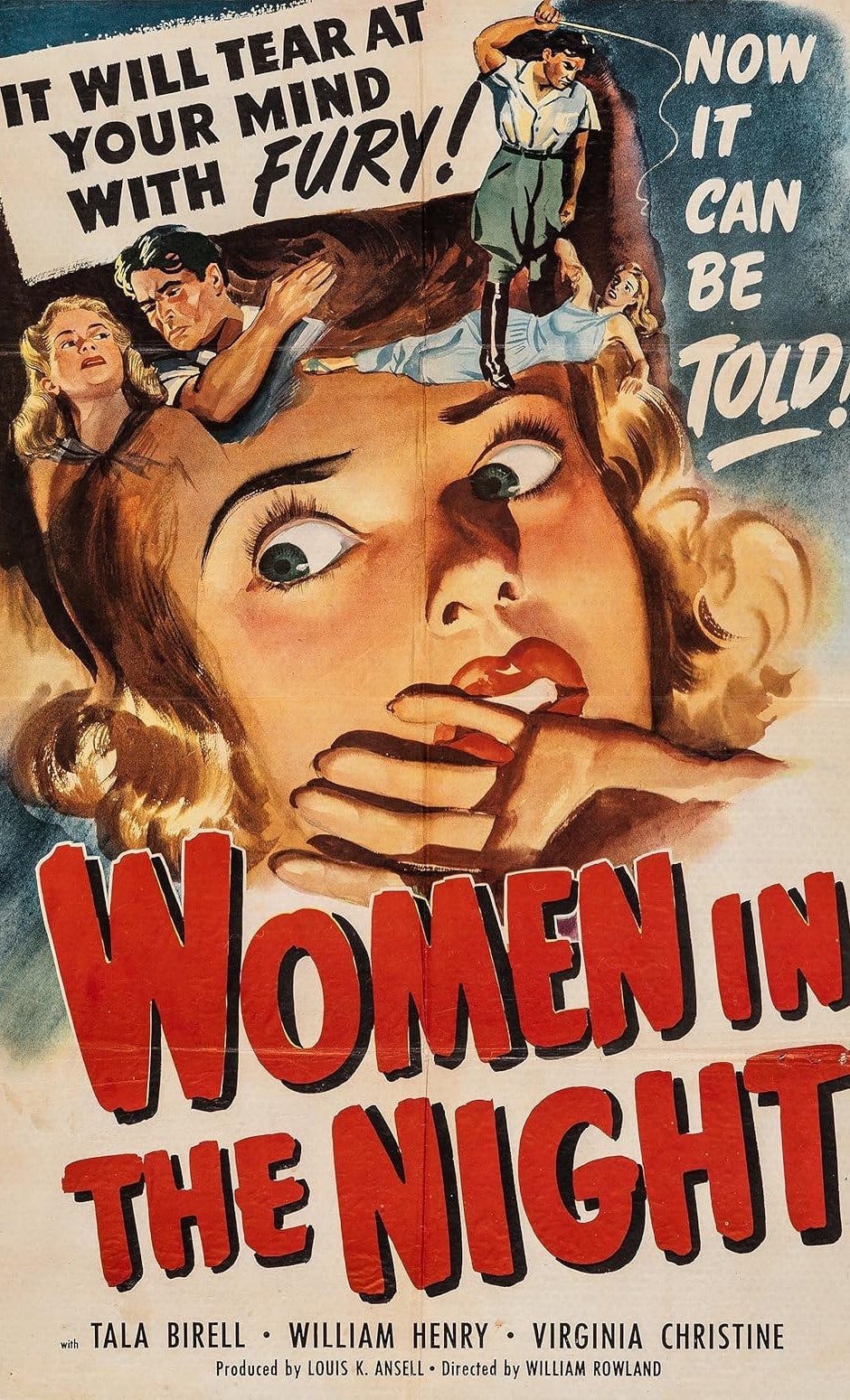
In January 1948, three years after the end of World War II, a low-budget production called Women in the Night arrived in American theaters carrying an extraordinary premise: German and Japanese officers in Shanghai are secretly developing a cosmic death ray a thousand times more powerful than the atomic bomb, and the only people positioned to stop them are a group of women of different nationalities being held as forced “hostesses” in a Nazi officers’ club. That premise is simultaneously lurid and serious, exploitation and propaganda, B-picture and genuine attempt to dramatize wartime atrocity for a 1948 audience still processing what the war had actually been. The film is now freely available as a public domain classic. It is messier than it should be and more interesting than it first appears — and Virginia Christine, who would later become permanently associated with coffee commercials, gives one of its better performances.
Women in the Night 1948 — Movie Overview Table
| Detail | Information |
|---|---|
| Title | Women in the Night |
| Also Known As | When Men Are Beasts; Curse of a Teenage Nazi (some markets) |
| U.S. Release Date | January 2, 1948 |
| Country | United States |
| Runtime | ~98 minutes |
| Genre | War Drama, Espionage Thriller, Women-in-Captivity, Exploitation |
| Language | English, with French and German |
| Format | Black & White (colorized version also circulates) |
| Setting | Shanghai, China — final days of World War II |
| Director | William Rowland |
| Story By | William Rowland |
| Screenplay | Maude Emily Glass, Ali Ipar, Robert St. Claire, Edwin V. Westrate |
| Production Company | Southern California Pictures |
| Exterior Filming | On location in Mexico |
| Public Domain | Yes — widely treated as public domain; available via Internet Archive and free streamers |
| Home Media | Various budget DVD releases since 2005; multiple free online uploads |
Full Cast Table — Women in the Night (1948)
| Actor | Role |
|---|---|
| Tala Birell | Yvette Aubert (French nightclub entertainer) |
| William Henry | Philip Adams / Maj. von Arnheim (OSS agent posing as German officer) |
| Richard Loo | Col. Noyama (Japanese officer) |
| Virginia Christine | Claire Adams (American; Philip’s wife) |
| Bernadene Hayes | Frau Thaler |
| Gordon Richards | Col. von Meyer (German commandant) |
| Frances Chung | Li Ling (Chinese resistance contact) |
| Jean Brooks | Maya |
| Kathy Frye | Helen James (16-year-old Australian) |
| Helen Mowery | Sheila Hallett (Englishwoman) |
| Benson Fong | Chang (Chinese waiter; Li Ling’s fiancé) |
| Helen Brown | Angela James (Helen’s mother) |
| Frederick Giermann | Major Eisel |
| Philip Ahn | Prof. Kunioshi |
| Arno Frey | Field Marshal von Runzel |
| Beal Wong | General Mitikoya |
Why Women in the Night 1948 Is Worth Your Attention
Women in the Night was released on January 2, 1948 less than three years after Hiroshima, less than three years after the liberation of the Nazi concentration camps. The whole war, its real scope was still being sorted out by almost everyone who had been there and lived through it. The movie lands at this pretty particular cultural time, like an exploitation film kind of noticing that actual wartime atrocity makes better material than anything a screenwriter could just invent. And then, it kinda doesn’t quite know what to do with that responsibly, as in, where to put the moral weight or something.
What results is a film that is simultaneously more honest than most 1948 war pictures about what was done to women during the war, and less disciplined than it needed to be to turn that honesty into genuine drama. Those two qualities coexist throughout its 98 minutes — sometimes in the same scene. The film is now compared to the women-in-prison and Naziploitation genre films that followed in later decades, but what separates it from those successors is that it was made by people who were not yet working within an established exploitation template. They were improvising.
The Production — Southern California Pictures and the Shanghai Setting
Southern California Pictures was a minor independent production company with no particular track record in the material it was handling here. The film’s exterior sequences were shot on location in Mexico — a cost-saving decision that gives the outdoor scenes a visual distinctiveness their interior counterparts, built on clearly limited sets, don’t share.
Shanghai as a setting was kind of deliberate, and honestly shrewd too. By 1948, Shanghai sort of summed up the full mess, complexity of wartime Asia in a way that pretty much any American audience would get right away, a cosmopolitan city occupied by the Japanese, with German military advisors around , harboring resistance networks from a mix of Allied nations and kind of sitting right at the intersection of every geopolitical fight the war had thrown into the air.
You can drop French and American and English and Russian and Australian and Chinese and Mexican characters, all in one room in Shanghai in 1944, and it still feels credible, like it should. The script, well it leans on that credibility all the way through, without really letting go .
Full Plot Summary — Women in the Night (1948)
Germany has already surrendered, but a small group of dedicated Nazi officers remains hidden in Shanghai, working alongside Japanese military command to protect an experimental weapon they call a “cosmic ray” — described in the film as a thousand times more destructive than the atomic bomb the Americans have already used. Col. von Meyer (Gordon Richards) commands the operation. Col. Noyama (Richard Loo) represents the Japanese interest. Both sides want the weapon. Neither fully trusts the other.
To maintain control of the compound and root out potential spies, von Meyer seizes a group of foreign women at Shanghai University. He falsely accuses them of killing a German officer and forces them into service as “hostesses” at a Nazi officers’ club that also entertains Japanese dignitaries. The women include Yvette Aubert (Tala Birell), a French nightclub entertainer; Claire Adams (Virginia Christine), an American; Sheila Hallett (Helen Mowery), English; Helen James (Kathy Frye), a sixteen-year-old Australian; and women representing Russia and Mexico.

Angela James — The Film’s Most Extreme Scene
Among the compound’s laborers, Helen discovers that her mother Angela (Helen Brown) is being worked as hard labor in the same facility. Their brief reunion is the film’s emotional center — and what follows is its darkest scene. Angela is a devout Catholic who understands what is about to happen to her teenage daughter. Unable to stop it and unable to live with it, she kills Helen herself to protect her from the coming assault.
A 1948 film depicting a mother killing her own child to prevent rape by enemy soldiers is not the material most studios were producing at the time. The scene places Women in the Night in a different category from conventional war pictures of the period — it is willing to follow its own premise to its logical conclusion in a way that is genuinely disturbing, and that willingness is both the film’s most uncomfortable quality and its most honest one.
Three Resistance Threads — The Intelligence War Inside the Club
Unknown to the Germans and Japanese, three separate resistance operations are running simultaneously inside the club. Claire Adams is working with her husband Philip (William Henry), an OSS agent who has infiltrated the German command posing as Maj. von Arnheim. Li Ling (Frances Chung) and her fiancé Chang (Benson Fong) — a Chinese waiter at the club — are plotting to destroy the cosmic ray generator and the facility with explosives planted in the wine cellar. Maya (Jean Brooks) occupies an uncertain position: she may be a Japanese infiltrator, or may simply be suspected of being one, depending on which character’s perspective you’re following at a given moment.
The German officers are simultaneously planning to double-cross their Japanese partners — clinging to fantasies of a future Fourth Reich even as their empire has already collapsed around them. The Japanese, desperate for the weapon that might still shift the Pacific war in their favor, are pressing hard for transfer of the technology. The paranoia between Axis partners produces its own casualties before the Allies make their move.
The Cellar — The Film’s Climax
Yvette, who has been collaborating with von Meyer under the pressures the film only partially shows, undergoes a gradual change of conscience under the influence of the English girl Sheila’s appeals to duty and country. The climax places her in the wine cellar with Maya and a lit fuse on Li Ling’s bombs — a fight between the two women over whether the weapon will be destroyed or preserved for the Japanese to capture. The OSS plan, the Chinese resistance plan, and Yvette’s personal redemption arc all converge in that cellar simultaneously.
The resolution thwarts the cosmic ray transfer. The German-Japanese alliance implodes under the pressure of mutual betrayal. Several of the resistance figures — and some of the captive women — die in the process. The survivors emerge from ruins that the war has already created and the resistance has made final.
Tala Birell — The Film’s Moral Center
Tala Birell plays Yvette with a quality the role genuinely requires: the ability to make collaboration and resistance legible as responses from the same person to the same impossible situation. Yvette is not a traitor and not a hero at the outset — she is a pragmatist making the calculations that survival in an occupied city demands. Her arc across the film is toward something she initially doesn’t believe she can afford.
Birell was a Czech-born actress who had spent most of her Hollywood career in supporting roles following her early 1930s work at Universal. By 1948 she was working B-picture territory, and Women in the Night gave her one of her more demanding roles of the period. The complexity she builds into Yvette is more than the material strictly requires, which is the mark of a performer taking the work seriously regardless of budget.
Virginia Christine — Before the Coffee Commercials
Virginia Christine plays Claire Adams — the American woman who is secretly married to the OSS agent at the center of the anti-Axis plot. It’s a role that requires her to maintain the performance of ignorance while communicating a completely different inner reality to the audience, which Christine handles with the controlled stillness that distinguishes her work throughout the film.
Christine would sort of become, one of the most recognized faces on American television advertising in later decades—her portrayal of Mrs. Olson in Folgers Coffee commercials lasted for years , and it made her immediately recognizable to viewers who had no clue that she had been working as an actress since the 1940s. Her showing in Women in the Night is a handy reminder too, that before the commercials she still had a real screen career, doing real screen work, and that mattered .
Frances Chung as Li Ling — The Film’s Most Praised Performance
Contemporary reviews of the film consistently identify Li Ling as the film’s standout character, and Frances Chung as its standout performance. Li Ling is the most actively heroic figure in the ensemble — she arrives at the club with a resistance mission already underway, maintains that mission under constant surveillance, and drives the physical mechanism of the film’s climax. Chung plays her with a directness and urgency that the role requires and that the film’s other performances don’t consistently match.
Richard Loo and Philip Ahn — 1940s Hollywood’s Go-To Asian Antagonists
Richard Loo and Philip Ahn were among the most frequently cast Asian-American actors in 1940s Hollywood war films — a period when the industry needed Asian faces for villainous roles and had a very limited pool of actors it was willing to hire. Both men navigated the complicated position of playing the enemies of their own ethnic heritage with a professionalism that the roles rarely deserved and the films rarely acknowledged.
Loo’s Col. Noyama is menacing within the constraints the role allows — a man whose authority is real but whose position is deteriorating as the Japanese military position collapses around the cosmic ray fantasy he’s staking everything on. Philip Ahn as Prof. Kunioshi functions in the scientific dimension of the Axis plot. Both performances are competent in the way that experienced actors in bad material are competent: they do what the scene needs without making the film’s structural problems more visible than they already are.
The Cosmic Ray — Pulp Science Fiction Meets Post-Hiroshima Anxiety
The “cosmic death ray, a thousand times more powerful than the atomic bomb” is the element that most divides viewers of Women in the Night. Detractors see it as a ludicrous pulp science fiction device grafted onto material that would work better without it. Defenders see it as exactly what it is: a 1948 expression of post-Hiroshima nuclear anxiety, refracted through a B-picture sensibility that couldn’t afford to be subtle about the thing it was afraid of.
Both readings are defensible. The film was released six months after the first atomic bombs were dropped and two years before the Soviet Union would test its own nuclear device — a period of enormous public anxiety about weapons of mass destruction and who might next possess them. A cosmic ray more powerful than the A-bomb, being developed in secret by Axis powers who refused to accept their own defeat, is not a detached science fiction premise. It’s a direct articulation of a specific 1948 fear. The pulp framing doesn’t diminish that; it amplifies it.
Where to Watch Women in the Night (1948) Free Online
Women in the Night is widely treated as public domain and legally available across multiple platforms at no cost, in both the original black-and-white version and a colorized edition.
| Platform | Format | Cost |
|---|---|---|
| Internet Archive | Stream + Download (MP4 and other formats) | Free |
| YouTube | Stream (multiple uploads including colorized) | Free |
| Plex | Stream (with ads) | Free |
| Tubi | Stream (with ads) | Free |
| Public Domain Movies | Stream | Free |
Women in the Night (1948) on Internet Archive:
Is Women in the Night (1948) in the Public Domain?
Yes. Women in the Night (1948) is widely treated as public domain in the United States. It is available across the Internet Archive, YouTube, Plex, and Tubi without licensing fees, and has been distributed on budget DVD releases since 2005. You can legally stream, download, and share it without restriction or payment.
Critical Reception — What Viewers Actually Think
The film sits in the “slightly below average” range across review aggregators — a position that accurately reflects its gap between ambition and execution, while underselling the genuine interest of what it’s attempting. Viewers who approach it as a conventional war drama tend to find it slow and structurally loose. Viewers who approach it as an early example of women-in-captivity genre filmmaking — with genuine wartime context rather than pure exploitation fantasy — tend to find considerably more.
The most consistent, critical observations are sorta that Tala Birell and Frances Chung are really carrying the film when the script doesn’t, like it’s not doing them the right favors. The Angela James scene is genuinely shocking, even by basically any era’s standards. The cosmic ray subplot is either embarrassingly pulpy or productively pulpy, depending on what you can stand from a 1940s B picture kind of science fiction.
And there’s also that script’s trick of giving each woman a nationality to stand in for her country, it feels calculated in a way that was likely intentional, because a 1948 film would naturally be trying to lean hard into patriotism for an Allied audience that had recently been victorious.
The comparison to later women-in-prison and Naziploitation films is legitimate but can be misleading. Those later genres worked within an established template that Women in the Night helped create. It is less polished than its descendants partly because it didn’t have a template to follow — it was building one, in 1948, out of material that was still historically recent and politically immediate.
Frequently Asked Questions — Women in the Night 1948
Q: What is Women in the Night (1948) about?
A group of foreign women — American, French, English, Australian, Russian, Mexican, and Chinese — are seized by Nazi officers in Japanese-occupied Shanghai and forced to serve as hostesses in a German officers’ club. Unknown to their captors, several women and their contacts are running separate resistance operations targeting both the Axis officers and a secret ‘cosmic death ray’ weapon being developed for the Japanese military.
Q: Is Women in the Night (1948) in the public domain?
Yes. Women in the Night is widely treated as public domain in the United States. It is freely available on the Internet Archive, YouTube, Plex, Tubi, and multiple other platforms, and has been distributed on budget DVD releases since 2005.
Q: What are the alternate titles for Women in the Night?
The film was also released as When Men Are Beasts and, in some markets, as Curse of a Teenage Nazi.
Q: Who directed Women in the Night (1948)?
William Rowland directed the film for Southern California Pictures. He also wrote the original story, with the screenplay developed by Maude Emily Glass, Ali Ipar, Robert St. Claire, and Edwin V. Westrate.
Q: Who plays the lead role in Women in the Night?
Tala Birell plays Yvette Aubert, a French nightclub entertainer whose arc from pragmatic collaborator to active resister drives the film’s moral center. Frances Chung as Li Ling receives consistent critical praise as the film’s most actively heroic performance.
Q: Is Virginia Christine in Women in the Night?
Yes. Virginia Christine plays Claire Adams, the American woman secretly married to the OSS agent who has infiltrated German command. Christine is better known to later audiences as Mrs. Olson in Folgers Coffee television commercials, but she had a substantial film career in the 1940s before those commercials defined her public image.
Q: What is the cosmic ray in Women in the Night?
The film’s Axis antagonists are protecting an experimental ‘cosmic death ray’ described as a thousand times more powerful than the atomic bomb — a post-Hiroshima science fiction device that taps directly into 1948 audience anxiety about weapons of mass destruction and which faction might next possess them.
Q: Is Women in the Night related to women-in-prison films?
It’s considered an early precursor to both the women-in-prison and Naziploitation genres that would develop in later decades. Women in the Night predates those established templates and was working from 1948-era wartime material rather than genre convention — which makes it less polished than its successors but more politically immediate.
Q: Where was Women in the Night filmed?
Interior sequences were shot on constructed sets. Exterior sequences were filmed on location in Mexico, which gives the outdoor scenes a visual distinctiveness that the interior studio work doesn’t share.
Q: Where can I watch Women in the Night 1948 for free?
Women in the Night is freely available on the Internet Archive (with download option), YouTube, Plex, Tubi, and Public Domain Movies. Both the original black-and-white version and a colorized edition are available online.
Related Free Classic War and Drama Films
If Women in the Night (1948) drew you into WWII public domain cinema and classic war drama, these are the natural titles to explore next:
- Public Domain Cartoons
- Public Domain Horror Movies – Free Classic Scary Films Online
- Bird of Paradise (1932) Full Movie Review, Plot, Cast & Free Classic Romance Film
- Public Domain Movies List – All Free Classic Films (Complete Guide)
Movie Tags
Women in the Night 1948, Women in the Night full movie, watch Women in the Night free, Women in the Night public domain, When Men Are Beasts 1948, Curse of a Teenage Nazi, William Rowland director, Tala Birell actress, Virginia Christine actress, Virginia Christine Mrs Olson, Frances Chung actress, Richard Loo Japanese officer, Philip Ahn 1940s war film, cosmic death ray weapon film, Nazi officers Shanghai film, WWII women in captivity, women resistance WWII film, Naziploitation precursor, exploitation war drama 1940s, free classic WWII movie online