
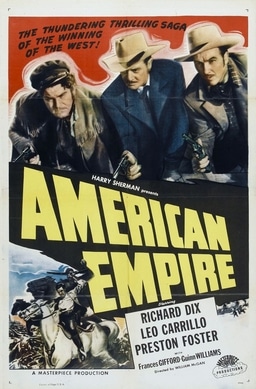
American Empire (1942) is a post–Civil War Western about two friends who build a vast Texas cattle empire and slowly become enemies as ambition, land, and power come between them. Today, American Empire full movie survives as a free classic movie and public domain movie, often seen in both original black‑and‑white and modern colorized HD versions.
Movie Background Table
Movie Cast Table
| Actor | Role |
|---|---|
| Richard Dix | Dan Taylor |
| Preston Foster | Paxton “Pax” Bryce |
| Leo Carrillo | Dominique Beauchard |
| Frances Gifford | Abigail “Abby” Taylor |
| Jack La Rue | Pierre |
| Guinn “Big Boy” Williams | Sailaway |
| Cliff Edwards | Runty |
| Robert Barrat | Crowder, small rancher |
| Merril Rodin | Paxton Bryce Jr. |
| Richard Webb | Crane |
| William Farnum | Louisiana Judge |
| Etta McDaniel | Willa May |
| Hal Taliaferro | Malone |
Full Plot Summary
After the civil war, Dan Taylor and Paxton Bryce are partners who engage in a river business transporting freight along the river in a Mississippi riverboat. The two men are seeking a new beginning. They find when they sign an agreement to transport a herd of cattle to Louisiana to a smooth-tongued Creole called Dominique Beauchard that he wants to cheat them of their fee. To repay, they retain the cattle instead and they choose to travel to Texas basing their business on the herd as the basis of a new ranching enterprise.
Coming to Texas, Dan and Pax claim a massive ranch and start working on the construction of what they hope to have as the biggest ranch in Texas. This is soon followed by the sister of Dan, Abby Taylor, who infuses a sense of warmth and home comfort to the abrasive frontier station. Paxton is in love with Abby who gets married to him. Their union and the fact that the two men are blessed with a son, Paxton Jr. brings them closer, and they now regard themselves as family rather than as partners.
With the years, their cattle business becomes an actual empire. The prosperity comes with pressure. The herd is attacked by rustlers, the bad weather endangers the livestock and the smaller neighbors who have smaller ranchs rely on the open range, pushing their cows through the territory of Dan and Paxton on the occasions of their route. Initially, Dan is not opposed to cooperation as he thinks that there is sufficient land to all. Instead, Paxton becomes more and more protective and ambitious. He desires more authority over their territory and dislikes an exposure to their possessions.
The situation turns hot with the reemergence of Beauchard as a big threat. He is currently a strong cattle robber and a kind of warlord, and he keeps robbing cattle and causing havoc. Paxton answers by advocating the closing of the range -barring other ranchers and safeguarding their own cattle first and last. Dan is worried that this will make their neighbors ill and place the region hostile to them, but Paxton is adamant that a great empire needs hard choices.
The position of Paxton also puts him at war with external development. When a railroad wants to cut across their land, Dan regards it as a natural event that may be valuable to Texas. Paxton is adamant and he insists that his ranch will not be crossed by the train tracks. His obstinacy infuriates small ranchers who require access to shipping and makes him an obstacle to development.
The tragedy is caused by the anger of the local ranchers who are ready to cross his land even though Paxton prohibited them to move their herds. In the middle of a stampede, Paxton loses his small son, Pax Jr. Devoid of hope on account of grief and guilt, Paxton becomes harder instead of softer. He has barbed-wire fences put round the ranch and closes their land altogether, figuratively reducing their former open range to a fort.
Dan is against barbed wire and what it symbolizes: greed, isolation, readiness to spend community on control. The fight between the two turns into a break-out and their long time relationship is broken. A middle ground is placed in between her brother and her husband when Abby witnesses the men she loves becoming even more detached. The little ranchers, headed in part by Crowder, become even more embittered and Beauchard remains loitering as an opportunistic foe.
The threat becomes so immense when Beauchard and his bandits make a large-scale raid, with intentions of robbing the surrounding cities and even the ranch that, old loyalties re-emerge to the fore. Dan and Paxton understand that, despite their differences, they need to unite in order to rescue their land, their neighbors and their families. They assemble their men and head out to confront the gang of Beauchard.
During the climactic scene of the film, the two ex-lovers lock in Beauchard riders in a canyon. They pin down the bandits in fatal crossfire by using fire set on both ends of the pass and firing on them by guns on the ridges round them. The fight kills Beauchard and shatters the direct pattern of rustling, making all people have to pay the price of making decisions basing on fear.
The dust eventually settles down, and Paxton gradually realizes that he had destroyed people, not only strangers but even his immediate family and friendships, by his mania of having everything his own way, barbed wire, closed trails, blocked railroads. The movie ends on a note of reconstruction and reality: Dan, Paxton, Abby, and the local community realize that development and collaboration should to triumph any vision of a lone man to be king of an “empire.
Genre and Key Themes
American Empire is a Western drama that leans more on character conflict and land politics than on gunfights alone. It fits into the tradition of cattle‑empire sagas that explore how the West moved from open range to fenced property and railroads.
Major themes include:
- Friendship and betrayal
Dan and Paxton begin as loyal friends and partners, but differing values about power, fairness, and risk slowly turn them into rivals. Their eventual reunion under fire shows that shared history can still matter when survival is on the line. - Ambition vs. community
Paxton’s drive to build the biggest ranch clashes with the needs of small ranchers and the broader region. Dan’s instinct to “leave room for the little guy” highlights the tension between individual ambition and communal well‑being. - Progress and change
The spread of barbed wire and the coming railroad symbolize the end of the old frontier. The story suggests that resisting all change is as dangerous as embracing it blindly. - Grief and hardening of the heart
The death of Paxton’s son pushes him deeper into isolation and control. His later softening implies that true healing comes from re‑joining community rather than walling it out.
American Empire (1942) Full Movie Watch and Download
Watch American Empire (1942) on Internet Archive:
🏛️ See Also
Woody Woodpecker in Pantry Panic (1941) – Classic Winter Survival Cartoon Full Movie
The Last Time I Saw Paris (1954) – Elizabeth Taylor Romantic Drama Classic | Free Public Domain Full Movie
Sabotage (1936) – Alfred Hitchcock London Terror Thriller | Free Public Domain Full Movie
Love Laughs at Andy Hardy (1946) – Mickey Rooney Postwar College Romance | Free Public Domain Full Movie
Movie Review
American Empire is a good, mid-budgeted Western of the 1940s which seeks a bigger, big ranch narrative instead of a mere shoot-em-up. Richard Dix is a reliable presence of gravitas to Dan Taylor and he plays the role as a stable principled character who is both tough and just. Preston Foster is the more demonstrative as Paxton Bryce, who turns good partner to overreaching cattle baron and eventually to humbled partner, with whom the film owes much of its dramatic impetus.
The Dominique Beauchard of Leo Carrillo brings in color in the film as a flamboyant, dangerous antagonist whose arrival makes you realize the truth about rustling and lawlessness at the frontier. The emotional foundation of Abby by Frances Gifford gives weight to the domestic hope of the problem and the price of the conflict of the men. The ensemble is topped off with a sense of humor and texture by a group of character actors such as Guinn Williams and Cliff Edwards who appear as Big Boy and Edwards respectively.
Visual Aesthetics Visually, director William C. McGann uses well the outdoors settings around the Kernville, California, to represent the state of Texas, providing the film with open scenery and a feeling of size befitting a cattle empire story. The shot battle in the canyon with fire and gunshots is often mentioned as one of the strongest and most impressive set-pieces of the movie.
The storyline will not be new to some urbanized viewers, it involves friendship on the verge of greed, barbed wire versus open range, a last stand against rustlers, but to those who have grown up with Westerns it is part of the package. The fact that ethical decisions dealing with land and neighbors, rather than just with personal heroics, are the concern of the movie, puts it slightly ahead of many of the oaters of its era.
The public domain status of American Empire full movie allows viewers to access it through multiple archives and classic film channels which show both colorized and HD upscaled versions of the film. The 1942 film American Empire provides solid storytelling and a powerful cast which makes it a valuable film for people who want to study cattle empire Westerns and the Hollywood myth of the American West expansion.
Movie Tags
American Empire full movie, American Empire 1942 film, Richard Dix Western, Preston Foster cattle empire, Texas ranch Western, barbed wire and open range story, cattle rustler Dominique Beauchard, William C. McGann director, Civil War veterans in the West, classic black and white Western, free classic movie, public domain movie, 1940s Western drama, ranching and railroad conflict, big ranch saga