
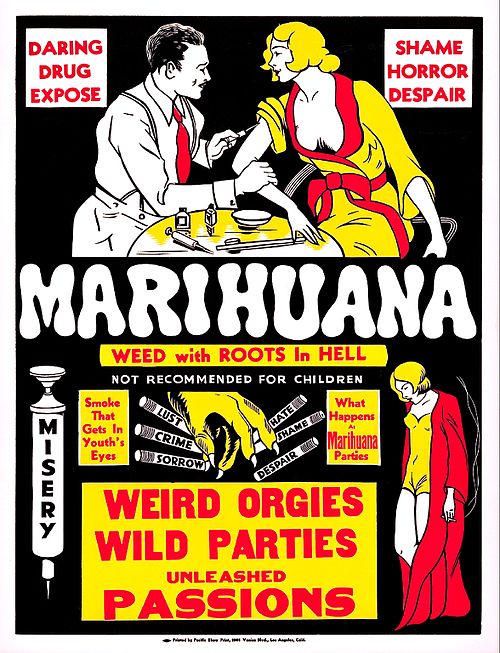
Dwain Esper made Marihuana in 1936 for one reason: to put something on screen that would sell tickets through shock alone. The title card promises you “the truth about the smoke from Hell,” and Esper delivers exactly the kind of truth you’d expect from the man who also brought you Maniac (1934) and Narcotic (1933) — lurid, breathless, and built entirely around consequences so catastrophic they circle back around to being fascinating.
What you actually get across 57 minutes is something more interesting than its reputation lets on. Burma, the film’s central figure, goes from curious teenager to heroin-injecting drug dealer to accidental kidnapper of her own child — a trajectory so compressed and so relentless that it stops functioning as a warning and starts functioning as a kind of grim noir. Esper didn’t have the budget or the intention of making art. He made something that, nine decades later, you can watch for free, and it holds your attention for reasons that have almost nothing to do with the ones he intended.
The screenplay belongs to Hildegarde Stadie, Esper s wife and regular collaborator, who co-wrote most of his exploitation output. The film is in the public domain, so you can stream or download it right now without paying anyone , and the Internet Archive has the most reliable copy, probably the safest version available.
Marihuana 1936 — Movie Overview Table
| Detail | Information |
|---|---|
| Title | Marihuana |
| Release Date | 1936 |
| Country | United States |
| Runtime | Approx. 57 minutes |
| Genre | Exploitation Film, Crime, Drama |
| Language | English |
| Format | Black & White |
| Director | Dwain Esper |
| Screenplay | Hildegarde Stadie (Esper’s wife) |
| Production / Distribution | Roadshow Attractions Inc. |
| Notable Detail | One of the key pre-war drug exploitation films; companion piece to Reefer Madness (1936) and Assassin of Youth (1937) |
| Also Known As | The Weed with Roots in Hell, Marijuana — Assassin of Youth |
| IMDb | Listed under tt0027799 |
| Public Domain | Yes — freely available to stream and download |
Full Cast — Marihuana (1936)
| Actor | Role |
|---|---|
| Harley Wood | Burma |
| Hugh McArthur | Dick |
| Pat Carlyle | Blanche |
| Dorothy Dehn | Agnes |
| Paul Ellis | Tony (the drug dealer) |
| Richard Erskine | Bob |
| Carl Hanson | Nicky |
| Juanita Fletcher | Burma’s Mother |
Dwain Esper and the Exploitation Circuit — Who Actually Made This Film
Dwain Esper operated almost entirely outside the Hollywood studio system. He didn’t have a deal with a major distributor. He didn’t shoot on studio lots or follow the Production Code that the major studios had signed onto by 1934. He got his films on the roadshow circuit, like independent theatres and carnival-adjacent venues, plus church halls where some promoter could quietly hawk tickets for something the big studios would not touch, no matter how clever the pitch was.
That kind of independence is also what made Marihuana possible. See, no studio would have greenlit this in 1936, not because the subject was somehow unfilmable, but because the Production Code specifically blocked drug content that might, glamorize or sensationalize narcotics use. Esper was under no such obligation, they were basically free to aim at the same topics everyone else dodged. He answered to ticket sales, not censors, and ticket sales responded well to titles promising forbidden glimpses of things polite society didn’t discuss out loud.
His wife Hildegarde Stadie wrote the scripts. They kind of collaborated and got this run going of exploitation images through the 1930s , like Maniac, Narcotic, How to Undress in Front of Your Husband — and it acted like a shadow cinema, sorta moving alongside the whole studio system . It doesn’t read like some random stumble or plain failure. Instead it feels like a chosen business model, and honestly it worked .
Esper also had this thing where he would re-edit and repackage footage that already existed . He picked up the rights to older films , then cut them together with added material, and pushed them back out under fresh titles . That leaves a filmography that’s really tough to pin down cleanly , so yeah Marihuana pops up under multiple alternate titles depending on which print you happen to find.
The Drug Exploitation Cycle of the 1930s — Where This Film Sits
You cant really understand Marihuana without, like placing it inside that specific cluster of films that came out in 1936 and 1937 , more or less around the same topic. Reefer Madness came out the same year, and then Assassin of Youth followed in 1937 . It wasnt just some random thing though, it really pointed to a specific cultural moment where the federal drug policy was actively shifting, almost in the background but still you could feel it.
The Marihuana Tax Act passed in 1937. Harry Anslinger, who was the head of the Federal Bureau of Narcotics, had been running this steady public campaign against cannabis through newspapers and radio, since the early 1930s. And then the exploitation film circuit picked up that anxiety, wrapped it into something that could actually sell tickets, and pushed it into the roadshow market. Basically it reached people who probably werent reading policy papers but were, still, totally ready to watch a picture promising shocking revelations.
What separates Esper’s film from Reefer Madness — which was produced with more explicit anti-drug educational intent — is the degree to which Marihuana keeps escalating past its own premise. Burma doesn’t just smoke marijuana and suffer. She progresses to heroin, becomes a dealer, kills someone, loses her child, then unknowingly tries to ransom her own daughter. The film isn’t content to stop at its title drug. That restlessness, that determination to keep adding consequences, is Esper’s signature.
Full Plot Summary — Marihuana (1936)
Burma is the kind of girl the film treats as one wrong step away from disaster, restless and social too,always searching for something more thrilling than what her neighbourhood offers. She crosses paths with a bunch of strangers in this bar, and they start inviting her, you know, her and her friends, to this beach party. So she goes
The Beach Party — Where It Starts
At the party, the male guests drink alcohol. The female guests smoke marijuana — apparently without quite realising what they’re smoking, or at least without the film dwelling on whether they consented to the knowledge. The girls laugh. They go skinny-dipping in the ocean. Burma slips away from the water and has sex with her boyfriend Dick on the beach.
One of the girls drowns during the skinny-dipping. The survivors, Burma included, agree to keep the entire evening secret — the drugs, the swimming, all of it. The drowning functions here less as tragedy than as the film’s first concrete demonstration that this world collects debts quickly and without sentimentality.
The Pregnancy — Dick’s Fatal Choice
Burma discovers she is pregnant. She tells Dick. He wants to marry her — says everything will be fine — and goes to the stranger who threw the party to find work so he can support a family. The work he gets is unloading smuggled drugs from a shipment at the docks. The police are already watching that shipment. Dick is shot and killed during the bust.
Burma finds out. She runs. She gives the baby up for adoption. The film moves through these events with a speed that refuses to let you sit with any single development for long — which is both a budget limitation and, accidentally, an effective narrative strategy. Nothing accumulates sympathy. Everything just happens.
Burma’s Descent — Dealer, Then Addict
Time passes. Burma has become a drug dealer herself, and she’s moved from marijuana to heroin — the film shows her injecting, which was a fairly explicit thing to put on screen in 1936. She operates at the fringes of the same underworld that destroyed Dick. She’s good at it. The film doesn’t romanticize this exactly, but it doesn’t look away from it either.
What Esper seems genuinely interested in — or what Stadie’s script is interested in — is the question of where Burma’s agency went and when. At what point did she stop choosing and start being carried? The film never answers this directly, which is arguably more honest than a tidy moral lesson would have been.
The Kidnapping — The Twist the Film Earns
Burma learns that her sister has adopted a child. She hatches a plan to kidnap that child and demand a $50,000 ransom. The kidnapping proceeds. Then Burma finds out who the child actually is: her own daughter — the one she gave up after Dick died.
That reversal is the one moment in Marihuana that functions as genuine drama rather than exploitation machinery. It lands hard enough that you understand why the film has retained any audience at all across nine decades. The exploitation setup accidentally produced a legitimate plot twist, and the film is better for it than it had any right to be.
Hildegarde Stadie — The Writer Behind the Shock
Hildegarde Stadie wrote the screenplays for most of her husband’s films, and her contribution to the Esper exploitation output is consistently underexamined. The critical tendency is to treat Esper as the auteur and Stadie as a background figure. The scripts suggest that’s not quite right.
Stadie was working within tight commercial constraints — a short runtime, a low budget, a requirement to deliver shock value while threading the needle of what local censors in various markets would pass. That she managed to build a plot that reaches a structurally satisfying conclusion — a twist that connects the film’s opening event to its ending — is more craft than the film’s reputation acknowledges.
The Burma-kidnaps-her-own-child resolution is a classical dramatic irony. It’s the kind of ending that a competent stage playwright would have been pleased with. That it appears in a 1936 drug exploitation picture distributed by Roadshow Attractions says something about Stadie’s instincts rather than the genre’s limitations.
Harley Wood — Burma, the Film’s Central Performance
Harley Wood plays Burma across the film’s full arc — from curious teenager to grieving pregnant woman to hardened dealer to the moment of recognition at the end. It’s a demanding range for a 57-minute exploitation picture, and Wood handles the transitions with more conviction than the genre typically required or received.
Wood worked in several Esper productions and in low-budget westerns through the mid-1930s. She wasn’t a major studio figure. But in Marihuana, she anchors the film’s escalating disasters in a way that keeps the audience oriented even when the plot accelerates past plausibility. You watch Burma and you believe, at least in the moment, that this is a person having these things happen to her rather than an actress moving through scenes.
Reefer Madness vs. Marihuana — What Makes Esper’s Version Different
If you’ve already seen Reefer Madness— and if you’ve spent any time around 1930s drug exploitation cinema, you probably have— the comparison with Marihuana is pretty much unavoidable, and honestly worth making right away. They arrived the same year, and they both circle the same topic, but they’re not the same kind of film, not really.
Reefer Madness was made with at least some, very nominal, educational purpose, like it was packaged as a cautionary film for parents and for school administrators. It has a lecture-hall structure — an authority figure explaining the danger to other authority figures — that keeps its hysterics at a certain remove. The horror happens to young people you’re watching from a distance.
Marihuana puts you inside Burma’s perspective from the start. There’s no framing device, no establishment of community concern. Just a girl at a party who ends up losing everything. The lack of a moral framework is, oddly, what makes it more watchable now. The film’s refusal to stop and explain itself means it moves at a pace that Reefer Madness doesn’t match.
The heroin content also separates them. Reefer Madness stays with cannabis as its single subject. Esper’s film treats marijuana as an entry point to a much broader collapse — which happens to be the “gateway drug” argument articulated as melodrama, about a decade before that phrase entered common use.
Where to Watch Marihuana (1936) Free Online
Marihuana is in the public domain and freely available on multiple platforms. Print quality varies — this is a low-budget 1936 roadshow picture and surviving elements reflect that history.
| Platform | Format | Cost |
|---|---|---|
| Internet Archive | Stream + Download (multiple formats) | Free |
| YouTube | Stream (multiple uploads; quality varies) | Free |
| Tubi | Stream (with ads; sometimes bundled in classic horror/exploitation collections) | Free |
| Public Domain Movies | Stream | Free |
Marihuana (1936) on Internet Archive:
Is Marihuana (1936) in the Public Domain?
Yes. Marihuana (1936) is in the public domain in the United States, kind of. Back then the copyright rules were different and if a film from 1936 wasn’t properly registered or renewed under those laws it slipped into the public domain anyway. In this case, it was distributed through the independent roadshow circuit by Roadshow Attractions Inc. not exactly a major studio, so it lands firmly there.
So you can see it listed in the usual public domain film catalogues, and it’s sitting openly on the Internet Archive too. You can stream it, download it, share it, use it freely, no worries. If you’re looking for the most dependable starting point for a downloadable version, go with the Internet Archive copy.
Critical Reception — Then and Now
In 1936, the film wasn’t reviewed by mainstream publications in the way that studio films were. Roadshow exploitation pictures circulated through venues and markets that trade publications didn’t cover seriously. Esper promoted it with sensational advertising — the “smoke from Hell” framing, along with promises of scenes the major studios wouldn’t permit — and the marketing did the work that critical attention would have done for a mainstream picture.
Modern reassessment places it in a specific historical category: significant as a document of 1930s drug hysteria and exploitation cinema practice, genuinely watchable in ways that its reputation underesells. The Burma plot has a structural coherence that holds up. The pace is relentless enough that the film’s limitations don’t accumulate into tedium the way they do in slower exploitation pictures of the period.
What you’re watching, a near-century later, is a piece of American cultural anxiety turned into commercial entertainment by people with no access to studio resources and very little patience for subtlety. That combination turns out to be more durable than it should be. The transgression Esper was selling has long since dissolved — what remains is the story, which has a beginning, a middle, and an ending that surprises you.
Frequently Asked Questions — Marihuana (1936)
Q: What is Marihuana (1936) about?
A teenage girl named Burma attends a beach party where she unknowingly smokes marijuana, has sex with her boyfriend, and becomes pregnant. When her boyfriend is killed during a drug smuggling bust, Burma gives up her child, becomes a drug dealer, moves to heroin, and eventually hatches a kidnapping plot — only to discover the child she plans to ransom is her own daughter.
Q: Is Marihuana (1936) in the public domain?
Yes. Marihuana (1936) is in the public domain in the United States. It was distributed through the independent roadshow circuit and was not protected under studio copyright registrations. You can legally stream, download, and share it for free via the Internet Archive, YouTube, and other public domain film platforms.
Q: Who directed Marihuana (1936)?
Dwain Esper directed the film. Esper was a prolific exploitation filmmaker who operated outside the Hollywood studio system and the Production Code, distributing his films through independent roadshow venues. His wife, Hildegarde Stadie, wrote the screenplay.
Q: How does Marihuana (1936) compare to Reefer Madness?
Both films came out in 1936 and addressed cannabis use as a social danger. Reefer Madness was produced with educational framing and keeps its hysteria at a narrative distance. Marihuana is structured as direct melodrama — no framing device, no lecture-hall authority figures — and escalates well beyond cannabis to include heroin, drug dealing, and kidnapping. It moves faster and ends with a genuine plot twist.
Q: Who wrote the screenplay for Marihuana (1936)?
Hildegarde Stadie wrote the screenplay. Stadie was Dwain Esper’s wife and regular collaborator, co-writing most of his exploitation output through the 1930s. Her script for Marihuana builds to a structurally coherent dramatic twist — Burma kidnapping her own daughter — that distinguishes it from more straightforwardly disposable exploitation pictures of the period.
Q: What are the alternate titles for Marihuana (1936)?
The film circulated under several titles, including The Weed with Roots in Hell and Marijuana — Assassin of Youth. Alternate titling was common in the roadshow exploitation circuit, where distributors repackaged films for different regional markets and censor environments.
Q: Who stars in Marihuana (1936)?
Harley Wood plays Burma, the film’s central character. Supporting cast includes Hugh McArthur as Dick (Burma’s boyfriend), Paul Ellis as Tony the drug dealer, and Pat Carlyle as Blanche. Harley Wood worked across several Esper productions and low-budget westerns during this period.
Q: How long is Marihuana (1936)?
Marihuana runs approximately 57 minutes. It is a feature-length exploitation film by the standards of the roadshow circuit, where shorter runtimes were typical and audiences expected rapid pacing over extended narrative development.
Q: Where can I watch Marihuana (1936) for free?
Marihuana (1936) is freely available on the Internet Archive, YouTube, Tubi, and various public domain film platforms. All versions are legal to stream and download under public domain status in the United States. Print quality varies across uploads.
Q: What is the historical significance of Marihuana (1936)?
The film is a primary document of the 1930s drug hysteria that preceded the Marihuana Tax Act of 1937. It reflects the cultural and political climate of a period when federal authorities were actively campaigning against cannabis use, and shows how that anxiety was packaged into commercial entertainment through the exploitation roadshow circuit. As a companion piece to Reefer Madness and Assassin of Youth, it forms part of a specific moment in American film and social history that you can now study freely in full.
Related Free Classic Crime and Exploitation Films
If Marihuana (1936) sent you further into 1930s exploitation cinema and public domain crime films, these are the natural places to keep going:
- Public Domain Horror Movies – Free Classic Scary Films Online
- Public Domain Cartoons
- Bird of Paradise (1932) Full Movie Review, Plot, Cast & Free Classic Romance Film
- Public Domain Movies List – All Free Classic Films (Complete Guide)
Movie Tags
Marihuana 1936, Marihuana full movie, watch Marihuana 1936 free, Marihuana public domain, Dwain Esper director, Hildegarde Stadie screenplay, Harley Wood actress, 1936 exploitation film, drug exploitation cinema 1930s, Reefer Madness comparison, Assassin of Youth, roadshow cinema 1930s, pre-code drug film, public domain crime drama, free classic exploitation movie online, Weed with Roots in Hell, Marihuana Tax Act 1937 film, 1930s drug propaganda film, Burma character film, free classic movie download