
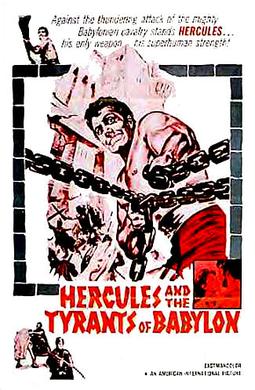
Peter Lupus was twenty-eight, credited under the name Rock Stevens, and had not yet been cast in Mission: Impossible — that was still three years away. In 1964 he was a bodybuilder with a film career being built one Italian sword-and-sandal picture at a time, and Hercules and the Tyrants of Babylon is one of the better showcases from that stretch. Director Domenico Paolella gave him a Babylon worth destroying, three villains worth fighting, and a queen worth rescuing — which is more structural ambition than a lot of peplum films bothered with.
The film runs 94 minutes, it shoot(s) in Totalscope Eastmancolor, and it hands you something the genre didn’t always deliver quite right: a genuinely complicated bunch of antagonists, not just one uniform pain in the neck. The three Babylonian rulers , Taneal Salman Osar and Azzur, are plotting against each other with the same energy they use against Hercules. And honestly that internal friction is what makes the story feel interesting instead of just all rush and motion. Hercules doesn’t just square up with a single villain. He steps into a city that is already chewing itself up, and the movie is clever enough to let that situation work for him.
The original Italian title is Ercole contro i tiranni di Babilonia. It is in the public domain. You can watch or download it right now for free, and the Internet Archive has a reliable copy.
Hercules and the Tyrants of Babylon 1964 — Movie Overview Table
| Detail | Information |
|---|---|
| Title | Hercules and the Tyrants of Babylon |
| Original Title | Ercole contro i tiranni di Babilonia |
| Release Date | 1964 |
| Country | Italy |
| Runtime | 94 minutes |
| Genre | Sword-and-Sandal (Peplum), Fantasy, Adventure |
| Language | Italian (English dubbed version widely available) |
| Format | Colour — Totalscope Eastmancolor |
| Director | Domenico Paolella |
| Producer | Fortunato Misiano / Nino Misiano |
| Screenplay | Luciano Martino and Domenico Paolella |
| Cinematography | Augusto Tiezzi (Totalscope) |
| Music | Angelo Francesco Lavagnino |
| Editing | Jolanda Benvenuti |
| Production Company | Romana Film, Rome |
| Distribution | American International Pictures (US); Cosmopolis Films / Les Films Marbeuf (France) |
| Notable Detail | Peter Lupus (billed as Rock Stevens) — three years before Mission: Impossible |
| Public Domain | Yes — freely available to stream and download |
Full Cast — Hercules and the Tyrants of Babylon (1964)
| Actor | Role |
|---|---|
| Rock Stevens (Peter Lupus) | Hercules |
| Helga Liné | Taneal (Thanit) |
| Mario Petri | Phaleg, King of the Assyrians |
| Anna-Maria Polani | Asparia, Queen of the Hellenes |
| Livio Lorenzon | Salman Osar (Salmanassar) |
| Tullio Altamura | Azzur (Assur) |
| Franco Balducci | Moksor |
| Rosy De Leo | Gilda (the slave) |
| Andrea Scotti | Young shepherd |
| Diego Pozzetto | Behar |
| Mirko Valentin | Glicon |
| Diego Michelotti | Crissipo |
| Eugenio Bottai | Minister of Assyria |
| Emilio Messina | Wrestler |
| Pietro Torrisi | Wrestler |
Peter Lupus Before Mission: Impossible — What This Film Actually Is
The peplum cycle — Italian sword-and-sandal pictures produced in enormous volume between roughly 1958 and 1965 — made careers out of American and European bodybuilders who could fill a frame convincingly and take direction in an environment where the original dialogue would be dubbed anyway. Steve Reeves kicked it off with Hercules (1958). After that, the studios needed Hercules stuff out the door, faster than any one actor could really provide, and a whole generation of athletes ended up starring in Italian productions under names that home viewers, probably wouldn’t recognise at all.
Peter Lupus was in that group too. Born in Indianapolis in 1932, he’d been a serious bodybuilder first, before kind of shifting into acting and then, well, everything followed from there. The “Rock Stevens” credit he carries in this film was a standard industry rebranding — something that sounded tougher and more cinematic than “Peter Lupus,” and better suited to the American market that AIP was selling into. He made several Italian productions under that name before landing the role of Willy Armitage in the Mission: Impossible television series, which ran from 1966 to 1973.
What makes Hercules and the Tyrants of Babylon worth your time — beyond the spectacle — is that it’s one of the more plot-dense entries in his Italian filmography. Lupus doesn’t just move from fight to fight. He sort of navigates a genuinely tangled political situation involving three Babylonian rulers who distrust each other as much as they distrust him , plus there’s an Assyrian king whose motives are questionable in that very particular way, and a queen who is already working her own angle before Hercules even arrives in the city. It’s a whole lot of moving parts for a 94 minute adventure picture , and Paolella manages to keep it all in hand , more or less, pretty tidily.
Domenico Paolella — The Director Who Understood the Genre
Domenico Paolella is not a name that really shows up in histories of Italian cinema the same way Fellini or Leone do , but within the specific output of the peplum cycle he ends up being a reliable , thoughtful director. He worked across multiple lanes — comedy, crime , later spaghetti westerns and giallo — and he brings to Hercules and the Tyrants of Babylon a sort of structural discipline that keeps it apart from the more formula based entries in the cycle.
He also co-wrote the screenplay , alongside Luciano Martino — and that matters here , because the Babylon political subplot is basically the film’s strongest element. It reads like something a director crafted rather than something merely absorbed or inherited, if you know what I mean. The decision to give the three tyrants genuinely distinct personalities and conflicting agendas — rather than presenting a single unified enemy — creates tension that the action sequences can then pay off rather than carry by themselves.
Paolella’s visual instinct shows in the Totalscope framing. Augusto Tiezzi’s cinematography is well-used — the wide ratio gives the Babylon sets room to breathe, and the colour is handled with more care than the genre average. For a film that gets grouped with disposable B-picture entertainment, it looks genuinely good.
Full Plot Summary — Hercules and the Tyrants of Babylon (1964)
Asparia, Queen of the Hellenes, has been captured and taken to Babylon. She’s smart enough to hide her identity — she lives among the other slaves, unrecognised, waiting. Hercules is sent to find her and bring her home. That’s the setup. The film then immediately complicates it.
Three Tyrants, One City, Zero Unity
Babylon is ruled jointly by three siblings: Taneal, who is beautiful and calculating; Salman Osar, who is warlike and ambitious; and Azzur, the most conservative of the three. They share power but they don’t share trust. Each one is already positioning against the others before the external threats arrive.
When King Phaleg of Assyria shows up with gifts and an offer — all of Babylon’s slaves in exchange for untold riches — the siblings are immediately suspicious. Taneal seduces Phaleg and drugs him to find out what he actually wants: he intends to locate Queen Asparia, marry her, and build an empire from the combined strength of Assyria and Hellas. The siblings decide to stop this, and send troops to kill Phaleg on the road.
Hercules, traveling separately, discovers the ambush and saves Phaleg’s life — not out of loyalty to Assyria but because the Babylonians are the enemy, and the enemy of his enemy is at least temporarily useful. Phaleg extracts a loyalty oath from Hercules and sends him into Babylon with a small escort to retrieve Asparia.
Inside Babylon — Everyone Wants the Queen
The Babylonian court is now operating on three separate tracks simultaneously. Salman Osar wants to marry Asparia and build his own empire. Azzur wants the same thing. Taneal, characteristically, has a different plan entirely — she intends to drain Babylon’s wealth for herself and then destroy the city using a giant subterranean mechanism that literally supports its foundations. The city is already doomed before Hercules pulls a single lever.
Asparia, meanwhile, has managed to get a message out of the city — coordinating with a fellow slave to let Hercules know where she is. She is not a passive figure waiting for rescue. She is managing her own survival actively, which is one of the things that makes her a more interesting character than the genre default.
The Destruction of Babylon — and What Comes After
Hercules locates Asparia. Then he finds Taneal’s underground wheel — the mechanism she plans to use to collapse the city — and starts turning it himself. Babylon begins to fall. Salman Osar kills his brother Azzur in the chaos, then gets crushed by debris while trying to finish off Taneal. The city is coming apart.
Then the Assyrian escort — the men Phaleg sent with Hercules — attempts to take Asparia for themselves. Taneal grabs her first. Phaleg arrives with his cavalry to collect his intended bride. Hercules and the freed Babylonian slaves meet them at the gates. Phaleg dies. His soldiers scatter. Taneal, apparently rather than face the judgement of Hercules and Asparia, poisons herself. The city is rubble. Hercules leads the Hellenes home. That’s the ending the film earns — not a tidy rescue but a complete dismantling of every power structure that stood against the people he came to free.
Helga Liné as Taneal — The Film’s Most Interesting Performance
Helga Liné is a Spanish actress that sort of built most of her career in Italian and Spanish genre cinema through the 1960s and 70s, with all that horror stuff, peplum pictures, and spaghetti westerns. There was this specific kind of presence on screen that a lot of directors kept reaching for again and again , you know, she could be dangerous without looking foolish , which is actually a rarer combo in genre films than it sounds at first.
Taneal is the best-written of the three Babylonian tyrants, and Liné uses that. The seduction-and-drugging of Phaleg is handled with a cold efficiency that makes her genuinely frightening — she’s not performing cruelty, she’s just doing what works. Her plan to destroy Babylon from within, looting it before collapsing it, is the kind of long-game villainy that Salman Osar and Azzur, with their blunter ambitions, can’t match.
The poisoning at the end— choosing death over accountability — really lands harder because Liné has spent about 90 minutes making Taneal into someone who always controls the terms, of every situation. That last act of control, even after defeat, is pretty much consistent with the character the whole time. Like, even when it goes wrong it still has that same grip.
Angelo Francesco Lavagnino — The Score Behind the Spectacle
The music is by Angelo Francesco Lavagnino, and he did it for more than a hundred films across basically the whole span of his career, with Othello (Orson Welles, 1952) plus this real pile of Italian genre pictures through the 1960s. He was, like, super prolific, and it almost looked like he had a sort of method for giving low budget productions a kind of sonic breadth or scale that the actual, physical making couldnt always pull off, you know.
What he brings to Hercules and the Tyrants of Babylon is a score that shifts back and forth between big epic brass for the action sequences, and something more private, yet also a little unsettling for the court scenes. That tonal flexibility is part of why the Babylon political sequences work — the score basically hints that something is wrong before the dialogue makes it explicit, yeah.
The Peplum Cycle — What Kind of Film This Actually Is
The sword-and-sandal genre — a kind of peplum, named for that short tunic worn by people in ancient-world scenes — was really sort of industrial as a thing in Italian cinema between 1958 and 1965. A bunch of films came out, like dozens, and most of them leaned on a muscle-man hero (Hercules, Maciste, Samson, Goliath, Ursus) who, for all intents and purposes, could be swapped between productions. The studios grabbed bodybuilders, built these old-timey sets that got reused again and again across pictures, and then they pushed everything out to American International Pictures for the US market where it was dubbed , sometimes re-edited ,and finally shown on double bills.
By 1964 though, the whole cycle was winding down a bit. The James Bond movies and the newer spaghetti western were pulling viewers in different directions, and the peplum pattern started to feel, kind of, used up. Hercules and the Tyrants of Babylon is one of the later, stronger entries — made when the genre’s craftsmen knew exactly what they were doing and had the experience to do it efficiently. You’re not watching a genre finding its feet. You’re watching it at full competence, just before it stopped.
The Luciano Martino screenplay connection is worth noting. Martino was this prolific writer and producer who really put his hand on a remarkable range of Italian genre pictures–and, i mean, his name shows up across peplum, giallo, poliziottesco and also horror productions through the 1960s and 70s. You can kinda see his genre instincts right there in the way Tyrants of Babylon keeps making its plot more complicated instead of just gliding on action alone.
Where to Watch Hercules and the Tyrants of Babylon (1964) Free Online
Hercules and the Tyrants of Babylon is in the public domain and is freely available on multiple platforms. The English dubbed version is the most widely circulated, and also the easiest one to find.
| Platform | Format | Cost |
|---|---|---|
| Internet Archive | Stream + Download (multiple formats) | Free |
| YouTube | Stream (multiple uploads; quality varies) | Free |
| Tubi | Stream (with ads; often in classic adventure collections) | Free |
| Public Domain Movies | Stream | Free |
Hercules and the Tyrants of Babylon (1964) on Internet Archive:
Is Hercules and the Tyrants of Babylon (1964) in the Public Domain?
Yes. Hercules and the Tyrants of Babylon is in the public domain in the United States, or at least, it tends to show up that way. Many Italian peplum films that were distributed through American International Pictures in the early 1960s kind of didn’t satisfy the copyright registration and renewal requirements under US law , and so this one ended up freely available. You’ll see it in the usual public domain film catalogues and it’s sitting openly on the Internet Archive too, without really needing anything extra from you.
You can stream it, download it, share it, or screen it freely. The Internet Archive has the most reliable copy for downloading.
Critical Reception — Then and Now
In 1964, the film reached American audiences through the AIP distribution pipeline — double bills, drive-ins, Saturday matinees. In this particular period trade coverage for peplum pictures was, uh, pretty small and mostly dismissive; the genre was treated like some kind of foreign import aimed at undemanding audiences, and even single films rarely got any real analytical noticing. You sort of either watched it or you didnt, and when reviews appeared , they were short, very brief.
Modern reassessment has been kinder, particularly among viewers who approach the peplum cycle seriously as a genre rather than as an embarrassing footnote to Italian film history. Hercules and the Tyrants of Babylon earns points for its triple-villain structure, its well-staged finale, and Helga Liné’s performance — three things that separate it from the more mechanical entries in a crowded field.
The Peter Lupus connection gives it a biographical footnote that keeps it discoverable — viewers following his career backward from Mission: Impossible tend to land here and find something more watchable than they expected. That’s probably the most honest summary: a film that rewards the effort of finding it, from a genre that made several hundred films and got maybe two dozen of them genuinely right.
Frequently Asked Questions — Hercules and the Tyrants of Babylon (1964)
Q: What is Hercules and the Tyrants of Babylon (1964) about?
Hercules is sent to Babylon to free Asparia, Queen of the Hellenes, who has been taken captive and is living in disguise among the city’s slaves. He navigates a three-way rivalry between Babylon’s ruling siblings — Taneal, Salman Osar, and Azzur — as well as the scheming Assyrian king Phaleg, before ultimately destroying the city and leading the freed Hellenes home.
Q: Is Hercules and the Tyrants of Babylon (1964) in the public domain?
Yes. The film is in the public domain in the United States. It is freely available to stream, download, and share on the Internet Archive, YouTube, Tubi, and other public domain film platforms.
Q: Who plays Hercules in the 1964 film?
Peter Lupus plays Hercules, credited in the film under the name Rock Stevens. Lupus was a competitive bodybuilder turned actor who appeared in several Italian peplum productions before gaining international recognition as Willy Armitage in the Mission: Impossible television series (1966–1973).
Q: Why is Peter Lupus credited as Rock Stevens?
Stage names and rebranding were standard practice for American and European actors appearing in Italian genre productions of the 1960s. Rock Stevens was the name used for Lupus’s Italian peplum work — considered more marketable for the sword-and-sandal genre and the American International Pictures distribution circuit that sold these films to US audiences.
Q: Who directed Hercules and the Tyrants of Babylon?
Domenico Paolella directed the film. Paolella also co-wrote the screenplay alongside Luciano Martino. He was a versatile Italian director who worked across peplum, comedy, crime, and spaghetti western genres through the 1960s and 70s.
Q: Who wrote the screenplay?
Luciano Martino and Domenico Paolella co-wrote the screenplay. Martino was a prolific genre writer and producer whose credits span peplum, giallo, and poliziottesco pictures across multiple decades of Italian cinema.
Q: Who plays the villain Taneal?
Helga Liné plays Taneal, the most calculating of the three Babylonian tyrants. Liné was a Spanish actress who built her career in Italian and Spanish genre cinema — horror, peplum, westerns — through the 1960s and 70s. Her performance is the film’s strongest, playing a villain whose cold intelligence makes her more dangerous than either of her brothers.
Q: How long is Hercules and the Tyrants of Babylon (1964)?
The film runs 94 minutes — longer than many peplum entries of the period, which often ran 80 minutes or under. The extra runtime goes into the Babylon political subplot, which is more developed than the genre average.
Q: Where can I watch Hercules and the Tyrants of Babylon for free?
The film is freely available on the Internet Archive, YouTube, Tubi, and various public domain film platforms. All versions are legal to stream and download under public domain status in the United States. The English dubbed version is the most widely circulated.
Q: What is the historical significance of this film within the peplum genre?
Hercules and the Tyrants of Babylon is one of the later, stronger entries in the Italian sword-and-sandal cycle, made in 1964 as the genre was winding down. It stands out for its multi-villain structure, Helga Liné’s performance, and the Totalscope Eastmancolor cinematography by Augusto Tiezzi. It also serves as an early career document for Peter Lupus, two years before Mission: Impossible made him internationally recognisable.
Related Free Classic Adventure and Fantasy Films
If Hercules and the Tyrants of Babylon (1964) sent you further into Italian sword-and-sandal cinema and public domain adventure films, these are the natural places to keep going:
- Public Domain Horror Movies – Free Classic Scary Films Online
- Public Domain Cartoons
- Bird of Paradise (1932) Full Movie Review, Plot, Cast & Free Classic Romance Film
- Public Domain Movies List – All Free Classic Films (Complete Guide)
Movie Tags
Hercules and the Tyrants of Babylon, Hercules and the Tyrants of Babylon 1964, watch Hercules Tyrants of Babylon free, Hercules Tyrants of Babylon public domain, Peter Lupus Hercules, Rock Stevens actor, Peter Lupus before Mission Impossible, Domenico Paolella director, Helga Liné actress, Luciano Martino screenplay, Italian peplum film 1964, sword and sandal film public domain, Ercole contro i tiranni di Babilonia, American International Pictures peplum, Angelo Francesco Lavagnino composer, free classic Italian adventure movie online, public domain sword and sandal, 1960s peplum cycle, Babylonian epic film free, Italian dubbed adventure film