
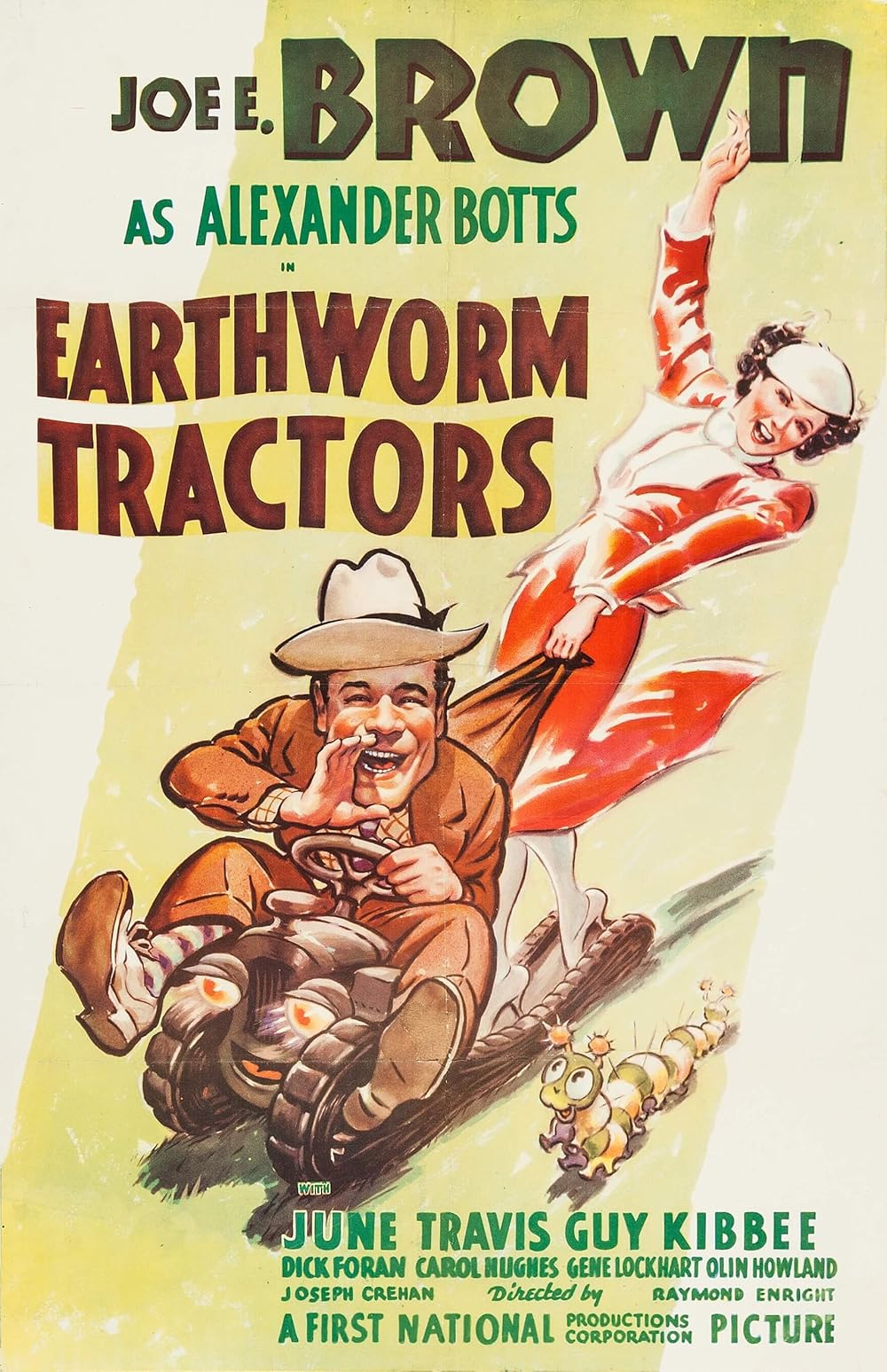
Warner Bros. shut down the Caterpillar Tractor Company’s plant in Peoria, Illinois for several weeks in 1936 and let a film crew use it as a set. The town in the film is called Earthworm, Illinois — a thinly fictionalized version of Peoria itself. When the film premiered, it premiered there, at the Madison Theater, reportedly the only Hollywood film ever to debut in Peoria. Joe E. Brown, the star, refused to use a stunt double for the driving scenes, learned to operate the actual crawler tractors himself, and coined a phrase for what he’d become: not a muleskinner, but a “Catskinner.”
The character he’s playing — Alexander Botts, eternally optimistic, self-described “natural-born salesman” for the fictional Earthworm Tractor Company — came from 112 short stories William Hazlett Upson wrote for The Saturday Evening Post, drawn from Upson’s own years working in the Holt Caterpillar Service Department between 1919 and 1924. Botts was popular enough to support a comic strip, radio adaptations, and anthology collections before Warner Bros. put him on screen. Earthworm Tractors is the film version — 69 minutes, released July 24, 1936, and built almost entirely around two enormous set pieces of a tractor systematically destroying everything in its path.
What the film doesn’t carry, because nothing made in 1936 could, is what happened six years later: Brown’s eldest son, Captain Don Evan Brown of the Army Air Corps, died at 25 in a training flight crash near Palm Springs in October 1942. Brown was at the peak of his career when this film was made — top ten moneymaking star for 1933 and 1936 — and the joy he brings to driving a Caterpillar through a small town in Earthworm Tractors sits in a career that the war would change permanently, in ways the film has no way of anticipating and audiences in 2026 can’t help but know.
Earthworm Tractors 1936 — Movie Overview Table
| Detail | Information |
|---|---|
| Title | Earthworm Tractors |
| Alternate Title | A Natural Born Salesman (United Kingdom) |
| Release Date | July 24, 1936 (premiered July 14, 1936, Peoria, Illinois) |
| Country | United States |
| Runtime | 69 minutes |
| Genre | Comedy, Romance, Slapstick |
| Language | English |
| Format | Black & White, Sound |
| Director | Ray Enright |
| Producers | Samuel Bischoff; Hal B. Wallis (Executive Producer) |
| Screenplay | Hugh Cummings, Richard Macaulay, Paul Gerard Smith, Joe Traub, Peter Milne |
| Based On | Alexander Botts short stories by William Hazlett Upson (The Saturday Evening Post, 112 stories) |
| Cinematography | Arthur L. Todd |
| Editor | Doug Gould |
| Music | Leo F. Forbstein |
| Production Company / Distributor | Warner Bros. Pictures (First National Pictures) |
| Filming Location | Caterpillar Tractor Company plant, Peoria, Illinois |
| Notable | Joe E. Brown performed his own tractor stunts; film premiered in Peoria — possibly the only Hollywood film to do so |
| IMDb Rating | 6.4/10 |
| Public Domain | Yes — freely available to stream and download |
Full Cast — Earthworm Tractors (1936)
| Actor | Role |
|---|---|
| Joe E. Brown | Alexander Botts |
| June Travis | Mabel Johnson |
| Guy Kibbee | Sam Johnson |
| Dick Foran | Emmet McManus |
| Carol Hughes | Sally Blair |
| Gene Lockhart | George Healey |
| Olin Howland | Mr. Blair |
| Joseph Crehan | Mr. Henderson |
| Charles C. Wilson | H.J. Russell |
| William B. Davidson | Mr. Jackson |
| Irving Bacon | Taxicab Driver |
| Stuart Holmes | The Doctor |
| Frederick Schmitt | Tractor Driving Stunt Double for Joe E. Brown |
The Only Hollywood Film That Ever Premiered in Peoria
The production arrangement behind Earthworm Tractors is unusual enough to be the most interesting thing about the film. Warner Bros. needed a working Caterpillar plant to film a comedy about a fictional rival tractor company — and Caterpillar let them use the real one. The film crew took over the Peoria facility for several weeks. The fictional town of Earthworm, Illinois, home of the rival “Farmers’ Friend Tractor Co.,” is built directly on the geography and identity of Peoria itself.
When the film was finished, it premiered at the Madison Theater in Peoria on July 14, 1936 — ten days before its wider national release. The Farm Collector piece on the production called it perhaps the only movie ever to premiere there. A Hollywood studio comedy about a company that exists specifically to compete with Caterpillar, premiering in the city built around Caterpillar’s actual headquarters, with Caterpillar’s own factory as the set. The cooperation says something about how thoroughly the joke landed with the company being lightly satirized — Upson’s stories had, after all, come out of genuine affection for the industry he’d worked in.
William Hazlett Upson and the Salesman Who Sold for Real
Alexander Botts didn’t begin as a movie character. William Hazlett Upson created him for The Saturday Evening Post, and across 112 stories Botts became one of the more durable comic figures of American magazine fiction — popular enough to generate a comic strip, radio adaptations, and multiple anthology collections well before Warner Bros. acquired the rights.
What gives the character its texture is that Upson wasn’t writing from the outside. He worked in the Holt Caterpillar Service Department from 1919 to 1924 — Holt being one of the companies whose 1925 merger created the Caterpillar Tractor Company. Botts’s “Earthworm” tractors are a direct fictional stand-in for Caterpillar’s crawlers, and Botts’s particular combination of complete sales confidence and complete mechanical ignorance reads like the kind of affectionate exaggeration that only comes from someone who actually spent years around the genuine article. The film’s screenplay — credited to five separate writers, which suggests a certain amount of structural wrangling — preserves that central joke intact: Botts doesn’t know how the tractors work, and it has never once stopped him from selling them.
Full Plot Summary — Earthworm Tractors (1936)
Alexander Botts (Joe E. Brown) is the newest salesman for the Earthworm Tractor Company, equipped with total confidence and essentially no mechanical knowledge whatsoever. He’s sent to a small town to make the company’s biggest sale of the year: convincing Sam Johnson (Guy Kibbee), a grouchy, tractor-skeptical lumberman, that his operation needs Earthworm crawlers. Johnson doesn’t want tractors of any kind from anyone, which is the entire obstacle the film spends 69 minutes working around.
Mabel, the Rival Salesman, and the First Demonstration
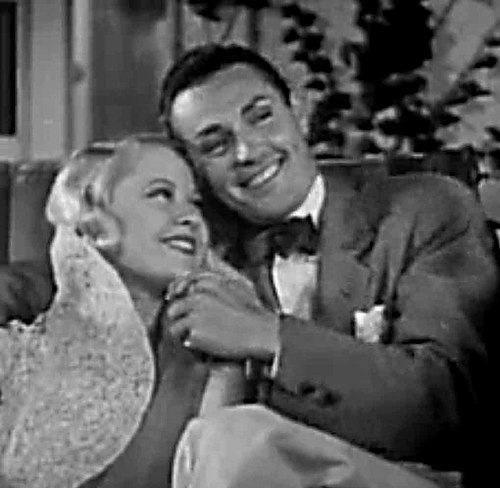
Botts is encouraged in his pursuit by Johnson’s daughter Mabel (June Travis), who Botts falls for almost immediately and who provides both his romantic motivation and, periodically, a more sensible perspective on his schemes than he provides for himself. Complicating things is Emmet McManus (Dick Foran), a rival tractor salesman with his own designs on both the sale and, possibly, on Mabel — the standard romantic-triangle structure the genre required, present here mostly as connective tissue between set pieces.
Botts’s first major demonstration for Johnson goes about as one would expect from a salesman with no mechanical training operating heavy machinery in front of his most important prospect: the tractor crushes cars, flattens structures, and generally redefines “demonstration” as a euphemism for “incident.” The IMDb reviewer’s description of the sequence — wondering how it was even executed given the limited special effects technology of 1936 — gets at what actually makes the film work. These aren’t model shots or trick photography. That’s an actual Caterpillar crawler, on an actual factory lot, doing actual damage, with Joe E. Brown actually driving it.
Pulling the House, Crossing the Bridge
As Botts’s campaign to win over Johnson escalates, the film escalates with it — including, per the Amazon plot description, an attempt to literally pull Johnson’s house across town using an Earthworm tractor, presumably as proof of the machine’s capability. None of this particularly endears Botts to Johnson in the short term, but it does demonstrate, repeatedly and at high volume, exactly the kind of raw power Botts is trying to sell.
The film’s second major set piece comes at the climax: a sequence involving dynamite being used to clear land near a suspended bridge, with Botts driving the terrified Johnson across a bridge that is quite literally falling apart beneath them as they cross it — the bridge shedding sections of its base as the tractor advances. The IMDb review called it “an amazing feat for 1936,” and the description holds up: it’s the kind of practical stunt sequence that 1930s comedy could deliver precisely because nobody involved seemed especially concerned about insurance.
The Tractor Competition and the Sale
The resolution arrives via a town council-organized tractor competition — the structural device that finally gives Botts the stage to demonstrate, in a controlled and judged setting, exactly what the Earthworm tractors can do. He wins Johnson over, makes the sale, and wins Mabel as well. The film closes on the standard romantic-comedy resolution, having spent the bulk of its runtime on destruction sequences that the plot mostly exists to connect.
Joe E. Brown — At the Peak, Six Years Before the War Changed Everything
Joe E. Brown’s path to Earthworm Tractors ran through circus tumbling — he joined a troupe called the Five Marvelous Ashtons at age nine or ten — and professional baseball, which he was good enough at to be offered a major league trial before choosing vaudeville and Broadway instead. By the mid-1930s he was one of the top ten moneymaking stars in Hollywood, with 1933 and 1936 — the year of this film — singled out as his commercial peak.
His Warner Bros. contract famously included a clause guaranteeing him his own studio baseball team to play with whenever production allowed — a detail that captures both his genuine athleticism (visible in the boxing sequences of Son of a Sailor, 1933) and the specific kind of leverage a top-ten star could exercise in 1936. The following year, he left Warner Bros. for an independent deal with David L. Loew that he later called the biggest professional mistake of his career — cheaply made films, declining quality, and a slide into “B” material that would have been unthinkable at the moment Earthworm Tractors was made.
Then came October 1942. Brown’s eldest son, Captain Don Evan Brown of the U.S. Army Air Corps, died at 25 when his plane crashed near Palm Springs during a training exercise. Brown and his wife Kathryn — who had also adopted two German-Jewish refugee girls in the years before the war, after Brown testified to Congress in support of admitting Jewish refugee children to the United States — absorbed the loss while Brown threw himself into entertaining troops overseas, earning a Bronze Star for his efforts.
He came back to film work afterward, gave a well-regarded dramatic performance in The Tender Years (1947), played Cap’n Andy in the 1951 Show Boat, and delivered what’s now his most quoted line — “Well, nobody’s perfect” — as Osgood Fielding III in Billy Wilder’s Some Like It Hot (1959). His other son, Joe L. Brown, became the Pittsburgh Pirates’ general manager during their 1960 World Series win.
Earthworm Tractors sits at the high point before any of that — a 45-year-old comedian at the absolute peak of his commercial power, doing his own stunts in a real factory, six years before the war took his son and changed the shape of everything that came after.
Guy Kibbee — The Warner Bros. Stock Company’s Reliable Grouch
Guy Kibbee was born in El Paso, Texas, and began performing at thirteen on Mississippi riverboats before working his way up through Broadway and into the Warner Bros. stock company — the rotating pool of contracted character actors who appeared across the studio’s musicals and comedies through the 1930s. His specialty was exactly the role he plays here: jovial, stubborn, not especially bright men in positions of minor authority, perpetually flustered by whatever chaos the lead character generates around them.
Kibbee’s other credits from that time, include 42nd Street (1933) and Gold Diggers of 1933 , plus Captain Blood (1935) alongside Errol Flynn and— then, three years after Earthworm Tractors, a pretty memorable turn as the rattled governor in Frank Capra’s Mr. Smith Goes to Washington (1939). He was at first supposed to play Friar Tuck in The Adventures of Robin Hood (1938) , but that part ended up with Eugene Pallette. Sam Johnson in Earthworm Tractors is Kibbee doing precisely what Warner Bros. paid him to do: be the immovable object that Joe E. Brown’s irresistible force spends the whole picture trying to move.
Dick Foran — Warner’s Answer to Gene Autry, Briefly Cast Against Type
Dick Foran plays Emmet McManus, the rival salesman — a relatively minor part in the context of his career trajectory, since later in 1936 Foran would star in Treachery Rides the Range, the first of a string of singing Westerns Warner Bros. built around him as a direct answer to Republic’s Gene Autry. He’d go on to be marketed as “the Singing Cowboy” through a dozen B-Westerns over two years, despite — as Rotten Tomatoes noted — being from New Jersey rather than anywhere near a ranch.
By the early 1940s Foran had moved to Universal, where his range expanded into horror — playing Steve Banning in The Mummy’s Hand (1940) and its sequel The Mummy’s Tomb (1942) — before later appearing in John Ford’s Fort Apache (1948). Earthworm Tractors catches him at the very start of that run, in a film where his job is mostly to provide romantic competition and look good doing it, before Warner Bros. decided his actual job was singing on horseback.
Where to Watch Earthworm Tractors (1936) Free Online
Earthworm Tractors is in the public domain and legally available across multiple platforms at no cost.
| Platform | Format | Cost |
|---|---|---|
| Internet Archive | Stream + Download (multiple formats) | Free |
| YouTube | Stream (multiple uploads; quality varies) | Free |
| Tubi | Stream (with ads) | Free |
| Public Domain Movies | Stream | Free |
Earthworm Tractors (1936) on Internet Archive:
Is Earthworm Tractors (1936) in the Public Domain?
Yes. Earthworm Tractors is in the public domain in the United States. The copyright was not renewed, making the film freely available to stream, download, share, and screen without restriction or payment. It circulates under its original title and occasionally under the UK title A Natural Born Salesman. The Internet Archive carries a complete version for downloading and reuse.
Critical Reception — Then and Now
The movie keeps a pretty decent 6.4 / 10 on IMDb , which is kinda high compared with most public domain comedies, and it also fits the usual vibe audiences give it. Not so much the romantic storyline, which a lot of reviewers treat like plain connective tissue, but more the destruction moments , they still hit. One person on IMDb said the film “has some amazing sequences that makes the viewer wonder how were they executed”, and they call out the tractor demonstration plus the collapsing-bridge climax as scenes that feel honestly dangerous even in today’s world.
The Letterboxd consensus is similarly direct: “Joe E. Brown and Guy Kibbee run rampant with a giant caterpillar tractor, destroying lots of stuff in their path and cracking a lot of legitimately funny jokes. It has a plot too, but really, the scenes of chaotic destruction are actually what the film is about.” Not every viewer responds equally to Brown’s performance — one reviewer found him a “camera-hog” whose scenes with Kibbee work better than his scenes alone — but the consensus on the practical stunt work is consistent: for 1936, on a Warner Bros. budget, with a real Caterpillar plant standing in for the set, this is some of the more genuinely impressive physical comedy of the decade.
Frequently Asked Questions — Earthworm Tractors (1936)
Q: What is Earthworm Tractors (1936) about?
A perpetually optimistic but mechanically incompetent salesman, Alexander Botts (Joe E. Brown), is sent to sell tractors to a tractor-hating lumberman, Sam Johnson (Guy Kibbee). Botts falls for Johnson’s daughter Mabel and spends the film attempting increasingly destructive demonstrations of the Earthworm Tractor Company’s machines — crushing cars, pulling a house across town, and crossing a collapsing bridge — before winning both the sale and the girl via a town tractor competition.
Q: Is Earthworm Tractors in the public domain?
Yes. Earthworm Tractors is in the public domain in the United States. The copyright was not renewed, making the film freely available to stream, download, and share. The Internet Archive, YouTube, Tubi, and Public Domain Movies all carry it at no cost.
Q: Where was Earthworm Tractors filmed?
The film was shot on location at the Caterpillar Tractor Company’s plant in Peoria, Illinois. Warner Bros. used the actual factory as the setting for the fictional town of Earthworm, Illinois. The film premiered at the Madison Theater in Peoria on July 14, 1936, ten days before its wider release — reportedly the only Hollywood film ever to premiere there.
Q: Who is Alexander Botts and where did the character come from?
Alexander Botts is a character created by William Hazlett Upson for The Saturday Evening Post, appearing in 112 short stories. Upson based the character’s world on his own experience working in the Holt Caterpillar Service Department from 1919 to 1924. The Earthworm Tractor Company in the stories and film is a fictional stand-in for Caterpillar, formed from the 1925 merger that included Holt.
Q: Did Joe E. Brown do his own stunts in Earthworm Tractors?
Yes, largely. Brown insisted on operating the Caterpillar crawler tractors himself for most of the film’s demonstration sequences, learning to drive them on location at the Peoria plant. He coined the term ‘Catskinner’ to describe the experience, by analogy to a muleskinner. A stunt double, Frederick Schmitt, was used for the most dangerous tractor-driving sequences.
Q: What happened to Joe E. Brown after Earthworm Tractors?
Brown was a top-ten moneymaking star in 1936, the year of this film’s release. In 1937 he left Warner Bros. for an independent deal he later called his biggest professional mistake, and his career declined into B-pictures. In October 1942, his eldest son, Captain Don Evan Brown, died at 25 in a training flight crash. Brown spent the war years entertaining troops, earning a Bronze Star, and later gave acclaimed performances in The Tender Years (1947), Show Boat (1951), and Some Like It Hot (1959), where he delivers the famous line ‘Well, nobody’s perfect.’
Q: Who directed Earthworm Tractors?
Ray Enright directed the film for Warner Bros. (First National Pictures), with Samuel Bischoff producing and Hal B. Wallis as executive producer. The screenplay credited five writers: Hugh Cummings, Richard Macaulay, Paul Gerard Smith, Joe Traub, and Peter Milne, adapting the Alexander Botts stories by William Hazlett Upson.
Q: What is the alternate title for Earthworm Tractors?
In the United Kingdom, the film was released as A Natural Born Salesman — a reference to how Alexander Botts describes himself throughout the Saturday Evening Post stories and the film.
Q: Who plays the rival salesman in Earthworm Tractors?
Dick Foran plays Emmet McManus, Botts’s rival for both the tractor sale and Mabel’s affections. Later in 1936, Foran would become Warner Bros.’ answer to Gene Autry, starring in a series of singing Westerns marketed around his ‘Singing Cowboy’ persona, despite being from New Jersey rather than the American West.
Q: Where can I watch Earthworm Tractors (1936) for free?
Earthworm Tractors is freely available on the Internet Archive, YouTube, Tubi, and Public Domain Movies. All versions are legal to stream and download under the film’s public domain status in the United States.
Related Free Classic Comedy Films
If Earthworm Tractors (1936) sent you further into 1930s studio comedy and public domain Pre-Code-adjacent farce, these are the natural places to keep going:
- Public Domain Cartoons
- Public Domain Horror Movies – Free Classic Scary Films Online
- The Amazing Transparent Man (1960) Full Movie Review, Plot, Cast & Free Sci-Fi Classic
- Public Domain Movies List – All Free Classic Films (Complete Guide)
Movie Tags
Earthworm Tractors 1936, Earthworm Tractors full movie, watch Earthworm Tractors free, Earthworm Tractors public domain, A Natural Born Salesman 1936, Joe E. Brown actor, Joe E. Brown comedy films, Alexander Botts character, William Hazlett Upson, Guy Kibbee actor, Dick Foran singing cowboy, Ray Enright director, Warner Bros comedy 1936, Caterpillar Tractor Company film, Peoria Illinois film history, 1930s slapstick comedy, public domain comedy movie, free classic Warner Bros film, Joe E. Brown Some Like It Hot, classic 1930s comedy free online