
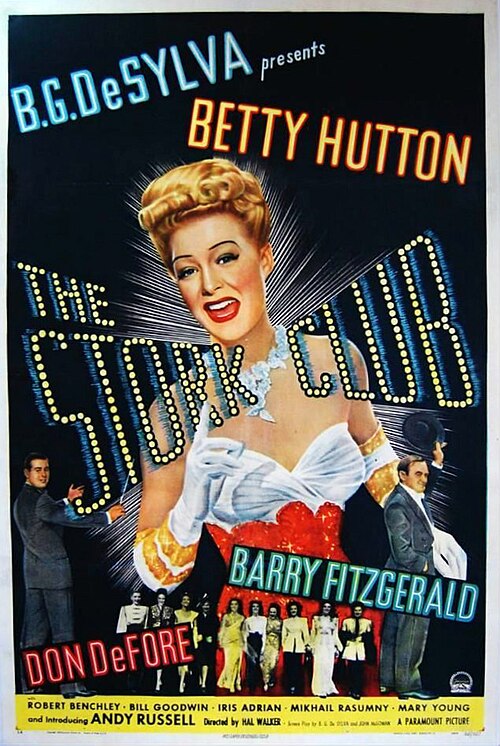
When Barry Fitzgerald walked onto the set of The Stork Club in the spring of 1945, he was carrying the single strangest distinction in Academy Awards history. A couple weeks earlier , at the 17th Oscars he ’d been nominated for Best Actor and also Best Supporting Actor for the very same part Father Fitzgibbon from Going My Way , which is the only moment this has happened in the ceremony’s almost near-century run. He lost the main award chase to his own co-star, Bing Crosby, and picked up the side award trophy instead , then it’s said he snapped the head clean off his statuette a few weeks later while just practicing his golf swing.
The Academy was so unsettled by the situation that it rewrote the nomination rules before the next ceremony so no actor could ever be split across both categories again. The Stork Club cast him as its eccentric millionaire lead within months of all that chaos, which makes this fluffy Betty Hutton musical, whether anyone planned it this way or not, the first film where audiences got to watch the most talked-about Oscar story of the decade play a man pretending to be poor.
The film carries a second, sadder footnote. Robert Benchley, the Algonquin Round Table humorist , playing Bates ‘ s exasperated lawyer, died of a cerebral hemorrhage on November 21, 1945 — like roughly five weeks before The Stork Club finally got to theaters on December 28 . It was among his last screen credits though, delivered after he was gone , to viewers who had no clue they were seeing a dead man’s final little jokes. Benchley’s own line kind of keeps going , it straight up runs through to one of the biggest movies ever made; his grandson was Peter Benchley , who wrote Jaws. None of that is in the plot. All of it is sitting quietly in the credits of a movie about a hatcheck girl who can’t stop misunderstanding her own good fortune.
The Stork Club 1945 — Movie Overview Table
| Detail | Information |
|---|---|
| Title | The Stork Club |
| Release Date | December 28, 1945 |
| Country | United States |
| Runtime | 98 minutes |
| Genre | Comedy, Musical, Romance |
| Language | English |
| Format | Black & White |
| Director | Hal Walker |
| Producer | B.G. DeSylva (uncredited) |
| Associate Producer | Harold Wilson |
| Screenplay | Buddy G. DeSylva, Jack McGowan |
| Cinematography | Charles Lang |
| Film Editing | Gladys Carley |
| Music | Robert Emmett Dolan |
| Costumes | Edith Head |
| Production Company / Distributor | B.G. DeSylva Productions, Inc. / Paramount Pictures |
| Filming Location | Paramount Studios, Hollywood — Stork Club interior recreated from over 700 reference photographs |
| Notable | Andy Russell’s film debut; Robert Benchley’s posthumous release; Barry Fitzgerald’s first lead role after his historic dual Oscar nomination |
| IMDb Rating | 6.4/10 |
| Public Domain | Yes — freely available to stream and download |
Full Cast — The Stork Club (1945)
| Actor | Role |
|---|---|
| Betty Hutton | Judy Peabody |
| Barry Fitzgerald | Jerry B. “J.B.” / “Pop” Bates |
| Don DeFore | Sgt. Danny Wilton |
| Andy Russell | Jimmy “Jim” Jones |
| Robert Benchley | Tom P. Curtis |
| Bill Goodwin | Sherman Billingsley |
| Iris Adrian | Gwen |
| Mary Young | Mrs. Edith Bates |
| Charles Coleman | MacFiske |
| Perc Launders | Tom, Saxophone Player |
| Mikhail Rasumny | Mr. Coretti |
| Catherine Craig | Louella Parsons |
| Audrey Young | Jenny |
The Most Talked-About Oscar Nomination in Academy History Walks Into a Nightclub Picture
Barry Fitzgerald spent most of his career as a character actor — gruff, Irish, reliably excellent in small doses. Going My Way changed the math entirely. His performance as the aging Father Fitzgibbon was strong enough, and ambiguous enough in its screen time, that Paramount’s awards strategists couldn’t decide whether to push him as a lead or a supporting player. They submitted him for both. The Academy let it stand, and Fitzgerald became — and remains — the only performer ever nominated in both acting categories for the identical performance in the identical film.
The fallout was immediate. Crosby took Best Actor. Fitzgerald took the Best Supporting Actor, and the Academy, kind of visibly uncomfortable with what it had just allowed to go through , rewrote its rules before the next ceremony , so that any performance getting votes in both categories would be locked into whichever one reached the nomination threshold first. The rule stayed in place for eighty one years, until the Academy went back and looked at its acting categories again for the 99th ceremony in 2027.
That’s the actor Paramount put right at the center of The Stork Club later that same year. He plays a wealthy man, so committed to vanishing into the background that he lets a hatcheck girl believe he’s a vagrant, instead of flat out admitting who he is. It’s a small irony that a performer who had just spent a season being defined and redefined by category labels would spend his next film pretending not to be who he actually is.
Hal Walker Got the Job by Accident — and Used It to Direct Martin and Lewis
Hal Walker wasn’t supposed to direct this film. Trade reports from early 1945 named actor Noel Madison as the intended feature directing debut on The Stork Club, but Madison withdrew from the project by April 24 of that year and Walker, an assistant director who had already been Oscar-nominated for his work on Souls at Sea (1937), stepped into the chair instead. It was his first directing credit on a feature film.
What Walker did with the opportunity is worth tracking forward. He went on to direct Duffy’s Tavern and Road to Utopia the very same year, then spent the rest of the decade becoming Paramount’s go-to comedy director — handling My Friend Irma Goes West (1950) and At War with the Army (1950), the film that gave Dean Martin and Jerry Lewis their first top-billed starring vehicle after stealing scenes as supporting players. He closed out his director’s run with Road to Bali (1952), the only Crosby-Hope road picture shot in color. A film that almost didn’t get a director at all ended up launching one of Paramount’s most reliable comedy hands of the postwar era.

Robert Benchley’s Last Year — and the Bloodline That Led to Jaws
Robert Benchley was not really, you know, an actor first. He was sort of one of the founding wits behind the Algonquin Round Table, a Harvard Lampoon alumnus who did theater criticism and absurdist little essays for Vanity Fair, Life, and The New Yorker. That mix made him, during the 1920s and ’30s, one of the most quoted humorists in American letters, at least in certain circles.
His film career began almost like a side hobby— and then, in 1935, his short subject How to Sleep won the Academy Award for Best Short Subject. Which is honestly a pretty strange kind of honor for someone whose “real” work was writing jokes about coughing audience members while they were sitting in Broadway plays .
By the time The Stork Club went into production, Benchley had appeared in dozens of features, including Hitchcock’s Foreign Correspondent. He plays Tom P. Curtis, the long-suffering lawyer tasked with secretly making a hatcheck girl rich without her ever learning who’s behind it — dry, slightly weary, exactly the register Benchley had spent two decades perfecting. He died of a cerebral hemorrhage on November 21, 1945, roughly five weeks before this film’s December 28 release, and appeared in two further pictures released posthumously after it.
The line runs further than most people watching this film in 1945 could have guessed. Benchley’s boy Nathaniel became a pretty respected novelist and biographer. And Nathaniel’s son—Robert Benchley’s grandson, basically—was Peter Benchley , who wrote the 1974 novel Jaws and then, the next year, got it adapted into the movie that really did something like invent the modern summer blockbuster, if you ask me. What is kind of funny is that a small, dry supporting role in a forgettable Paramount musical and one of the most consequential thrillers of the twentieth century sit just two generations apart on the same family line, pretty much exactly.
Andy Russell’s First Day on a Hollywood Set
The Stork Club marked the screen debut of Andy Russell, and the debut nearly didn’t happen. Russell — born Andrés Rábago Pérez to Mexican immigrant parents in Boyle Heights — arrived at Paramount Studios after Buddy DeSylva personally invited him to screen-test, and a security guard at the gate told him the set was closed and he’d have to leave. He sat outside the stage door in the sun until director Hal Walker came looking for him, at which point Russell, by his own account, asked nervously whether it was really all right for him to go in now.
Once inside, he played a version of himself: a dance-band singer and swing drummer, performing a duet of “If I Had a Dozen Hearts” with Betty Hutton and a solo on “Love Me.” Russell would go on to become one of the first crossover Latino pop stars in American music, selling roughly eight million records through the 1940s with bilingual hits like “Bésame Mucho” and rivaling Sinatra and Perry Como in popularity at his peak. An actor who almost got turned away at the gate ended up sharing a duet credit with the film’s biggest star on his very first day in pictures.
Charles Lang and Edith Head — More Talent Than a Musical Comedy Needed
By the time Charles Lang shot The Stork Club, he had already been nominated for six Academy Awards for Cinematography, having won his first back in 1932 for A Farewell to Arms. He kept working long enough to amass eighteen nominations across his career before retiring in 1973 — a record that, even now, places him among the most recognized cinematographers in Hollywood history. None of that prestige is what most viewers expect walking into a featherweight Betty Hutton vehicle, but the visual polish is there in the nightclub sequences regardless of who’s watching for it.
Edith Head designed the costumes — years before she became the most decorated costume designer in Oscar history. The pairing of Lang behind the camera and Head dressing the cast says something about how Paramount approached even its lighter productions in 1945: the studio system put serious craft behind films that were never going to be mistaken for prestige pictures, simply because the talent on payroll happened to be that good.
The Real Stork Club, Recreated From Seven Hundred Photographs
The Stork Club wasn’t an invented setting. It was a real, famously exclusive Manhattan nightclub at 3 East 53rd Street, run by former Prohibition-era operator Sherman Billingsley, where the city’s actual celebrities mingled under his watch. Paramount never filmed inside the real club — the entire set was built on a Hollywood soundstage, reconstructed from more than 700 reference photographs taken of the genuine location to get the details right.
Billingsley himself is played on screen by Bill Goodwin, best known to contemporary audiences as the announcer on George Burns and Gracie Allen’s radio program. By some accounts, Billingsley lobbied for the film to get made in the first place and may have helped finance it as a glamorous, feature-length advertisement for his own establishment. Watching the film today means watching a soundstage simulation of a real place that no longer exists, dressed by a studio that did its homework down to the photographic detail.
Full Plot Summary — The Stork Club (1945)
Judy Peabody (played by Betty Hutton) is basically a hatcheck girl at New York’s well known Stork Club, and she sings plus dances in between shifts, while shes waiting for her bandleader boyfriend Danny (Don DeFore) to come back from the Marines. So one afternoon, while she’s sunbathing on this dock, she sees an older man sort of stumble, then he falls right into the water. She immediately dives in to rescue him, thinking he must be broke, and maybe even suicidal too, you know, just based on how disheveled he looks.
The Rescue and the Secret Benefactor
The man she calls “Pop” is actually J.B. Bates (Barry Fitzgerald), a wealthy and recently estranged husband whose own marriage has just collapsed over his stinginess. Touched by Judy’s kindness toward a man she believes to be destitute, Bates instructs his lawyer, Tom P. Curtis (Robert Benchley), to anonymously reward her with a luxury apartment and a generous line of credit at a fashionable department store, with no strings attached and no name attached either.
New Riches, New Suspicions
Judy spends freely, still unaware of who’s behind her sudden good fortune. She even tries to get “Pop” — who has shown up at the club to keep an eye on her — a job as a busboy, which fails almost immediately, so she invites him to share her new apartment instead. When Danny finally returns from overseas and finds his girlfriend living in a furnished apartment with furs, a line of credit, and an old man he’s never met, he draws the obvious — and wrong — conclusion, and the relationship sours.
Posing as Walter Winchell to Save Danny’s Band
Determined to fix what her unwanted wealth has broken, Judy calls Sherman Billingsley (Bill Goodwin) at the Stork Club, posing as gossip columnist Walter Winchell, and tips him off about a sensational new band he simply has to hear. Billingsley shows up, hears Danny’s band perform with Judy singing, and offers them the job — then casually reveals he knew her voice the entire time and had been having lunch with the actual Winchell when the call came in.
Reconciliation at the Stork Club
When Judy finally meets Bates’s estranged wife, Edith (Mary Young), the truth comes out: “Pop” is her secret benefactor, not her sugar daddy. Seeking to return the favor, Judy engineers a reunion between Bates and Edith. Meanwhile, Danny confronts Curtis and learns the real story behind Judy’s apartment and bank account. Realizing he misjudged her, he apologizes — on the bandstand, mid-song, in front of the entire club — and the couple reunites as Bates and Edith dance their own reconciliation nearby.
Where to Watch The Stork Club (1945) Free Online
The Stork Club is in the public domain and freely available across multiple platforms. As with most public domain titles from the 1940s, print quality varies significantly depending on the source.
| Platform | Format | Cost |
|---|---|---|
| Internet Archive | Stream + Download (multiple formats) | Free |
| Tubi | Stream (with ads) | Free |
| YouTube | Stream (multiple uploads; quality varies) | Free |
| Public Domain Movies | Stream | Free |
| Pluto TV / The Roku Channel | Stream (with ads) | Free |
The Stork Club (1945) on Internet Archive:
Is The Stork Club (1945) in the Public Domain?
Yeah, so the original copyright holder sort of missed the renew part for the film’s copyright and as a result The Stork Club slid into the public domain in the United States. That means you can stream it, download it, share it, or even screen it without paying anyone or asking for permission. This also kinda lines up with why so many of the copies you see floating around look a little rough , because a lot of public domain versions out there have been copied from second or third generation source material rather than from some crisp studio master.
If you want the most reliable copy for downloading or reuse, the Internet Archive is generally the safest starting point.
Critical Reception — Then and Now
The New York Times’ Bosley Crowther reviewed the film the day after it opened, framing it as a frivolous Christmas-week confection delivered with a bow on top, and singled out Betty Hutton’s performance as boisterous to the point of being a force of nature. That assessment has more or less held up for eighty years: nobody, then or now, mistakes The Stork Club for serious cinema. What kept it commercially alive in 1945 was Hutton’s number “Doctor, Lawyer, Indian Chief,” written by Hoagy Carmichael and Paul Francis Webster, which became her biggest chart hit and reached number one on the Billboard charts the following spring — meaning the song genuinely outlasted the movie that introduced it.
Modern aggregate scores reflect a film that’s pleasant rather than memorable: a 6.4/10 on IMDb and a 59% approval rating on Rotten Tomatoes from a small sample of reviews. Viewer reactions split along a predictable line — fans of Hutton’s relentless, high-energy musical style tend to enjoy it unreservedly, while those expecting sharper plotting from a story this implausible tend to find the back half repetitive. What survives best today isn’t the plot, which even contemporary critics found talky and overcomplicated, but the supporting cast: Fitzgerald’s deadpan delivery, Benchley’s dry asides, and a nightclub set built with more care than the screenplay strictly required.
Frequently Asked Questions — The Stork Club (1945)
Q: What is The Stork Club (1945) about?
A hatcheck girl at New York’s famous Stork Club nightclub rescues an elderly man from drowning, unaware he is a wealthy benefactor. He anonymously rewards her with a luxury apartment and a department store credit line, which causes her returning soldier boyfriend to suspect she has become a kept woman. The misunderstanding resolves through a posed phone call, a faked identity, and a reconciliation staged at the club itself.
Q: Is The Stork Club (1945) in the public domain?
Yes. The original copyright holder failed to renew the film’s copyright, placing it in the public domain in the United States. You can legally stream, download, and share the film at no cost. Print quality varies widely across platforms because most circulating copies were duplicated from second- or third-generation source material.
Q: Why is Barry Fitzgerald’s casting in this film notable?
Fitzgerald appeared in The Stork Club shortly after becoming the only actor in Academy Award history nominated for both Best Actor and Best Supporting Actor for the same performance, in Going My Way (1944). The controversy led the Academy to rewrite its nomination rules to prevent it from happening again, a rule that held until the 99th Academy Awards in 2027.
Q: Who directed The Stork Club, and was it his first film?
Hal Walker directed The Stork Club, and it was his first feature directing credit. He took over after original director Noel Madison withdrew during preproduction. Walker went on to direct Road to Utopia the same year, later helmed Dean Martin and Jerry Lewis’s breakout vehicle At War with the Army (1950), and directed the Crosby-Hope picture Road to Bali (1952).
Q: What happened to Robert Benchley around the time this film was released?
Robert Benchley, who plays lawyer Tom P. Curtis, died of a cerebral hemorrhage on November 21, 1945, roughly five weeks before The Stork Club’s December 28, 1945 release. It was one of his final screen appearances; two more films featuring him were released posthumously afterward. His grandson, Peter Benchley, later wrote the novel Jaws.
Q: Was The Stork Club a real nightclub?
Yes. The Stork Club was a real, famously exclusive Manhattan nightclub at 3 East 53rd Street, run by Sherman Billingsley. The film’s nightclub set was built on a Paramount soundstage and recreated from more than 700 reference photographs of the actual venue. Billingsley is portrayed on screen by Bill Goodwin.
Q: Who was Andy Russell, and what role did he play?
Andy Russell, born Andrés Rábago Pérez, made his film debut in The Stork Club playing dance-band singer Jimmy ‘Jim’ Jones. He went on to become one of the first major Mexican-American crossover pop stars in the United States, selling roughly eight million records in the 1940s with bilingual hits including ‘Bésame Mucho.’
Q: What song made The Stork Club commercially successful?
Betty Hutton’s performance of ‘Doctor, Lawyer, Indian Chief,’ written by Hoagy Carmichael and Paul Francis Webster, became her biggest-selling recording and reached number one on the Billboard charts in the spring of 1946, outlasting the film’s own theatrical run in cultural visibility.
Q: Who else worked on The Stork Club behind the scenes?
Cinematographer Charles Lang, who had already won an Academy Award for A Farewell to Arms (1932) and would eventually earn 18 Oscar nominations across his career, shot the film. Costumes were designed by Edith Head, who later became the most decorated costume designer in Academy Award history.
Q: Where can I watch The Stork Club (1945) for free?
The Stork Club is freely available on the Internet Archive, Tubi, YouTube, Public Domain Movies, Pluto TV, and The Roku Channel. All versions are legal to stream and download under the film’s public domain status in the United States.
Related Free Classic Comedy and Musical Films
If The Stork Club (1945) sent you further into 1940s comedy and musical cinema, these are the natural places to keep going:
- Public Domain Cartoons
- Public Domain Horror Movies – Free Classic Scary Films Online
- Aces and Eights (1936) Full Movie Review, Plot, Cast & Free Western Classic
- Public Domain Movies List – All Free Classic Films (Complete Guide)
Movie Tags
The Stork Club 1945, The Stork Club full movie, watch The Stork Club free, The Stork Club public domain, Betty Hutton 1945, Barry Fitzgerald movies, Barry Fitzgerald Oscar history, Robert Benchley actor, Robert Benchley Jaws connection, Don DeFore early films, Andy Russell singer, Andy Russell film debut, Hal Walker director, Charles Lang cinematographer, Edith Head costumes, Sherman Billingsley Stork Club, Paramount Pictures 1945, classic Hollywood musical comedy, free 1940s musical movie, public domain musical film