
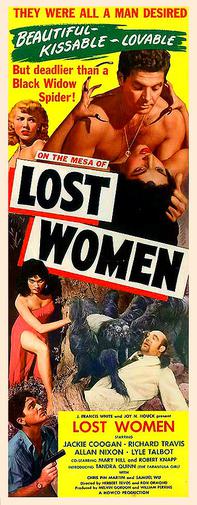
Hoyt Curtin would go on to write the theme songs for The Flintstones, The Jetsons, Scooby-Doo and roughly 250 other animated series that basically defined Saturday morning television for three decades. But before any of that, fresh out of a masters degree at USC, studying under Miklós Rózsa he landed his first professional film score for a movie about a Mexican mesa. In it, a mad scientist injects women with spider venom to form a superior race, and meanwhile dwarves shuffle around the laboratory, while a flamenco guitar keeps repeating the same small handful of notes, like it’s for the entire 70 minute runtime or close to it.
That film is Mesa of Lost Women (1953), and it was assembled—kind of not really made, assembled—out of an unreleasable 1951 picture called Tarantula that ran out of money. Then a distributor purchased it and hired a second director, to shoot enough fresh scenes so the whole thing could barely cohere. Jackie Coogan, once the top paid child star in Hollywood history, plays the mad scientist, sort of a frantic experimenter. It’s in the public domain, yes. It is, by wide consensus, one of the worst films ever assembled with genuine professional crew members involved. It is also genuinely difficult to stop watching.
Mesa of Lost Women 1953 — Movie Overview Table
| Detail | Information |
|---|---|
| Title | Mesa of Lost Women |
| Original Title (1951) | Tarantula (Pergor Productions) |
| Working Title (1952) | Lost Women of Zarpa |
| Release Date | June 17, 1953 (Los Angeles opening delayed to October 1956) |
| Country | United States |
| Runtime | 70 minutes |
| Genre | Science Fiction, Horror, Mad Scientist Film |
| Language | English |
| Format | Black & White |
| Directors | Herbert Tevos (original footage, 1951); Ron Ormond (additional footage, 1952) |
| Screenplay | Herbert Tevos; dialogue supervision by Orville H. Hampton |
| Producers | Melvin Gordon, G. William Perkins |
| Narrator | Lyle Talbot |
| Cinematography | Karl Struss, A.S.C.; Gilbert Warrenton, A.S.C. |
| Editors | Hugh Winn, Ray H. Lockert; W. Donn Hayes (supervising) |
| Music | Hoyt S. Curtin (his first feature film score) |
| Production Companies | Pergor Productions (original); A Ron Ormond Production |
| Distributor | Howco Productions, Inc. |
| Filming Location | Death Valley and Mojave Desert, California |
| IMDb Rating | 2.7/10 |
| Public Domain | Yes — freely available to watch and download |
Full Cast Table — Mesa of Lost Women (1953)
| Actor | Role |
|---|---|
| Jackie Coogan | Dr. Aranya (the mad scientist) |
| Richard Travis | Dan Mulcahey |
| Allan Nixon | Grant Phillips (“Doc” Tucker / the pilot) |
| Mary Hill (Paula Hill) | Doreen Culbertson |
| Robert Knapp | Grant Phillips |
| Tandra Quinn | Tarantella (the Tarantula Girl) |
| Harmon Stevens | Dr. Leland J. Masterson |
| Lyle Talbot | Narrator (voice only) |
| Chris-Pin Martin | Pepe |
| Angelo Rossitto | Dwarf laboratory assistant |
| John George | Dwarf laboratory assistant |
| Dolores Fuller | Spider-woman (uncredited) |
| Mona McKinnon | Spider-woman (uncredited) |
| Samuel Wu | Supporting role |
Two Films Stitched Into One — The Production Story
To understand Mesa of Lost Women, you have to understand that it isn’t really one film. It began in 1950 as a project conceived by writer-director Herbert Tevos — born Herbert Schoellenbach, who reportedly claimed a prior film career in Germany directing films with Marlene Dietrich and Erich von Stroheim, a claim that has never been independently verified. Tevos wrote and partially shot a picture titled Tarantula for Pergor Productions: a mad scientist, spider venom, glandular experiments producing giant arachnids and dwarfed servants. The film ran out of money before it was finished. It sat unreleasable, viewed and granted a Production Code Administration seal in October 1951, but with no distributor willing to touch it.
In the spring of 1952, Howco Productions bought the incomplete footage and assigned Ron Ormond — a prolific director of low-budget Westerns and exploitation pictures — to shoot additional material that could turn Tevos’s unfinished work into something releasable. The project was retitled Lost Women of Zarpa. Production records show Jackie Coogan was signed to the now-retitled Mesa of Lost Women in July 1952. Ormond’s additional footage was substantial: actress Tandra Quinn later recalled that Ormond spent several months shooting new sequences after Tevos’s footage was complete, including scenes of Coogan’s and Quinn’s characters being shot — sequences that did not exist in the original version. Actress Katherine Victor, hired separately by Ormond, recalled being brought in specifically to shoot desert sequences that the original film lacked, because the picture still could not be sold to a distributor without them.
The revised film received its own PCA seal in mid-August 1952. It was reviewed in trade publication The Exhibitor in June 1953. It did not actually open in Los Angeles until October 1956 — more than five years after Tevos first started shooting. The credits, somewhat appropriately, are inconsistent: there are documented differences between the cast list given at the film’s opening and the cast list given at its conclusion, a small but telling artifact of a production that was never fully reconciled with itself.
Full Plot Summary — Mesa of Lost Women (1953)
The film opens with two dishevelled survivors found wandering across the Muerto Desert — a man and a woman, barely conscious, who are brought to a hospital. Lyle Talbot’s narration, delivered over an extended shot of the pair stumbling through sand for several uninterrupted minutes, sets the philosophical tone before any plot begins: he mocks humanity as a race of “puny bipeds” who believe they own the Earth, when insects outnumber them and will likely outlast them. The narrator’s specific contempt for the audience he is addressing does not let up for the rest of the runtime.
The pilot, Grant, regains consciousness in the hospital and relates the story in flashback. Dr. Aranya (Jackie Coogan) — his name derived from the Spanish word for spider — has secluded himself atop the remote Zarpa Mesa in Mexico, accessible only by air, where he has developed a glandular crossbreeding program. His serum, derived from tarantula venom, transforms spiders into humans — but the results split sharply by gender. Female spiders become voluptuous, scantily clad superwomen. Male spiders become hunchbacked, deformed dwarves. The film offers this as a commentary on gender inequality in the insect world, delivered with the same flat sincerity as everything else in the script.
Dr. Masterson — The Reluctant Recruit
Aranya invites Dr. Leland J. Masterson (Harmon Stevens), described as the “world’s foremost organo-therapist,” to join him on Zarpa Mesa. Masterson is horrified by what he finds and refuses to participate. Aranya’s response is to drug him — turning Masterson into a mental patient who is institutionalized, his protests dismissed as delusion. Masterson eventually surfaces in a bar, deranged from his treatment, where he shoots Tarantella (Tandra Quinn) — Aranya’s most successful spider-woman creation — immediately after watching her perform a seductive cantina dance that the film treats as its centerpiece set piece.
More Read
Masterson then hijacks a wealthy American’s private plane and its passengers. The plane, now carrying six people including Masterson, crashes on Zarpa Mesa. Several passengers are killed by the spiders and spider-women roaming the mesa. The pilot Grant, a woman named Doreen, and the still-deranged Masterson are taken into Aranya’s laboratory. Masterson eventually breaks free of his drugged stupor long enough to blow up the entire laboratory. Grant and Doreen escape the destruction. The film returns to its framing device: the hospital, the disbelieving doctors, two survivors whose account no one believes. The end.
Jackie Coogan — From the Highest-Paid Child Star to Zarpa Mesa
Jackie Coogan’s presence in Mesa of Lost Women carries a weight that the film itself does nothing to acknowledge. Coogan had been, in the 1920s, the highest-paid child actor in Hollywood — his performance opposite Charlie Chaplin in The Kid (1921) made him an international star and, briefly, one of the wealthiest children in America. His mother and stepfather spent virtually all of his childhood earnings. When Coogan came of age and discovered what had happened to the fortune he’d earned, the resulting lawsuit against his own parents produced the California Child Actor’s Bill (commonly known as the “Coogan Law”) — legislation specifically designed to protect child performers’ earnings from exactly the kind of exploitation Coogan himself had suffered. The lawsuit left him with a fraction of what he’d earned and a reputation that made adult casting directors hesitant.
By the early 1950s, Coogan was bankrupt and taking whatever work was available — which included Mesa of Lost Women. His performance as Dr. Aranya is, by every available account, genuinely strange, like really off, a large black mole prosthetic and then a barking delivery of every line and this sort of committed lunacy that one IMDb reviewer summed up as “achingly bad” while another called the film’s primary, if accidental, pleasure.
Coogan’s career would not really recover in any meaningful way until the 1960s, when he was cast as Uncle Fester in The Addams Family (1964–1966) , a part that basically introduced him to an entirely new generation and gave him that second act which the years after his lawsuit had seemed to close off. Mesa of Lost Women sits squarely in the bleakest stretch of that career, which gives his performance here a specific historical poignancy that none of the people laughing at it in 1953 would have understood.
Hoyt Curtin — The Flintstones Composer’s First Film Score
Hoyt Curtin had just completed a master’s degree in music at USC, studying motion picture composition under Miklós Rózsa — the same Rózsa whose own scores anchor several other films in this public domain collection — when he took the Mesa of Lost Women assignment as his first professional feature film credit. The ultra-low budget allowed for only guitar, bass, and piano. Curtin built the score around a flamenco guitar motif repeated continuously across nearly the entire runtime, layered with what one reviewer described as “jarring piano chords” in an approach closer to improvisational free jazz than conventional film scoring.
The score has become, in its own right, one of the film’s most discussed elements — usually unfavorably. A Letterboxd review captured the consensus precisely: “It just consists of an endlessly OBNOXIOUS flamenco guitar solo interlaced with some awful piano slamming. It’s practically the only piece of music in the entire movie, and it never seems to shut up. EVER.” The score was distinctive enough — or cheap enough to reuse — that Ed Wood licensed it for his own film Jail Bait (1954), giving Curtin’s first professional score a second life inside one of the other most-discussed bad-movie filmographies in American cinema.
What makes this footnote genuinely remarkable rather than merely ironic is where Curtin’s career went next. Within a few years he became the music director for Hanna-Barbera Productions, composing more than 250 scores and themes across three decades — The Flintstones, The Jetsons, Top Cat, Jonny Quest, and dozens of other series that are, collectively, among the most recognized pieces of music in American television history. The same composer responsible for some of the most beloved theme songs of the 20th century began his film career writing the score that multiple critics have called among the worst ever composed for a motion picture. Both things are true simultaneously, and the gap between them is the single most interesting fact in this film’s production history.
Tandra Quinn — Tarantella and the Film’s Centerpiece Dance
Tandra Quinn plays Tarantella, Aranya’s most successful spider-woman creation, and her cantina dance sequence — performed to Curtin’s flamenco score — is the scene multiple reviewers single out as the film’s actual highlight. One IMDb reviewer’s assessment is representative: she “seductively moves” to the score, is “very sexy, but certainly no professional dancer.” The scene ends with Dr. Masterson, freshly deranged, shooting her immediately after watching the performance — one of the film’s more abrupt tonal swings, executed with the same flat matter-of-factness that characterizes the rest of the picture.
Quinn’s screen career did not extend much beyond this period, and the film remains her most discussed credit — a position shared by several members of the cast, for whom Mesa of Lost Women represents the most visible surviving record of their work.
The Ed Wood Connection — A Shared Cast and Crew Universe
Mesa of Lost Women sits in unusually close proximity to Ed Wood’s filmography — not through any direct collaboration, but through overlapping cast and a recycled score. Narrator Lyle Talbot would go on to appear in several Wood productions, including Plan 9 from Outer Space (1959). Spider-women Dolores Fuller and Mona McKinnon both appear here in uncredited roles and would also appear in Wood’s films — Fuller was Wood’s girlfriend during this period and would later go on to a genuinely successful career writing songs recorded by Elvis Presley, a trajectory considerably more improbable than anything in this film’s own plot.
Cinematographer Karl Struss, one of two credited directors of photography, had — somewhat remarkably — won the first-ever Academy Award for Cinematography for Sunrise: A Song of Two Humans (1927) and had shot Dr. Jekyll and Mr. Hyde (1931). His presence on a production this troubled is a reminder that the line between prestige and exploitation cinema in mid-century Hollywood was frequently a matter of which job happened to be available that month, not a reflection of talent.
Where to Watch Mesa of Lost Women (1953) Free Online
Mesa of Lost Women is in the public domain and legally available across multiple platforms at no cost.
| Platform | Format | Cost |
|---|---|---|
| Internet Archive | Stream + Download (multiple formats) | Free |
| YouTube | Stream | Free |
| Tubi | Stream (with ads) | Free |
| Public Domain Movies | Stream | Free |
Mesa of Lost Women (1953) on Internet Archive:
Is Mesa of Lost Women (1953) in the Public Domain?
Yeah. “Mesa of Lost Women” from 1953 is, technically, in the public domain here in the United States, it even shows a Public Domain Mark 1.0 badge on the Internet Archive. So you can go ahead and stream it, download it, share it, and screen it, no hassle or extra fee involved.
Critical Reception — What Viewers Actually Think
The movie has a 2.7 out of 10 on IMDb, based on a solid voter base (more than 2,100 votes) — which basically puts it among the most reliably and wholeheartedly panned films in the whole of that public domain set. What’s kind of striking is how steady the review consensus stays: it’s bad, it knows it’s bad, and the exact flavor of its badness ends up getting real fondness, not just a quick, easy shrug and move on.
One IMDb reviewer’s wording is the bit that gets quoted the most: “One of the best of the so-bad-it’s-beautiful movies.” Meanwhile, the Scifist write-up said the usual crowd response is “a really bad fever dream” and also mentioned that the film is “one of those films that you love after seeing it because it’s so ridiculously bad, but sitting through it is a nightmare.” That distinction — the experience of watching versus the experience of having watched — is the most accurate possible description of what Mesa of Lost Women offers.
The film’s reputation rests on a specific combination of elements that no individually bad movie typically assembles: a stitched-together two-production history, Jackie Coogan’s genuinely committed strangeness, Hoyt Curtin’s soon-to-be-legendary career starting here at its absolute nadir, and an Ed Wood-adjacent cast that connects it to the broader universe of mid-century bad-movie cinema. None of those elements alone would make the film worth seeking out. Together, they make it one of the more historically interesting entries in American exploitation filmmaking — interesting specifically because of how badly it was made, not despite it.
Frequently Asked Questions — Mesa of Lost Women 1953
Q: What is Mesa of Lost Women (1953) about?
A mad scientist, Dr. Aranya, conducts experiments atop a remote Mexican mesa, injecting humans and spiders with crossbred glandular serum to create giant tarantulas, deformed dwarves, and beautiful but deadly spider-women in an attempt to engineer a master race. The story is told in flashback by survivors of a plane crash who stumbled onto the mesa and barely escaped.
Q: Is Mesa of Lost Women in the public domain?
Yes. Mesa of Lost Women carries a Public Domain Mark 1.0 designation on the Internet Archive and is freely available to stream, download, and share without restriction.
Q: Why does the film have two directors?
The film began in 1950 as an unfinished, unreleasable project called Tarantula, written and partially directed by Herbert Tevos for Pergor Productions. When Howco Productions bought the footage in 1952, they hired Ron Ormond to shoot substantial additional footage — including new scenes with Jackie Coogan and Tandra Quinn — to make the picture releasable. Both directors share credit on the finished film.
Q: Who plays the mad scientist in Mesa of Lost Women?
Jackie Coogan plays Dr. Aranya. Coogan had been the highest-paid child star in Hollywood in the 1920s (most famous for The Kid, 1921, opposite Charlie Chaplin) before a lawsuit against his own parents over his squandered earnings left him bankrupt — leading directly to the California Child Actor’s Bill, commonly called the ‘Coogan Law.’ He took roles like this one during the bleakest stretch of his career, before later finding renewed fame as Uncle Fester in The Addams Family (1964–1966).
Q: Who composed the score for Mesa of Lost Women?
Hoyt S. Curtin composed the score — his first professional feature film credit, written immediately after completing a master’s degree in film composition at USC under Miklós Rózsa. The flamenco guitar and piano score is widely regarded as one of the worst in film history, and was later reused by Ed Wood in Jail Bait (1954). Curtin went on to become the legendary music director for Hanna-Barbera, composing the themes for The Flintstones, The Jetsons, and over 250 other animated series.
Q: What was the original title of Mesa of Lost Women?
The film began production in 1950 under the title Tarantula. After Howco Productions purchased the unfinished footage in 1952, it was retitled Lost Women of Zarpa before settling on its final release title, Mesa of Lost Women, following Jackie Coogan’s signing in July 1952.
Q: Is Mesa of Lost Women connected to Ed Wood’s films?
Indirectly, yes. Narrator Lyle Talbot and uncredited spider-women Dolores Fuller and Mona McKinnon all appear in Ed Wood productions, including Plan 9 from Outer Space (1959). Hoyt Curtin’s score from this film was also reused by Wood in Jail Bait (1954), connecting the two filmographies through shared personnel and recycled music.
Q: When did Mesa of Lost Women actually open in theaters?
The film received its final Production Code seal in August 1952 and was reviewed in trade publications in June 1953, but it did not open in Los Angeles until October 1956 — more than five years after Herbert Tevos began shooting the original footage.
Q: How long is Mesa of Lost Women?
The film runs 70 minutes.
Q: Where can I watch Mesa of Lost Women for free?
Mesa of Lost Women is freely available on the Internet Archive, YouTube, Tubi, and Public Domain Movies. All versions are legal to stream and download under public domain status.
Related Free Classic Sci-Fi and Cult Films
If Mesa of Lost Women (1953) sent you deeper into 1950s B-picture science fiction and public domain cult cinema, these are the natural titles to explore next:
- Public Domain Cartoons
- Public Domain Horror Movies – Free Classic Scary Films Online
- Aces and Eights (1936) Full Movie Review, Plot, Cast & Free Western Classic
- Public Domain Movies List – All Free Classic Films (Complete Guide)
Movie Tags
Mesa of Lost Women 1953, Mesa of Lost Women full movie, watch Mesa of Lost Women free, Mesa of Lost Women public domain, Jackie Coogan mad scientist, Jackie Coogan before Uncle Fester, Jackie Coogan Addams Family, Hoyt Curtin first film score, Hoyt Curtin Flintstones composer, Ron Ormond director, Herbert Tevos director, Tandra Quinn actress, spider woman film 1950s, mad scientist 1953 movie, Zarpa Mesa film, Ed Wood connected films, Lyle Talbot narrator, Karl Struss cinematographer, so bad its good movies, free classic sci-fi movie online