
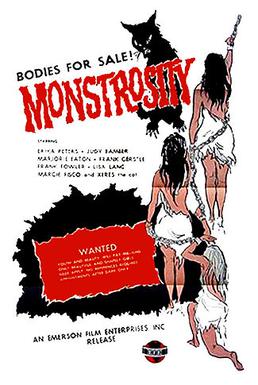
Monstrosity (1964), better known to late‑night TV fans as The Atomic Brain, is one of those sci‑fi horror curiosities that sounds like a joke and then turns out to be just unsettling enough to stick with you. A rich, vicious old woman, an outcast mad scientist, three unsuspecting immigrant maids, and a lab powered by atomic fission — it’s all here in a brisk hour of drive‑in exploitation that’s now a freely available public domain movie.
The film Monstrosity (1964) which has gained cult status because of its outrageous storyline and low-budget distribution and its distinct appearance on Mystery Science Theater 3000 under the title The Atomic Brain.
Movie Background Table
Movie Cast Table
Full Plot Summary
In a gloomy mansion owned by the wealthy and deeply unpleasant Mrs. Hettie March, science has gone places no ethics board would ever approve. Deep beneath her home, in an “atomic‑powered” laboratory, Dr. Otto Frank experiments with brain transplantation funded by Mrs. March’s fortune.
So far, the results are not reassuring. Dr. Frank’s successes include Hans, a snarling man‑beast with a dog’s brain, and the “Walking Corpse,” a beautiful young woman who shuffles around the lab with an empty, glassy stare after her own brain was tampered with. Mrs. March doesn’t care how many ruined lives lie in the lab; she has one goal: to cheat death by moving her aging brain into a perfect young body.
To that end, she and her oily younger lover Victor arrange for the arrival of three foreign domestic workers: Anita Gonzales from Mexico, Bea Mullins from England, and Nina Rhodes from Austria. Officially, they’re hired as housekeepers. Unofficially, they’re candidates — test subjects Mrs. March can evaluate up close.
The women who arrive at the mansion experience discomfort from the mansion’s unsettling atmosphere. The combination of locked doors and basement strange noises and Mrs. March’s icy observing stare establishes that something is wrong. Nina particularly detects danger because she observes her surroundings better than other people who travel to the United States with their dreams of success.
Meanwhile, Dr. Frank continues refining his work with atomic energy in a cyclotron, a device that somehow allows him to transplant brains without traditional surgery in the film’s pseudo‑science. We learn that Mrs. March expects results soon. Her health is failing, but her libido and her appetite for control remain very much alive.
Dr. Frank’s next experiment involves Anita and Mrs. March’s beloved cat, Xerxes. In one of the film’s stranger turns, he swaps Anita’s brain with the cat’s to test his process. The result is a feral, animalistic Anita who moves and scratches like a cat — at one point clawing out Bea’s eye in a vicious attack. Bea is badly injured, her beauty damaged, and Anita is reduced to a snarling, inhuman thing.
Bea’s maiming effectively removes her from Mrs. March’s list of potential host bodies. Anita, now cat‑brained, has become another failed experiment wandering the halls. That leaves Nina as the most attractive and mentally intact option.
Nina, sensing that something unspeakable is happening, confides in Bea. The two piece together clues — the locked lab, Mrs. March’s obsession with youth, Dr. Frank’s secretive work — and become determined to escape. They also witness Hans and the Walking Corpse, confirming that Dr. Frank’s operations are not just theoretical.
As Mrs. March pushes Frank harder, the scientist starts to realize he may be next on her list of people to discard. Victor, too, begins to understand that once Hettie has the body she wants, she won’t need an aging gigolo or a discredited scientist anymore. Betrayal starts to look like the only path to survival.
Plans of double‑crossing swirl beneath the mansion. Frank considers eliminating Mrs. March after he completes the procedure. Victor angles to keep access to her money. Mrs. March, ever sadistic, keeps them all in line with threats and promises.
When the time comes, Dr. Frank prepares Nina as the final recipient of Mrs. March’s brain transplant project. Nina is drugged and taken toward the lab as Mrs. March, in her wheelchair, anticipates waking up in a young, beautiful body, ready to enjoy her wealth for decades more.
But the schemes collide. Frank, having pieced together how disposable he really is, starts to push back. Mrs. March, in a rage, turns on him. In the climax, she uses her control over Xerxes — now implied or understood to be linked to her through the earlier experiments — to trap Frank in his own atomic chamber.
Locked inside the experimental vault, Dr. Frank is exposed to the full force of his atomic equipment. In a sequence straight out of atomic‑age cautionary tales, his body is reduced to a skeleton, and the overload sets off a chain reaction in the atomic pile beneath the lab. The resulting explosion destroys the laboratory and starts a fire that will consume the entire mansion, wiping away most of the evidence of the atrocities committed there.
Hans, the Walking Corpse, Anita the cat‑woman, Victor, and Mrs. March herself are all caught in the fallout, with only limited, ambiguous hope for the surviving girls. The narration (voiced by Bradford Dillman) underlines the irony: in trying to outwit death with atomic science and stolen bodies, Mrs. March merely hastened doom for herself and everyone around her.
Genre and Key Themes
Monstrosity / The Atomic Brain is a science‑fiction horror film with a strong exploitation edge.
Key themes include:
- Fear of aging and loss of power
Mrs. March’s terror of growing old — especially of losing control over men and money — fuels everything. Her desire to move her brain into a young “sexy” body is as much about maintaining dominance as about survival. - Abuse of science and class privilege
Atomic power and brain transplants are just tools for the wealthy to exploit the poor. The three immigrant women, hired as servants, become literal raw material for their employer’s quest for immortality. - Dehumanization and objectification
Anita, Bea, and Nina are valued only for their looks. Once Bea is disfigured, she’s off the list. Anita’s transformation into a cat‑brained creature drives home how little anyone in power cares about their minds or consent. - Mad science consequences
Hans, the Walking Corpse, and Anita’s fate show the trail of failed experiments behind every “genius breakthrough.” Dr. Frank’s own gruesome end in his atomic chamber reinforces the old genre lesson: tamper with nature long enough, and it turns on you.
The film uses these themes in a pulp way, but they’re why it still feels oddly relevant when you strip away the camp.
Monstrosity (1964) Full Movie Watch and Download
Watch Monstrosity (1964) on Internet Archive:
🏛️ See Also
Woody Woodpecker in Pantry Panic (1941) – Classic Winter Survival Cartoon Full Movie
The Last Time I Saw Paris (1954) – Elizabeth Taylor Romantic Drama Classic | Free Public Domain Full Movie
Sabotage (1936) – Alfred Hitchcock London Terror Thriller | Free Public Domain Full Movie
Love Laughs at Andy Hardy (1946) – Mickey Rooney Postwar College Romance | Free Public Domain Full Movie
Movie Review
The filmmakers used their available budget to design their science fiction horror movie yet produced a film that maintains effective storytelling. The filmmakers used their limited budget to produce quick shooting which resulted in a complete nightmare that explores class and gender and scientific ambition’s dangerous aspects.
Marjorie Eaton leans into Mrs. March’s nastiness with relish. She exhibits brittle personality together with arrogant behavior while showing no remorse for her vicious actions which create her character as a permanent antagonist who remains villainous from beginning to end. Frank Gerstle portrays Dr. Frank as an exhausted scientist who knows his research is incorrect but continues his work because he needs financial support from Mrs. March. Their scenes create a tense atmosphere because they both express strong disrespect towards each other.
The three young women — Erika Peters (Nina), Judy Bamber (Bea), and Lisa Lang (Anita) — do solid work within the limits of the script, giving their characters distinct personalities: Nina as watchful and cautious, Bea as more carefree until she’s hurt, Anita as hopeful and then horrifying once transformed. Their plight adds a bit of emotional weight to what could otherwise be pure gimmickry.
Joseph V. Mascelli’s direction is efficient. The film moves quickly, with little padding, and the lab set — full of coils, dials, and the ever‑important atomic chamber — delivers the right 1960s sci‑fi vibe. The black‑and‑white cinematography by Alfred Taylor lends a touch of atmosphere, especially in the basement sequences. Gene Kauer’s music adds just enough tension to keep things from feeling flat.
The biggest weaknesses are in the script and narration. Bradford Dillman’s voiceover, while distinctive, sometimes over‑explains the obvious or pushes the tone toward unintentional comedy. Plot logic is often sacrificed for speed and shock: the pseudo‑science around atom‑powered brain swaps is pure hand‑waving, and some character turns (like Anita’s sudden cat aggression) are more gimmick than development.
Yet for fans of vintage sci‑fi horror, those flaws are part of the charm. The Atomic Brain works as a time capsule of atomic‑age anxieties and as a compact little morality play where almost everyone scheming for advantage ends up destroyed. As a public domain movie readily available in multiple prints, including a nicely restored Blu‑ray sourced version and the MST3K riff, Monstrosity (1964) full movie is an easy, entertaining watch for anyone who enjoys mad scientist stories with a strong exploitation flavor.
Movie Tags
Monstrosity full movie, Monstrosity 1964 film, The Atomic Brain full movie, The Atomic Brain 1963 film, public domain movie, free classic movie, 1960s sci‑fi horror, mad scientist brain transplant, Marjorie Eaton Mrs. March, Frank Gerstle Dr. Otto Frank, Erika Peters Nina Rhodes, Judy Bamber Bea Mullins, Lisa Lang Anita Gonzales, atomic‑powered laboratory, immigrant maids brain experiments, Cinema Venture sci‑fi, MST3K Atomic Brain episode