
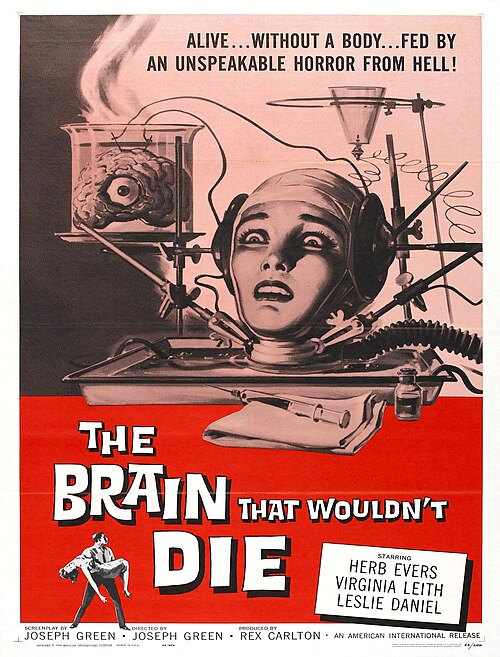
Few drive‑in horrors are as instantly memorable as the image of a living woman’s head in a pan, whispering revenge from a lab full of failed experiments. The Brain That Wouldn’t Die (1962) takes that wild premise and leans into it with gleeful, low‑budget intensity. Completed in 1959 but released in 1962 after a title change, this public domain movie has become a cult favorite — helped along by Mystery Science Theater 3000 and countless late‑night screenings.
For horror and sci‑fi fans exploring free classic movie catalogs, The Brain That Wouldn’t Die full movie is one of those titles you click out of curiosity and end up quoting for weeks. It’s campy, clumsy in places, and surprisingly dark in others — especially whenever “Jan in the Pan” starts talking.
Movie Background Table
Movie Cast Table
Full Plot Summary
Dr. Bill Cortner is a young and dangerous surgeon known to be a hotshot. He has been experimenting with human guinea-pigs under his father who is a conservative working in a city hospital and bringing transplant techniques to the edge of acceptable practice. His father is bothered when a patient who was clinically dead suddenly opens his eyes to the unusual way of doing things that Bill had placed them. Bill, though, only perceives evidence that he is about to make a medical breakthrough.
Out of the hospital, Bill owns a country house where his actual experiments are kept, rejected limbs, deformed animals, and a locked room where he keeps a severely disfigured something that he does not even want his fiance, Jan Compton, to see. Jan is aware of the fact that he is obsessed with his job, yet he is unaware of the extent to which he has gone.
One day, Bill and Jan are going to the country place in their car in order to spend a weekend together. He overdrives the car on the road. they do not argue seriously, and then tragedy strikes. The automobile crashes and flips and spins into flames. Jan is decapitated in the commotion. Bill survives and in a scene that establishes the themes of others in the movie, he does not grieve but rushes to salvage. He takes out the head of Jan that was severed in the wreck and takes it to his rural laboratory, leaving her to burn.
At the basement lab, Bill and his aide Kurt come to the rescue. They are able to resuscitate the head of Jan with a special serum and tremendous equipment, and keep it alive in a shallow metal tray filled with nutrient fluid, wired and tubed up. Her eyes open. She can speak. Physically, she’s a “success.” She is appalled emotionally.
Now, as nothing but a head on a table, Jan implores Bill to allow her to die. She complains about the inhumane life she is leading because of him. Bill shuns her, discussing in an ecstatic manner how he will transplant her head into another body, a new, perfect one, as soon as he can get it. He does not miss his fiancee in his mind, in fact he has given himself an opportunity to better her.
In the meantime, we get to know more about Kurt and what is in the closet. Kurt is a man who has already broken his own arm in experiments; he gets a task to feed and observe a monstrous body behind the door in the lab. This giant Frankenstein type is a product of what Bill has already tried to accomplish with life creation by means of surgery, a seven-foot man with a hideously deformed head, a failed experiment in transplantation turned into a dangerous prisoner.

Something peculiar occurs as the anger and desperation of Jan intensify. She finds out that she can telepathically communicate with the animal in the closet. They are both prisoners of Bill in one way or another, and a hate towards the doctor becomes a link between them. And when Bill is away, she is silently murmuring in her thoughts, asking the mutant to wait, to listen, to assist her in getting rid of the man who has done this.
Meanwhile, Bill enters the city on a hideous shopping trip. He requires a body to Jan, and he is going to get one, by any means possible. He loiters a burlesque club, where he looks at dancers as prospective donors, and wanders the streets where he ends up at a swimsuit model competition and a figure model studio where he treats women like shop goods. At some point, he becomes obsessed with Doris Powell, a glamour model with a scar on her forehead that she is desperate to get removed.
Bill gains the trust of Doris by playing a sympathetic surgeon who can perform her free plastic surgery. He takes her to his country house to seek advice, serves her drink with drugs and takes her unconscious body to the basement lab preparing her as a new host to Jan. Jan is in the tray, and he is telling his horror when explaining his plan. As she makes a complaint, he tapes her mouth.
Upstairs, Kurt is on the verge of breakdown in terms of guilt and fear. He nourishes the monster and attempts to maintain control, however, his wound and conscience cause him to be sloppy. There is a time when he leaves the hatch of the food unlocked in the cell door. The mutant takes the chance and plunges his massive arm into the hole and seizes Kurt. It cuts his arm off in an ugly display of violence. Kurt falls and dies bleeding.
All the threads come together as Kurt is gone and Doris on the slab. Bill is tying surgical tools as the tied up and half-conscious Doris is lying close by. The monster who has at this point realized, through Jan of what is occurring, becomes more agitated. Bill is too near the door of the cell – hatch open. Then the arm of the creature extends once more and this time it grasps Bill by the neck.
During the battle, the door is pulled off its hinges and the complete horror of the mutant is revealed: enormous, clumsy frame with horrendously malformed head as the visible result of the previous surgeries carried out by Bill. They start grappling and knock down equipment and fires break out in the lab. In the uncensored version, the monster snaps a piece of Bill on the face or neck, killing the latter.
The fire was fast spreading through the basement. The monster, which had yet to be contained, picks up the unconscious Doris and takes her up the stairs to safety. Jan, who is still in her pan, finds out that there is no turning back. When the lab burns round her she gives a final and chilling line: I told you to let me die and ends with a maniacal and mind-chilling cackle as the screen goes black.
Genre and Key Themes
The Brain That Wouldn’t Die (1962) sits right at the intersection of science‑fiction and horror, with a heavy dose of exploitation mechanics.
Key genre elements and themes:
- Mad science and hubris
Bill Cortner is the textbook mad doctor, convinced his brilliance justifies any violation of ethics. His refusal to accept death as a limit — first for anonymous patients, then for Jan — drives the plot and leads to monstrous outcomes. - Bodily autonomy and objectification
Jan’s insistence on wanting to die collides with Bill’s view of her as a project. His hunt for a new body treats women as collections of parts, judged for surface appeal and discarding their agency. - Innocent victims of “progress”
Kurt, the mutant in the closet, the strippers, the models, and Jan herself are all collateral damage in Bill’s quest. The film repeatedly suggests that the people most affected by his experiments never volunteered for the ride. - Revenge and poetic justice
Jan’s telepathic bond with the monster turns Bill’s own work against him. The creature he created destroys him; the consciousness he refused to let go chooses death on her own terms as the lab burns.
It’s all delivered with drive‑in flair — burlesque scenes, catfights, and rubber‑mask horror — but those themes are why the story lingers.
The Brain That Wouldn’t Die (1962) Full Movie Watch and Download
Watch The Brain That Wouldn’t Die (1962) on Internet Archive:
🏛️ See Also
Woody Woodpecker in Pantry Panic (1941) – Classic Winter Survival Cartoon Full Movie
Popeye for President (1956) – Classic Election-Day Cartoon Full Movie
The Lost World (1925) – Silent Dinosaur Adventure Classic | Watch Free
The Floorwalker (1916) – Charlie Chaplin’s First Mutual Comedy | Watch Free
Movie Review
The Brain That Wouldn’t Die is crude judged as pure cinema. The performance is not even and the lines monotonous, some scenes wear out. However, evaluated as a cult film, the movie is intriguing and unexpectedly strong.
Jason Evers acts Bill Cortner with a straight face turning his monstrous decisions all the more creepy. He never identifies himself as a villain, a stereotype of a well-intentioned scientist who has slipped into a sociopathy without much notice. As Jan, Virginia Leith provides the film with its creepy heart. Stuck under a pancake makeup with just her face to play with, she still manages to create a feeling of revulsion, rage, and dark humor. The true movement of the movie is her evolution out of loving betrothed to avenging brain.
Anthony La Penna’s Kurt adds a note of shabby tragedy; his damaged arm and anxious manner hint at a longer history of Bill’s experiments gone wrong. Adele Lamont’s Doris is given just enough characterization — shame over a scar, a desire for a new start — that Bill’s plan feels all the more predatory.
Joseph Green’s direction is workmanlike but occasionally inspired. The lab set, with its oversized equipment and shadowy closet, is classic 1950s/60s sci‑fi horror design. Location shooting around Tarrytown, New York, gives the driving scenes and rural exteriors a bit more texture than pure backlot fare. The pacing slumps during Bill’s extended body hunt, especially the burlesque club and catfight sequences, which were clearly designed to goose exploitation value.
The monster design, courtesy of performer Eddie Carmel — a real‑life “giant” from circus and sideshow circuits — is crude but memorable. In the uncut versions, the gore, while tame by modern standards, was strong enough in 1962 that AIP trimmed some shots for the original double‑bill release.
Where the film transcends its budget is in mood. Abe Baker and Tony Restaino’s score, “The Web,” uses low, ominous cues to give even the silliest scenes a sinister undertone. Jan’s disembodied voice, especially when she delivers the famous line “Like all quantities, horror has its ultimate, and I am that!” in some prints, captures that mix of pulp absurdity and genuine creepiness that defines so many beloved cult classics.
As a free classic movie that’s been riffed on Mystery Science Theater 3000 and remade in 2020, The Brain That Wouldn’t Die (1962) full movie lives now as both camp and artifact. You can watch it to laugh at the rubber monster, or you can lean into the weird, sad story of a woman whose mind becomes the only power she has left. Either way, it earns its place on any sci‑fi horror watchlist.
Movie Tags
The Brain That Wouldn’t Die full movie, The Brain That Wouldn’t Die 1962 film, The Head That Wouldn’t Die, mad scientist horror, Jan in the Pan, public domain movie, free classic movie, 1960s sci‑fi horror, independent American International Pictures, cult horror classic, Eddie Carmel monster, Joseph Green director, Rex Carlton production, MST3K featured film, decapitated fiancée head transplant story