
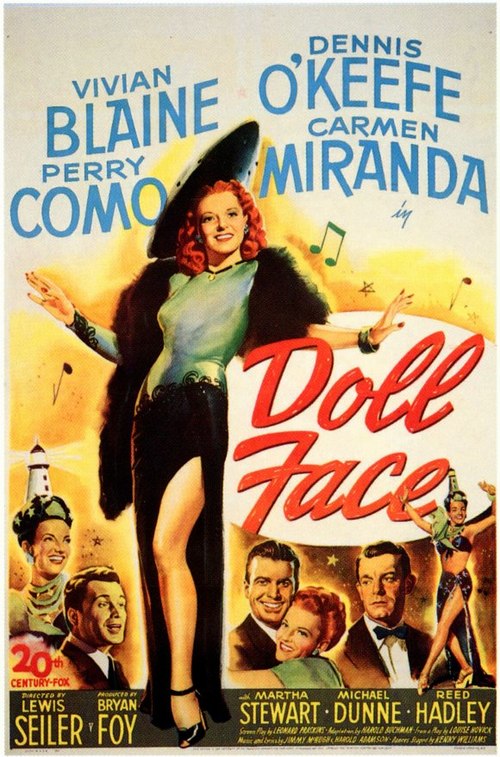
Doll Face (1945) is a bubbly backstage musical with a surprisingly sharp hook: what happens when a burlesque queen decides she deserves “respectable” success but the world refuses to forget where she came from. Inspired by Gypsy Rose Lee’s play The Naked Genius and now widely available as a public domain movie, Doll Face (1945) full movie lets you watch Hollywood wrestle — sometimes gracefully, sometimes not — with the idea of a “striptease intellectual.”
Movie Background Table
Movie Cast Table
Full Plot Summary
“Doll Face” Carroll is a popular burlesque performer at New York’s Gayety Theatre. She’s glamorous and successful on her own turf, but she wants more than catcalls and chorus lines. Her dream is to break into “legitimate” Broadway, where the critics and society types might finally treat her as a real actress.
Her fiancé and manager, Mike Hannegan, lands her an audition for a classy show. On paper, it looks like the big chance she’s been waiting for. In practice, it’s a disaster. The producer recognizes her as a burlesque queen, and the moment he connects her to the Gayety, her chances vanish. Whatever talent she has, her reputation walks into the room first.
Back at the theatre, Mike tries to solve the “problem” of her image. In a brainstorm that feels half sincere and half scheme, he suggests Doll Face “get some culture” by writing an autobiography. If the world sees her as literate, thoughtful, and more than just a shimmy, maybe Broadway will follow. Since Doll Face has neither the time nor the training to write a book herself, Mike hires a ghostwriter: Frederick Manly Gerard, a smooth, educated author who can shape her life story into a respectable volume.
Doll Face agrees on one condition: the book must be dedicated to Mike, with the inscription “For the love of Mike.” It’s her way of tying this new, “classy” version of herself to the man who believed she could get there — and a small insurance policy against feeling like someone else’s creation.
The other performers of the Gayety are neurotic about them. The other star of the show, Chita Chula (comic fire by Carmen Miranda) points out the obvious, when Doll Face becomes a legit sensation and quits burlesque, their revue is not going to make it. She does not trust what Mike says that the book will benefit everyone. Mike, who wants to show that he is not a mere rider of Doll Face coat of arms, gets another idea. Instead of having to rely on external producers, he will stage his own Broadway production, which will be funded by the performers themselves. They will do it their way in the event that they decide to go legit.
Frederick who has been sucked into the group gives an offer to pay any deficit in the budget. It is not just because of the fee he is in it; he appears to be really interested in Doll Face and the world she inhabits. Business, romance and ego gossiping Mike, and spills the beans to the media, creating headlines on the burlesque queen who wrote her own story. Such publicity, he contends, gives the troupe all the free publicity it could wish when featuring a new show. It does not actually have to publish the book in his mind because the book has already served its purpose.
Doll Face is in a different light. To her, the book is not merely a gimmick but an actual opportunity to be viewed in a new light. She insists on complete and release, even when it will involve going outside of the plan of Mike. In order to finish the manuscript, she takes Frederick to Jamaica (in Queens, New York, not the Caribbean island) wherein she can get some quiet time and some last minute polishing. Their boat has engine trouble along the way and they end up being stuck on a small island on Long Island Sound.
More Read
It is an inconveniencing, though harmless, situation. Nevertheless, when Mike discovers them, marooned, he can only see betrayal. He is jealous and hurt and thinks that Doll Face has decided to take the fine writer instead of the crass-edged manager. He ends up their engagement and leaves her life in anger.
Back in New York the blow goes round. The Gayety Theatre cannot afford to sell its tickets without Doll Face as its headliner. The burlesque that was once making money out of her name cannot survive on subsidiary performances and Mike is eventually forced to shut it down.
Doll face, at the same time, advances. Her book is written under the brash name The Genius DeMilo, a pun on genius and the Venus de Milo, which is a clue that a woman who is famous because of her body could also possess a brain. Twisting around to have emotional revenge or, possibly, straight up confusion, she gives it to Frederick and not Mike as she promised. Mike sees the dedication and his wrath turns regrettable. He understands that he has misunderstood her motives and overreacted to her and destroyed the personal and professional life of the woman and himself in the process.
Too down on himself or too proud to go to her point-blank, Mike retaliates by sending in a lawyer. On the eve of the debut of the new show of Doll Face, the Broadway play, which was to realize her legitimacy, the lawyer presents her with bad news. Mike still has a contract stating that she cannot be in any show that he does not produce. Technically, he can halt the performance in the middle of the opening, and that is what the lawyer threatens to do so.
Doll Face accepts to see Mike in person. Once they meet and speak, the bluster is dissipated. He apologizes; she challenges him to the extent to which his untrustingness had hurt her. Their previous chemistry remains in place despite the pain, and gradually they get back to a relationship, romantic and professional.
In the end, Doll Face turns Mike’s own tactics around on him. She persuades the current producer to give Mike a 25 percent share and co‑producer credit on the show in exchange for lifting his legal claim. The compromise lets the production go on, keeps the company employed, and re‑aligns Doll Face’s public “legitimate” success with the man who first helped her chase it. She gets her Broadway stage, he regains his pride, and the burlesque girl turned author finally steps into the spotlight on her own terms — or as close as 1940s Hollywood would allow.
Genre and Key Themes
Doll Face (1945) is best described as a romantic musical comedy with strong backstage and show‑business elements. It mixes songs, slapstick, and light romance with a storyline about image, class, and who gets to be taken seriously.
Major themes include:
- Respectability vs. roots
Doll Face wants out of burlesque not because she’s ashamed of working, but because she’s tired of being dismissed. The tension between her origins and her ambitions drives nearly every scene. - Public image and reinvention
The ghostwritten autobiography is both a sincere attempt at self‑definition and a marketing ploy. The film gently mocks the idea that a book can magically confer “culture,” even as it uses that idea to move the plot. - Jealousy and trust in relationships
Mike’s inability to trust Doll Face with a male collaborator nearly destroys them. His arc is less about learning business smarts and more about learning not to blow up at the first sign of insecurity. - Women’s agency in show business
Within Production Code limits, the film hints at how little control performers like Doll Face and Chita have over the labels stuck on them, and how they push back — through contracts, clever deals, and choosing their own projects.
These themes sit under plenty of musical fun, but they give the story a bit of bite when you look closely.
Doll Face (1945) Full Movie Watch and Download
Watch Doll Face (1945) on Internet Archive:
🏛️ See Also
Woody Woodpecker in Pantry Panic (1941) – Classic Winter Survival Cartoon Full Movie
The Last Time I Saw Paris (1954) – Elizabeth Taylor Romantic Drama Classic | Free Public Domain Full Movie
Sabotage (1936) – Alfred Hitchcock London Terror Thriller | Free Public Domain Full Movie
Love Laughs at Andy Hardy (1946) – Mickey Rooney Postwar College Romance | Free Public Domain Full Movie
Movie Review
Doll Face is not a forgotten masterpiece, but it is a light and fascinating time capsule. It is sometimes referred to as a curiosity, by no means a classic, it sounds right to me. It is also not as polished as subsequent Gypsy Rose Lee-inspired fare such as the 1962 film Gypsy, though the combination of Vivian Blaine, Perry Como, and Carmen Miranda gives it a personality one can recall.
Following her triumph in the stage and screen versions of Guys and Dolls, Vivian Blaine, plays the title character with a charming mixture of brassiness and vulnerability. As a burlesque character, she convinces and as a woman who feels she might be more. Her musical numbers (Somebody Walking in my Dream, Red Hot and Beautiful) do not necessarily provide her with those sharp lines that you might wish, but there is a reason why Fox bet on her.
Dennis O Keefe is flaunting around as Mike, the manager-fiancee who is undeniably unable to rein in his ego. He is too loud to the subject, to some viewers, yet his pushy personality suits a man who is always putting deals and feelings together. In Frederick, Stephen Dunne is softer and less obnoxious, which provides Doll Face with an easy-going counter to the unpredictability of Mike.
It is the supporting cast that tends to provide the real sparks. In one of his early screen performances, Perry Como gives the movie a warm musical touch; his songs, Here Comes Heaven Again, Dig You Later (A-Hubba-Hubba-Hubba), and others, bring on a sense of homeland security. As Chita Chula, Carmen Miranda walks off with her scenes almost literally. The exuberance of her character, her number Chico Chico, is Technicolor, even in black and white, and her comic time breaks through parts of the script that are flat.
The direction of Lewis Seiler is the pure studio craft. The production of the musical is neat, but not glamorous, and the scenes in the background are full of enough hustle and bustle to look inhabited. The weakness of the film lies in execution: it occasionally is aiming at being a witty remark on censorship and class and at the same time it does everything on big and safe to meet the Production Code. Bosley Crowther of The New York Times has lamented that the writing was a monotonous devotion to form and grammatical errors, and that the movie never entirely matches the smart of the book behind it.
Movie Tags
Doll Face full movie, Doll Face 1945 film, Doll Face Vivian Blaine, Perry Como musical, Carmen Miranda Chico Chico, Gypsy Rose Lee The Naked Genius adaptation, 1940s romantic musical comedy, backstage burlesque story, burlesque queen goes legit, Broadway showbiz film, Twentieth Century Fox classic, free classic movie, public domain movie, Lewis Seiler director, Jimmy McHugh Harold Adamson songs