
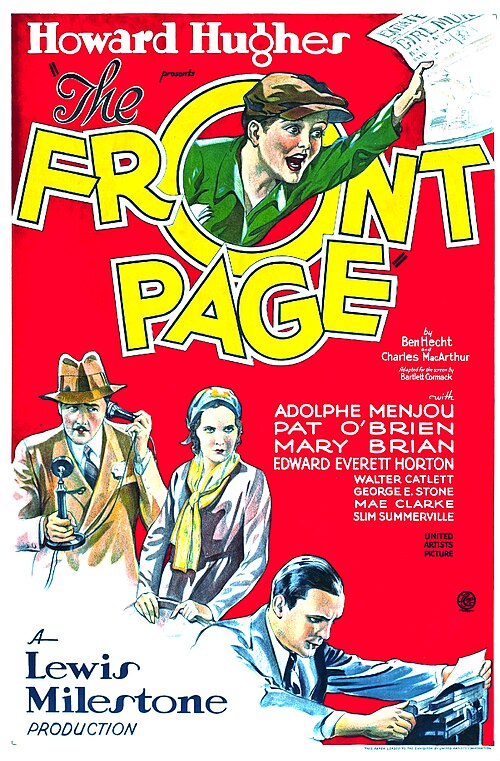
The Front Page (1931) is a fast-paced screwball comedy in which lead reporter Hildy Johnson is attempting to leave journalism to love and advertising only to be entangled in a last-minute spectacle of an escaped murderer hiding underneath a desk in the pressroom of the courthouse by his vulture-like editor. This is a sharp The Front Page full movie featuring Adolphe Menjou and Pat O Brien, all of which is now a free classic movie, a public domain movie, which the National Film Registry keeps on its archives as a cultural icon.
The Front Page (1931)
In the film The Front Page (1931), which is a pre-Code screwball black comedy, the director is Lewis Milestone and the film is based on the renowned 1928 play, front page, by Ben Hecht and Charles MacArthur, former Chicago newspaper reporters. The film is produced by Howard Hughes under United Artists and it reflects the hard-drinking cynical world of journalism of the 1920s of Chicago with breakneck dialogue and new cinematography. It was nominated in three Academy Awards and introduced into the National Film Registry in 2010, running 101 minutes. The movie has become public domain.
Movie Background
Two versions exist—one for international release and Milestone’s preferred domestic cut—both available on home video.
Movie Cast Table
| Actor | Role |
|---|---|
| Adolphe Menjou | Walter Burns (editor) |
| Pat O’Brien | Hildebrand “Hildy” Johnson |
| Mary Brian | Peggy Grant |
| George E. Stone | Earl Williams |
| Edward Everett Horton | Roy V. Bensinger |
| Walter Catlett | Jimmy Murphy |
| Mae Clarke | Molly Malloy |
| Slim Summerville | Irving Pincus |
| Matt Moore | Ernie Kruger |
| Frank McHugh | “Mac” McCue |
| Clarence Wilson | Sheriff Peter B. “Pinky” Hartman |
| James Gordon | The Mayor |
| Effie Ellsler | Mrs. Grant |
Menjou received his only Oscar nomination for this role, while O’Brien delivers one of his signature fast-talking performances.
Full Plot Summary
The Front Page (1931 film) begins in the seedy pressroom of the Criminal Courts Building of Chicago, where a band of jaded reporters pass the time with wisecracks, playing cards, and gossip as they wait to hang an anarchist, Earl Williams, who has been charged with murdering a black policeman. The hanging will take place during the time of dawn, which is very precise because politicians will use it to secure the next election by seeming like they are fierce on crime.
Into this chaos walks star reporter Hildebrand “Hildy” Johnson, who stuns his colleagues by announcing he’s quitting journalism for good. Hildy is engaged to sweet Peggy Grant, whose respectable family—especially her disapproving mother Mrs. Grant—demands he leave the sleazy newspaper business. He’s promised to take a safe, boring advertising job in New York and marry Peggy immediately.
Hildy’s manipulative editor, Walter Burns of the Morning Post, refuses to accept this. Walter calls Hildy to the office one last time and tries every trick to change his mind—reminiscing about past scoops, mocking the dullness of advertising, painting married life as a prison. Hildy resists, determined to keep his promise to Peggy.
But Walter throws a seed: he begs Hildy to write one more (story) about the Williams execution before she leaves town. Hildy just goes by the courthouse newsroom to collect quotes by insisting it is his very last job.
Hildy reunites with the reporters at the courthouse (Murphy, Bensinger, McCue, and others), who all make jokes about politics, invent some facts, and have no concern of whether Williams is guilty or not. They simply want them to be executed in their morning editions. The Mayor is a corrupt man and the Sheriff Hartman, a bumbling individual who desperately requires the hanging to be carried out well in order to win votes.
The next moment, everything turns out of control: Earl Williams manages to get out of prison a few hours before his execution. Reporters run away to cover the story, however, Hildy has instincts. He uses his money of 260 dollars in honeymoon to bribe a tipster who would give him firsthand information on the escape despite promising Peggy otherwise.
When the pressroom gets out of control, Williams, who is terrified, disoriented, and obviously mentally ill, goes through the window in search of refuge. Hildy discovers him lurking and makes a quick decision that will ruin his marriage plans in a moment of choice that hides Williams in the pressroom in a roll-top desk.
Hildy calls Walter who races to the courthouse to assist. They both decide to keep Williams hidden until they could secure an exclusive interview and expose the corruption of the politicians. Walter views this as a career-making scoop and permanent retention of Hildy in the field of journalism.
In the meantime, Peggy and her mother come to the courthouse and are growing more agitated because Hildy continues to promise and promise and never fulfills it. He makes excuses and excuses to Peggy regarding one more minute as he makes frantic phone calls and evades other reporters who are on the desk snuffing out the truth.
The Mayor and Sheriff who are in need of hanging onto anything to conceal the fact that they were incompetent to allow Williams to get away, they also seek to bribe reporters and officials to keep their mouth closed. Molly Malloy, a prostitute with a heart of gold who befriended Williams attempts to protect him by informing the press he is mentally ill and is a frame-up, but the cold-hearted press ignores or mocks her.
When the clock runs out and the pressure sets in, the two lives of Hildy come to an end. Williams is finally found in desk. Hildy and Walter are caught with a wanted fugitive in their house and Peggy has enough, the engagement is broken and she runs out of the house heartbroken and enraged.
However, the newsmen have not exhausted all their cards yet: they have discovered evidence that can incriminate the Mayor and Sheriff as being corrupt and that Williams was mentally unfit and was railroaded to advance political interests. The politicians themselves withstand the scandal. Hildy and Walter are set free.
There is a sweet and sour ending to the film with a reprieve given to Williams at the eleventh hour. The exhilarated Hildy who is still tired but not having enough time to calm down after the adrenaline release of well meaning big story break, reconciles with Peggy at the train station. They get ready to ride the train to New York together.
But right at the moment that Hildy assures Peggy that this is indeed the end of his newspaper career, Walter presents him with one parting “gift” his beloved watch, which Walter had earlier stolen. This is a cynical gesture compared to sentimental, a reminder that Walter will never properly abandon Hildy. The train is going, it is obvious that Hildy is going, still, journalism, and Walter Burns, will never leave him.
Genre and Key Themes
The Front Page (1931) is a pre-Code screwball black comedy that blends rapid-fire wit, satirical social commentary, and cynical newsroom farce. It established the “fast-talking reporter” archetype that would dominate 1930s and 1940s cinema.
Key themes include:
- Journalism vs. ethics: Reporters invent facts, exploit tragedies, and prioritize scoops over truth or humanity.
- Addiction to the story: Hildy can’t resist the thrill of a breaking news event, even when it destroys his personal life.
- Political corruption: The Mayor and Sheriff manipulate justice for election advantage, showing government as cynically self-serving.
- Work vs. love: The film explores whether Hildy can ever balance his passion for journalism with Peggy’s demand for a normal, stable life.
- Pre-Code freedom: Sexual innuendo, political satire, and topless photos on pressroom walls reflect pre-censorship Hollywood’s boldness.
These themes make The Front Page full movie a biting, sophisticated comedy ahead of its time.
The Front Page (1931) Full Movie Watch and Download
Watch The Front Page (1931) on Internet Archive:
🏛️ See Also
Woody Woodpecker in Pantry Panic (1941) – Classic Winter Survival Cartoon Full Movie
Popeye for President (1956) – Classic Election-Day Cartoon Full Movie
Betty Boop: Minnie the Moocher (1932) – Jazz-Fueled Ghostly Cartoon Full Movie
Inner Sanctum (1948) – A Suspenseful Noir Thriller
Movie Review
The Front Page (1931) is a masterpiece of screwball comedy raised to a greater level by the fact that it is played by geniuses, the dialogs are so sharp, the direction is original.
- Acting: The best thing in the film is Adolphe Menjou as Walter Burns, a devotee of conniving, charismatic, completely manipulative acting that saw him earn his only Oscar nomination. Pat O’Brien keeps pace with him with lightning vigor as Hildy, the ambivalent reporter caught by his obligation and his lust. Mary Brian is very cozy and irritating to Peggy and George E. Stone plays an emotional role of the indecisive, desperate Williams. The ensemble ensemble of the wrangling reporters brings about believable, disorganized newsroom atmosphere.
- Direction and cinematography: The active camera work by Lewis Milestone makes his pressroom visually stimulating with the long tracking shots, ingenious angles, and constant motion to prevent stage-locked staleness. Even his use of long and still takes in crucial dialogue scenes is juxtaposed with the action.
- Screenplay: The screenplay by Bartlett Cormack and Charles Lederer maintains the legendary rat-a-tat dialogue by Hecht and MacArthur cynical, profane (in 1931), and funny. The sexual openness and the political stingingness of the script are representative of pre-Code Hollywood at its most ambitious.
- Cultural influence: The movie defined the alcoholic, cynical reporter stereotype and spawned many successors, and the movie by Howard Hawks His Girl Friday (1940) redefined Hildy as a woman. The impact of its influence rings decade after decade in newsroom dramas and comedies.
- Legacy: In 2010, it was inducted into the National Film Registry as an indication of its historical and aesthetic value. The satire of the media manipulations and the political corruption that are in the film is still frighteningly topical.
As a free classic movie and public domain movie, The Front Page 1931 film is widely available, though quality varies. Seek restored versions showcasing Milestone’s innovative cinematography.
Movie Tags
The Front Page 1931, The Front Page full movie, The Front Page 1931 film, Adolphe Menjou Walter Burns, Pat O’Brien Hildy Johnson, Lewis Milestone director, Ben Hecht Charles MacArthur play, Howard Hughes producer, pre-Code comedy, screwball comedy classic, Chicago journalism film, newspaper reporter movie, Earl Williams escape, courthouse pressroom, political corruption satire, fast-talking comedy, National Film Registry, 1930s Hollywood, public domain movie, free classic movie, Academy Award nominated, United Artists.