
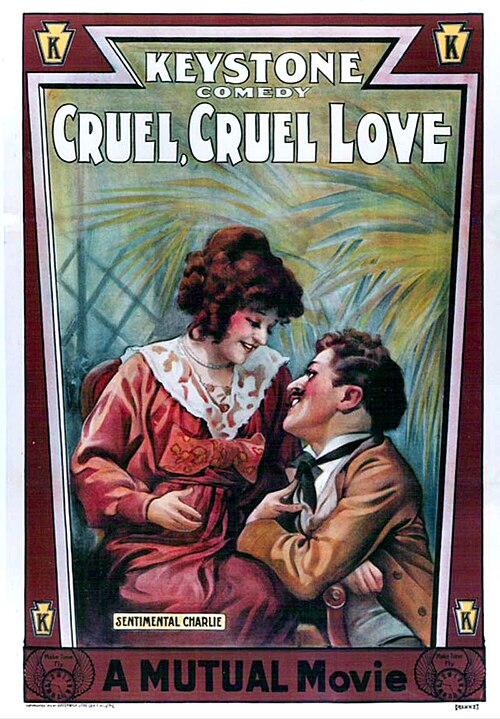
Every film fan carries a fixed image of Charlie Chaplin. The battered bowler. The waddling walk. The cane twirling just ahead of disaster. Cruel, Cruel Love (1914) strips all of that away. There is no Tramp here — just a well-dressed aristocrat with a melodramatic streak, a glass of what he believes is poison, and a vision of Hell staffed by pitchfork-wielding devils. It’s Chaplin at his most unrecognizable, in a film that disappeared from circulation for over fifty years before turning up in South America. You can watch it free online right now, and it’s a far stranger ten minutes than most Chaplin surveys suggest.
Cruel, Cruel Love 1914 — Movie Overview Table
| Detail | Information |
|---|---|
| Title | Cruel, Cruel Love |
| Also Known As | Charlot marquis (France), Un amor cruel (Spain), Verrückte Liebe (Germany) |
| Chaplin Film Number | 8th released film (approximately 13th produced) |
| Release Date | March 26, 1914 |
| Finished & Shipped | March 5, 1914 |
| Runtime | ~10 minutes (one reel) |
| Country | United States |
| Language | Silent (English intertitles) |
| Director | George Nichols, Mack Sennett |
| Producer | Mack Sennett |
| Screenplay | Craig Hutchinson |
| Studio | Keystone Studios |
| Distributor | Mutual Film Corporation |
| Format | Black & White, Silent, One Reel |
| Public Domain | Yes — freely available to watch and download |
| IMDb Rating | 5.3/10 |
| Lost Film Status | Presumed lost for 50+ years; recovered from South America |
Full Cast Table — Cruel, Cruel Love (1914)
| Actor | Role |
|---|---|
| Charlie Chaplin | Lord Helpus / Mr. Dovey |
| Minta Durfee | The Lady (his fiancée) |
| Edgar Kennedy | Lord Helpus’ Butler |
| Eva Nelson | The Maid |
| Alice Davenport | Supporting Cast |
| Chester Conklin | Supporting Cast |
| Billy Gilbert | Supporting Cast |
| Glen Cavender | Supporting Cast |
| William Hauber | Supporting Cast |
| Bert Hunn | Supporting Cast |
| Harry Russell | Supporting Cast |
Why Cruel, Cruel Love 1914 Matters More Than Its Rating Suggests
A 5.3 on IMDb from a small voter pool is not the full picture. Cruel, Cruel Love is one of the most genuinely unusual entries in Chaplin’s entire Keystone output — not because it’s his best work, but because of what it reveals about where he was as a performer in early 1914, and because its survival story is one of the more remarkable in early silent film history.
Most of the thirty-five films Chaplin made for Keystone in 1914 have been seen, analyzed, and filed under “formative period — good for context.” Cruel, Cruel Love is different. It requires a second look.
Chaplin’s Keystone Period — What Most Summaries Miss
By the time Cruel, Cruel Love was released on March 26, 1914, Chaplin had been working for Mack Sennett’s Keystone Studios for just over two months. He had arrived in December 1913 from the Fred Karno stage company, nervous enough about the transition from vaudeville to film that he nearly turned the contract down.
The Keystone operation ran on speed above everything else. Sennett’s directors — including George Nichols, who co-directed Cruel, Cruel Love — pushed their casts through production at a pace that left minimal room for the kind of careful character development Chaplin would later build his reputation on. In 1914, Charlie Chaplin began making pictures churned out in very rapid succession for Mack Sennett, also known as Keystone Studios. The short comedies had very little structure and were largely ad-libbed. As a result, the films, though popular in their day, often prioritized speed over craft.
What makes Cruel, Cruel Love stand out within that context is that it represents Chaplin making a deliberate choice. He played a character completely outside the Tramp persona he was already developing — a decision driven by creative curiosity, not studio pressure.
Lord Helpus — The Anti-Tramp
The Tramp is defined by poverty and resilience. He survives through ingenuity, charm, and a particular kind of dignity-under-pressure that audiences found both funny and quietly moving. Lord Helpus is his exact opposite: wealthy, coddled, and catastrophically unable to handle the slightest emotional setback.
The name itself telegraphs the joke. “Lord Help Us” — a man so helpless within his own privilege that even a misunderstanding with a maid drives him to attempted suicide. That satirical edge toward upper-class melodrama gives the film a sharper purpose than its modest reputation implies.
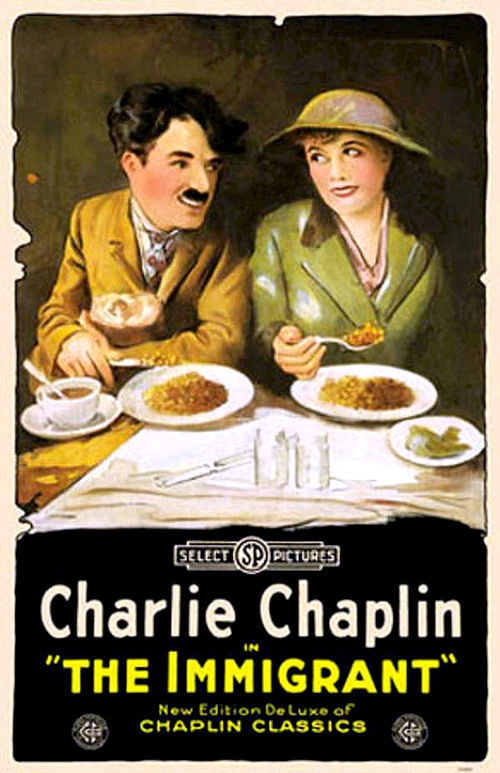
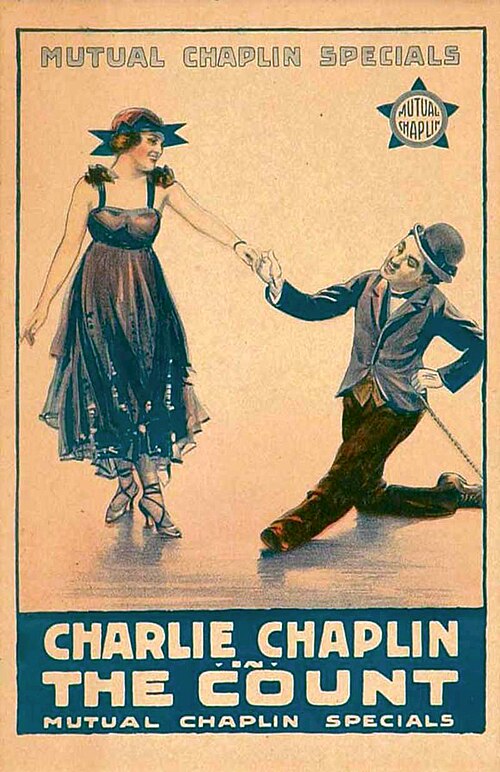
Cruel, Cruel Love is more of a parody of a D.W. Griffith melodrama, with the gentleman pining for the woman who has left him, contemplating suicide, and envisioning his torment by pitchfork-wielding devils. It points to Chaplin’s continuing fluidity in these early films — his screen persona is by no means fixed at this stage.
The Tramp and Lord Helpus share one thing: both are Chaplin. But Lord Helpus shows what Chaplin looked like when the safety valve of poverty was removed. Without the need to survive, the character collapses at the first crisis. The comedy comes from that collapse.
Full Plot Summary — Cruel, Cruel Love (1914)
The film opens at the home of Lord Helpus. His fiancée — played by Minta Durfee — arrives for a visit and witnesses something that looks, from the wrong angle, entirely compromising: a maid is embracing Lord Helpus. The embrace is innocent. The maid has merely found something to be grateful about. The fiancée, however, draws the obvious wrong conclusion.
She storms out, sends Lord Helpus a note ending the engagement, and refuses all contact. Lord Helpus, receiving the dismissal letter, reacts with the theatrical despair of a man raised to believe his emotions deserve an audience.
The Poison Scene — The Film’s Comic Centerpiece
Convinced his life is no longer worth living, Lord Helpus heads to a shelf in his home and selects what he believes is a glass of poison. He drinks it with tragic ceremony. His butler — played by Edgar Kennedy — watches with the expression of a man who has seen his employer do many inexplicable things and long since stopped being surprised.
Charlie envisions his future in Hell — tortured by pitchfork-wielding devils and surrounded by fire. When a letter arrives from his fiancée asking his forgiveness and reconciliation, panic replaces his agony as he calls his physicians to save him. A parody of a D.W. Griffith race-to-the-rescue follows as the film cuts between the two doctors and his fiancée rushing to his aid.
The Hell vision is the film’s most striking sequence. Two theatrical-looking devils — costumed with the broad strokes of a pantomime production — menace the prostrate Lord Helpus among painted flames. For 1914, the sequence was unusually elaborate and tonally unexpected inside a Keystone comedy short.
The Antidote Panic
While Lord Helpus is suffering through his imagined afterlife, practical truth is being sorted out at the fiancée’s household. Her gardener and maid explain to Minta that Lord Helpus was not flirting — the embrace was completely innocent. Minta immediately writes a letter of apology and dispatches it at speed.
Lord Helpus receives the letter. His emotion shifts instantly from tragic resignation to frantic self-preservation. He realizes he has actually swallowed something — whether water or poison, he cannot be certain — and summons an ambulance with escalating desperation. He also attempts to drink milk as a self-administered antidote, in scenes the official Chaplin archive notes directly anticipate a similar sequence he would revisit in Monsieur Verdoux (1947) — thirty-three years later.
The race to save Lord Helpus from a poison he never actually took produces the film’s funniest sustained sequence. Chaplin’s performance shifts from outrageous mugging in the despair scenes to something closer to controlled panic in the antidote scenes — two very different registers within the same ten minutes.
The Finale
When the gentleman discovers he has not ingested poison, chaos ensues as Charlie goes on a violent tirade against his butler and the doctors before the reconciled couple embrace at the film’s conclusion.
The tirade against the people who came to save him is a characteristic Chaplin inversion — the rescuers become the objects of rage simply because their arrival now embarrasses Lord Helpus. The couple reconciles over the wreckage of the attempted rescue. The film ends, as most Keystone comedies do, in the rough vicinity of order restored.
The Performance — Chaplin at His Most Unguarded
Today Chaplin’s reputation rests largely on the subtle brilliance of his pantomime, his ability to convey eloquent shades of meaning by the slightest gesture or flicker of an eyelid. That Chaplin is practically nowhere to be seen in Cruel, Cruel Love. Here, when he realizes he may have mistakenly poisoned himself, he reacts with an outburst of outrageous mugging — in what is surely the most wildly exaggerated display of hysterical facial contortions in his career — the more striking because some of it appears in screen-filling closeups.
Film historian J.B. Kaufman identified that in some of the early Keystones Chaplin seemed to be imitating fellow Keystone comedian Ford Sterling’s broader style of performance. Cruel, Cruel Love takes that borrowing further than any other film in the period.
Whether this was Chaplin’s own choice, director George Nichols’ instruction, or simply what Keystone’s house style demanded in early 1914 is unclear from surviving records. What the performance does show is a Chaplin still finding the register that would serve him — the subtle, precise pantomime that would define his mature work was a technique being built in real time across exactly these early films.
The D.W. Griffith Parody — A Specific Comic Target
The parallel-editing sequence — cutting between Lord Helpus writhing on the floor, the two doctors racing toward him, and the fiancée traveling in a separate vehicle — is a direct structural parody of D.W. Griffith’s last-minute rescue sequences. Griffith had made parallel editing a signature technique, building tension through rapid cuts between converging storylines.
The comedy business with the false poison would be revisited much later in Chaplin’s career in the brilliant Monsieur Verdoux (1947) to much better effect — the late 1940s seemed to be a time when Chaplin was deliberately redoing some of his old Keystone gags in light of everything he had learned about comedy film craft in the years since.
Keystone used the same technique, but for comedic effect rather than dramatic tension — the urgency of the rescue becomes absurd when the thing being rescued from was never real. Cruel, Cruel Love applies that parody with enough clarity that even viewers unfamiliar with Griffith’s work can read the joke in the rhythm of the cutting.
Minta Durfee — Arbuckle’s Wife and Keystone’s Reliable Presence
Minta Durfee plays the fiancée in Cruel, Cruel Love. In early 1914 she was a Keystone stalwart who had already appeared opposite Chaplin in A Film Johnnie, Tango Tangles, and Making a Living. She was also the wife of Roscoe “Fatty” Arbuckle, one of Keystone’s biggest stars.
The note Minta’s character sends to reconcile with Lord Helpus is signed with her real name — a self-referential touch that would register with 1914 audiences who already knew the Keystone roster. She would be showing up quite a bit over the next few months at Keystone, alongside both Chaplin and Arbuckle — there are the beginnings of something of a small rep company that would also frequently include Mabel Normand.
The Chaplin-Durfee-Arbuckle triangle of early Keystone output represents an important creative environment. All three performers were working at the same studio, appearing in each other’s films, developing a shared comedic vocabulary that would carry them in different directions within a few years.
Edgar Kennedy — Before the Slow Burn
Edgar Kennedy plays Lord Helpus’ butler with the watchful patience the role requires. Kennedy would go on to develop his signature “slow burn” comedic persona — a gradually building frustration at the absurdity around him — across decades of work in Hollywood. In 1914 at Keystone, that technique was still being developed. His butler in Cruel, Cruel Love shows the early seeds: a man surrounded by chaos, maintaining composure longer than seems humanly possible.
The Lost Film Recovery — South America and the Nitrate Print
Cruel, Cruel Love has a survival story as unusual as its plot. The film was presumed lost for more than fifty years — one of the many early Keystone films that had not survived in any known archive.
The film was presumed to be a lost film for more than 50 years until a complete nitrate film copy in reasonable condition was discovered in South America. Restoration copies were made by David Shepard of Film Preservation Associates and by Lobster Films of Paris, and its original two-reel format is available for sale.
The discovery in South America reflects a pattern in silent film preservation. As early cinema spread globally in the 1910s and 1920s, film prints traveled to territories where they were shown repeatedly until they wore out — or, in some cases, were stored in conditions that accidentally preserved them. South America, where Chaplin’s films were enormously popular and the climate in certain regions proved favorable to nitrate preservation, has been the source of multiple important early film recoveries.
The Flicker Alley Chaplin at Keystone DVD set, released in 2010, features sparkling restorations of almost every one of Chaplin’s Keystone pictures — giving modern audiences a chance to view the full 1914 period in a way that was simply not possible for most of the 20th century.
The film’s original Motion Picture World trade review called it “slight in texture, but it makes a pleasing, laughable picture” — a measured assessment that holds up reasonably well against modern viewing.
Where to Watch Cruel, Cruel Love (1914) Free Online
Cruel, Cruel Love is in the public domain and legally available across multiple platforms at no cost.
| Platform | Format | Cost |
|---|---|---|
| Internet Archive | Stream + Download (MP4, OGG, H.264) | Free |
| YouTube | Stream | Free |
| Public Domain Movies | Stream | Free |
| Flicker Alley DVD | Physical media (highest quality) | Paid |
Cruel, Cruel Love (1914) on Internet Archive:
The Internet Archive hosts the restored version for both streaming and download. For the highest-quality viewing experience, the Flicker Alley Chaplin at Keystone (2010) DVD set contains a restored print with a newly commissioned music score.
Is Cruel, Cruel Love (1914) in the Public Domain?
Yes. All American films produced before 1928 whose copyrights were not renewed under the pre-1978 U.S. copyright system are now in the public domain. Cruel, Cruel Love (1914) falls well within that window.
You can legally stream, download, share, screenshot, remix, and screen this film in educational contexts without restriction or payment.
Critical Reception — What Viewers Actually Think
The film holds a 5.3 out of 10 on IMDb, which places it in the lower half of Chaplin’s Keystone output by audience rating. Most reviews reflect a version of the same observation: this is not the Chaplin people came looking for, and the performance is deliberately — almost aggressively — unsubtle by his usual standards.
The Letterboxd community splits between viewers who find the Hell vision genuinely creative, those who find the mugging exhausting, and a third group who recognize the film primarily as evidence of how rapidly Chaplin’s craft would develop between 1914 and 1917.
The most useful critical framing comes from the charliechaplin.com archive, which positions the film as a direct link to Monsieur Verdoux (1947) through the repeated poison gag — and that connection is legitimately interesting. Chaplin returned to the same comedic mechanism thirty-three years later and executed it with the full weight of everything he had learned. Watching both films together makes the 1914 version more interesting than it is on its own terms.
Frequently Asked Questions — Cruel, Cruel Love 1914
Q: What is Cruel, Cruel Love 1914 about?
An upper-class gentleman named Lord Helpus drinks what he believes is poison after his fiancée breaks off their engagement over a misunderstanding. He envisions Hell, then receives a reconciliation letter, panics about the supposed poison, and summons doctors to save him — before discovering he drank water, not poison.
Q: Is Cruel, Cruel Love 1914 a public domain movie?
Yes. It entered the public domain after its copyright was not renewed under the pre-1978 U.S. copyright system. You can legally stream, download, and share the film for free.
Q: Does Chaplin play the Tramp in Cruel, Cruel Love?
No. He plays Lord Helpus — a wealthy, upper-class aristocrat with no connection to the Tramp persona. This is one of three 1914 Keystone films in which Chaplin appears outside his famous Tramp character.
Q: Who directed Cruel, Cruel Love?
The film was co-directed by George Nichols and Mack Sennett, with the scenario written by Craig Hutchinson. Chaplin did not direct this film — he was still under studio direction at this stage of his Keystone contract.
Q: Was Cruel, Cruel Love a lost film?
Yes. It was presumed lost for more than fifty years until a complete nitrate print in reasonable condition was discovered in South America. Restoration work was completed by David Shepard of Film Preservation Associates and Lobster Films of Paris.
Q: Who plays the fiancée in Cruel, Cruel Love 1914?
Minta Durfee plays the fiancée. She was a Keystone Studios regular and the wife of Roscoe “Fatty” Arbuckle. She appeared alongside Chaplin in several Keystone shorts during 1914.
Q: What is the connection between Cruel, Cruel Love and Monsieur Verdoux?
Both films include a scene where Chaplin’s character swallows a liquid believing it to be poison and then panics about the supposed fatal dose. The 1947 film Monsieur Verdoux revisited the same comedic situation with far more sophisticated execution — the official Chaplin archive identifies Cruel, Cruel Love as the direct precursor to that sequence.
Q: Where can I watch Cruel, Cruel Love 1914 for free?
The film is freely available on the Internet Archive, YouTube, and Public Domain Movies. All versions are legal under public domain status.
Q: What number was this in Chaplin’s filmography?
Cruel, Cruel Love was Chaplin’s 8th film released at Keystone, released on March 26, 1914 — just under three months after he began working for Mack Sennett’s studio in late 1913.
Related Free Classic Chaplin and Silent Films
If Cruel, Cruel Love (1914) pulled you into Chaplin’s early period, these films are the natural next step:
- War Goddess (1973) – Terence Young’s Amazon Sword-and-Sandal Epic | Full Review, Cast & Where to Watch
- Guest in the House (1944) – Anne Baxter Film‑Noir Drama | Full Public Domain Classic Movie Online Free
- Public Domain Horror Movies – Free Classic Scary Films Online
- Public Domain Movies List – All Free Classic Films (Complete Guide)
Movie Tags
Cruel Cruel Love 1914, Cruel Cruel Love Chaplin, Cruel Cruel Love full movie, watch Cruel Cruel Love 1914 free, Charlie Chaplin 1914 short, Charlie Chaplin Keystone film, Lord Helpus Chaplin, Chaplin without Tramp, Chaplin silent comedy, Minta Durfee actress, Edgar Kennedy butler, Mack Sennett 1914, George Nichols director, lost silent film recovered, Chaplin public domain movie, Keystone Studios silent film, Charlie Chaplin 8th film, free silent movie online, Cruel Cruel Love Internet Archive