
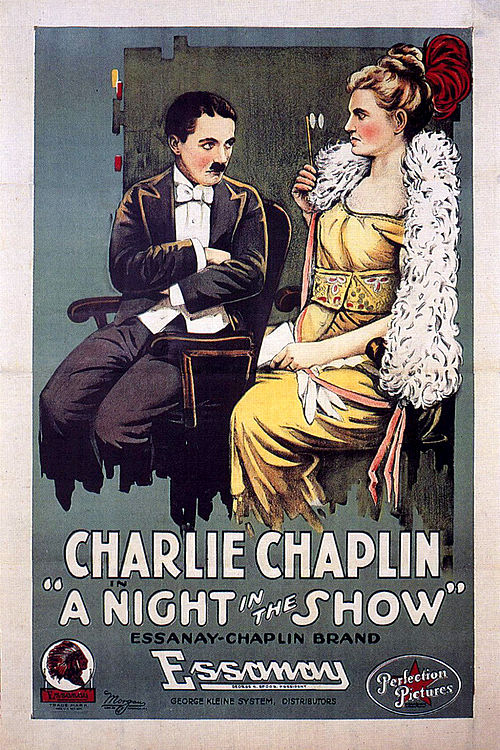
Watch A Night in the Show (1915) free — Chaplin plays two roles in his 12th Essanay short. Plot, cast, Karno stage origins & where to stream online.
Most people who search for early Chaplin expect the Tramp — the battered bowler, the cane twirl, the gentle pathos. A Night in the Show gives you none of that. Instead, you get two Chaplins for the price of one: a well-dressed drunk tormenting an orchestra from the front stalls, and a rowdy gallery thug pouring beer on everyone below him. That double act is exactly what sold out music halls across Britain and America for years before a single frame was ever filmed — and in 1915, Chaplin finally put it on screen. You can watch the whole thing free today.
A Night in the Show 1915 — Movie Overview Table
| Detail | Information |
|---|---|
| Title | A Night in the Show |
| Also Known As | Charlie at the Show |
| Release Date | November 20, 1915 |
| Runtime | ~24 minutes |
| Country | United States |
| Language | Silent (English intertitles) |
| Director | Charlie Chaplin |
| Written By | Charlie Chaplin |
| Based On | Mumming Birds — Fred Karno’s music hall sketch (1904) |
| Producer | Jess Robbins (uncredited) |
| Studio | Essanay Film Manufacturing Company |
| Distributor | General Film Co. (1915); Warner Bros. (1919 re-release) |
| Filmed At | Majestic Studio, Los Angeles |
| Chaplin’s Essanay Film No. | 12th |
| Genre | Silent Slapstick Comedy Short |
| Color | Black & White (colorized versions also exist) |
| Public Domain | Yes — free to watch and download legally |
| IMDb Rating | 6.4/10 |
Full Cast Table — A Night in the Show (1915)
| Actor | Role |
|---|---|
| Charles Chaplin | Mr. Pest / Mr. Rowdy (dual role) |
| Edna Purviance | Lady in the Stalls with Beads |
| Charlotte Mineau | Lady in the Stalls |
| Dee Lampton | Fat Boy |
| Leo White | Frenchman / Negro in Balcony |
| Wesley Ruggles | Second Man in Balcony Front Row |
| John Rand | Orchestra Conductor |
| James T. Kelley | Trombone Player and Singer |
| Paddy McGuire | Feather Duster / Clarinet Player |
| May White | Fat Lady and Snake Charmer |
| Phyllis Allen | Lady in Audience |
| Fred Goodwins | Gentleman in Audience |
| Charles Inslee | Tuba Player |
| Bud Jamison | Supporting Cast |
| Carrie Clark Ward | Supporting Cast |
The Film Behind the Film — What Most Pages Get Wrong
Every article about A Night in the Show mentions that it came from a stage sketch called Mumming Birds. What most articles skip is just how deeply embedded that sketch was in Chaplin’s career before the camera ever rolled on it.
Fred Karno, the British music hall impresario, created Mumming Birds in 1904 at the Hackney Empire, London. Film producer Hal Roach later described Karno as the man who “originated slapstick comedy” and said Hollywood “owed much to him.” The sketch became the longest-running single comedy act the music halls ever produced — running in various forms for four decades.
Chaplin joined Karno’s company in February 1908, when he was just 19. His half-brother Sydney had persuaded Karno to take a chance on the quiet, thin teenager. Karno was initially unconvinced. He quickly became the company’s biggest draw.
How Chaplin Became “The Inebriated Swell”
The central character in Mumming Birds was a drunk socialite in evening wear — “The Inebriated Swell” — who disrupted a terrible variety show from his box seat. Earlier Karno performers including Billie Ritchie had played the part. Chaplin took it over and made it his own.
By 1912, press materials for Karno’s American tours were leading with Chaplin’s name. An advance notice for the Seattle Empress Theatre that year called him “the clever English comedian” and placed his photo on the dramatic page — an unusual level of individual billing for a troupe act.
Chaplin performed the sketch across Britain and then on two Karno tours of America in 1910 and 1913. His understudy on those tours was a young man named Stanley Jefferson — later known as Stan Laurel. Both men would carry what they learned in Karno’s company directly into their film careers.
More Read
Why Chaplin Adapted It for Essanay in 1915
When Chaplin reached his 12th film for Essanay, he was already feeling the constraints of the studio’s production speed demands. As one film historian noted, Essanay wanted more shorts produced faster while Chaplin’s instincts were moving in the opposite direction — fewer films, more thought, deeper character work.
Rather than develop new material under pressure, Chaplin made a strategic call: adapt the stage routine he had performed hundreds of times and knew inside out. The result was A Night in the Show. He renamed the characters, split the “Inebriated Swell” into two distinct roles — the tuxedoed Mr. Pest and the working-class galleryman Mr. Rowdy — and built a film around the chaos they both cause.
For American audiences who had seen the touring stage version billed as A Night in an English Music Hall, the film offered familiar territory in a new format.
Full Plot Summary — A Night in the Show (1915)
The film plants Chaplin simultaneously on two levels of a music hall theater. Both characters arrive already drunk.
Mr. Pest wears evening clothes and occupies the dress circle — the expensive seats. He cannot find a comfortable position. He shifts from chair to chair, stepping on feet, knocking over drinks, and generally treating every other audience member as a personal obstacle. When he finally settles near the front, he escalates his aggression toward the orchestra pit itself.
The orchestra conductor strikes him with a baton. Pest responds by brawling with the conductor, then gets thrown into the lobby. There, he shoves a large woman into a decorative fountain, soaking her. He returns to his seat damp but undeterred.
Later, he falls asleep — and several snakes from the snake charmer’s act slither out of their basket and settle in his lap. He wakes with a start, brushes them directly into the orchestra pit, and triggers a full audience stampede.
Mr. Rowdy occupies the gallery — the cheap upper seats where the working-class crowd stood. He is less controlled than Pest and more aggressive. He pelts the stage performers with ice cream, tomatoes, and beer, pouring drinks down on the audience below, including Mr. Pest.
The two Chaplins never directly interact — they operate on different social planes of the same theater — but their combined chaos works upward and downward simultaneously, dismantling the entire event.
The film ends when a fire-eater takes the stage. Mr. Rowdy locates a fire hose in the gallery and turns it on the performer. The jet of water floods the stage, drenches the cast, soaks the audience, and shuts down the entire show. The building empties in chaos.
Mr. Pest vs. Mr. Rowdy — Two Characters, One Comedian
Chaplin playing a dual role in a single film was not new in 1915 cinema, but the way he differentiates the two characters here is worth examining.
Mr. Pest is the formal version of chaos. He wears a tailored suit and operates with a kind of entitled obliviousness — he doesn’t see himself as the problem, because people of his class never do. His aggression is reactive: he disrupts because the world keeps failing to accommodate him. Chaplin plays him with a haughty posture that softens just enough at the edges to stay funny rather than repellent.
Mr. Rowdy is the unfiltered version of the same impulse. He has no social armor and no pretensions. His attacks are deliberate, gleeful, and directed downward at people he perceives as above him. The beer goes specifically toward the dress circle. The hose targets the stage performers who represent the organized entertainment he finds worthless.
Both characters are, underneath it all, the same drunk causing the same destruction. The joke is that social class shapes the style of disruption more than its substance. It’s a pointed observation dressed up as pure slapstick — and it’s one of the reasons critics regard A Night in the Show as a step above typical 1915 comedy shorts.
The Essanay Period — Where Chaplin Found His Voice
By 1915, Chaplin had left Mack Sennett’s Keystone Studios behind. His Keystone period produced an extraordinary volume of shorts — some brilliant, many inconsistent — under the pressure of constant output. Essanay gave him more creative control.
A Night in the Show sits near the end of his Essanay contract, alongside films like The Bank (1915) and The Tramp (1915) that showed a maturing approach to character and pathos. It doesn’t carry the emotional weight of those two films, but it demonstrates something equally valuable: Chaplin’s ability to generate comedy from physical architecture.
The theater setting itself is the machine. The layout — gallery above, stalls below, orchestra in front, stage ahead — creates a natural geography of comedy. Every seat change by Mr. Pest, every projectile launched by Mr. Rowdy, follows the physical logic of the space. Chaplin didn’t just bring a stage routine to film — he redesigned it around what film could do that the stage couldn’t: cut between floors, show simultaneous action, control the audience’s point of view.
In 1915, it was estimated that Chaplin’s worldwide audience totalled around 300 million people. That figure gives some context for what A Night in the Show was releasing into — a global audience that already knew Chaplin’s face and expected something worth their time.
Edna Purviance — Chaplin’s Most Trusted Collaborator
Edna Purviance appears in A Night in the Show in a small role — the lady in the stalls with beads, seated near Mr. Pest. She has little to do here beyond react to the chaos around her.
That matters as context rather than content. Purviance appeared in the majority of Chaplin’s Essanay and Mutual films as his leading lady — a creative partnership that would define some of the most emotionally resonant work of the silent era. Films like The Tramp (1915), The Immigrant (1917), and A Woman of Paris (1923) built their emotional center on her presence.
Seeing her in A Night in the Show in a background role is a reminder that Chaplin deliberately chose ensemble comedy here — no leading lady dynamic, no romance arc. The film is a pure showcase for his own physical range.
Where to Watch A Night in the Show 1915 Free Online
A Night in the Show is in the public domain and available to stream and download at no cost across multiple platforms.
| Platform | Format | Cost |
|---|---|---|
| Internet Archive | Stream + Download (multiple formats) | Free |
| YouTube | Stream (multiple uploads, B&W and colorized) | Free |
| Public Domain Movies | Stream | Free |
| Criterion Channel | Stream (with 2014 Timothy Brock score) | Subscription |
Night in the Show 1915 on Internet Archive:
The Internet Archive hosts multiple versions including the original black-and-white print and a colorized edition. The Criterion Channel version pairs the film with a specially commissioned 2014 score by composer Timothy Brock — worth watching if you want the best-presented version.
Is A Night in the Show (1915) in the Public Domain?
Yes. Like all pre-1928 American films whose copyrights were not renewed under the original 28-year term system, A Night in the Show entered the public domain. You can legally stream, download, share, remix, or screen it for educational purposes without restriction.
Colorized and restored versions may carry their own separate copyright for the newly added material — the restoration work or colorization itself. The underlying original film, however, remains freely usable.
Critical Reception — Then and Now
Contemporary trade reviews from 1915 recognized the film’s entertainment value. The Moving Picture World synopsis described it as “exceptional comedy” adapted from Karno’s sketch, noting Chaplin’s double role as a distinct structural achievement.
Modern audiences on IMDb rate it 6.4/10 — a respectable score that reflects its status as a solidly entertaining short rather than one of Chaplin’s transcendent works. Reviewers frequently note that it lacks the emotional depth of The Tramp or The Bank but compensates with relentless physical invention and well-timed crowd comedy.
Film critics who have examined Chaplin’s Essanay period consistently place A Night in the Show as evidence of his growing directorial maturity — particularly in how he maps the comedy spatially across the theater’s multiple levels rather than relying on a single set piece.
For fans approaching Chaplin’s work chronologically, the film represents a useful bridge: the vaudeville comedian fully in control of his material, before the deeper emotional ambitions of the Mutual and First National years transformed his work into something more complex.
Frequently Asked Questions — A Night in the Show (1915)
Q: What is A Night in the Show 1915 about?
Charlie Chaplin plays two drunk characters — the well-dressed Mr. Pest in the theater stalls and the rowdy Mr. Rowdy in the gallery — who each independently destroy a music hall performance through escalating acts of chaos.
Q: Is this a full movie or a short film?
It is a short film with a runtime of approximately 24 minutes. It was produced as a comedy short for Essanay Studios, in line with the standard format of 1910s comedy film production.
Q: What was Mumming Birds and how does it relate to this film?
Mumming Birds was a comedy sketch created by Fred Karno in 1904, built around drunken hecklers disrupting a bad variety show. Chaplin performed the sketch extensively with Karno’s company between 1908 and 1913, using the character known as “The Inebriated Swell.” The 1915 film directly adapts that stage routine, splitting the central character into two separate roles.
Q: Who plays opposite Chaplin in A Night in the Show?
Chaplin himself plays both lead roles. The supporting cast includes Edna Purviance, Charlotte Mineau, Dee Lampton, Leo White, John Rand, May White, and others. There is no traditional romantic lead dynamic in this film.
Q: Where can I watch A Night in the Show 1915 for free?
The film is freely available on the Internet Archive, YouTube, and Public Domain Movies. All versions are legal, as the film is in the public domain.
Q: Is A Night in the Show 1915 colorized?
Yes, colorized versions exist alongside the original black-and-white print. Both are freely available online. The Criterion Channel version uses the original B&W print with a 2014 music score by Timothy Brock.
Q: What number was this in Chaplin’s Essanay contract?
A Night in the Show was Chaplin’s 12th film for Essanay Studios. It was also among his last, as he left Essanay shortly after to sign with the Mutual Film Corporation for an unprecedented level of creative and financial autonomy.
Q: Did Stan Laurel appear in the original Mumming Birds stage sketch?
Stan Laurel — then performing under his real name, Stanley Jefferson — served as Chaplin’s counterpart in the Karno troupe during the 1910 and 1913 American tours. He performed in Mumming Birds alongside Chaplin and later acknowledged that Karno taught him “most” of what he knew about comedy.
Related Free Classic Films to Watch
If A Night in the Show (1915) pulled you in, these public domain classics belong on your list:
- Swing High, Swing Low (1937) – Watch Free Romantic Musical Drama Online
- Guest in the House (1944) – Anne Baxter Film‑Noir Drama | Full Public Domain Classic Movie Online Free
- Public Domain Horror Movies – Free Classic Scary Films Online
- Public Domain Movies List – All Free Classic Films (Complete Guide)
Movie Tags
A Night in the Show 1915, A Night in the Show Chaplin full movie, watch A Night in the Show 1915 free, Charlie Chaplin 1915 short film, A Night in the Show public domain, Mr Pest Mr Rowdy Chaplin, Essanay Studios Chaplin films, Mumming Birds Fred Karno film, Edna Purviance silent film, free Chaplin movie online, Charlie Chaplin dual role silent comedy, Chaplin Essanay period, silent comedy short 1915, free classic movies online, Chaplin full movie YouTube, A Night in the Show Internet Archive