
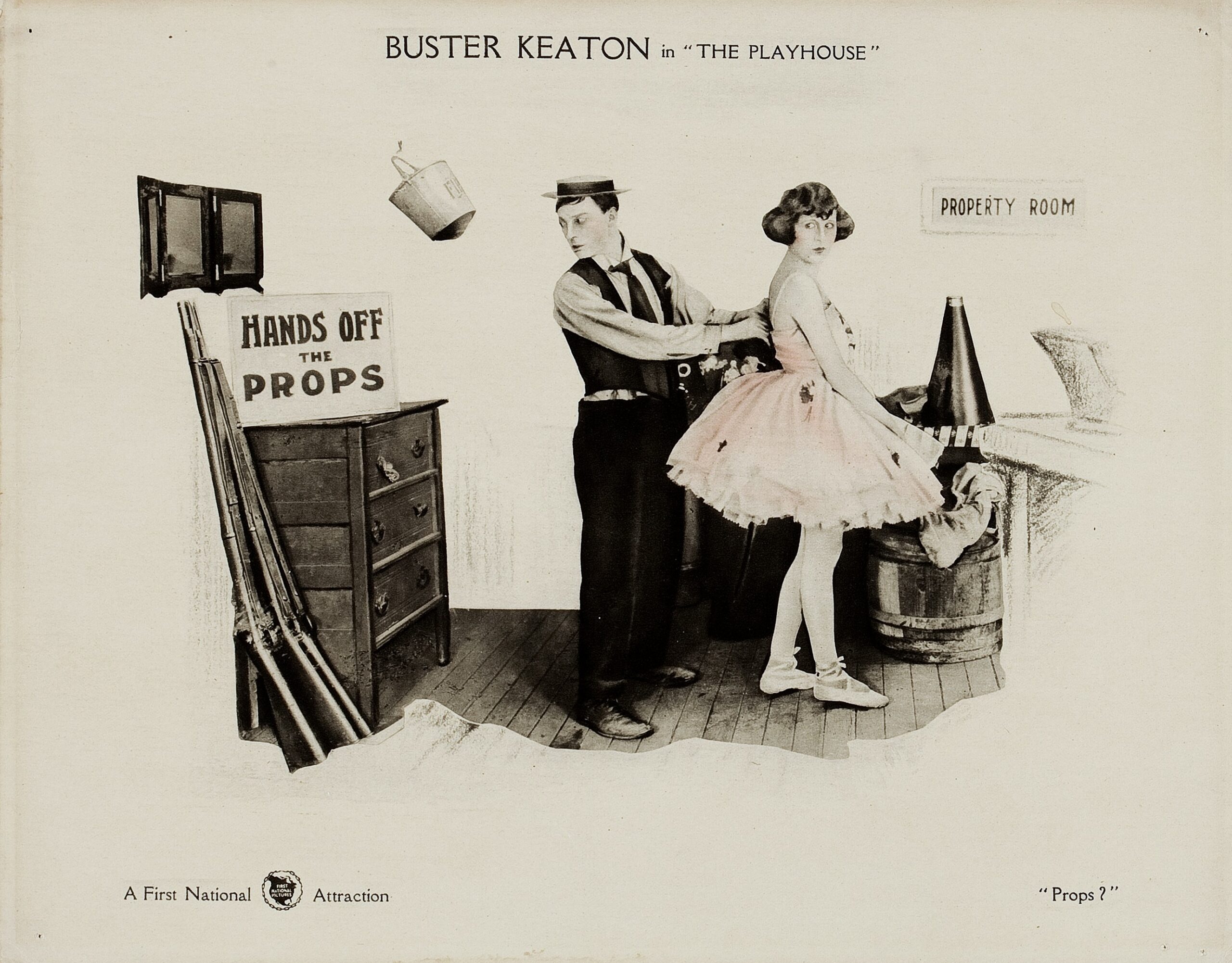
The Playhouse 1921 is a creative short film which features Buster Keaton playing all the parts of a theater audience and its orchestra together with its stage company. The Playhouse 1921 film is a free classic movie and public domain movie, widely available online in restored silent‑comedy collections and standalone uploads.
Movie Background Table
Movie Cast Table
Because The Playhouse is a short silent film, most performers are uncredited and appear in brief comic turns.
What is the complete plot of The Playhouse?
The Playhouse 1921 film is structured in two main parts: a surreal dream and a chaotic “real world” backstage story.
The dream: Buster is “the whole show”
The film starts at a vaudeville theater. The orchestra tunes their instruments on stage while ushers guide patrons to their seats and the performance is about to start. The entire theater audience which includes all musicians dancers and stagehands together with the conductor and his team are depicted through Buster Keaton’s advanced multiple exposure techniques.
Keaton conducts the orchestra as the bandleader, then appears simultaneously as all the orchestra members playing different instruments. He is also the entire audience, reacting in unison or in scattered gags—one Keaton coughs, another sleeps, another uses opera glasses. On stage, a minstrel show performs, and again, every performer, interlocutor, and “end man” is Keaton.
At one point, one Keaton in the audience comments via title card, “This fellow Keaton seems to be the whole show,” a sly jab at producer Thomas Ince, who was notorious for plastering his name over his productions. The sequence becomes increasingly dreamlike, with impossible repetition and perfectly synchronized actions that only trick photography can achieve.
Just as the vaudeville madness peaks, Buster is shaken awake. The entire opening is revealed to be a dream: he has been asleep in a bed. Joe Roberts, playing a burly stage manager/actor, rouses him roughly.
Waking up: the stagehand’s disasters
The “bedroom” space starts to transform into its actual function as a stage design element. Buster works at a small theater as an overworked stagehand who handles all backstage duties because he lacks recognition as a performer. The film develops from this point into a sequence of rapid-fire comedic bits which depict life in the theater.

Buster needs to move all equipment as well as perform stagehand duties for watching devices during their performance of strongman and dancing and novelty display and Zouave soldiers (French-style soldiers) sketch. He constantly makes mistakes because he misjudges timings and objects collapse at inappropriate times and he unintentionally enters dangerous areas where objects and heavy materials are thrown.
Buster accidentally sets free a trained monkey (or orangutan) which belongs to an animal show operated by Edward F. Cline’s animal trainer character. Buster must impersonate the missing animal by wearing a costume to perform on stage as he creates a fake animal display which includes climbing and running to deceive both the audience and the trainer. The impersonation almost succeeds until a real monkey appears or other events reveal the deception.
The twin romance and mistaken identity
A running subplot involves Buster’s interest in a young woman who happens to be a twin. One twin likes him; the other does not. The identical twin sisters create problems for Buster because they wear identical clothing and share no identification which results in Buster making romantic advances toward one sister while he actually interacts with the other sister.
The gags show people entering through doors before they exit through doors while Buster believes he speaks with one sister and not the other sister. People warn him to “mark your twin” but he fails to understand their warning and everything he does to identify them goes wrong.
The climactic segment of the movie shows one twin becoming stuck inside a water tank which functions as a theatrical prop. Buster attempts to free her by turning on the water which causes the tank to overflow and eventually flood the entire stage area. Water floods into the orchestra pit which forces the audience to flee in panic while the theater transforms into a swimming pool.
Buster saves the girl from drowning while everything else in the show gets destroyed. The short ends with the theater in ruins because Buster creates tremendous chaos whenever he appears in a theater whether people are awake or dreaming.
Genre and Key Themes of The Playhouse
The Playhouse is a silent slapstick comedy short with strong elements of surreal fantasy and backstage farce.
Key themes and ideas include:
- Identity and duplication
The opening dream turns identity inside out: Buster is everyone, everywhere, at once. This identity‑bending playfulness carries into the real‑world confusion with identical twins. - Reality vs. illusion
The shift from dream theater to real theater blurs the line between what is staged and what is “real,” emphasizing that both worlds are artificial constructions full of tricks. - The chaos of show business
As a stagehand, Buster embodies the invisible labor behind performance. His frantic efforts highlight both the fragility of theatrical illusion and the sheer physical effort required to keep a show going. - Technical innovation as comedy
Keaton’s multiple‑exposure effects are not just spectacle; they serve the gag about one man being “the whole show,” demonstrating how technology can deepen visual humor. - Mistaken identity in romance
The twin sisters storyline plays on classic farce devices: mixed‑up partners, wrong doors, and the danger of assumptions based on appearance alone.
The Playhouse (1921) Full Movie Watch and Download
Watch The Playhouse (1921) on Internet Archive:
🏛️ See Also
Women in the Night (1948) – WWII Nazi Exploitation Thriller in Shanghai | Full Public Domain War Drama Movie Online Free
The Kennel Murder Case (1933) – William Powell Philo Vance Locked‑Room Mystery | Classic Public Domain Full Movie Online Free
Embryo (1976) – Rock Hudson Sci‑Fi Horror Classic | Full Public Domain Movie “Created to Kill” Online Free
Popeye: Assault and Flattery (1956) – Classic Popeye vs Bluto Courtroom Cartoon | Free Public Domain Full Movie
Detailed Review of The Playhouse
The Playhouse 1921 film is widely regarded as one of Buster Keaton’s most technically daring and conceptually playful shorts. The multiple‑exposure dream sequence alone has earned it “classic” status, with modern critics calling it “identity‑bending” and “envelope‑pushing” for its time.
Technically, the film is astonishing. Cameraman Elgin Lessley used a custom shutter with nine independently movable strips to expose the film in sections, re‑winding it repeatedly as Keaton performed each new “clone” in exact timing. The precision required—guided by a metronome and hand‑cranked camera—was extreme, and the seamless result still impresses a century later.
The film presents two different comedic experiences which generate two distinct comedic experiences. The first element displays pure dream-based surrealism which shows Busters performing as an orchestra Busters who sit in an audience and Busters who participate in a minstrel show all displaying deadpan seriousness. The second element shows actual backstage disorder through which Keaton performs his usual style of underacting while using traditional prop-based humor and collapsing set pieces and increasing disasters.
Modern audiences face discomfort when they see minstrel show elements and blackface performances which display the stage traditions of the 1920s because these stage elements received widespread criticism but the film remains essential for technical analysis. The dual sister love story provides a humorous yet timeless companion story which depends on misunderstandings instead of character assumptions.
The Playhouse runs for 22 minutes which allows it to proceed swiftly and maintain a steady pace without extending its comedic moments. The film establishes two different worlds which prevent it from presenting one continuous performance that lacks substance as it reaches its maximum point with multiple exposures, then it transitions into backstage comedy.
The Playhouse serves as mandatory viewing for people who want to study silent film comedies. It shows Keaton not only as a great physical comedian but also as an inventive director and technician, and as a public domain movie it is easy to find in good‑quality transfers on archive sites and streaming platforms.
Frequently Asked Questions (FAQs)
1. Is The Playhouse (1921) in the public domain?
The Playhouse 1921 film is in the public domain in the United States and is widely available as a free classic movie on Internet Archive, YouTube, and other sites.
2. Who directed The Playhouse?
Buster Keaton wrote and directed The Playhouse while he performed the lead role, and Edward F. Cline shared directing and writing duties with him.
3. How long is The Playhouse, and what kind of film is it?
The Playhouse exists as a silent comedy short that lasts approximately 22 to 23 minutes and functions as a two-reel movie which combines slapstick and fantasy elements.
4. Where can I watch The Playhouse full movie online?
The public domain status of The Playhouse allows you to watch the full movie for free on Internet Archive and Plex and on multiple YouTube channels which feature restored Buster Keaton shorts.
Movie Tags
The Playhouse full movie, The Playhouse 1921 film, The Play House Buster Keaton, Buster Keaton silent comedy short, Buster Keaton multiple exposure trick film, vaudeville theater dream sequence, Keaton plays entire audience and orchestra, silent slapstick backstage farce, twin sisters mistaken identity plot, Edward F Cline co director, Elgin Lessley cinematography, 1920s American silent short film, classic Buster Keaton public domain movie, free classic movie, public domain movie