

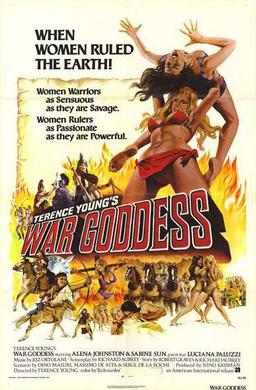
War Goddess 1973 directed by James Bond’s Terence Young. Full plot, cast table, Robert Graves story origins, Riz Ortolani score & where to watch online.
Genre: Action / Adventure / Sword-and-Sandal | Runtime: 95–100 minutes | Rating: R | IMDb: 4.7/10
You expect a certain standard when the director of Dr. No, From Russia with Love, and Thunderball signs on to a project. War Goddess (1973) is not that standard. It is, however, something genuinely interesting in its own right — a lavishly produced European co-production built around Amazon mythology, starring a multinational cast of Euro-cult actresses, scored by an Academy Award-winning composer, and drawing its story from one of the 20th century’s most respected classicists. Whether it delivers on that pedigree is a different question entirely. This is the full breakdown.
War Goddess 1973 — Movie Overview Table
| Detail | Information |
|---|---|
| Title | War Goddess |
| Also Known As | The Amazons / The Bare-Breasted Warriors / Charlie at the Show |
| Original Title | Le guerriere dal seno nudo (Italy) |
| French Title | Les Amazones |
| Spanish Title | Las Amazonas |
| Release Year | 1973 |
| Runtime | ~95–100 minutes (US release: 89 min) |
| Country | Italy / France / Spain (co-production) |
| Language | English dub / Italian |
| Director | Terence Young |
| Story By | Robert Graves (co-authored) |
| Screenplay | Richard Aubrey, Massimo De Rita, Serge de la Roche, Luciano Vincenzoni |
| Cinematography | Aldo Tonti, Alejandro Ulloa |
| Music | Riz Ortolani |
| Production Design | Mario Garbuglia |
| Editor | Roger Dwyre |
| Genre | Sword-and-Sandal / Adventure / Exploitation |
| MPAA Rating | R (nudity, sexuality, violence) |
| IMDb Rating | 4.7/10 |
| Letterboxd Rating | 2.5/5 |
Full Cast Table — War Goddess (1973)
| Actor | Role |
|---|---|
| Alena Johnston | Antiope — Queen of the Amazons |
| Sabine Sun | Oreitheia — Rival and Antagonist |
| Rosanna Yanni | Penthesilea |
| Helga Liné | High Priestess |
| Malisa Longo | Leuthera |
| Luciana Paluzzi | Phaedra |
| Rebecca Potok | Supporting Amazon |
| Lucy Tiller | Supporting Amazon |
| Almut Berg | Supporting Amazon |
| Angelo Infanti | Theseus — King of the Greeks |
| Ángel del Pozo | Greek Officer |
| Franco Borelli | Greek Warrior |
| Rita Calderoni | Supporting Cast |
| Lisa Halvorsen | Supporting Cast |
| Agnes Kalpagos | Supporting Cast |
| Paola Arduini | Supporting Cast |
The People Who Made War Goddess — And Why That’s the Real Story
Most discussions of War Goddess stop at “a Bond director made a trashy Amazon film.” That framing misses what makes the production genuinely unusual. Three of the key creative figures behind it carry serious credentials that sit in jarring contrast with the film’s exploitation packaging.
Terence Young — From James Bond to the Amazons
Terence Young directed the first three James Bond films for EON Productions: Dr. No (1962), From Russia with Love (1963), and Thunderball (1965). He shaped the visual and tonal blueprint of the entire Bond franchise — the tailored suits, the cool under pressure, the knowing wit layered over genuine tension.
By 1973, Young was operating in a different market entirely. The sword-and-sandal boom that had flooded Italian screens in the late 1950s and early 1960s had wound down, but the European co-production model — pooling Italian, French, and Spanish financing for genre pictures — remained active and profitable. War Goddess was that kind of project: a vehicle designed for international distribution rather than artistic ambition.
What’s visible of Young’s direction in the film is uneven. The large-scale sequences — battles involving extras in period costume, chariot work, horseback action — show the evidence of real budget. The intimate scenes carry far less craft. The film feels like two different directors working on it, which may say more about the production conditions than Young’s skill.
Robert Graves — The Classicist Who Co-Wrote the Story
The most genuinely surprising credit on War Goddess belongs to Robert Graves (1895–1985). Graves was one of the most respected English writers of the 20th century — poet, novelist, and the author of I, Claudius (1934) and The Greek Myths (1955), the latter being the defining popular reference work on classical mythology in the English language for decades.

His contribution to the War Goddess story provided the mythological scaffolding that the film builds on. The Amazon tribe, their rituals, their relationship to the Greeks, the character of Antiope and her connection to Theseus — all of these draw from the body of Greek myth that Graves spent decades analyzing and retelling.
Whether Graves had any meaningful creative control over the final screenplay — or whether his name was attached primarily for credibility — remains unclear. The screenplay went through multiple writers (Richard Aubrey, Massimo De Rita, Serge de la Roche, and Luciano Vincenzoni), and the finished film reflects the priorities of the producers more than the priorities of a classicist.
Riz Ortolani — The Score That Outperforms the Film
The third standout credit belongs to Riz Ortolani, the Italian composer who scored War Goddess. Ortolani won an Academy Award for Best Original Song for the theme from Mondo Cane (1962) and built a career scoring across European genre cinema — horror, spaghetti westerns, crime thrillers, and period epics.
His War Goddess score works independently of the film’s other qualities. The main theme is sweeping and dramatic, with an orchestral texture that the film itself struggles to live up to. Even critical reviews that dismiss most of War Goddess typically acknowledge that Ortolani’s music doesn’t embarrass itself.
Full Plot Summary — War Goddess (1973)
The film opens approximately three thousand years in the past. The Amazon tribe — a fully self-governed, all-female warrior state — holds a tournament to select their new queen.
The contest runs through multiple physical disciplines before reaching its final round: a wrestling match between Antiope and her longtime rival, Oreitheia. Antiope wins. She is crowned queen and immediately signals what kind of ruler she intends to be.
Believing the tribe has gone soft, Antiope reimposes strict discipline. Her primary decree: sexual contact with men is permitted only once a year, for the sole purpose of procreation. Male children born from these encounters are not kept. Oreitheia — ambitious, calculating, and resentful — begins quietly organizing opposition.
The Annual Meeting with the Greeks
The Amazons travel to their annual meeting with a group of Greek soldiers. Unknown to Antiope, the “captain” she selects as her mate is actually Theseus, King of the Greeks, operating incognito to understand the tribe he is dealing with.
Their night together produces something neither expected: genuine attraction. Antiope, trained from birth to use men as instruments and nothing more, finds herself unsettled by Theseus. She does not act on it — but the encounter has changed something.
Theseus, using his detailed knowledge of the terrain, directs the Amazons home via a route he knows is controlled by a rival male warrior tribe. The Amazons walk into an ambush. They fight back and drive the attackers off, but the damage — and the humiliation — is real. Antiope suspects Theseus engineered the situation.
The Male Child and the Plot Against Antiope
Back at the Amazon settlement, Antiope gives birth to a male child. Amazon law demands male infants be abandoned. What she does not know — what she will only learn much later — is that Theseus secretly retrieved and raised the boy in Athens. The child’s name is Hippolytus.
Meanwhile, Oreitheia’s conspiracy against Antiope deepens. She cultivates allies among the tribe’s senior warriors and positions herself to move the moment Antiope shows any sign of weakness. That sign comes when Antiope agrees to a second meeting with the Greeks.
The Second Meeting and the Battle
Antiope arranges the follow-up encounter with the intent of using it as a trap — mate with the Greeks and then destroy them as revenge for the ambush. She walks in expecting to kill Theseus. Theseus instead reveals what he knows: the assassination plot, the treacherous Amazons who fed him information about it, and the fact that their son is alive and being raised in Athens.
The revelation breaks Antiope’s composure. She slips away from the Amazon camp and travels secretly to Athens to see Hippolytus for herself.
The rest of the tribe — misled by Oreitheia and most of the senior warriors — believes Antiope was kidnapped. They pursue the Greeks to prevent news of the supposed abduction from spreading and dishonoring the tribe. A running battle unfolds. Theseus, trying to protect Antiope, has her physically tied to a carriage against her will to prevent her from fighting.
Both sides take casualties. Antiope watches Oreitheia die in the fighting — a death she cannot prevent and, despite everything, did not want. When Theseus calls a halt to the bloodshed, both armies listen.
The film ends with Antiope alone. She takes Oreitheia’s queen’s ring and slides it onto her own finger — an acknowledgment of her rival’s ambition, and of what the throne cost both of them.
The Sword-and-Sandal Genre — Where War Goddess Fits
The peplum or sword-and-sandal genre peaked in Italian cinema between roughly 1958 and 1965, producing dozens of films built around mythological and ancient historical settings — Hercules, Maciste, Spartacus variants, and Amazon stories among them.
War Goddess arrived in 1973, well after that peak. By then the genre had either evolved into the grittier historical epics of American and British cinema or collapsed into self-parody and exploitation. War Goddess inhabits the latter space — more interested in spectacle and provocation than in mythological authenticity.
It sits alongside other early-70s European productions that kept the ancient-world aesthetic alive while pivoting toward the adult content that distinguishing post-Production Code cinema: more nudity, more overt sexuality, less concern with historical plausibility.
The film’s scale — large cast, genuine location work, period costuming and chariot sequences — puts it above the cheapest end of this market. But the production’s internal tensions between its serious credentials (Graves, Ortolani, Young) and its exploitation objectives (the original Italian title translates directly to “bare-breasted warriors”) produce a film that fully satisfies neither audience.
The Euro-Cult Cast — Who These Actresses Were
The female ensemble in War Goddess draws from the deep pool of European actresses who built careers across Italian genre cinema during the 1960s and 1970s.
Alena Johnston, who plays Antiope, made only three films in her career. Her screen presence is striking, but the English-language dub and the screenplay’s limited characterization work against her in the dramatic sequences.
Luciana Paluzzi is the cast member with the most internationally recognizable credit. She played Fiona Volpe — the SPECTRE assassin — in Thunderball (1965), making her one of the few cast members with a direct connection to director Terence Young’s earlier work.
Helga Liné and Rosanna Yanni were both prolific performers in Spanish and Italian co-productions throughout the 1970s, appearing regularly in horror, fantasy, and adventure genre films across that decade.
Sabine Sun, who plays the antagonist Oreitheia, later married director Terence Young — a biographical footnote that adds a layer of curiosity to the dynamic between her character and Johnston’s Antiope.
Where to Watch War Goddess (1973)
War Goddess has had a complicated distribution history, with several different cut versions circulating under different titles across different markets. The US theatrical release ran approximately 89 minutes; longer European prints exist.
| Platform | Availability | Notes |
|---|---|---|
| Tubi | May be available free | Check current catalog |
| Amazon Prime Video | Rental/Purchase | Various print qualities |
| YouTube | Some uploads available | Print quality varies significantly |
| DVD | Available (out of print) | Mammoth double feature release includes this film |
| Archive.org | Check current listings | Availability varies |
Print quality across all available versions is inconsistent. The Mammoth Entertainment DVD release is the most commonly cited home video version. Viewer reviews note issues with image quality, contrast, and — in some prints — missing sequences referenced in other cuts.
Critical Reception — What Audiences and Critics Actually Said
War Goddess sits at 4.7 out of 10 on IMDb from a limited voter pool, reflecting its status as a niche curiosity rather than a broadly watched film. Letterboxd audiences are similarly divided, with the split running between viewers who find its camp value entertaining and those who find even that underwhelming.
The most consistent critical observation across reviews is the gap between the film’s ambitions and its execution. The production clearly spent real money — the scope of the battle sequences, the number of costumed extras, and the large shooting locations all suggest a genuine budget. The screenplay and direction don’t always make use of that investment.
Riz Ortolani’s score receives consistent praise even from critics who dismiss everything else. The stunt work and physical sequences draw mixed responses — some reviewers found the female cast’s athletic ability impressive, others found it unconvincing.
For fans of European exploitation cinema and sword-and-sandal genre history, War Goddess registers as a significant title — not because it is good, but because its production circumstances are genuinely unusual. A James Bond director, a classicist of international reputation, and an Oscar-winning composer converging on an Italian exploitation picture is not a thing that happened often.
Frequently Asked Questions — War Goddess 1973
Q: What is War Goddess 1973 about?
The film follows Antiope, the newly crowned queen of the Amazon warrior tribe, as she navigates a power struggle with her rival Oreitheia, an annual mating ritual with Greek soldiers, and an unexpected emotional connection with the Greek king Theseus.
Q: Who directed War Goddess 1973?
Terence Young directed the film. Young is best known for directing the first three James Bond films: Dr. No (1962), From Russia with Love (1963), and Thunderball (1965).
Q: Who wrote the story for War Goddess?
The story was co-authored by Robert Graves, the English poet and classicist best known for I, Claudius and The Greek Myths. The screenplay was developed by Richard Aubrey, Massimo De Rita, Serge de la Roche, and Luciano Vincenzoni.
Q: What countries produced War Goddess?
It was a three-country co-production involving Italy, France, and Spain. The Italian title is Le guerriere dal seno nudo, the French title is Les Amazones, and the Spanish title is Las Amazonas.
Q: Who composed the music for War Goddess 1973?
Riz Ortolani composed the score. Ortolani was an Italian composer who won an Academy Award for Best Original Song for his work on Mondo Cane (1962).
Q: What other names is War Goddess 1973 known by?
The film circulated under several titles: The Amazons, The Bare-Breasted Warriors, Les Amazones, Las Amazonas, and Le guerriere dal seno nudo. The title used in any given market often reflected what the local distributor thought would sell tickets.
Q: Is War Goddess 1973 based on mythology?
Yes. The film draws from Greek mythology surrounding the Amazon tribe, the figure of Antiope as queen, and her mythological connection to Theseus, King of Athens. Robert Graves’ contributions to the story root it in classical source material, though the finished film prioritizes spectacle and exploitation content over mythological accuracy.
Q: What is the IMDb rating for War Goddess 1973?
The film holds a 4.7 out of 10 on IMDb. Letterboxd users average around 2.5 out of 5, with mixed responses split between camp appreciation and genuine disappointment with the execution.
Q: Does Luciana Paluzzi appear in War Goddess?
Yes. Paluzzi plays Phaedra in the film. She is most recognizable internationally for her role as SPECTRE agent Fiona Volpe in Thunderball (1965) — the same Bond film directed by Terence Young.
Related Films to Explore
If War Goddess (1973) sits in your interest zone, these films cover adjacent territory:
- Swing High, Swing Low (1937) – Watch Free Romantic Musical Drama Online
- Guest in the House (1944) – Anne Baxter Film‑Noir Drama | Full Public Domain Classic Movie Online Free
- Public Domain Horror Movies – Free Classic Scary Films Online
- Public Domain Movies List – All Free Classic Films (Complete Guide)
Movie Tags
War Goddess 1973, War Goddess film, War Goddess 1973 cast, War Goddess Terence Young, War Goddess Amazon movie, War Goddess full movie, Les Amazones 1973, Le guerriere dal seno nudo, The Amazons 1973 film, Alena Johnston Amazon queen, Luciana Paluzzi 1973, Sabine Sun actress, Robert Graves film, Riz Ortolani score, sword and sandal 1973, Euro-cult adventure film, Italian peplum 1973, Amazon warrior movie, War Goddess where to watch, War Goddess streaming