
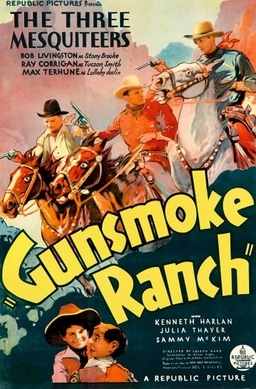
Gunsmoke Ranch (1937) is a compact, energetic Three Mesquiteers Western that mixes dust‑bowl angst with B‑movie action. In just under an hour, it gives you flood refugees, a crooked land syndicate, and three saddle pals determined to stop a slick politician from stealing everything desperate families have left. Now that Gunsmoke Ranch is a public domain movie, it’s one of the easier entries in the long‑running Mesquiteers series to find and enjoy as a free classic movie.
Movie Background Table
Movie Cast Table
| Actor | Role |
|---|---|
| Robert Livingston | Stony Brooke |
| Ray Corrigan | Tucson Smith |
| Max Terhune | Lullaby Joslin |
| Kenneth Harlan | Phineas T. Flagg |
| Jean Carmen | Marion |
| Sammy McKim | Jimmy |
| Oscar & Elmer | Themselves (ventriloquist act) |
| Burr Caruth | Warren |
| Allen Connor | Reggie |
| Yakima Canutt | Spider |
| Horace B. Carpenter | Larkin |
| Jane Keckley | Mathilda |
| Robert Walker | Williams |
| Jack Ingram | Jed |
| Loren Riebe | Hank |
| Jack Kirk | Sheriff |
| “Vinegar” Roan | Zeke |
| Wes Warner | Old Man |
| Jack Padjan | Duke |
Full Plot Summary
The movie starts with a background of the great depression. A horrible flood has swept farms and towns back East, making families homeless and desperate to have a second start. That is where Phineas T. Flagg, a smiling businessman who establishes the Paradise Land Syndicate, comes in. He offers fertile land and clean slate west, in a place named Gunsmoke ranch, to whoever is willing to put his or her name to the dotted line.
Flagg owns land at a bargain of two dollars an acre of the struggling Arizona ranchers, and he sells it back to victims of flooding at a profit of fifty dollars an acre. His glib talk and printed brochures put the business across as a charitable mission, when it is nothing more than profiteering. Beyond the small print is an even greater snare: the parcel he is selling is already being planned to be drowned and covered with a state dam. The newcomers are repairing a town that is going to be submerged.
The Three Mesquiteers, Stony Brooke, Tucson Smith and Lullaby Joslin, ride in on the other side of this situation. They are approached by the local ranchers with the syndicate offering them options on their land to benefit the poor folks in the East. Stony and Tucson are disposed to cooperate until one name is mentioned, Phineas T. Flagg. They know that he is the same crook who had been chased out of the local Mesquite three years ago.
Knowing a con is going on, Stony and Tucson are in a race to prevent a fellow rancher, Warren, turning his signed option to Flagg. They come when the ink has just dried, when it is too late to take the deal off without making a fuss. Flagg is reminding them with a smug expression that Warren is the one who signed voluntarily and the money is already in his hands. The syndicate is now the legal holder of a big piece of land in which Gunsmoke is located and nothing in the contract notifies the buyers of the impending dam.
In the meantime, caravans of flood refugees start to come: wagons, jalopies, trucks with families, furniture, and hope. They include Marion and her younger brother Jimmy who cling onto the notion of Gunsmoke ranch as a home. Flagg takes the group through the location, paints an idyllic image of their new town and gladly takes money and the Mesquiteers hang around him, deliberating about how to step in.
Lullaby is the ventriloquist in the trio, with his character Elmer, who is taking the comic relief and sometimes spying or distracting the villains with his dummy. The settlers feel grateful to the Mesquiteers who assist them with odd jobs, such as building, rounding up cattle, settling small misunderstandings, but they are much more hesitant to be warned that the whole business is a sham. Having lost everything in a flood once, they are emotionally involved in thinking that now their fortunes have looked upon them.
Stony fights with Flagg right in their face, and he accuses him of eating on disaster victims, and concealing the dam project to the victims. Flagg dismisses it as business and demands that the state should pay him fair value in case they want the land. In fact the options and contracts have been drafted in such a manner that the settlers have had no bargaining power. They will get a penny on the dollar, if that, of the tract they condemn.
The Mesquiteers make their mind up to remain near. They also assist the newcomers to construct houses, to drill wells and to plant gardens all the time compiling information quietly on the affairs of Flagg. They arrive at a camp to deal with muscle hired by Flagg, among them Spider (Yakima Canutt) and thereafter their fight culminates into fistfighting, horseback riding duels and the barroom brawls.
Week by week Gunsmoke starts to appear like an actual town. When the settlers begin feeling safe, a surveying squad comes with government directives. The whole Gunsmoke tract will be cleared to accommodate a new dam and reservoir. The houses, barns and fences constructed by the refugees will be submerged by the time the project is done. The shock is soon followed by panic and anger.
Of course, all this is known to Flagg already. Under stress, he says that he did not have a choice and that he was only obliged to accept to sell the land to the chief engineer of the dam, Rankin. He positions himself as being a mere businessman who was in-between the settlers and the state. The Mesquiteers don’t buy it. They are aware of the syndicate arrangement that was created to channel all the power into Flagg and his two invisible partners.
Stony finds a possible avenue of attack: when at least one of the settlers possesses a clear, fully paid deed to a bit of land, big or little, the state will be obliged to negotiate on the spot, instead of merely driving everyone out as part of the deal made by the syndicate. That would either delay the condemnation, or increase the payout, or at least blow the whistle over Flagg doing the same.
They have the forty acres of land which Warren has in his possession deeded to him outright, paying Flagg 2000 dollars–money raised with the aid of the Mesquiteers and friendly ranchers. There is one catch: Flagg states that his signature is not enough. The deed is required to be made legal by all three heads of the syndicate and he claims that the rest are not available at hand.
Here on, the movie juggles between action and procedural obstacles. The Mesquiteers plan to locate the other partners and make them confirm the act as Flagg and his men attempt to undermine or incriminate the three on and off the murder. Lullaby and Elmer serve as a distraction, Tucson is the one involved in the rough fighting, and Stony takes care of the political and legal side.
The schemes of Flagg in the climax lead to the legal battle and threat. The Mesquiteers reveal his story as cheater to the settlers and the local authorities, presenting how he purchased the property at a low price and concealed the plans of dam but when he sold the property, he sold the lot to the settlers at very high prices. Settlers finally realize the pattern and become his turncoats.
Action scenes, stampedes, ambushes, and shoot-outs are used to tie the loose ends up, and the Flagg and his gang are taken to jail, run away, or otherwise disarmed. The act of Warren is not unknown; the presence of one title makes the state difficult to bulldoze the society and provides the settlers with a basis to insist on more appropriate treatment.
As the dust settles, Gunsmoke Ranch still faces the dam, but the people who moved there are no longer blind pawns in one man’s scheme. Thanks to the Three Mesquiteers, they have time, leverage, and the backing of honest locals. The film closes with the trio riding off, ready to tackle the next injustice on the range.
en if the setting is far from modern life.
Gunsmoke Ranch (1937) Full Movie Watch and Download
Watch Gunsmoke Ranch (1937) on Internet Archive:
🏛️ See Also
Woody Woodpecker in Pantry Panic (1941) – Classic Winter Survival Cartoon Full Movie
The Last Time I Saw Paris (1954) – Elizabeth Taylor Romantic Drama Classic | Free Public Domain Full Movie
Sabotage (1936) – Alfred Hitchcock London Terror Thriller | Free Public Domain Full Movie
Love Laughs at Andy Hardy (1946) – Mickey Rooney Postwar College Romance | Free Public Domain Full Movie
Genre and Key Themes
Gunsmoke Ranch is a B‑Western, part of Republic’s long‑running Three Mesquiteers series, but it’s more topical than many oaters of its era. It blends standard cowboy action with New Deal‑era concerns about displaced farmers, government projects, and shady middlemen.
Key themes include:
- Exploitation of disaster victims
Flagg’s entire scheme is built on the desperation of flood refugees. He offers them hope and uses their need to justify outrageous markups and legal traps. In 1937, that would have resonated with Dust Bowl and flood‑era audiences. - Crooked intermediaries vs. government power
The film doesn’t demonize the dam project itself so much as the private swindler who positions himself between the state and vulnerable people. The state is faceless; Flagg is the one we’re encouraged to hate. - Populist justice
The Mesquiteers side instinctively with the dispossessed. They use both guns and legal loopholes to fight back, suggesting that justice can be pursued within the system if honest people are willing to dig in. - Community solidarity
Ranchers, refugees, and the trio have to cooperate to buy Warren’s deed and push back against Flagg. The story leans on the idea that working together is the only way small people can counter big schemes.
These ideas give the film a light political edge, consistent with other Depression‑era Westerns that quietly endorsed aspects of Roosevelt’s New Deal by criticizing exploiters rather than reforms.
Movie Review
As a Three Mesquiteers entry, Gunsmoke Ranch is tight, lively, and surprisingly topical. Robert Livingston’s Stony is the de facto lead, playing the straight‑arrow problem solver who balances talk and action. Ray Corrigan’s Tucson provides muscle and easygoing charm, while Max Terhune’s Lullaby—along with his dummy Elmer—supplies comic relief that lands more often than it distracts.
Kenneth Harlan makes Phineas Flagg an enjoyably hissable villain: smooth when selling, petulant when challenged, and just cowardly enough that you want to see him squirm in the final reel. Jean Carmen and Sammy McKim add a bit of heart as Marion and Jimmy, though like many supporting characters in B‑Westerns, they’re more symbolic (hopeful settlers) than deeply developed individuals.
Director Joseph Kane keeps the story moving briskly. At 53 minutes, Gunsmoke Ranch doesn’t have time to waste, and it rarely does. Dialogue scenes are short and functional, quickly giving way to riding sequences, fistfights, and plot turns. The staging of action—helped by Yakima Canutt’s stunts—is a cut above some contemporaries, with a few memorable gags and falls.
The script’s greatest strength is its hook. Using flood victims and a dam project as the backbone of the story grounds the usual “land swindle” plot in something real people were reading about in newspapers. Modern reviewers on IMDb even comment that the film “resonated well with people in the dust bowl,” precisely because it reflected their anxieties about losing land and being manipulated by smooth talkers.
On the downside, characters beyond the core trio and Flagg can feel thin, and the emotional stakes are more implied than explored. We rarely sit with the settlers’ fear for long; the film is always hurrying to the next set piece. Some modern viewers also see the pro‑New Deal shade—casting the private syndicate as villain and the state as neutral—as a bit on the nose, though it’s historically interesting.
As a public domain movie, Gunsmoke Ranch (1937) full movie exists in many different prints, some badly worn and others nicely restored by outfits specializing in classic Westerns. When you find a decent transfer, it’s an enjoyable, efficient slice of 1930s B‑Western history, especially for anyone tracking the evolution of Republic’s Three Mesquiteers formula.
Movie Tags
Gunsmoke Ranch full movie, Gunsmoke Ranch 1937 film, Three Mesquiteers Western, Robert Livingston Stony Brooke, Ray Corrigan Tucson Smith, Max Terhune Lullaby Joslin, Phineas T. Flagg land swindle, Republic Pictures B‑Western, Great Depression flood refugees, dam project Western plot, Joseph Kane director, classic black and white Western, free classic movie, public domain movie