

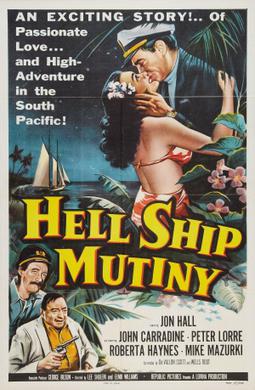
The Hell Ship Mutiny (1957) is that type of South Seas adventure that could only be shot in the 1950s: a form of travelogue, a sort of boys own adventure, a submerged demo reel. Jon Hall cruises in crystal waters, searches in pearl beds, battles mugs, makes love with a Polynesian princess, and even finds time to share scenes with John Carradine, Peter Lorre, and a chimp that goes by the name Salty, and steals scenes. Hell Ship Mutiny is a free domain film nowadays so it is an easy breezy viewing experience to any person interested in vintage island mysteries and TV-to-film experiments of the mid 20th century.
Movie Background Table
Movie Cast Table
| Actor | Role |
|---|---|
| Jon Hall | Capt. Jim Knight |
| John Carradine | Malone |
| Peter Lorre | Commissioner Lamoret |
| Roberta Haynes | Princess Mareva |
| Mike Mazurki | Ross, chief henchman |
| Charles Mauu | Tula, sailor |
| Stanley Adams | Roxy, first mate |
| Danny Richards Jr. | Tatoa, native boy |
| Felix Locher | King Parea |
| Peter Coe | Prince Terahi |
| Michael Barrett | Pinky, Malone’s henchman |
| Salvador Baguez | Kuala |
| Salty the Chimp | Salty |
Full Plot Summary
Captain Jim Knight is a master of a tiny trading schooner plying cargo and people between sun-drenched islands. His usual crew consists of a rainbow team of Roxy, the first mate who always has something to say; Tula, a sure-footed islander who is also a sailor and a regular contributor on this ship; and Salty, the chimpanzee, who doubles as a mascot and partial servant. They work job to job and make a moderate income and low-adventure risk.
On one of their regular calls, Knight steers his ship toward an island he knows well, home to King Parea, Princess Mareva, and a community of pearl divers. He expects a friendly welcome. Instead, he finds fear. The beach is quiet, the divers are wary, and the king’s authority seems hollow. It doesn’t take long to learn why.
A pearl‑poaching operation run by Malone, a cold, manipulative outsider, and his brutal henchman Ross has taken control of the island. Malone and Ross force the local divers to work far beyond safe limits, driving them to dangerous depths and pushing them back into the water when they’re exhausted. Several have already died. The villagers are trapped between their own reef and the thugs’ guns.
Knight, who grew up in the islands and feels genuine loyalty to the locals, can’t just sail away. He and his crew begin quietly pushing back, testing Malone’s control and looking for a way to break it. Tensions flare when Knight refuses to play along with Malone’s “business” terms. At one point he’s shackled underwater to force him to gather pearls for the gang, only to wriggle out and swim to freedom in a sequence that doubles as a showcase for the film’s underwater photography.
Eventually, Knight and his crew manage to outfight and outmaneuver Malone’s small gang on the island. After a brawl and some clever sabotage, they capture Malone, Ross, and Pinky, their remaining henchman. The islanders are briefly free, but Knight knows that unless the men are formally tried and sentenced by colonial authorities, they could return—or worse, be replaced by someone even more vicious.
Knight sails his prisoners to Tahiti, where Commissioner Lamoret, a circuit magistrate, is supposed to take charge of them for trial. Lamoret, played with typical dry amusement by Peter Lorre, is more interested in creature comforts than in rushing off to administer justice. Still, he understands that Malone’s abuses can’t simply be ignored. Knight prepares to hand the men over.
The transfer does not go smoothly. Malone and his crew escape custody, seizing an opportunity to get the drop on Knight and his men. They force Knight to take them aboard his own ship and order him to sail for New Zealand, where they hope to disappear and cash in pearls and stolen loot far from the reach of island law. In effect, they turn Knight’s schooner into their getaway boat—the closest thing the movie offers to the “mutiny” promised by its title.
Knight is more knowledgeable about the geography and the boat than anyone. Instead of being docile, he is the one to sabotage their escape. He throws both the food and water on board of the ship overboard, knowing that Malone is unable to kill the sole man who knows how to sail them through the reefs and the currents. It turns into the fight of wills the crooks possess guns, however, Knight is the one who possesses the only way to lead them to the safe place.
Knight and his crew are able to reverse the tide once more by a series of faked cooperation and timing and defeating the Malone crew and reclaiming the ship. Again, the villains are now trussed and handed over. On this occasion, a new legal set up is established. Rather than carrying the men away a small French magistrate is sent out to the island of King Parea in order to hold the trial there.
The magistrate arrives with formal robes and nominal authority, but he doesn’t have Lamoret’s weary integrity. When a native boy, Tatoa, stumbles on the wreck of an old ship offshore—rumored to contain the treasure of a Burmese king—the magistrate’s moral compass starts spinning. The idea of sudden wealth proves too tempting.
Seeing an opening, Malone and Ross pitch the magistrate a new deal. Instead of delivering justice, they can all get rich together by controlling access to the wreck and its treasure. The magistrate agrees, effectively switching sides and joining the criminals he was sent to judge. Corruption, once an outside pressure on the island, now has a local legal face.
Knight, Princess Mareva, and the islanders realize they are back where they started—again facing armed outsiders who want to use their reef and their lives as expendable tools. The difference now is that Knight knows exactly how far Malone will go, and he has already beaten him twice.
The last act is all about the race towards the wreck and possession of the treasure. Submerged shots depict forced and willing divers swimming over coral reefs and debris seeking treasure chests and artifacts. Knight and his men wish to save Tatoa and Mareva, ensure the treasure does not go around the necks of the islanders like jewelry and reveal the betrayal of the magistrate.
In a series of underwater brawls, deck hands, and reverse twists, Knight and his comrades can disable Malone and Ross permanently and expose the corruption of the magistrate. As the dust is cleared, King Parea and his people take back their island and pearls, and it is promised that the law, in this case represented however poorly by Lamoret and the colonial government, will now realize what occurred.
Knight takes away his crew, leaving an island a bit more free than when he had discovered it, and with him the feeling that there will ever be another reef, another crooked trader and another adventure somewhere in the South Pacific.
Genre and Key Themes
Hell Ship Mutiny (1957) is first and foremost a South Seas adventure film, with a strong dose of seafaring action and light crime elements. It belongs to that mid‑century “island picture” tradition: sarongs, schooners, colonial officials, and pearl beds rather than saloons and six‑shooters.
Key themes include:
- Exploitation vs. stewardship
Malone and Ross treat the islanders as expendable labor, forcing them to dive dangerously for pearls and later scheming over a sunken treasure. Knight, in contrast, sees the people and the reef as something to be protected, not mined to death. - Corruption of authority
Commissioner Lamoret is lazy but fundamentally honest; the minor magistrate who joins the criminals shows how easily official power can be twisted when money is involved. The film makes a simple but pointed comment: titles don’t guarantee integrity. - Outsider heroism and insider agency
Knight is the white adventurer at the center of the story, but moments like Tatoa discovering the wreck and King Parea asserting his rule remind us that the islanders are not just scenery. Still, the framing is firmly of its era, with Polynesian culture romanticized and flattened. - Adventure as escape and advertisement
There’s an extra‑textual theme, too: Jon Hall made Hell Ship Mutiny partly to showcase underwater cinematography and promote his own underwater equipment business. The film’s many diving scenes serve the story and double as a sales reel for a certain fantasy of South Seas life.
These themes aren’t explored with modern subtlety, but they give the film more structure than a simple string of fistfights.
en if the setting is far from modern life.
Hell Ship Mutiny (1957) Full Movie Watch and Download
Watch Hell Ship Mutiny (1957) on Internet Archive:
🏛️ See Also
Woody Woodpecker in Pantry Panic (1941) – Classic Winter Survival Cartoon Full Movie
The Last Time I Saw Paris (1954) – Elizabeth Taylor Romantic Drama Classic | Free Public Domain Full Movie
Sabotage (1936) – Alfred Hitchcock London Terror Thriller | Free Public Domain Full Movie
Love Laughs at Andy Hardy (1946) – Mickey Rooney Postwar College Romance | Free Public Domain Full Movie
Movie Review
Hell Ship Mutiny is a lightweight and straight forward film taken as it is. Being a free classic movie, it is like a long TV episode, which is what it is, a pilot of a failed series glued together. The fact that TV is DNA is evident in the snappy pace, in the way that each crisis is resolved, and in the manner that Knight and his crew flow through their troubles and issues without much psychological baggage.
Captain Jim Knight, played by Jon Hall as the type of plain, square-jawed hero that he had made his specialty, is calm in the water, at home in the water, and as at home giving orders or bestowing a few soft flirtations to Princess Mareva. He is not straining himself, but he has no reason to. What is appealing about the character is his invincible competence and his relaxed attitude to his crew and the natives of the island.
The villainy demanded by the film is delivered by John Carradine, Malone, and Mike Mazurki, Ross. Carradine bends forward behind his lanky threat and smooth voice and Malone finds himself the brains of the outfit even when the script does not provide him an elaborate scheme. Ross by Mazurki is a more overt type of force, a hulking enforcer whose presence heightens the physical antecedent any time he is present.
Peter Lorre’s Commissioner Lamoret is a highlight despite limited screen time. Even in what amounts to an extended cameo, Lorre can’t help but bring layers: his Lamoret is greedy, sardonic, and oddly sympathetic, a man clearly tired of his circuit but still more decent than the minor magistrate who replaces him.
Roberta Haynes’s Princess Mareva is written largely as an exotic love interest and symbol of the island’s innocence, with less interiority than a modern script would give her. Still, she and Hall generate a gentle chemistry, and her scenes help ground Knight’s heroics in something more personal than abstract justice.
On the technical side, the film’s strongest asset is its underwater work. The diving sequences, pearl‑bed shots, and underwater scuffles are clearly where the production’s energy went. For a mid‑1950s independent feature drawing from a TV pilot, the footage is impressive and likely played as a major novelty for audiences at the time.
Critically, Hell Ship Mutiny didn’t make much of a splash. The Monthly Film Bulletin dismissed it as a “juvenile adventure film” that “sadly lacks vitality” apart from the fights and underwater shots. Modern viewers on genre blogs and sites like Letterboxd tend to echo that: pleasant enough, thinly plotted, and mainly of interest for its cast and its place in Jon Hall’s late‑career run of South Seas projects.
As a viewing experience now, Hell Ship Mutiny (1957) full movie works best if you go in expecting exactly what it offers: a lean, 66‑minute island caper with a likable hero, colorful villains, a sprinkle of Lorre, and a lot of time spent in and under the water. Its public domain status means prints vary in quality, but it’s easy to sample and just as easy to abandon if the retro charm doesn’t click for you.
Movie Tags
Hell Ship Mutiny full movie, Hell Ship Mutiny 1957 film, Jon Hall South Seas adventure, John Carradine island villain, Peter Lorre Commissioner Lamoret, Polynesia adventure movie, pearl diver exploitation story, South Pacific seafaring film, Republic Pictures black and white adventure, underwater treasure hunt, Knight of the South Seas pilot, Salty the chimp classic, free classic movie, public domain movie