
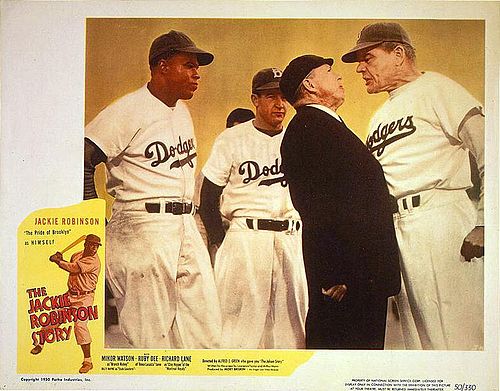
The Jackie Robinson Story (1950) is a fast‑moving biographical drama in which Jackie Robinson plays himself, tracing his journey from talented kid athlete to the man who broke Major League Baseball’s color barrier with the Brooklyn Dodgers. Today, The Jackie Robinson Story full movie is a widely available free classic movie and public domain movie, often seen in both original black‑and‑white and later colorized editions.
Movie Background Table
Movie Cast Table
| Actor | Role |
|---|---|
| Jackie Robinson | Himself |
| Ruby Dee | Rae (Rachel) Robinson |
| Minor Watson | Branch Rickey |
| Louise Beavers | Jackie’s mother |
| Richard (Dick) Lane | Clay Hopper |
| Harry Shannon | Frank Shaughnessy |
| Ben Lessy | Shorty |
| William H. Spaulding | Himself |
| Billy Wayne | Clyde Sukeforth |
| Joel Fluellen | Mack Robinson |
| Bernie Hamilton | Ernie |
| Kenny Washington | Tigers Manager |
| Pat Flaherty | Karpen |
| Larry McGrath | Umpire |
| Emmett Smith | Catcher |
| Howard Louis MacNeely | Jackie as a boy |
| George Dockstader | Bill |
Full Plot Summary
The Jackie Robinson Story starts with a sandlot in Pasadena, California, where a young Jackie impresses a passing person with his fielding. Being impressed by the instinctive talent of the boy, the man gives him a battered baseball glove, a little yet significant thing that gives some clues about the future of Jackie. When he becomes a man, Jackie is a star multi-sport player at UCLA who lettered in football, basketball, track, and baseball, yet he is concerned that there is no future with a Black college athlete when school is over.
Mack, who is his elder brother is a testament to that fear. Although Mack is an Olympic winner and a college graduate, he is reduced to a position of cleaning the street, good, steady work, which nevertheless highlights the fact of racism that curtails Black potential. Jackie writes letters in an attempt to secure a coaching position to no avail since the only response he gets is the rejection.
Jackie is drafted during the World War II and is in U.S. Army, where he is talented in sports and becomes an athletic director. Despite being uniform, he has to face segregation and discrimination, which leaves their mark on his interpretation of racism as something that permeates every aspect of American life. Following the war, he enters the Kansas City Monarchs, one of the top Negro Leagues clubs and starts his career in professional baseball under the harsh circumstances of bus touring and meager pay that most of the Blacks are subjected to.
Jackie is in a relationship with his college sweetheart, Rae (Rachel) off the field, although they are always on the move and this does not help in sustaining their relationship. On his way to the road, something extraordinary occurs that Branch Rickey, the president and the general manager of Brooklyn Dodgers, silently makes the decision that it is time to sign a Black player. He sends scout Clyde Sukeforth to locate Jackie and assess him.
Initially, when Jackie is approached by meeting Rickey he thinks it must be a joke. The notion that a Black athlete can invite himself to participate in organized white baseball is ludicrous considering a long-standing understanding called the gentlemen agreement that prevents Black athletes to participate in the majors. After he is convinced that the offer is real, he goes to Brooklyn to give him a face to face meeting.
It is in the most critical dialogue in the film when Rickey and Jackie are measuring each other. Rickey tells of his plan: Jackie will be assigned to the highest farm club of the Dodgers the Montreal Royals, where he will demonstrate that integration is possible. And there is one condition: Jackie should be able not to fight off. Rickey tells him that he will be cursed, spiked, taunted, even threatened and that any display of temper can destroy not only his own future but the future of every Black player who might come after him. Jackie is first offended by the thought of not fighting, but eventually consents to, having the greater cause in mind.
Jackie also marries Rae before they head north to help him to get through the ordeal he is about to go through. Jackie is soon proven in Montreal. At second base with Royals, he is the leader in hitting, and a popular athlete with the fans, particularly in the warmer quarters of Montreal. Nevertheless, he does not get along with non-cooperative players and even with his own teammates, and the movie demonstrates that he has to bear slurs and dirty play and suppress his emotions and focus on baseball.
Rickey chooses to take Jackie to Dodgers against the claims by the Commissioner of Baseball and club owners complaints. The 1947 season invited Jackie to Brooklyn and this made him the first Black player in the modern major league baseball. The advertising increases the intensity. A petition on refusing to play with him is being passed amongst some Dodgers players, fans dump racist abuse in the stands, and some opposing teams attempt to get games canceled instead of playing an integrated club.
At the field, Jackie is invited to play the first base where he has never played before and he plunges into a slump in batting. Positional change, hostile crowds and constant scrutiny are driving him out of his confidence. All the time Rae offers emotional support at home reminding him of the reasons he made the risk and he should believe that his performance will be respected by the end.
Steadily, the talent and hard work of Jackie reverse the fortunes. His baserunning and hitting start transforming games, and some of the teammates who previously were disbelieving about him also start to believe that he is making them win. Some main white players publicly support him, which eases tensions at the clubhouse and sends a message that the Dodgers are one team.
There is a build-up to a pennant-race game. In the final scenes, the Dodgers require a victory to win the National League pennant. Jackie is the driving run in the tying run and, after that, takes the winning run (because this film amounts events to drama), winning the flag to Brooklyn. Following that triumph, it is even more difficult to have opponents and racist critics claim that he does not fit in.
The movie does not have a definite end but is symbolic. Jackie is called upon to speak to the United States House of Representatives in Washington, D.C. the acknowledgement that his influence had transcended into the world of sport into the world of politics and civil rights. In front of legislators, he himself is a symbol of his success as well as the fight of equality that will go on even after the last credits.
Genre and Key Themes
The Jackie Robinson Story combines elements of a biographical sports drama with its main social justice theme. The film decreases its time span while showing essential human aspects of the story because it maintains its primary focus on three themes which are racism and bravery and self-control.
Key themes include:
- Breaking the color barrier
The film shows how a single player’s entry into Major League Baseball challenged a deeply entrenched segregation system and opened doors for others. - Courage through restraint
A central tension is Jackie’s promise not to retaliate against abuse. The story frames his refusal to fight back physically as a different kind of bravery: enduring humiliation for a larger purpose. - Support and partnership
Rae Robinson and Branch Rickey are presented as crucial allies—one emotional, one institutional—who help Jackie survive a path no one had walked before. - Talent versus opportunity
Mack’s fate as a street cleaner and Jackie’s initial job rejections highlight how systemic racism wastes ability and limits options, regardless of merit. - Symbol and individual
The film walks a line between presenting Jackie as a symbol of progress and as a human being who feels fear, anger, and doubt, making the story accessible beyond baseball fans.
The Jackie Robinson Story (1950) Full Movie Watch and Download
Watch The Jackie Robinson Story (1950) on Internet Archive:
🏛️ See Also
Woody Woodpecker in Pantry Panic (1941) – Classic Winter Survival Cartoon Full Movie
The Last Time I Saw Paris (1954) – Elizabeth Taylor Romantic Drama Classic | Free Public Domain Full Movie
Sabotage (1936) – Alfred Hitchcock London Terror Thriller | Free Public Domain Full Movie
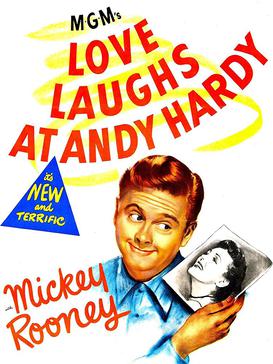
Love Laughs at Andy Hardy (1946) – Mickey Rooney Postwar College Romance | Free Public Domain Full Movie
Movie Review
Being a movie, The Jackie Robinson Story is simple and even preachy, yet it has the real strength behind the mere fact that Jackie Robinson stars in it only several years after his debut. Modern critics such as Bosley Crowther observed sincerity of the dramatization and fine, unexcited acting by Robinson that many Hollywood stars would be jealous of such possession on screen.
Jackie is not a sophisticated professional actor, but his naturalness and silent dignity are appropriate to the content. Ruby Dee, at the beginning of her career, extends the comfort and power to Rae and makes the story look more realistic with the marriage than with an ideal love. Branch Rickey, the character played by Minor Watson, is filled with a sense of being both savvy businessman and ethical maneuverer, which lends the scenes of them in their offices the dramatic importance of more than the sports-movie clichéd pep-talk.
The director Alfred E. Green maintains fast pacing through the entire film because he needs to complete the story from childhood to college and to military service and to the Negro Leagues and to Montreal and finally to Brooklyn within a time span of one hour. The movie’s fast pace leads to a rushed and simplified presentation of certain scenes while the film presents only mild prejudice against Robinson instead of showing the severe violent hate that he experienced. The 1950 studio-production directly illuminates racism through its main theme.
The film uses basic elements for its theater presentation and shows baseball games through simple game recreations and it contains multiple scenes which take place in offices and living spaces. The film achieves its highest level of quality through its authentic presentation of Jackie Robinson who runs and swings and speaks about current events which were still fresh in public memory at that time because the footage shows actual events.
Modern critics sometimes describe The Jackie Robinson Story as “corny but important” because the movie fails to meet artistic standards yet serves as an essential historical document which connects sports history with Hollywood and the civil rights movement. The film remains available to audiences because it exists as a public domain movie which has been used in television packages and classroom presentations and online archives while new viewers experience the film through colorized and remastered versions which they discover through recent films about Robinson.
Movie Tags
The Jackie Robinson Story full movie, The Jackie Robinson Story 1950 film, Jackie Robinson biopic, Jackie Robinson plays himself, Branch Rickey integration story, Brooklyn Dodgers color barrier, Negro Leagues to MLB, classic baseball movie, 1950s sports drama, Alfred E. Green director, Ruby Dee Rae Robinson, Eagle‑Lion Films biographical drama, civil rights and baseball, free classic movie, public domain movie