
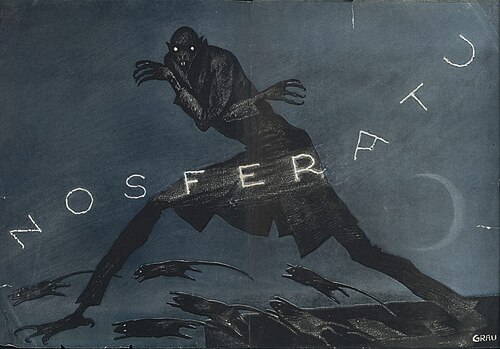
Nosferatu (1922) is a silent German expressionist horror masterpiece based on a real-estate agent who goes to Transylvania and brings back to his home city a vampire that spreads a plague. This classic Nosferatu (1922) movie is nowadays popularly viewed as Nosferatu full movie and regarded as a free classic movie and a powerful public domain movie that influenced virtually all screen vampires that followed after it.
Nosferatu (1922)
Nosferatu (1922) or Nosferatu: A Symphony of Horror, is a silent horror film produced by F. W. Murnau and written by Henrik Galeen, which is based on a novel by Bram Stoker, however, it is a loose adaptation of the original Dracula story. In this movie, Max Schreck depicts Count Orlok, a vampire who resembles a dead body and who arrives in Wisborg, a port town, and spreads death and terror with him to the remote castle in Transylvania. Nosferatu was released in 1922 by the short-lived Prana Film and, despite being one of the earliest works to get the open domain status in the US, it has since been recognized as one of the most significant horror films in the history of the industry.
Movie Cast Table
Max Schreck’s disturbing physicality as Orlok, juxtaposed to the wide-eyed purity of Gustav von Wangenheim and Greta Schröder as Hutter and Ellen respectively, contributes to the haunting, surrealistic effect of the silent movie Nosferatu (1922).
Full Plot Summary
Nosferatu (1922) begins with a fictional German town of Wisborg where a young estate agent Thomas Hutter and his wife Ellen live a happy life. The weird and passionate Knock, the employer of Hutter, is approached by an unknown nobleman called Count Orlok who desires to buy a house in Wisborg, conveniently, the house standing directly opposite the residence of Hutter. Knowing a profitable opportunity Knock sends Hutter to Transylvania to sign the deal.
Ellen is left with their friend Harding and the sister of Harding, Hutter, and Hutter starts the long drive to the distant castle owned by Orlok in the Carpathian mountains. Local people who stay at an inn close to the border react with terror when they hear the name of Orlok and tell Hutter that there is danger in the area, about werewolves and evil spirits. They encourage him not to go out at night and he sweeps off their superstitions and proceeds.
A coach drives Hutter to a mountain pass the next day, but the drivers decide not to go any further because it is getting late. Hutter, after crossing a bridge, is taken by a mysterious black carriage which is driving in an unnatural speed to the castle where he is met by the dirty, claw-fingered Count Orlok. During dinner, Hutter accidentally cuts his thumb and Orlok is incredibly eager to suck his blood, though Hutter turns away in fright.
Hutter wakes up the next morning alone in the castle, feeling weak and noticing small puncture marks on his neck, which he first blames on mosquitoes. That night, Orlok signs the papers to buy the house in Wisborg and notices Ellen’s picture, remarking greedily on her lovely neck. Disturbed, Hutter begins reading a book about Nosferatu he picked up at the inn and slowly realizes that “Nosferatu” is another word for vampire.
As midnight approaches, Hutter is trapped in his room with no way to bar the door. It opens by itself, and Orlok glides toward him, casting the now‑famous long shadow on the walls. The film cuts away as Hutter faints, leaving the full horror implied rather than shown.
The following day, Hutter goes to the castle, and the coffin of Orlok is in one of the crypts, with the vampire lying in the grave. In shock, he runs back to his room and at some point, he finds Orlok packing the coffins with soil on a coach and then gets to pack his own coffin before the others, and they head to Wisborg. Hutter manages to get out of the castle through the window, but on his way, he cuts himself and finds himself in a hospital later as Orlok proceeds with his journey.
The coffins are floated downriver first on a raft and secondly on a schooner going to Wisborg. When sailors open one box, they see it is full of rats, and soon the crew starts dying in a mysterious way. The crew members fall sick one by one and die till only the captain and the first mate are left. The mate descends to the lower deck to destroy the coffins, but Orlok stands up stiffly from his coffin in one of the film’s most breathtaking scenes; in fear, the mate throws himself into the water. The captain ties himself to the steering wheel, but Orlok kills him at last, and the haunted ship drifts into the harbor of Wisborg.
On discovering the body of the captain tied to the wheel when they investigate, they attribute the numerous deaths to a plague introduced by the ship. Meanwhile, Orlok sneaks on shore with the coffin on his arms to his new house across the street of the home of Hutter. Very soon, the citizens of Wisborg begin dying in masses and the town turns into a panic, as the people are sure that the Black Death is reappearing.
Back home in Wisborg, Hutter goes back to Ellen who has been having weird visions and psychic linkage with the far off vampire. Knock, who has mentally connected with Orlok, is imprisoned in an asylum, but manages to escape, which scares even more the townspeople who follow him both in the streets and on the roofs. Ellen reads the Nosferatu book hidden in Hutter and knows that the only means of destroying such a vampire is that a pure hearted woman would willingly sidetrack the vampire with her beauty and make him feed until the sun comes up.
Knowing the price this would entail, Ellen waits till one night, and opens her window, which catches the attention of Orlok, who was on the other side of the road. However, Hutter is on her own despite her anxiety, and she dispatches Hutter to find Professor Bulwer (the film version of Van Helsing). In a sequence of odd and dark shots, Orlok is crossing the street and entering her bedroom, where he starts to feed on her lying in bed.
Orlok is totally captivated and fails to keep up with the passage of time as he consumes her blood well after he should have returned to the coffin. When the rooster crows and the sun comes up, he attempts to walk out but is exposed in broad daylight, and turns into smoke and disappears before the window. Ellen dies of her injuries when Hatter returns and before her death he is carried by Hatter in his arms. The last shot is of the ruined castle of Orlok in the mountains and this is the symbol of the termination of his curse.
Genre and Key Themes
Nosferatu (1922 film) is a foundational work of silent horror, German Expressionism, and vampire cinema. Its jagged shadows, unusual camera angles, and on‑location shooting create a world that feels both realistic and nightmarish.
Key themes include:
- The vampire as plague: Unlike later suave Draculas, Count Orlok brings rats and disease, making him a personification of pestilence and collective fear.
- Fear of the foreign “other”: Orlok is an outsider from a distant land whose arrival triggers panic and death, echoing early‑20th‑century anxieties about invasion and contamination.
- Sacrifice and love: Ellen’s choice to offer herself to save Wisborg turns the climax into a tragic, almost spiritual act of self‑sacrifice.
- Expressionist psychology: The stark architecture, exaggerated shadows, and stiff movement mirror the characters’ inner fear and powerlessness.
Because of these themes and its striking visuals, Nosferatu full movie still feels eerie and poetic rather than just dated, which is rare for a horror film over a century old.
Nosferatu (1922) Full Movie Watch and Download
Watch Nosferatu (1922) on Internet Archive:
🏛️ See Also
Charlie Chaplin’s The Adventurer (1917) – Free Classic Silent Comedy Full Movie
Charlie Chaplins Police (1916) Full Movie – Classic Silent Comedy Short
A Man Betrayed (1936) – Classic Republic Crime-Drama
The Terror (1963) – A Gothic Mystery Horror Classic
Movie Review
Nosferatu (1922) is considered to be one of the best movies ever produced in the genre of horror and is still an important landmark of reference to both academics and viewers of the genre. It is hailed by critics as having used location shooting, creative camera-work, and memorable imagery, in particular the shadow of Orlok ascending up the staircase and the inflexible emergeance of the coffin.
The role of Count Orlok portrayed by Max Schreck is the axis point of the impact of the film. His angular body, claw-like hands, bald head, and rat-like teeth make him a monster, and not romantic one at that; he is made to appear really sick and old, a walking death. The supporting actors, especially Gustav von Wangenheim and Greta Schroder, are straightforward but genuine performers that bring to the earth the more surreal aspects.
The pace of the action and the acting style used by the modern audience can be regarded as slow and rather broad, typical of silent movies, yet the atmosphere and visual narration are very strong. Its status as an unauthorized adaptation to the novel caused it to be the subject of a well-known lawsuit and an effort to make all prints of the film disappear, which nevertheless enabled it to exert an influence on subsequent productions such as Nosferatu the Vampyre (1979) and the creation of numerous homages and parodies as well as scholarly debates.
Nosferatu in the U.S. is mostly considered a public domain film so there are numerous versions and many of them are restored, many of them are damaged such that it is easy to find a free version of the film as an old movie. Nosferatu full movie is a must watch to anyone who has an interest in silent films, German Expressionism and is fascinated by vampire lore.
Movie Tags
Nosferatu 1922, Nosferatu full movie, Nosferatu 1922 film, Nosferatu A Symphony of Horror, F. W. Murnau, Max Schreck, Count Orlok, German Expressionist horror, silent horror film, vampire movie, Dracula adaptation, Thomas Hutter, Ellen Hutter, Knock character, plague and vampire, German silent films, Weimar cinema, classic horror movie, free classic movie, public domain movie, vintage cinema, black and white horror, early vampire film, Wisborg setting, Transylvania castle, influential horror classic.