
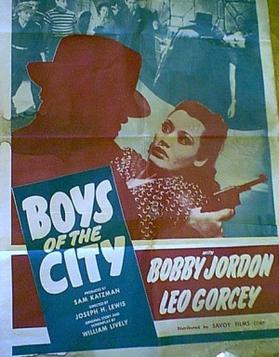
public domain films that seems to have stumbled upon a lost Scooby-Doo pilot project with New York accents. It is the one time the East Side Kids are truly the East Side Kids, casting Leo Gorcey and Bobby Jordan in a haunted-house film that runs like a blueprint of a bad-B-movie of the decades to come of spooky jokes.
Movie Background Table
Historical Background and Cultural Irrelevance.
Boys of the City came at a highly precise time in the Hollywood film cycle of the so-called kid gangs. Already, the Dead End Kids and the Little Tough Guys had demonstrated that scrappy city boys could sustain an entire series of low-budget films with a combination of social commentary and hamfight comedy. One of the producers, Sam Katzman, saw a chance: rebrand the concept a little bit and even some of the same faces.
The initial film of the East Side Kids was rather an experiment. Katzman had the formula in place, and more importantly, with Boys of the City, Bobby Jordan, the former Dead End Kid now, and, first time in the series, Leo Gorcey, who was now already known to the audience as they bounced around the faux-gothic murder plot.
At the industry level, Monogram Pictures was in the business of just such a programmer; fast, cheap, and targeted at neighborhood cinemas which required something new each week. Director Joseph H. Lewis was well in his youth, having cut his teeth on B-pictures before proceeding to noirs that were more stylish such as Gun Crazy. Even critics and admirers have been able to see his penchant towards shady compositions in the mansion sequences here.
Boys of the City is a cultural artifact of how the juvenile delinquency was dealt with in the films of the 1940s: the boys crack wise, get into trouble, and appear before judges, but the system always gives them an option to reform school they are sent to a summer camp in the country. It is light, and it mirrors the real issues of the time regarding urban young adults and the hope that the environment can change them.
The movie nowadays comfortably occupies the catalog of the public domain, re-emerging as a free vintage movie on sites like Archive.org and YouTube, where it can be re-discovered by the viewer as an old curiosity and as the initial entry in the long East Side Kids/Bowery Boys series.
Movie Cast Table
| Actor | Role |
|---|---|
| Bobby Jordan | Danny Dolan |
| Leo Gorcey | Muggs McGinnis |
| Hal E. Chester | Buster |
| Frankie Burke | Skinny |
| Ernest “Sunshine Sammy” Morrison | Scruno |
| Donald Haines | Peewee |
| David Gorcey | Pete |
| Eugene Francis | Algy Wilkes |
| Vince Barnett | Simp, the bodyguard |
| Inna Gest | Louise Mason |
| Dave O’Brien | “Knuckles” Dolan |
| Minerva Urecal | Agnes, the housekeeper |
| Dennis Moore | Giles |
| Forrest Taylor | Judge Malcolm Parker |
| Stephen (Alden) Chase | Jim Harrison |
| Jerry Mandy | Cook |
| George Humbert | Tony |
Cast Biography Faces behind the Gags.
Bobby Jordan (Danny Dolan)
Jordan already had his name as one of the original Dead End Kids, appearing on stage and screen as tough but likeable street boys. In Boys of the City he remains the nominal leader of the band, the more reasonable one of the group compared to the other noisier personalities around him. His appearance served to bring over viewers of previous series into this new East Side Kids run.

Leo Gorcey (Muggs McGinnis)
Here Leo Gorcey actually comes into the scene. Following his work with the Dead End Kids, he transplants his trademark malapropisms, swagger and scrunched-up attitude to the character of Muggs, establishing the persona that would make him the star of dozens of East Side Kids and Bowery Boys movies. Even in this case, fans observe that when Gorcey appears on screen, all the things change; he is not a member of the gang, he is already the center of gravity of the gang.
Ernest Sunshine Sammy Morrison (Scruno).
One of the earliest Black child stars of Hollywood, having starred in the Our Gang comedies, Morrison joined the East Side Kids, bringing it some vitality, some physical humor, but, unfortunately, some elements of racial stereotyping which has been justly criticized by contemporary audiences and critics. His time and experience demonstrate, even when the matter he deals with does not stand well.
Vince Barnett (Simp) & Minerva Urecal (Agnes).
Barnett is a character actor who usually does stuff as dim or nervous, but here, he plays Simp, the bodyguard whose name speaks it all. Minerva Urecal with her acute features and harsh demeanor was a favourite with gooey or grim housemaids, and as Agnes she lends the sections about the old dark house a real element of danger.
Joseph H. Lewis (Director)
Off screen, Lewis does contribute to the reason why the film is interesting in the present. He was later to be known as the master of a stylish noir and the western, here he displays the initial signs of the visual panache- interesting angles, good use of shadows – that would make him a cult figure in film lovers.
Full Plot Summary
The movie starts with the blazing city. A gang of street children- East side Kids- make up their minds that the most appropriate way to cool down is to open a fire hydrant and pour water over the block. To them it is harmless fun but to the authorities it is malicious mischief. They get rounded and dragged to court.
The boys are threatened with reformatory school and are about to receive a harsh lecture, but they have a lifeline however. They are accepted by Knuckles Dolan, a re-formed ex-con who has a fondness of kids, who takes them to a summer camp in Adirondacks and keeps them out of trouble. The judge, finding an opportunity of rehabilitation instead of punishment, accepts.
Knuckles drives the boys out of the city in a car, and they break jokes and bait each other all along the way. When the night comes and the countryside is getting darker, their automobile stops working in a remote street. In search of assistance, they meet Judge Malcolm Parker who is a middle-aged man with a weight evident on his mind. He unwillingly takes them in his large and damp home.
The environment changes in the mansion. Judge Parker has been indicted of bribery and has to live in fear. He lives with his niece Louise and a housekeeper Agnes, a body-guard, Simp and a friend, Giles who appears to know too much. Racketeers have threatened the Judge and Louise, and Giles openly charges him with embezzling the inheritance of Louise. Agnes on the other hand attributes the death of her former mistress, Leonora to the Judge.
His paranoia rises when the Judge realizes that Knuckles is a man whom he sentenced to death and subsequent reversal of this decision. Now, he is in the world of the people who can take revenge: fugitives, his ancient foes, and even his employees. The boys feel the tension but do not know all the undercurrents of the adult world and make jokes and search the house.
On that night everything backfires. The electricity is cut off, the streets are filled with darkness and Louise is stolen away somewhere inside the labyrinth of rooms and back corridors. A little later Judge Parker is discovered, strangled. During the confusion, the fingers are pointing everywhere. Giles and Simp turn on Knuckles and dig up his criminal record as evidence that he is the murderer.
The boys, who are loyal to Knuckles and who do not trust the adults of the house, conclude that they will investigate the case on their own. They are able to get hold of Simp and Giles, tie them up and attempt to interrogate them as they dig in the mansion. Upon a hunch, Muggs and Danny find a secret wall panel in the library. There is some secret opening behind it.
As they creep through the dim dark alley they discover Louise in a faint on the ground and they have a glimpse of a man running further into the passages. Knuckles races back and is able to intercept and seize the stranger. On being challenged, he produces himself as a Jim Harrison of the district attorney office and says he is undercover in the case of bribery of the Judge.
This further enigmas the mystery. Unless Harrison is the murderer, other people in the house are murderers as well-and they have proven capable of kidnapping, concealing and murdering in the middle of the night right before the eyes of everyone. In the new commotion, Louise is reclaimed by the actual murderer, taken away as a ransom or end woman.
The boys refuse to stand back. With the knowledge they have acquired regarding the secret corridors and the house construction, they follow the kidnapper to the secret passages and into the dark rooms. In a climax they reveal the murderer as the bodyguard of the Judge, Simp, who was avenging old scores and perhaps silent over some more sinister transactions.
Harrison is right: Simp is a contract killer, the one who was threatening the Judge the whole time. At last, Louise is saved, Knuckles is free, and the case is closed and the boys are able to leave the haunted house. They come to the summer camp, as it was planned at first, when the daylight or at the first appearance of the sun, they leave on the proposed expedition—they have managed to make a mere reform journey into a murder- investigation.
Uniqueness of Plot and Character Analysis.
The only reason why Boys of the City is interesting is not that the film simply plunks a group of kids gangs into an old dark house scene; it is the way it interacts with conceits, reputation, and terror.
Knuckles is central to this. He is an ex-death-row inmate with his conviction reversed, and entrusted to guide delinquent children on the right track. Judge Parker has once condemned him, and is mistaken, and must now be content to share space with a living memorial of his own untrustworthiness. That is the tension that lingers upon their interactions. As soon as the murder occurs, old prejudice reappears: Knuckles is the scapegoat. The way the boys are violently defending him speaks volumes of loyalty and the manner in which they evaluate character according to the lived experience rather than by official designation.
The children are themselves at a cross between being juvenile delinquents and amateur heroes. They are literally in front of a judge at the beginning of the mischief. At the end, they are smarter than adults, they have survived a trap and saved innocent individuals. The haunted house serves as a testing ground in which their street knowledge and bravery, as well as, team spirit are put into the test.
Judge Parker is a bundle of guilt and fear. Under indictment for bribery, blamed by Agnes for Leonora’s death, and accused by Giles of mishandling Louise’s money, he embodies compromised authority. His strangling feels not just like a plot twist but like the physical manifestation of all the pressures closing in on him.
It is not a mere coincidence that Simp turns out to be the killer. Being a bodyguard, he literally gets paid to defend, and here, he literally gets the opposite of that of what he is supposed to do, being the source of violence set against the man he is supposed to protect. The fact Harrison is there as a D.A. investigator is another dimension added to this: the justice systems, corrupt and upright, are haunting this house on all sides.
Directorially, Joseph H. Lewis foreshadows what he would accomplish in noir later. The underground corridors, low-lit corridors and cramped enclosing around the boys in dark corridors generate a tension beyond the limits of the budget. The juxtaposition of the wisecracks of the kids and the truly creepy background of the film makes the movie seem to be half a comedy, half a ghost-story dress rehearsal.
Genre and Key Themes
Boys of the City is a comedy-thriller, a detective, haunted house, and kid-gang movie.
Key themes include:
Second chances, redemption.
The boys are actually getting an opportunity to escape reform school. Knuckles is an old death inmate with a mission of doing good. According to the film, environment and trust can help point people who went astray.
Mistrust of authority
There are corrupt judges, body-guards, and friends. The ex-con is the only constant and decent adult character. That cynicism is appropriate to Depression-era and early-40s cynicism of institutions.
Youth vs. fear
Real fear is under the cover of bravado by the kids, which also holds them in motion. When they play jokes on ghosts they are in pursuit of a real murderer, demonstrating that humor can serve as the means of coping in terrifying circumstances.
Class and opportunity
Kids working in the streets of the city tripping into an aristocratic mansion emphasizes contrasts of classes, but the movie does not explore politics deeper. The summer camp as such is positioned as a nicer environment that is purchased with charity and goodwill.
It is these themes that provide the film with a little more texture than it would seem with its cheap haunted-house quickie image.
Background Information and Hearsay.
The second film of the East Side Kids and the first to have the three boys of the Children: Bobby Jordan, Leo Gorcey and Ernest Sunshine Sammy Morrison together, virtually forming the main gang that would develop into the Bowery Boys.
It was also sold in other markets as The Ghost Creeps, focusing on the spooky-house aspect.
The producer, Sam Katzman, who was a particularly low-budget eater, used Boys of the City as evidence that an East Side Kids series would work on the Monogram Pictures.
Hal E. Chester made it through the first film, however, his character was killed in the previous film and thus he does a different role here. This was the last time he appeared in the East Side Kids.
It was not renewed and thus the movie went into the public domain, hence the reason why there are so many poor quality duplicates. The scans have been later improved and released on Archive.org and YouTube.
This is one of the areas where the work of Joseph H. Lewis is singled out by film historians as an early example of the visual ingenuity which he would later apply to film noir, particularly in his long takes and expressive compositions in crowded areas.
Reception and Legacy Criticism Critical Reception and Legacy
Boys of the City was dressed at the time as the B-movie it was, a Monogram B-picture designed to pad out double bills. The East Side Kids and the mixture of laughs and chills were the attraction of the trade reviews, yet it was not a high-end product.
Subsequent evaluations have been in both directions but more interesting. According to Turner Classic Movies, it can be called a street-kids-in-a-haunted-house comedy that had its glowing moments, and it left a mark in ensuring Leo Gorcey becomes an important figure in the series. It is now disregarded by some contemporary critics on platforms such as Letterboxd as being mediocre horror comedy, since the visual side of its performances cannot wholly compensate for such shallow content, and they decry blatantly racist jokes at the expense of Scruno.
Simultaneously, fan groups that trace their origins to the Dead End Kids / East Side Kids / Bowery Boys tradition regard Boys of the City as a significant precursor: the transition between more brash and dramatic juvenile-delinquent films and the more gag-a-minute comedies that would become dominant in the 1940s.
Since it is a movie in the public domain, Boys of the City full movie continues to resurface in classic film streams and DVD collections, especially as an illustration of how much ambience a resourceful director could squeeze out of a small budget. It is no masterpiece, but a cheerful, exposing object.
Boys of the City (1940) Full Movie Watch and Download
Watch Boys of the City (1940) on Internet Archive:
🏛️ See Also
Woody Woodpecker in Pantry Panic (1941) – Classic Winter Survival Cartoon Full Movie
The Time of Your Life (1948) – James Cagney Barroom Drama Gem | Free Public Domain Full Movie
Billy the Kid Returns (1938) – Roy Rogers Singing Cowboy Western | Free Public Domain Full Movie
War of the Wildcats (1943) – John Wayne Oil Boom Western | Free Public Domain Full Movie
Editorial Movie Review
Viewing Boys of the City today may not be as suspenseful, with most aficionados of the genre likely to figure out who the murderer is early on, but it is a chance to experience the crass dynamics of the East Side Kids in their early stage of development. The performance is stereotypical yet it works as such. The grounded, even earnest center of Danny played by Bobby Jordan is matched by Leo Gorcey who steals most scenes with his mouthed bravado and mugging expressions. Ernest Morrison gives it dynamism, but the stuff he has to work with is more the blindnesses of the age than his genius.
Joseph H. Lewis is more careful in directing than the script itself dictates. The corridors of the mansion are designed to seem deeper and darker than the set was likely, and movement, like boys scurrying through hidden passages, characters emerging through doorways, etc., is employed to ensure that the film does not seem stagnant. The haunted-house gimmicks (panels that fall out of the wall, blackouts, strange noises) are all cliches, yet they are used sufficiently fast to be entertaining.
The narration is unproblematic. As soon as the children get to the house of the Judge, the movie switches between the detective, arguing, and usual jump-scares. The pacing is usually brisk, which is aided by the brief duration, and the initial scene with fire-hydrants and certain comic moments of the movie may feel unnecessarily long unless you are already a believer in the Kids being chatty.
Boys of the City, as an experience, feels like a comfort-food curiosity: it is not essential cinema, but it is a delightful, sometimes awkward blending of genres that precursors of much of subsequent kid-mystery formula owe their own existence to. Being a free classic film, it can be sampled with ease, and in the case of East Side Kids or Bowery Boys history, it is almost obligatory.
Movie Tags
Boys of the City full length movie, Boys of the City 1940 film, East Side Kids film, origins of the Bowery Boys, Leo Gorcey Muggs McGinnis, Bobby Jordan Danny Dolan, Joseph H. Lewis director, haunted house kid gang comedy, Monogram Pictures B -movie, Sam Katzman producer, black and white mystery thriller, old dark house comedy, classic public domain movie, free classic movie, 1940s juvenile delinquent films.