
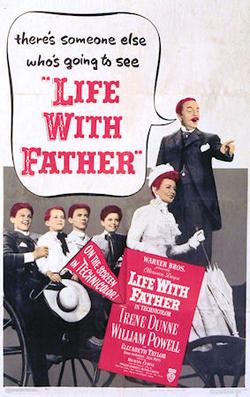
Life with Father (1947) is an endearing, softly satirical peep at a Victorian New York family that is governed by the father who merely believes that he is in charge. It is a Technicolor comedy with nowadays the status of a movie in a free domain, allowing you to see William Powell and Irene Dunne transform the most ordinary family conflicts into something entertaining, poignant and would you believe, heartfelt.
Movie Background Table
Movie Cast Table
Full Plot Summary
The setting of Life with Father (1947) is in 1883 Manhattan, in a nice brownstone where Clarence Day Sr. is a stockbroker, his wife Vinnie, and their four red-haired sons. Clarence prefers to think that his house functions just like his office: he has to do everything his way, at his time and nothing to have any surprises. He suits himself better than ever, works at Wall Street every morning, and demands that everyone should be quiet and obedient at home.
Reality is different. His adorable and apparently confused wife, Vinnie, tends to control almost all decision-making and allow Clarence to believe he is the king of the world. The boys, Clarence Jr., John, Whitney and Harlan are growing at a fast rate, getting into petty scrapes, finding girls, and experimenting at their own little enterprises, such as selling patent medicines.
The plot is presented in a sequence of related episodes. At the very beginning, Clarence explains that he does not wish to see any relatives. Virtually the next minute Vinnie tells him that she has already invited their cousin Cora Cartwright and her young friend Mary Skinner to spend a week at their place. Clarence talks the big talk, moans and demands that the house cannot be converted into a boarding house. Vinnie smiles and listens and does not alter anything.
The house is made livelier when Cora and Mary come in. Clarence Jr. falls in love with Mary, and his rigidity and awkwardness prevent their initial scenes with a lot of embarrassment and comedy. They find themselves sitting on his lap in the parlor at one point. Still rattled, he says get up, she cries hysterically because she does not want him to believe that she is some forward and audacious girl. That misconception is the knot of Victorian manners, which ties together the normal teenage emotions so tightly.
In the meantime, Clarence Sr. still presides over all suits to servants. Another quote that will always stick in the mind is when an employment agent inquires about the character of the home in which he sends a maid, he replies, Madam, I am the character of my home! But he is always outsmarted: maids appear and disappear, Margaret the cook sticks her ground and Vinnie simply spends money which he believed to be saved.
The main theme comes out when the family finds out that Clarence Sr. was not baptized. To Vinnie it is a theological emergency: she is screaming that he will not make it to heaven not because of being unbaptized. The entire notion seems ridiculous to Clarence. He argues that his upright conduct should be more than a ritual in which he never felt the need to have.
The local minister, Rev. Dr. Lloyd, is drawn into the debate. He gently urges Clarence to consider baptism, more to reassure his family than to change God’s mind. Clarence resists, arguing religion like a contract, quibbling over doctrine and propriety. The more others push, the more stubborn he becomes.

While this argument simmers, daily life goes on. Clarence Jr. and Mary deepen their shy romance; the boys jockey for attention and independence; Vinnie has a mild health scare that reminds everyone, including Clarence, how fragile comfort can be. There are little domestic crises—spilled soup, household bills, a new suit that doesn’t fit—that show how this “iron” father is constantly knocked off balance by real life.
After some time, Vinnie becomes unwell to the extent that Clarence is actually scared. In a flash, the fearless leader of the home visualizes the loss of a silent yet strong woman who is the pillar of the whole house. In his weak condition, he vows to be baptized should she just recover. She does and he is caught in his own words.
The film builds toward the question: Will he go through with it? There are discussions with Rev. Lloyd, logistical fuss about when and where the baptism should take place, and plenty of comic hedging on Clarence’s part. In keeping with Production Code rules, the original play’s line “I’m going to be baptized, dammit!” had to be toned down, but the basic idea remains: a proud man grudgingly accepting a symbolic act for the sake of peace at home.
The transformation of Clarence to an easy-going father is not done at the end. He continues to shout orders, worry about costs and say that he runs it. However, we and he know better, that the true power of the home rests in the patience of Vinnie, the affection of the boys, and in a mutual understanding that love is more than perfect power. Life with Father ends very warmly: a quarrelling, laughing, and scrabbling family, and Father in the centre, but not exactly the throne to which he dreams.
Genre and Key Themes
Life with Father (1947) is a comedy and family film with elements of gentle period drama.
Key themes include:
- Family authority vs. quiet influence
Clarence believes he is the unquestioned head of the house, yet almost every major decision is steered by Vinnie’s softer, more effective approach. - Tradition and change
Set in 1883, the film shows a Victorian household where strict rules meet a changing world: growing children, less rigid romantic ideas, and new ways of making a living. - Religion and everyday life
The baptism plot isn’t theological debate so much as a look at how faith, fear, and habit shape family choices, especially when someone you love is worried about your soul. - Appearance vs. reality
The house looks perfectly ordered; the father looks in control. Underneath, the messiness of real life—money issues, mild chaos, bubbling emotions—is always there.
These themes keep the story relatable even if the setting is far from modern life.
Life with Father (1947) Full Movie Watch and Download
Watch Life with Father (1947) on Internet Archive:
🏛️ See Also
Woody Woodpecker in Pantry Panic (1941) – Classic Winter Survival Cartoon Full Movie
The Last Time I Saw Paris (1954) – Elizabeth Taylor Romantic Drama Classic | Free Public Domain Full Movie
Sabotage (1936) – Alfred Hitchcock London Terror Thriller | Free Public Domain Full Movie
Love Laughs at Andy Hardy (1946) – Mickey Rooney Postwar College Romance | Free Public Domain Full Movie
Movie Review
The Life with Father (1947) is a movie that does not follow one long storyline but a set of well-considered incidents. It is as it is in the memoirs of Clarence Day Jr., and the long-running Broadway production, and it fits the skillful, classical direction of Michael Curtiz.
The star performance is that of William Powell. As Clarence Sr., he is a character we know well autocratic and yet fundamentally decent patriarch, but he gives him minor tics, outbursts, and glimpses of self-doubt, which make him seem real. His nomination and nomination is a sign of how he fuses comedy and sincerity by his Oscar nomination in Best Actor.
Irene Dunne fits him perfectly well. Her Vinnie appears to be distracted on the surface, losing bills and forgetting to inform Clarence about something until the very end, but she is never emotionally lagging behind. It is frequently mentioned in reviews that she does the housework silently but lets him think it is so and Dunne delivers that dual performance with a lovely and accurate touch.
Elizabeth Taylor, in an early Technicolor role, makes Mary Skinner sweet and slightly tacky, so that the subplot of teenage romance becomes endearing, instead of sickly sentimental. Edmund Gwenn, ZaSu Pitts, Jimmy Lydon and the younger actors are a nice complement and bring out a life that seems to be busy and inhabited.
Life with Father is a handsome book visually. The Technicolor cinematography received an Oscar nomination and the art direction and set decoration were as well with the period New York being detailed as it was polished. The interior is not excessive but very rich, and the palette of the colors helps the movie to look very warm and nostalgic.
Critics remark that the rhythm may be pedestrian in places, merely due to the story being of the everyday occurrences not of any earth-shattering twists. That milder pace suits the content, though; you are not supposed to run through the world of this family, but to slur through it.
Being a modern day free classic movie, Life with Father (1947) full movie is also subject to the blessings of the public domain, with several different versions of the film being restored and remastered; although older, damaged copies continue to exist. To the audience who wants to watch movies about character-oriented comedies, old Technicolor, and other stories about powerful yet loving families, it is a nice and sometimes insightful movie.
Movie Tags
Life with Father full movie, Life with Father 1947 film, William Powell comedy, Irene Dunne Technicolor classic, Elizabeth Taylor early role, Victorian New York family film, baptism family comedy, Michael Curtiz Warner Bros. movie, Broadway play adaptation, Clarence Day Jr. memoir film, classic Hollywood family comedy, free classic movie, public domain movie