
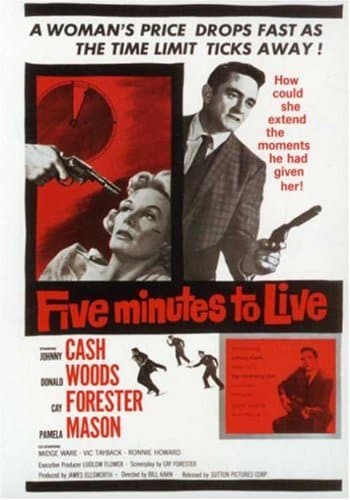
A person watching Johnny Cash approach a bright suburban entrance while carrying a guitar case and showing his crooked smile will realize that he brings nothing valuable to the situation. The 1961 film Five Minutes to Live uses that specific visual element to create an entire story which combines elements of a crime thriller with a heist film and a home invasion horror movie.
Long before true‑crime podcasts and prestige hostage dramas, this small black‑and‑white film quietly explored how fragile middle‑class safety really is. Today, it survives as a free classic movie and a U.S. public domain movie under both its original title and the re‑release name Door‑to‑Door Maniac, making it easy to watch—and hard to forget once you’ve seen Cash’s cold stare up close.
Movie Background Table
Movie Cast Table
| Actor | Role |
|---|---|
| Johnny Cash | Johnny Cabot |
| Donald Woods | Ken Wilson |
| Cay Forrester | Nancy Wilson |
| Pamela Mason | Ellen Harcourt |
| Vic Tayback | Fred Dorella |
| Ron Howard | Bobby Wilson |
| Merle Travis | Max |
| Midge Ware | Doris Johnson |
| Norma Varden | Priscilla Auerbach |
| Leslie Kimmell | Mr. Johnson |
| Marge Waller | Secretary |
| Patricia Lynn | Gert |
| Frances Flower | Irma |
| Hanna Landy | Carol |
| Cynthia Flower | Girl Bowling |
| Max Manning | Pete |
| Howard Wright | Pop |
| Charles Buck | Bank Teller |
Full Plot Summary
Five Minutes to Live opens in a darkened room with Fred Dorella, played by Vic Tayback, calmly describing how his latest bank robbery worked and how the next one will be even smarter. He isn’t a hot‑headed thug; he’s a planner, a man who believes he’s found the perfect small‑town score. His new idea is simple and cruel: rob a suburban bank by holding one of the executives’ wives hostage at home and giving the husband exactly five minutes on the phone to decide whether she lives or dies.
To pull this off, Fred needs a partner willing to do the ugliest part. Enter Johnny Cabot, played by Johnny Cash in one of his only theatrical film roles. Cabot is introduced as a hardened criminal—a man who enjoys his work a little too much. His job is to break into the home of bank vice president Ken Wilson, hold Ken’s wife Nancy at gunpoint, and kill her if Fred doesn’t call with confirmation that the ransom has been secured.
The morning of the job, Cabot parks outside the Wilsons’ neat suburban house and watches the routine unfold. Ken leaves for work in a suit and tie. Their young son, Bobby, heads off to school. The street is quiet, respectable, the kind of place where people answer the door without thinking twice. Cabot walks up carrying a guitar case and introduces himself as a door‑to‑door guitar teacher, looking for students. Nancy, alone in the house and not expecting danger, lets him in.
The act drops fast. Once inside, Cabot reveals his gun and his true intentions. He forces Nancy into a chair, binds her, and starts playing with her fear. Sometimes he’s mocking, sometimes oddly calm. He strums the guitar, sings the film’s title song about “five minutes to live,” and points his pistol at her almost casually, as if the whole scenario is a game he’s enjoying way too much.
Meanwhile, across town at the bank, Fred arrives in Ken Wilson’s office. He’s polite but direct. He hands Ken a check for $70,000 and explains the deal: Ken will process and withdraw that amount in cash to save his wife’s life. To prove Nancy is really being held, Fred makes Ken phone home. Nancy answers under Cabot’s watch, confirming that she’s in danger. Fred then tells Ken he has exactly five minutes to decide. If he doesn’t call back, Cabot has orders to kill her.
At first, something unexpected happens. Under pressure, Ken doesn’t react like a noble, panicked husband. Instead, he confesses to Fred that his marriage is disintegrating. He’s secretly planning to leave Nancy and run off to Las Vegas with his mistress, Ellen Harcourt. Letting his wife die, he hints, might actually solve a problem for him. He treats the whole thing like a grim, twisted opportunity.
Fred doesn’t buy it. He’s been around long enough to believe that when the clock really starts ticking, most men won’t let their wives be executed over the phone. As the five minutes pass, Ken strains to maintain his cold resolve. Eventually, as Fred expected, he cracks. Whether out of guilt, lingering love, or sheer self‑preservation, he agrees to get the money. Fred calls Cabot at the house and tells him to keep Nancy alive; the plan is still on.
Back at the Wilson home, Cabot continues to toy with his hostage. He fires shots near her to watch her flinch. He makes crude advances, which Nancy tries to manipulate to gain any advantage she can. She pushes, flatters, and stalls, but every time she seems to get somewhere, Cabot reasserts control. The house, once a safe domestic space, becomes a trap where the intruder has all the power and pleasure.
At the bank, the robbery starts to unravel. While Fred is working on Ken and trying to get the cash without drawing attention, someone triggers the silent alarm. Police converge on the building. The calm robber who narrated his “perfect” plan ends up caught in a very ordinary way. He’s taken down before he can leave or warn Cabot that everything has gone wrong.
Time stretches at the Wilson house. Cabot keeps waiting for the follow‑up call that never comes. The whole structure of the plan rests on precise timing, and that timing is now broken. As his certainty erodes, Cabot’s mood shifts from cruel amusement to growing paranoia. He realizes he might be alone on a sinking ship.
Then another complication walks in the front door: little Bobby Wilson, home from school for lunch. Suddenly, there’s not just a trapped wife but a child in the middle of the standoff. Cabot’s uneasy, unsure how to handle the boy. Around the same time, the police finally trace the situation and arrive outside, surrounding the house.
As sirens and officers gather, Cabot panics. Grabbing Bobby as a shield, he tries to fight his way out of the house. He runs into the yard with the boy in his arms and charges straight into police gunfire. Shots ring out. In the chaos, Bobby goes limp, and it looks like the worst has happened.
In a surprising twist, Bobby is only pretending. The boy plays dead so convincingly that Cabot, thinking he’s shot a child, is shaken for the first time. Horrified by what he believes he’s done—despite all his earlier threats—he drops Bobby and retreats back toward the gunfire, throwing himself into a final confrontation with the police. He’s killed in the exchange.
Bobby then appears alive again because he needs to show people that he faked his death. Nancy runs outside because she feels happiness after seeing her son alive and the terrible situation has ended. The movie ends with dark irony because Ken Wilson who planned to leave his wife for Ellen now drives to Las Vegas with his wife instead of his former lover. The crime has not succeeded but it has shown the real character of all people involved with it.
Genre and Key Themes
Five Minutes to Live (1961) is a lean crime thriller with strong film noir and home‑invasion elements. It mixes bank‑heist planning with suburban horror, using a single hostage situation to explore what people do under pressure.
Several themes stand out:
- The fragility of suburban safety
The Wilsons’ house is ordinary, pleasant, and open—exactly the kind of place where a man with a guitar can knock and be invited in. The film plays on the idea that danger doesn’t always come with warning signs; sometimes it wears a salesman’s smile. - Moral weakness vs. criminal brutality
Ken’s initial reaction is almost more chilling than Cabot’s violence. Where Cabot is openly monstrous, Ken hides selfishness under respectability. The story keeps asking which is worse: the man who terrorizes openly or the one who quietly sees benefit in another’s suffering. - Time pressure and choice
The “five minutes to live” gimmick isn’t just a hook—it frames how decisions are made. When you’re given a literal ticking clock to decide someone’s fate, what surfaces: love, guilt, cowardice, or cold calculation? The film lets that question hang over every phone call and missed signal. - Performance and identity
Cabot plays a guitar teacher; Fred plays the reasonable businessman; Ken plays the devoted husband. Everyone is acting to some degree. As events spiral, the masks slip, and the film’s suspense comes as much from those reveals as from the guns on screen. -
Five Minutes to Live (1961) Full Movie Watch and Download
Watch Five Minutes to Live (1961) on Internet Archive:
🏛️ See Also
Woody Woodpecker in Pantry Panic (1941) – Classic Winter Survival Cartoon Full Movie
The Last Time I Saw Paris (1954) – Elizabeth Taylor Romantic Drama Classic | Free Public Domain Full Movie
Sabotage (1936) – Alfred Hitchcock London Terror Thriller | Free Public Domain Full Movie
Love Laughs at Andy Hardy (1946) – Mickey Rooney Postwar College Romance | Free Public Domain Full Movie
Movie Review
As a piece of filmmaking, Five Minutes to Live is modest. The budget is low, the sets are sparse, and the pacing occasionally hiccups. But as a vehicle for Johnny Cash’s screen presence and a tight, unusual crime premise, it’s surprisingly effective.
Cash is not a polished actor here, and that works to the movie’s advantage. His stiffness reads as emotional detachment, and his natural physical weight and intense eyes make Johnny Cabot feel genuinely dangerous. When he sings the title song inside the Wilson living room, guitar on his knee, the scene lands somewhere between concert and threat. You’re watching Johnny Cash the icon and Cabot the character blur into one unsettling figure.
Cay Forrester, who also co‑wrote the script, shows Nancy through her performance as a character who experiences both terrified moments and resourceful situations. She shows her extreme fear but continues to search for weaknesses in Cabot through her three different tactics of flirting, stalling, and probing. Donald Woods displays Ken through his icy performance which makes him seem fragile during the moments when he considers his wife’s death. The film reaches psychological depth through its scenes which extend beyond traditional cops-and-robbers storytelling.
Vic Tayback’s Fred grounds the criminal side. He’s not flamboyant; he’s a working‑class thief who thinks he’s finally found his perfect plan. Watching that confidence evaporate as a silent alarm ruins everything is oddly satisfying. A very young Ron Howard, credited as Ronnie Howard, adds a sharp, natural presence as Bobby, especially in the sequence where he fakes being shot to escape.
Bill Karn’s direction shows functional skills which show occasional cleverness. The film uses its restricted settings which include the bank office and the Wilson living room to maintain suspense throughout the story. The suburban exteriors which show bright open spaces create a contrast with the interior spaces which make people feel confined showing how everyone remains trapped despite their apparent freedom. The black-and-white photography throughout the entire story produces a slightly dark noir style which extends to scenes that occur during daylight.
Storywise, the film holds together well. The structure—cutting between the bank and the house, watching the five‑minute windows open and close—is clear and easy to follow. A few beats, especially around the police response, feel rushed or underdeveloped, a reminder of the limited runtime and resources. But the core idea never gets lost, and the film doesn’t overstay its welcome.
As a viewing experience today, Five Minutes to Live full movie occupies a niche that’s become more interesting with time. It’s a rare chance to see Johnny Cash as a genuine screen villain, guitar and all. Its public domain status means it’s widely available in different transfers, and film fans have embraced it as a cult‑level curiosity: not a classic in the formal sense, but a memorable, oddly modern little thriller that punches above its weight.
Movie Tags
Five Minutes to Live full movie, Five Minutes to Live 1961 film, Door‑to‑Door Maniac, Johnny Cash crime movie, Johnny Cash first film role, bank heist hostage drama, suburban home invasion thriller, Ron Howard child actor, Cay Forrester Nancy Wilson, Bill Karn director, Sutton Pictures noir, 1960s black and white crime film, free classic movie, public domain movie, American neo‑noir crime drama