
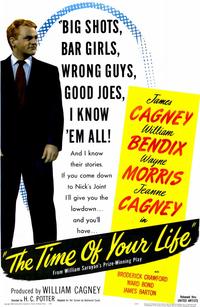
There aren’t many films where almost nothing “big” happens and yet you walk away feeling like you just spent an evening with people you actually know. The Time of Your Life (1948) is one of those rare, talky, humane movies that quietly get under your skin. Adapted from William Saroyan’s Pulitzer Prize–winning play, this public domain movie traps you in a San Francisco waterfront bar for two hours—and then makes you wish you could stay for one more drink.
For viewers discovering older cinema through streaming and free classic movie sites, The Time of Your Life (1948) full movie is a surprising change of pace. There are no car chases, no twists engineered for social media reactions, just a philosophical barfly, a handful of lost souls, and the question: what would happen if someone truly believed your dreams mattered more than your “real” life?
Movie Background Table
Historical Context and Cultural Relevance
The Time of Your Life was born twice: first on Broadway in 1939, then on film nearly a decade later. Saroyan’s play debuted just before World War II, at a moment when America was emerging from the Depression and heading toward global conflict. It won the 1940 Pulitzer Prize for Drama by insisting that ordinary lives in a seedy bar could carry as much poetry and importance as any epic battlefield.
By the time James Cagney brought it to the screen in 1948, the world had changed again. The war was over, returning veterans were adjusting to “normal” life, and Hollywood itself was wrestling with new pressures—television on the horizon, the studio system under strain, and audiences slowly drifting toward grittier realism and noir. In that climate, a film set almost entirely inside a single saloon, where the biggest explosions are emotional rather than physical, was already a risk.
Cagney and his brother William admired Saroyan’s writing enough to buy the rights, on the condition that their film couldn’t be reissued after seven years. They weren’t chasing a safe hit; they were chasing something they loved. The result was out of step with the trends even then, but that mismatch is exactly what makes the film feel oddly modern now. In an age of franchises, The Time of Your Life looks like an indie film that wandered into the 1940s: intimate, talk-heavy, and defiantly about “small” people.
Today, as viewers seek out public domain movie treasures on streaming and YouTube, the film has quietly gained a second life. Its focus on mental health, loneliness, and chosen family inside a regular bar feels closer to contemporary character dramas than to the crime pictures most people associate with James Cagney.
Movie Cast Table
Cast Biographies: Why These Faces Matter
James Cagney was the last actor you’d expect to find parked on a barstool, quietly listening. By 1948, he was famous for explosive energy—The Public Enemy, Yankee Doodle Dandy, White Heat—and yet here he plays Joe, a wealthy idler who spends his days thinking instead of punching. Some critics felt this “tiger of the screen” had been forced to sit down, but others noticed how much warmth and mischief he smuggled into the stillness. Cagney’s reputation gave Joe an instant gravity: if this guy says your dreams matter, maybe they really do.
William Bendix, as Nick, was already associated with working‑class, blue‑collar characters. He had originated a different role (Krupp) in the stage version and brought that same sense of solid, bruised humanity behind the bar. You believe instantly that Nick has seen it all and still somehow likes people anyway.

Jeanne Cagney, James’s sister, plays Kitty Duval, a former “good-time girl” who now clings to a fragile self-respect and a made-up past. Her scenes with Cagney are some of the film’s most tender; you feel the trust between the actors as Kitty slowly allows herself to hope for something better.
Wayne Morris, as Tom, gives the story a beating heart. Once saved by Joe from a suicide attempt, he now serves as Joe’s errand runner, protector, and surrogate younger brother. Morris plays him with such open-faced sincerity that his devotion to Joe never feels creepy; it feels like gratitude turned into purpose.
Around them swirl great character players—Broderick Crawford’s worn-out cop, Ward Bond’s loudmouthed McCarthy, James Barton’s half-mythic cowboy—each bringing their established screen persona into Saroyan’s world of nearly-forgotten dreamers.
Full Plot Summary
Almost everything in The Time of Your Life happens inside Nick’s “Pacific Street Saloon, Restaurant and Entertainment Palace” on the San Francisco waterfront. A sign in the window invites: “Come in and be yourself.” Inside, a small ecosystem has formed.
At one of the tables sits Joe, a compact man in a rumpled suit who clearly has money but no job. He spends his days there, quietly drinking good whiskey, reading newspapers, sending Tom out on mysterious errands, and watching people. Joe believes that “living is an art, not bookkeeping,” and he’s decided his art is helping other people become themselves.
Tom, the young man whose life Joe once saved, stops by regularly to see what Joe needs. Sometimes it’s small: buy a toy for a kid, pay someone’s tab, tip a stranger for no reason. Sometimes it’s big: find out why a young man named Dudley keeps calling a girl who never comes to the phone, or why a pinball-obsessed regular named Willie can’t stop feeding coins into a machine chasing an impossible jackpot.
Over the course of a single, expanded “day” in the bar, we meet a rotating cast:
- Nick, who runs the place and loves horses as much as people.
- Krupp, a weary cop, and McCarthy, a blowhard who talks endlessly without saying much.
- Kit Carson, an old man who claims to be the famous frontiersman—or maybe just a forgotten vaudevillian living inside the legend.
- Kitty Duval, elegant but brittle, whose burlesque past and real name (Katerina Koronovsky) haunt her.
- Harry, a gifted tap dancer who calls himself a comedian but can’t get laughs, only admiration.
Joe moves among them like a quiet conductor. He nudges Dudley to persist in calling his girl, Elsie. He gives Willie money and encouragement to finally beat the pinball machine. He gently coaxes Kitty to drop her invented glamorous history and admit who she really is.
Into this fragile balance walks Freddie Blick, a corrupt vice officer who extorts money from Nick in exchange for leaving the bar alone. Blick represents everything Joe hates: bullying, humiliation, and the misuse of power. When Blick starts harassing Kitty, threatening to expose her and drag her back into degradation, the bar’s easygoing atmosphere darkens.
Joe, who up to now has used only words and money, prepares for something more direct. He buys a gun, practices with Tom, and plans how far he’s willing to go to protect his unofficial family. In the film version, this builds to a more action‑oriented climax than in the play: Joe finally confronts Blick and beats him down, with Nick literally throwing the corrupt cop out into the street.
By the end, Joe’s small interventions have quietly paid off. Willie finally hits the winning combination on his beloved machine. Dudley and Elsie reconcile. Kitty and Tom find love and are sent off by Joe to start a new life, with Tom now holding a real job as a truck driver instead of drifting.
Joe stays behind in Nick’s, still drinking, still watching, still believing that people are not what they “are” but what they dream of being.
Unique Plot and Character Analysis
On paper, The Time of Your Life sounds like a hangout movie. In practice, it’s a study in how one person’s philosophy can transform a room without ever turning into a sermon.
Joe is wealthy enough never to work again, but instead of withdrawing into private comfort, he chooses to place himself every day where the broken and hopeful come through the door. His power comes from attention. He knows the details of everyone’s dreams—Kitty’s wish for dignity, Willie’s irrational faith in a game, Dudley’s fragile romance—and he treats those dreams as more real than the roles society has assigned them.
The central conflict is not Joe vs. Blick in the narrow sense; it’s generosity vs. exploitation. Blick uses his knowledge of people’s secrets to trap them. Joe uses what he knows to free them. That’s why the final confrontation matters thematically: it’s not just a bar fight, it’s Joe dropping his pacifist pose long enough to draw a line—there is a limit to what he will allow to happen to the people in Nick’s.
Characters like Kit Carson and the Arab philosopher deepen that idea. Kit may be lying about who he is, but the stories he tells lift the room. The Arab says little but offers aphorisms that reframe despair into possibility. Both men illustrate Joe’s belief that the “truth” in people lies less in census facts and more in the selves they reach for.
What makes this story different from most bar dramas is the absence of a single protagonist’s salvation arc. Joe doesn’t “learn to grow up.” Kitty doesn’t get a standard Hollywood makeover. Instead, we watch micro‑transformations: a beat cop admits his confusion, a windbag slowly realizes no one is listening, a dancer understands that being funny might be less important than being honest.
In modern terms, the bar feels like a proto‑support group where the price of admission is simply showing up and being seen.
Genre and Key Themes
The Time of Your Life (1948) is best described as a comedy‑drama: comic in its odd characters and gentle absurdities, dramatic in its undercurrent of sadness, failure, and threat.
Major themes include:
- The value of dreams over “facts”
Joe insists that people’s fantasies and aspirations reveal them more than their résumés or rap sheets. Kitty’s invented stage past, Willie’s obsession, Dudley’s romantic script—all are treated as sacred texts rather than delusions. - Community as salvation
No one in Nick’s gets better alone. Every small victory (a phone call answered, a game won, a job found) is the result of several people quietly conspiring to help. - Power and humiliation
Freddie Blick’s extortion and harassment show how easily vulnerable people can be crushed by petty authority. Joe’s refusal to accept that becomes the film’s moral backbone. - The art of living
Joe’s statement that “Living is an art, it’s not bookkeeping” serves as the essential message which drives the entire film. Life exists as a practice which people develop through their creative attempts and their success and failure moments instead of being treated as a business record that needs to be controlled.
The film maintains its contemporary feel through these themes which establish a connection to current societal issues. The story remains intact when you change the costumes because it can be performed in a contemporary bar setting.
Behind-the-Scenes Facts and Trivia
The Time of Your Life production history presents an engaging story which matches the excitement of its onscreen content.
- The original Broadway production opened in 1939 and ran for 185 performances before it won both the Pulitzer Prize and the New York Drama Critics’ Circle Award.
- The Cagneys acquired the film rights with an unusual condition: their adaptation couldn’t be in circulation for more than seven years, reflecting both their pride and their perfectionism.
- William Bendix, who plays Nick in the film, originated the stage role of Krupp the cop; in the movie, Krupp is played by Broderick Crawford.
- On Broadway, the role of Harry the dancer was played by a then‑unknown Gene Kelly, years before his film stardom.
- Cagney and his brother initially gave director H. C. Potter and legendary cinematographer James Wong Howe two weeks just to block the complex bar scenes. Once shooting started, they routinely blew past their budget and schedule in pursuit of the tone they wanted.
- The film’s new climax—with Joe physically beating Blick and Nick throwing him out—was added to give the story a more “cinematic” punch than the stage ending.
All of this helps explain why the movie feels both theatrical and unusually crafted for what is, essentially, people talking in one room.
Critical Reception and Legacy
On release in 1948, The Time of Your Life earned respectful but cautious reviews. Many critics admired the intent but felt the play’s energy had flattened on screen. James Agee wrote that what felt “taut and resonant as a drumhead” on stage became “relatively dull and slack on the screen,” even as he praised the filmmakers’ obvious affection for the material.
Some reviewers thought Cagney was miscast or underused—“the tiger of the screen sits down,” complained one French critic. Audiences stayed away, and the film flopped at the box office.
Yet the story didn’t disappear. A 1958 Playhouse 90 television adaptation with Jackie Gleason as Joe and Jack Klugman as Nick was widely acclaimed, suggesting that the material still had power when handled in a different format. Saroyan himself loved the Cagney film; he wrote the actor a long, glowing letter calling it “one of the most entertaining and original movies I have seen” and praising how “expertly” the team had translated his “almost unmanageable” play to the screen.
The film’s reputation has been rising in recent years because more viewers watch it through public domain movie channels and classic streaming services. Modern critics view the work as an interesting yet imperfect experiment because it tries to maintain theatrical language and rhythm through a medium that requires additional storytelling.
The Time of Your Life (1948) Full Movie Watch and Download
Watch The Time of Your Life (1948) on Internet Archive:
🏛️ See Also
Woody Woodpecker in Pantry Panic (1941) – Classic Winter Survival Cartoon Full Movie
Popeye for President (1956) – Classic Election-Day Cartoon Full Movie
The Lost World (1925) – Silent Dinosaur Adventure Classic | Watch Free
Bride of the Gorilla (1951) – Raymond Burr Gorilla Curse Horror | Free Public Domain Full Movie
Editorial Movie Review
Watching the 1948 film The Time of Your Life today might require one to change a little one’s mind about what to expect; but the pleasure is very real.
The acting is, overall, excellent. James Cagney dials his usual voltage way down without ever going limp; you can see the coiled energy in his eyes, released only in brief flashes when Joe’s patience runs out. William Bendix grounds the film as Nick, a man who has seen too many schemes and still lets himself trust Joe. Jeanne Cagney’s Kitty is fragile but not helpless, and Wayne Morris makes Tom’s devotion credible instead of cloying.
H. C. Potter’s direction embraces the stage roots rather than hiding them. The camera often behaves like an extra patron at the bar, drifting from conversation to conversation instead of forcing big cinematic moves. James Wong Howe’s cinematography keeps the single set visually interesting with careful lighting and framing.
Where the film struggles is pacing. Viewers used to tight, plot‑driven stories may find some monologues overlong and some digressions indulgent. A few subplots—like Willie’s pinball obsession—feel repetitive until their payoff arrives. The added fight climax is more conventional than the rest of the movie, and you can feel the tension between Saroyan’s open‑ended humanism and Hollywood’s need for a “finish.”
The viewing experience of the film maintains its emotional impact through its subtle presentation of moving scenes. Joe’s departure to send Tom and Kitty to their new existence reveals through his actions that he does not perceive himself as the main character but rather continues to operate as a backstage worker who assists others in reaching their moments of fame.
For anyone browsing older titles and stumbling across The Time of Your Life (1948) full movie in a free classic movie catalog, it’s worth pressing play on a night when you’re in the mood to listen rather than chase spectacle. It won’t shout to keep your attention. It will, however, offer you a seat at Nick’s, a drink, and the sense that your own half‑forgotten dreams might still be worth something.
Movie Tags
The Time of Your Life 1948 film, The Time of Your Life full movie, James Cagney drama, William Saroyan adaptation, barroom ensemble film, free classic movie, public domain movie, 1940s comedy drama, William Bendix Nick’s Pacific Street Saloon, Wayne Morris Tom, Jeanne Cagney Kitty Duval, James Wong Howe cinematography, H. C. Potter director, Pulitzer Prize play adaptation, character-driven classic film, San Francisco waterfront movie, philosophical drunk protagonist, ensemble cast story