
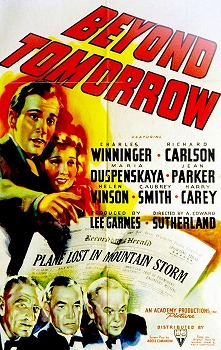
Most folks chasing down those missed Christmas movies kind of stop at the easy, obvious titles. Beyond Tomorrow (1940) sits just a little past that line—more or less, a ghost story wrapped up as a holiday romance, sort of arranged around three of Hollywood’s most reliable character performers, and it still has this real emotional gravity that its near-total silence in today’s Christmas film chatter makes genuinely puzzling. Three wealthy bachelors die in a plane crash on Christmas Eve. Then things go quiet, and stranger, than you’d expect a studio with a “brand” to defend would ever authorize. The good news is you can watch the whole thing free online right now, and honestly it pays you back for every one of its 84 minutes.
Beyond Tomorrow 1940 — Movie Overview Table
| Detail | Information |
|---|---|
| Title | Beyond Tomorrow |
| Also Known As | And So Goodbye |
| Release Year | 1940 |
| Country | United States |
| Genre | Fantasy, Romance, Drama, Christmas |
| Language | English |
| Format | Black & White, Sound |
| Director | A. Edward Sutherland |
| Producer | Lee Garmes |
| Principal Photography Began | Late November 1939, General Service Studios |
| Genre | American Christmas film, Ghost film, Romantic fantasy |
| IMDb Rating | 4.00/10 (small voter pool) |
| Public Domain | Yes — freely available to watch and download |
Full Cast Table — Beyond Tomorrow (1940)
| Actor | Role |
|---|---|
| Harry Carey | George Melton |
| C. Aubrey Smith | Allan Chadwick |
| Charles Winninger | Michael O’Brien |
| Richard Carlson | James Houston |
| Jean Parker | Jean Lawrence |
| Maria Ouspenskaya | Madame Tanya |
| Helen Vinson | Arlene Terry |
| Rod La Rocque | Phil Hubert |
| Alex Melesh | Josef, the butler |
| J. Anthony Hughes | Police Officer Johnson |
| Robert Homans | Police Sergeant |
| Virginia McMullen | Radio Station Secretary |
| James Bush | Jace Taylor |
| William Bakewell | David Chadwick |
Why Beyond Tomorrow 1940 Is the Christmas Film You Haven’t Seen
The film has a 4.00 on IMDb from a small sample of voters — almost all of whom appear to have found it while searching for holiday films and weren’t prepared for its specific emotional register. That rating is not a useful guide. What Beyond Tomorrow actually offers is something rare even among classic Christmas pictures: a story where the supernatural element serves genuine dramatic purpose rather than decorative whimsy.
Three men die. Their ghosts watch what happens to the people they cared about. One ghost risks his own salvation through that attachment. That’s not a premise you reach for when you want a comfortable holiday film — and that tension between warmth and genuine spiritual stakes is exactly what makes Beyond Tomorrow linger after it ends.
The Production Behind the Film — Lee Garmes as Producer
Lee Garmes is one of the handful of major cinematographers in Hollywood history who crossed over into producing. His visual career included work on Scarface (1932), Shanghai Express (1932), and multiple other prestige productions — a body of work that made him one of the most respected eyes in the industry. Beyond Tomorrow was produced under that sensibility, and it shows in the film’s visual patience.
Director A. Edward Sutherland had spent most of his career on comedies. Beyond Tomorrow asked him to hold a more delicate tonal balance — warm without being saccharine, melancholy without becoming heavy. He manages it, largely by trusting his three lead performers to do the work that the budget couldn’t.
Principal photography began in late November 1939 at General Service Studios — a deliberate scheduling choice that put the crew in the right seasonal mind to tell a Christmas story without manufacturing that feeling artificially on a summer lot.
Full Plot Summary — Beyond Tomorrow (1940)
The film opens on Christmas Eve with a gesture of genuine generosity. Three wealthy bachelors — George Melton (Harry Carey), Allan Chadwick (C. Aubrey Smith), and Michael O’Brien (Charles Winninger) — are spending the holiday alone. On impulse, they drop their wallets out of a window into the street below, each containing a card with their address. The idea: whoever returns the wallets gets invited to Christmas dinner.
Two strangers answer. James Houston (Richard Carlson) is a young Texan singer newly arrived in New York, honest enough to return the wallet immediately and charming enough to win the old men over in minutes. Jean Lawrence (Jean Parker) is a young woman with her own quiet warmth. The three bachelors recognize something in both of them — and engineer an introduction that is not entirely accidental.
The Crash — When the Story Shifts
James and Jean fall in love, exactly as the three men hoped. Then, in the film’s pivotal turn, all three bachelors die in a plane crash. The romance they helped kindle continues without them — but not quite without them. Their ghosts remain, bound to the world they left behind by the affection they carry for the two young people.
The film doesn’t treat their ghostly presence as comedy. It treats it as what it actually is: a form of loving attachment that, for one of the three, begins to shade into something more dangerous. George, the most emotionally invested of the trio, finds himself tied to the living world in ways that the other two are not — and that attachment carries consequences the film is honest enough to follow through on.
Arlene Terry — The Complication
While the ghosts watch, James’s life takes a turn the old men would have warned him against. Arlene Terry (Helen Vinson) enters his orbit — sophisticated, calculating, and entirely unlike Jean. James, now increasingly successful as a performer, is drawn toward Arlene in ways that cost him both his relationship with Jean and something of his own moral clarity.
The separation from Jean is the film’s emotional fulcrum. What makes it land is that James’s choices are comprehensible — he isn’t a villain making bad decisions, he’s a young man seduced by a version of success that comes packaged with the wrong person. The ghosts watch this unfold unable to intervene directly, which gives the film its most quietly painful sequences.
George’s Choice — The Film’s Moral Center
George’s attachment to the living world grows as James drifts further from the path the old men hoped he’d take. That attachment puts George’s own fate in genuine jeopardy — the film suggests clearly that the dead are not meant to hold on to the living, and that holding on has a spiritual cost.
The resolution handles this with more seriousness than you might expect from a 1940 Christmas fantasy. James returns to life. Michael is reunited with a now-repentant George. Both are admitted into Heaven — but only after George genuinely releases his grip on the world below. The ending earns its warmth because the film was honest about the cost of getting there.
Harry Carey, C. Aubrey Smith, and Charles Winninger — Three Veterans at the Center
The casting of the three principal ghosts is the decision that makes everything else in the film work. These are not young romantic leads carrying star power. They’re character actors with decades of screen craft between them — men who communicate interiority without scenery-chewing, which is exactly what these roles demand.
Harry Carey — born 1878, a veteran of early silent Westerns who became one of John Ford’s most trusted collaborators — brings a specific quality to George Melton: the weight of a man who has lived long enough to recognize what matters and still finds it hard to let go. His performance is the quietest of the three and the most affecting.
C. Aubrey Smith brought the authority of a British stage career spanning fifty years to Allan Chadwick. Where Carey works through stillness, Smith works through bearing — Chadwick is the most composed of the three, and Smith makes that composure feel genuinely earned rather than simply patrician.
Charles Winninger provides the warmth that holds the trio together. His Michael O’Brien is the most openly sentimental of the three bachelors — the one who wears his affection most visibly — and Winninger calibrates that sentiment carefully enough that it never tips into sentimentality.
All three died within a few years of making this film. There is something quietly resonant in watching three elderly men play ghosts reluctant to leave the world behind, knowing what was coming for each of them not long after the cameras stopped rolling.
Maria Ouspenskaya — A Rare Appearance, Precisely Used
Maria Ouspenskaya appears as Madame Tanya, and her presence is one of the film’s most valuable assets. Ouspenskaya was a trained actress of the Moscow Art Theatre who brought a quality of absolute conviction to every role she took — a quality that made her appear in fewer films than her talent warranted, because directors who didn’t know how to use her properly were better served leaving her alone.
In Beyond Tomorrow, she appears sparingly and to maximum effect. Her scenes ground the film’s supernatural elements in something that feels genuinely weighted — she doesn’t treat the otherworldly aspects of the story as fantasy, and that refusal to wink at the material is exactly what those scenes need.
If you’ve encountered Ouspenskaya before in The Wolf Man (1941) as the gypsy woman Maleva, her work here will look familiar in the best sense — the same absolute commitment to the reality of whatever world the film is building.
Beyond Tomorrow as a Christmas Film — What Separates It from the Crowd
Most Christmas films use the holiday as backdrop. The decorations are there, the music plays, and the seasonal setting provides warmth that the story borrows without earning. Beyond Tomorrow does something different — the Christmas setting is structurally necessary. The wallets dropped from the window only make sense as an act of holiday generosity. The dinner that follows only happens because three lonely men decided, on Christmas Eve specifically, to reach out to strangers.
Remove Christmas from Beyond Tomorrow and the entire chain of events that follows collapses. That’s a higher bar than most films in the genre clear, and it gives the seasonal elements a weight they don’t carry in films where the holly and the snow are purely decorative.
The ghost story element places it in an interesting subcategory alongside A Christmas Carol adaptations — films that use the supernatural to ask serious questions about attachment, regret, and what we owe the living and the dead. Beyond Tomorrow asks those questions without the scaffolding of Dickens to lean on, and it asks them sincerely.
Where to Watch Beyond Tomorrow (1940) Free Online
Beyond Tomorrow is in the public domain and legally available across multiple platforms at no cost.
| Platform | Format | Cost |
|---|---|---|
| Internet Archive | Stream + Download (multiple formats) | Free |
| YouTube | Stream | Free |
| Public Domain Movies | Stream | Free |
Beyond Tomorrow (1940) on Internet Archive:
Is Beyond Tomorrow (1940) in the Public Domain?
Yes. Beyond Tomorrow (1940) is fully in the public domain in the United States. Its copyright was not renewed under the pre-1978 U.S. copyright system, which means it is legally available to stream, download, share, and screen without restriction or payment.
You can use it freely in educational screenings, personal film nights, or online sharing without any licensing concerns.
Critical Reception — What Viewers Actually Think
The film lands on IMDb with a 4.00 out of 10, which really says more about the little and self-selecting group of voters, than anything about the film’s actual quality. The reviews that are there kind of split right down the middle, between people who feel the emotional register is too slow. and others who feel the character work is genuinely, deeply affecting.
The most steady praise, really, goes to the three leads. Reviewers who arrive at Beyond Tomorrow already aware of what Harry Carey, C. Aubrey Smith, or Charles Winninger can do tend to have a better time with it. The performances land in a different way when you already know what each actor is capable of, and you can recognize the restraint all of them are practicing here.
The main thing people complain about is pacing. The story builds slowly, it sort of creeps toward its supernatural resolution, and viewers wanting a quick holiday fantasy will likely find the middle third a bit testing. Still, that same patience is what gives the ending its weight, because movies that sprint straight to their emotional payoffs, don’t usually manage to make them stick.
Frequently Asked Questions — Beyond Tomorrow 1940
Q: What is Beyond Tomorrow (1940) about?
Three wealthy bachelor friends die in a plane crash on Christmas Eve and return as ghosts to watch over two young lovers they befriended before their deaths. One ghost risks his own path to Heaven through his emotional attachment to the living world. The film follows both the romance and the spiritual fates of the three men.
Q: Is Beyond Tomorrow 1940 a Christmas film?
Yes — and one of the more structurally committed ones. The Christmas setting isn’t decorative. The entire chain of events begins on Christmas Eve with a specific act of holiday generosity, and the story could not exist without that seasonal foundation.
Q: Is Beyond Tomorrow (1940) in the public domain?
Yes. Its copyright was never renewed under the pre-1978 U.S. copyright system. You can legally stream, download, and share the film at no cost.
Q: Who directed Beyond Tomorrow (1940)?
A. Edward Sutherland directed the film. It was produced by Lee Garmes, one of Hollywood’s most respected cinematographers, who became a film producer on a small number of projects.
Q: Who are the three main actors in Beyond Tomorrow?
Harry Carey, C. Aubrey Smith, and Charles Winninger play the three bachelor friends whose deaths set the story in motion. All three were veteran character actors with decades of screen experience.
Q: What role does Maria Ouspenskaya play?
Maria Ouspenskaya plays Madame Tanya. Her appearance is brief but central to the film’s treatment of its supernatural themes — she brings the same quality of absolute conviction to this role that she brought to Maleva in The Wolf Man (1941).
Q: What is the alternate title for Beyond Tomorrow?
The film is also known as And So Goodbye — an alternate title used in some markets and on some releases.
Q: Where was Beyond Tomorrow filmed?
Principal photography began in late November 1939 at General Service Studios in Hollywood.
Q: Where can I watch Beyond Tomorrow 1940 for free?
Beyond Tomorrow is freely available on the Internet Archive, YouTube, and Public Domain Movies. All versions are legal to stream and download under public domain status.
Q: Is Beyond Tomorrow in black and white?
Yes. The original film is black and white. This is the version available on the Internet Archive and YouTube — the one that preserves the film as it was intended to be seen.
Related Free Classic Fantasy and Christmas Films
If Beyond Tomorrow (1940) drew you into classic holiday fantasy and public domain drama, these are the natural films to explore next:
- Public Domain Horror Movies – Free Classic Scary Films Online
- Public Domain TV Shows – Watch Free Classic Television Online
- Public Domain Cartoons
- Public Domain Movies List – All Free Classic Films (Complete Guide)
Movie Tags
Beyond Tomorrow 1940, Beyond Tomorrow full movie, watch Beyond Tomorrow free, Beyond Tomorrow public domain, And So Goodbye 1940, Harry Carey ghost film, C. Aubrey Smith 1940, Charles Winninger Christmas film, Maria Ouspenskaya 1940, Richard Carlson Jean Parker romance, A. Edward Sutherland director, Lee Garmes producer, 1940 Christmas fantasy film, classic Christmas ghost story, forgotten Christmas films, public domain Christmas movie, free classic Christmas film online, black and white Christmas movie, 1940s holiday fantasy, classic American ghost romance