
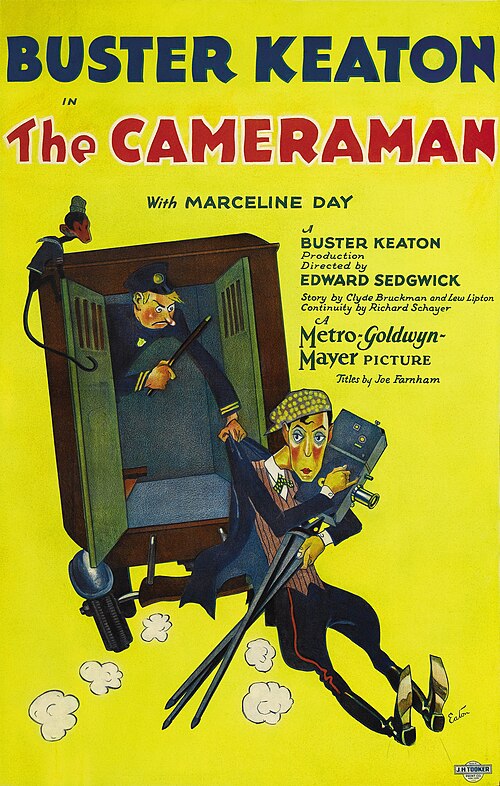
The Cameraman (1928) represents one of Buster Keaton’s final successful silent film comedies which tells the story of a timid tintype photographer who endangers his life to pursue a career as a newsreel cameraman in order to win his beloved. The United States has released The Cameraman full movie as a public domain classic movie which now allows all people to use it for both restoration and screening activities as well as for creative purposes.
Movie Background Table
Movie Cast Table
| Actor | Role |
|---|---|
| Buster Keaton | Buster (tintype cameraman) |
| Marceline Day | Sally Richards (MGM secretary) |
| Harold Goodwin | Harold Stagg, rival cameraman |
| Sidney Bracey | Edward J. Blake, newsreel boss |
| Harry Gribbon | Hennessey, the cop |
| Josephine the Monkey | Buster’s monkey companion |
| Richard Alexander | “Big sea lion” rival (uncredited) |
| Edward Brophy | Man in bathhouse (uncredited) |
| Ray Cooke | Office worker (uncredited) |
| Vernon Dent | Man in tight bathing suit (uncredited) |
| William Irving | Photographer (uncredited) |
| Harry Keaton | Man in swimming pool (uncredited) |
| Louise Keaton | Woman in swimming pool (uncredited) |
| Bert Moorhouse | Randall (uncredited) |
Full Plot Summary
Buster is a timid street photographer with a tintype camera, who engages in the business of making a living by capturing snap on portrait photographs on the streets of New York City. One day he also spots Sally Richards, a pretty secretary of MGM Newsreels and becomes immediately smitten. She is pleasant and has a hectic schedule, spinning around a world of actual cameramen and urban news as Buster lurks in the background with his outdated still camera.
Buster realizes that the best method of getting to Sally is to be a newsreel cameraman himself when he finds out that Sally is one of the workers at MGM. He sells his tintyp camera, depletes his bank account and purchases a tattered motion-picture camera, believing that this will start a new career. He meets the veteran cameraman Harold Stagg at the MGM offices, and he is also interested in Sally. Harold makes fun of Busters battered camera and his childish ambition but Sally is the one who urges Buster to give it a shot and tells him to shoot anything and everything.
The initial attempts of Buster are a failure. He captures the scenes around the city randomly, however, when he takes the exposed film to MGM, the film produces nothing that can be used: it is duplicated, overexposed, and technically ugly. Nevertheless, Sally understands how persistent he is and even pities him. She is going out with Buster when her Sunday date fails.
They sell at the city plunge, a public swimming pool and bath-house. There Buster trips over one indignity after another: cramming into a small changing room with a big man, losing clothes on a swimsuit and struggling to maintain his dignity amidst the free-and-easy bathers. Sally is amused but patient. At the end of the outing, Harold comes in handy to drive Sally home with a car. Buster becomes a relegated rumble seat. When it starts to rain the drive, Harold and Sally sit in the front of the car when it is dry, but Buster is soaked in the open back, another joke on his expense.
Back at the newsreel office Sally offers Buster a real opportunity: a tip, that something big is about to occur in Chinatown. Buster runs away with his camera. He runs over an organ grinder on the road and throws the man down, seemingly killing his monkey. A local policeman makes Buster pay to get the animal and pick the bleeding body off. And, to Buster, who is to receive later on, the monkey is just stunned. It brings Buster back to life and takes him joyfully, putting him on his shoulder and trailing him into trouble.
Chinatown witnesses a Tong war outbreak in the middle of a festival. Gunshots, gangsters fighting on the streets, and anarchy go on around Buster. He (and stupidly) charges into the fray, shooting his camera when people are running and others shooting each other. He just escapes the death a few times, being rescued at least twice, by mere chance and his physical comedy instincts ( ducking at the opportune moment, hanging on ladders or sliding through the center of the combatants ). The constantly-present policeman, Hennessey, who has already witnessed some of the previous misfortunes of Buster, comes to reinforce the situation, and because of a few seconds attempts to have Buster transported away as a madman. Buster runs away with his camera holding it like gold.
The next action of the surviving prints and summaries is a little different, but the essence is that Buster believes he has destroyed or lost the Chinatown film in some way or another due to some misfortune-be it forgetting to load the film or due to his inattentive behavior with the reels. He is heartbroken and thinks his great opportunity has passed. He is convinced that he has been failing at work and with Sally and so he retires, but his most faithful monkey quietly picks up the camera and the salvaged camera film.
The MGM employees later find out that the films in Chinatown are not lost, and are spectacular: a bright, thrilling record of the Tong war, that no other filmmaker has ever shot. When the reel is running, the newsreel office recognizes that they have a goldmine and that Buster and not Harold gave out the scoop of the year.
In the film’s conclusion, Buster returns to MGM unaware of his triumph. Initially, he believes he is about to be fired or laughed out again. Instead, he finds that his footage has made him a hero: the bosses finally recognize his talent, Sally sees his quiet bravery for what it is, and even rival Harold is outshone. The shy tintype man has, at last, become a real cameraman—and won the girl’s affection—through perseverance, luck, and a lot of near‑fatal slapstick.
Genre and Key Themes
The Cameraman presents itself as a silent film which combines romantic comedy elements with workplace satire and urban adventure elements. The film combines its extensive battle scenes and swimming pool scene with its personal comedy moments which focus on shyness and embarrassment and unrequited love.
Major themes include:
- Ambition and reinvention
Buster abandons his safe, low‑status job as a sidewalk photographer to chase a bigger dream, even when he is obviously out of his depth. - Technology and modernity
The film contrasts still photography with motion pictures and shows how newsreel cameras, editing, and film labs shape what the public sees as “reality.” - Love and rivalry at work
The triangle between Buster, Sally, and Harold plays out in the office and on assignments, turning job competition into romantic competition. - Perception vs. reality
Again and again, Buster appears foolish or unlucky, but his camera (and the monkey’s help) reveals that he has captured something remarkable. What others assume about him is often wrong. - Physical courage and vulnerability
Keaton’s character is mild‑mannered, but when it counts he walks into danger with his camera, showing a quiet bravery that hides beneath his bashful exterior. -
The Cameraman (1928) Full Movie Watch and Download
Watch The Cameraman (1928) on Internet Archive:
🏛️ See Also
Woody Woodpecker in Pantry Panic (1941) – Classic Winter Survival Cartoon Full Movie
The Last Time I Saw Paris (1954) – Elizabeth Taylor Romantic Drama Classic | Free Public Domain Full Movie
Sabotage (1936) – Alfred Hitchcock London Terror Thriller | Free Public Domain Full Movie
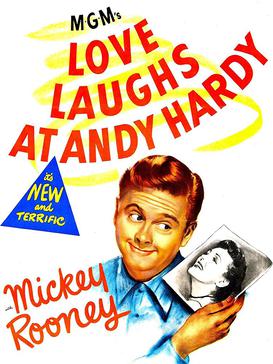
Love Laughs at Andy Hardy (1946) – Mickey Rooney Postwar College Romance | Free Public Domain Full Movie
Movie Review
The Cameraman is generally considered one of the best movies of Buster Keaton and the final masterpiece before MGM restricted the activities of this film star. Critics frequently refer to it as an ideal example of an unobtrusively fashioned silent comedy: all the gags are naturally developed out of their characters and circumstances, and the movie develops out of tiny inconveniences to colossal disasters without ever appearing forced.
The acting of Keaton is quintessential stone face at its finest; the expression of emotion is achieved through the use of delicate reaction shots, clever feats, and a tactful use of body language instead of mugging. The romance is tender and believable as Marceline Day is an ordinary, natural person, sympathetic and attractive to Sally. Harry Gribbon and Harold Goodwin complete the comic strife on Buster on behalf of the smug competitor and the frustrated police officer, respectively.
The Cameraman is visually impressive: The resources of MGM are utilized to the advantage of Keaton: New York city streets are crowded, a large pool provides him with lots of big playgrounds to play with, and the riot at Chinatown gives him even more big playgrounds. Meanwhile, the feeling of framing and timing maintained by Keaton makes the action understandable and the humor crisp even in the compositions of a crowd. The contemporary restorations such as the Criterion Blu-ray edition and high-quality digital scans have assisted viewers to observe the details and expressions that were previously lost in the tattered prints.
The pace used in silent film may not seem like that of more recent comedies, as there are longer set-pieces, and no verbal communication besides intertitles. However, to those who are ready to follow its beat, The Cameraman 1928 movie seems to be much more recent: the jokes at workplace, fears of technology, and horrible date crashes are all too familiar.
The Cameraman full movie can now be shown, shared and remixed freely, so this can only make it more widespread in retrospectives, streaming libraries and film-historical courses. Being not only a free classic film but also one of the masterpieces of the Keaton career, it serves as a perfect entry point of a person who is interested in silent comedy and the shift towards the dominion of large studios and the ability to control independent artists.
Movie Tags
The Cameraman full movie, The Cameraman 1928 film, Buster Keaton MGM comedy, silent romantic comedy classic, newsreel cameraman story, Marceline Day Sally Richards, Harold Goodwin rival cameraman, Chinatown Tong war sequence, swimming pool slapstick scene, Edward Sedgwick Buster Keaton collaboration, National Film Registry silent film, classic black and white comedy, public domain movie, free classic movie