
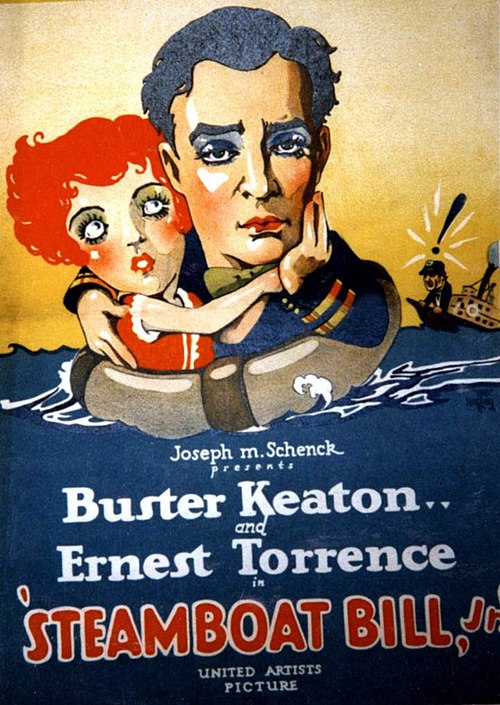
The 1928 film Steamboat Bill Jr. represents one of Buster Keaton’s most famous silent comedies and tells the story of a naive college-educated son who struggles to win his father’s approval throughout the film. The film features two iconic scenes which include a court-gawking cyclone and a legendary falling-house scene that make Steamboat Bill Jr. (1928) essential viewing for fans of traditional slapstick and physical comedy.
Movie Background Table
Movie Cast Table
The contrast between Keaton’s slight, dandyish “Bill Jr.” and Ernest Torrence’s burly, gruff father drives much of the film’s comedy.
Full Plot Summary
The 1928 film, Steamboat Bill, Jr, begins with the setting of the Mississippi River, where a retired captain, William “Steamboat Bill” Canfield Sr. operates an old and battered paddle steamer. John James King, a rich entrepreneur has, just constructed a new posh steamboat and would drive Bill Sr. out of business.
Bill Sr. learns that his estranged son William Jr. who he has not seen since infancy is coming to his rescue via a train. He creates a picture of a tough, rough young man who is willing to work the river. At the time when Bill Jr. gets out of the train, he is a thin, college-educated dandy in a beret, stylish clothes, and with a pencil moustache, playing a ukulele.
Bill Sr. embarrassed and disappointed attempts to harden his son up. He instructs him to take off his clothes, shave off the moustache and learn how to work a steamboat. Bill Jr. is awkward with all the things he does, tying ropes, moving in cargo and working with tools, yet he makes an effort to please his father.
The troubles are multiplied by the the fact that Bill Jr. encounters and falls in love with Kitty King, the attractive daughter of his father’s competitor. Both youths love one another but their dads despise the thought of a love affair between the two rival families. The two men also prohibit the relationship, and there is some Romeo and Juliet riverfront situation.
The situation becomes even worse when the authorities declare that the old steamboat of Bill Sr. is not safe. Bill Sr believes that King has taken advantage of his position to turn him in. He strikes out hard and punches King which takes him to jail. Now, Bill Jr. has to struggle with the problem of the release of his father as well as the family income.
Bill Jr. tries to rescue his father by improving him out of jail with the traditional silent-comedy resourcefulness. He places tools in a loaf of bread and his jailbreak mission is found out. Bill Jr. is knocked out by the sheriff and he later wakes up in a hospital dazed but still having the urge to assist.

At this stage, an enormous cyclone strikes the town. The storm destroys buildings, uproots trees and flies debris. In what is perhaps the most famous scene in the film history, Bill Jr. battles his way through the wind-blown streets as the houses and buildings around him fall down.
In the most memorable gag, a two-story building facade collapses right down on him. He appears to be hopeless, but the attic window is open and the body is perfectly in focus and the man is standing intact when the wall falls down on him. It was one real stunt, involving a full-size facade and Keaton had to stand on a specific point, with only a few inches to spare.
Bill Jr. locates Kitty lying there on a floating house through the chaos. He bravely saves her and then boards a steamboat to save his father who had been blown to the jail into the river. At last, he saves King also, showing his courage to the two families.
Eventually, when the storm is over and they are all safe, Bill Jr. and Kitty are free to be with each other. A minister is literally pushed in to be married off before them so the film is given a comedy romantic ending.
Genre and Key Themes
Steamboat bill, Jr. (1928) is a silent comedy and adventure movie and the components of family drama and romantic comedy are very strong.
Key themes include:
Father–son expectations
The movie runs on the theme of disappointment and later pride of a hard father over his apparently unfit son.
Class and image
The polished college appearance of Bill Jr. is contrasted with the coarse river working environment and this generates some visual comedy and character comedy.
Courage and identity
Bill Jr. is courageous and resourceful under the pressure and finds out who he is.
Rivalry and reconciliation
Family feud and competition in the business are replaced by cooperation once the storm makes everybody dependent on other people.
Having the emotional interests, romance, and a vast amount of physical comedy, this film by Steamboat Bill, Jr. (1928) is unique among all the features of the silent age.
Steamboat Bill, Jr. (1928) Full Movie Watch and Download
Watch Steamboat Bill, Jr. (1928) on Internet Archive:
🏛️ See Also
Woody Woodpecker in Pantry Panic (1941) – Classic Winter Survival Cartoon Full Movie
Popeye for President (1956) – Classic Election-Day Cartoon Full Movie
The Lost World (1925) – Silent Dinosaur Adventure Classic | Watch Free
The Floorwalker (1916) – Charlie Chaplin’s First Mutual Comedy | Watch Free
Movie Review
The movie Steamboat Bill, Jr. received mixed reviews during its initial release and performed poorly at the box office, but critics and fans now consider it one of Keaton’s greatest works. The film now appears on lists like 1001 Movies You Must See Before You Die and it maintains a perfect critical rating according to current review aggregation websites.
The work of Buster Keaton is the masterpiece of the physical comedy. His rigor mortis replies, the fine body movements and outbursts of athletics make the film interesting even without any dialogue. Ernest Torrence brings realistic emotional texture into the picture as the rough father who gradually is learning to love his son.
The orchestration and the filming of the cyclone sequence is breathtaking. Street sets were destroyed in systematic manner that used wind machines and cranes and Keaton himself was thrown over the air using cables to make it look like he had been tossed by the storm. Modern film and television still makes a reference to and reiterates the falling facade gag.
On the story front, the plot is bare and even nonsensical as some of the early reviewers argued, yet in a silent slapstick setting simplicity acts in the film favor. The story primarily exists to give the character interactions and set-piece antics.
Being a public domain film, the entire movie of Steamboat Bill, Jr. (1928) is abundantly found in restoration and low-end versions. The free classic movie is mandatory to any movie lover of silent film, physical comedy, or movie history: It is not only entertaining but a demonstration of how much can be accomplished in visual storytelling without the aid of computer-generated imagery.
Movie Tags
Steamboat Bill, Jr. (1928) full movie, Steamboat Bill Jr 1928 film, Buster Keaton riverboat comedy, silent comedy classic, free classic movie, public domain movie, cyclone stunt sequence, falling house gag, Ernest Torrence, Marion Byron, United Artists silent film, father son riverboat story, Mississippi steamboat comedy, physical stunt comedy, classic black and white silent film, 1920s American comedy, must‑see silent movies, Keaton independent production, paddle steamer rivalry