
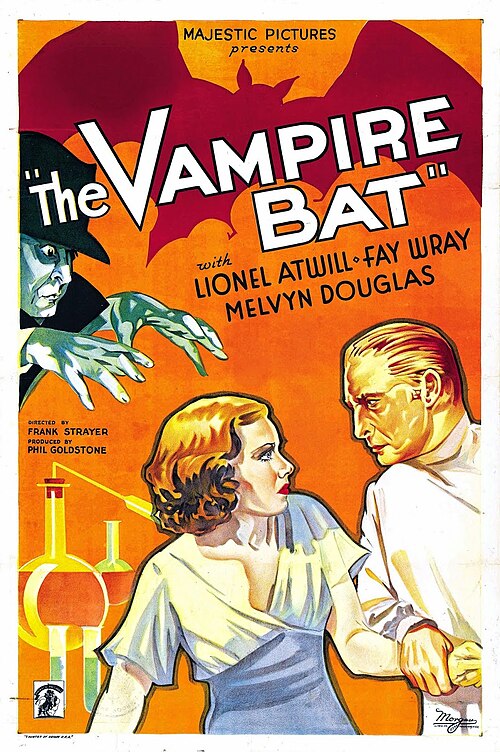
The Vampire Bat (1933) is a fast-paced horror film where mysterious blood-drained corpses in a small German village lead to panic, suspicion of vampires, and a deadly witch hunt against an innocent, bat-loving simpleton—while the real killer hides in plain sight. Today, this atmospheric The Vampire Bat (1933) film is widely enjoyed as a free classic movie and public domain movie, offering classic horror thrills on a shoestring budget.
The Vampire Bat (1933)
The Vampire Bat (1933) is an American pre-Code horror film directed by Frank R. Strayer and produced by poverty-row studio Majestic Pictures. Starring Lionel Atwill, Fay Wray, Melvyn Douglas, and Dwight Frye, the film was rushed into production to capitalize on the success of other horror films of the era. Released in January 1933, it runs about 63–65 minutes and has become a cult favorite among fans of vintage horror.
Movie Background
- Director: Frank R. Strayer.
- Producer: Phil Goldstone.
- Studio: Majestic Pictures Inc.
- Release year: 1933.
- Running time: Approximately 63–65 minutes.
- Main cast: Lionel Atwill, Fay Wray, Melvyn Douglas, Dwight Frye.
- Production notes: To save money and boost production value, Majestic leased leftover sets from Universal Studios, including the German village from Frankenstein (1931) and interiors from The Old Dark House (1932). Some location work was done at Bronson Caves.
- Context: Fay Wray and Lionel Atwill had just completed Doctor X (1932) and Mystery of the Wax Museum (1933) for Warner Bros., and Majestic quickly signed them for this “quickie” horror film to ride the wave of publicity around those bigger releases.
Movie Cast Table
This ensemble combines horror veterans like Atwill and Frye with leading lady Fay Wray, fresh off her iconic scream queen roles.
Full Plot Summary
The Vampire Bat (1933 film) takes place in the small, foggy village of Kleinschloss in Germany. When villagers begin dying mysteriously with their bodies completely drained of blood, panic spreads quickly through the town.
The local burgomaster, Gustave Schoen, is convinced that vampires have returned to plague the village, pointing to legends and folklore as proof. But the town’s police inspector, Karl Brettschneider, remains deeply skeptical, refusing to believe in supernatural explanations and insisting there must be a rational cause.
The respected town doctor, Otto von Niemann, tends to the victims and examines their bodies. He finds puncture marks on their necks and confirms the blood loss, lending credibility to the vampire theory. Von Niemann also cares for his laboratory assistant, Ruth Bertin, who happens to be Inspector Brettschneider’s girlfriend.
Suspicion soon falls on Herman Gleib, a simple-minded, eccentric man who lives alone and has an unusual fondness for bats. Herman collects bats, talks to them, and insists they are “soft like cats” and “nice.” When he visits one of the victims, Martha Mueller, to comfort her before she dies, his strange behavior makes people uncomfortable.
A townsman named Kringen claims he was attacked by a bat-like creature and barely escaped. Fueled by fear and superstition, the townspeople become convinced that Herman is the vampire—or at least connected to the attacks.
Another victim dies that night, and the mob’s anger reaches a breaking point. An angry group of villagers hunts Herman down, chasing him through the countryside and into a cave. Terrified and confused, Herman falls from a ledge and dies. To make sure he’s truly gone, the mob drives a stake through his heart.
But the killings don’t stop. That same night, Dr. von Niemann’s maid, Georgiana, is found dead—drained of blood in the exact same way as the other victims. Inspector Brettschneider and Ruth begin to realize that Herman was innocent and the real killer is still at large.
Ruth starts to notice strange things about Dr. von Niemann. She overhears him giving mental commands to his servant, Emil Borst, and discovers that von Niemann has been using hypnosis to control Emil.
It is revealed that Dr. von Niemann has been conducting secret experiments in his basement laboratory. He has created an artificial life form—a strange, pulsating organism that resembles a living sponge or blob kept in a glass container. This creature requires fresh blood to survive and grow, and von Niemann has been using Emil to murder villagers and drain their blood to feed his creation.
Von Niemann attempts to eliminate Inspector Brettschneider by giving him poisoned sleeping pills. But the inspector, now suspicious, doesn’t take them. Instead, he disguises himself and waits in the laboratory for von Niemann to reveal himself.
When Ruth confronts the doctor, he ties her up in the lab and prepares to kill her as well. But Brettschneider springs the trap, revealing himself and pulling a gun on von Niemann. In the struggle that follows, Emil Borst—finally freed from the doctor’s mental control—picks up the gun and shoots von Niemann, killing the mad scientist and ending his reign of terror.
The film ends with the monster destroyed, the village saved, and Inspector Brettschneider and Ruth reunited, having uncovered the truth behind the so-called vampire attacks.
Genre and Key Themes
The Vampire Bat (1933 film) is a classic horror mystery with strong elements of Gothic atmosphere, mad science, and mob hysteria. It blends vampire folklore with early sci-fi concepts like artificial life and mind control.
Key themes include:
- Superstition vs. science: The film plays with the tension between supernatural beliefs (vampires) and rational investigation (the inspector’s skepticism), ultimately revealing that the “monster” is man-made.
- Mob violence and scapegoating: The innocent Herman is hunted and killed by a frightened mob looking for an easy target, highlighting the dangers of fear-driven injustice.
- Mad science: Dr. von Niemann’s creation of artificial life and his willingness to murder for scientific progress make him a classic “mad scientist” villain.
- Appearance vs. reality: The seemingly kind doctor is the true monster, while the strange, outcast Herman is harmless—a reversal of expectations.
These themes, combined with moody lighting and Gothic sets, make The Vampire Bat full movie a solid example of early 1930s horror.
The Vampire Bat (1933) Full Movie Watch and Download
Watch The Vampire Bat (1933) on Internet Archive:
🏛️ See Also
Dementia 13 (1963) – Francis Ford Coppola’s Chilling Gothic Debut
The Man Who Cheated Himself (1950) – A Classic Film Noir Gem Set in San Francisco
A Man Betrayed (1936) – Classic Republic Crime-Drama
Inner Sanctum (1948) – A Suspenseful Noir Thriller
Movie Review
The Vampire Bat (1933) delivers effective atmosphere and suspense despite its low budget and rushed production.
- Acting: Lionel Atwill is the standout, playing the sinister Dr. von Niemann with quiet menace and intellectual arrogance. Dwight Frye brings sympathy and pathos to Herman, making his death genuinely tragic. Melvyn Douglas is solid as the skeptical inspector, and Fay Wray, though given less to do than in her other horror roles, brings warmth and intelligence to Ruth.
- Direction and atmosphere: Frank R. Strayer makes great use of the borrowed Universal sets, creating a convincingly eerie German village full of fog, shadows, and Gothic architecture. The pacing is brisk, and the film wastes little time getting to the horror.
- Story: The plot is straightforward but effective, with a nice twist revealing the doctor as the villain. Some viewers may find the “living organism” prop unconvincing, but it adds a weird science-fiction edge that was unusual for vampire films.
- Budget limitations: As a “poverty row” production, some effects and sets are clearly recycled, and the film lacks the polish of Universal’s bigger horror hits. But the strong cast and moody photography compensate for these limitations.
Overall, The Vampire Bat 1933 film is a brisk, entertaining horror tale that punches above its weight. As a free classic movie and public domain movie, it’s a great introduction to 1930s B-movie horror and remains a favorite among genre fans.
Movie Tags
The Vampire Bat 1933, The Vampire Bat full movie, The Vampire Bat 1933 film, Lionel Atwill, Fay Wray, Melvyn Douglas, Dwight Frye, Frank R. Strayer director, Majestic Pictures, 1930s horror, pre-Code horror, vampire film, mad scientist horror, German village horror, Gothic horror, mob violence, artificial life, hypnotism, poverty row horror, classic horror movie, black and white horror, vintage horror, free classic movie, public domain movie, Universal sets, Frankenstein backlot, classic monster movie, 1933 horror film.