
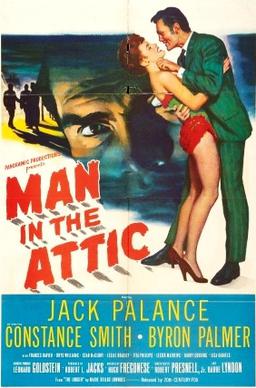
Hugo Fregonese did Man in the Attic (1953) in approximately four weeks on a previously used Twentieth Century-Fox script. The studio had already made the film on Marie Belloc Lowndes’s Jack the Ripper novel The Lodger in 1944, so it didn’t want to do anything new nine years later. It brought in a new writer to redo the old screenplay, gave it to a production unit that had never made a movie before, and had a rising young actor who did the selling.
That actor was Jack Palance, fresh off an Oscar nomination for Sudden Fear (1952), and he plays Slade, the soft-spoken pathologist who rents the attic room in a foggy Victorian London house. His landlady starts to suspect he’s the Ripper. The film is not a masterpiece, and most critics call it a competent also-ran in a long line of Lodger adaptations. But it’s a 82-minute shot of fog, gaslight, and Palance at his most unnerving, and it’s in the public domain, so you can watch it free right now.
Man in the Attic 1953 — Movie Overview Table
| Detail | Information |
|---|---|
| Title | Man in the Attic |
| Release Year | 1953 (December 1953) |
| Country | United States |
| Runtime | 81–82 minutes |
| Genre | Mystery, Horror, Film Noir |
| Language | English |
| Format | Black & White |
| Director | Hugo Fregonese |
| Screenplay | Barré Lyndon and Robert Presnell Jr. |
| Based On | The Lodger (1913 novel) by Marie Belloc Lowndes |
| Producer | Robert L. Jacks |
| Cinematography | Leo Tover |
| Film Editing | Marjorie Fowler |
| Music | Hugo Friedhofer |
| Costume Design | Travilla |
| Production Company | Panoramic Productions (Leonard Goldstein) — its first production |
| Distributor | Twentieth Century-Fox |
| Filming Dates | August 25 – September 22, 1953, RKO-Pathé Studios |
| Earlier Adaptations | The Lodger: A Story of the London Fog (1927), The Lodger (1932), The Lodger (1944) |
| Later Adaptation | The Lodger (2009) |
| IMDb Rating | 5.4/10 |
| Public Domain | Yes — freely available to watch and download |
Full Cast Table — Man in the Attic (1953)
| Actor | Role |
|---|---|
| Jack Palance | Slade |
| Constance Smith | Lily Bonner |
| Byron Palmer | Inspector Paul Warwick |
| Frances Bavier | Helen Harley |
| Rhys Williams | William Harley |
| Sean McClory | Constable No. 1 |
| Leslie Bradley | Constable No. 2 |
| Tita Phillips | Daisy |
| Lester Matthews | Chief Inspector Melville |
| Harry Cording | Detective Sergeant Bates |
| Lisa Daniels | Mary Lenihan |
| Lilian Bond | Annie Rowley |
| Isabel Jewell | Katy |
| Ben Wright | Detective in Theatre Box |
| Rama Bai | Lelah, Lily’s Maid (uncredited) |
Fox Remakes Its Own Ripper Film — Why Man in the Attic Exists
The answer is Jack Palance. Fox’s earlier version, The Lodger (1944), had done well, and the studio saw a chance to reuse the material while its newest villain was hot. The Radio Times Guide to Films describes the result as a modestly budgeted thriller built to exploit Palance’s sudden rise to villainous stardom.
The screenplay credit tells the same story. Barré Lyndon, who wrote the earlier Fox version, shares credit here with Robert Presnell Jr. Man in the Attic was also the first production from Leonard Goldstein’s Panoramic Productions, a small unit working inside the Fox system on a quick, cheap schedule. The AFI Catalog lists principal photography at RKO-Pathé Studios from August 25 to September 22, 1953, roughly four weeks.
Five Films, One Lodger — Where 1953 Fits
Lowndes’s story began as a magazine short story around 1911 and became a novel soon after. Filmmakers have returned to it again and again:
- 1927: The Lodger: A Story of the London Fog, directed by Alfred Hitchcock
- 1932: The Lodger, directed by Maurice Elvey
- 1944: The Lodger, directed by John Brahm
- 1953: Man in the Attic, directed by Hugo Fregonese
- 2009: The Lodger, directed by David Ondaatje
Critics usually rank the 1953 version below Brahm’s gothic 1944 film, which has more psychological weight. But it does something its predecessors skip. This version offers a full motive for the killer, built around Slade’s troubled relationship with his mother, so it works as a “why” story as much as a “who” story.
Jack Palance as Slade — A Rising Villain in Full Sinister Mode
Palance had earned his Oscar nomination the year before as Joan Crawford’s murderous husband in Sudden Fear, and Fox cast him because audiences already knew his menace. His Slade is a research pathologist with a quiet voice, a small black bag, and an unexplained habit of turning pictures of actresses to the wall.
Critics split on the performance. The Monthly Film Bulletin called him a “suitably sinister Ripper,” while others found him too obviously menacing to sustain any mystery. Radio Times shared that view, noting that the writers rarely let you doubt him. If you came for atmosphere and a strong central presence rather than a whodunit, it works.


Full Plot Summary — Man in the Attic (1953)
Spoiler warning: the summary below covers the film’s ending.
A Lodger Arrives in Fog-Bound London
It’s London, 1888, and the Ripper has already struck. Late one night, a man named Slade (Jack Palance) knocks at the home of Helen and William Harley (Frances Bavier and Rhys Williams), an older couple who need extra income. He rents a room and the attic, explaining that he’s a research pathologist who needs private space for his work.
Mrs. Harley notices strange habits. Slade keeps odd hours, never explains his experiments, and hides pictures of actresses from his sight. When the Harleys’ niece Lily Bonner (Constance Smith), a stage singer and dancer, arrives from Paris, Slade takes an interest in her. Mrs. Harley’s suspicions grow.
The Black Bag and the Burned Coat
Inspector Paul Warwick (Byron Palmer) investigates the murders and tells Lily that witnesses saw the killer in an Ulster coat, carrying a small black bag. Slade owns both. Mrs. Harley smells smoke from the attic and discovers he has burned the bag. Later Lily finds him burning clothing, including a coat with what looks like blood on it.
Slade tells Lily about his mother, an actress he both loved and hated, who ended her life in Whitechapel. Warwick eventually realizes that a photograph in Slade’s room shows the Ripper’s first victim.
The Theatre, the Knife, and the River
At Lily’s theatre, Slade watches the men in the audience stare at her and becomes agitated. Backstage, he begs her to leave with him. When she refuses, he draws a knife, but he can’t go through with it. He drops the blade and escapes through a window.
Police chase him through Whitechapel to the river, where he appears to drown. Searchers never recover a body, so the film leaves open the possibility that he survived.
Where the Film Struggles — Lily’s Stage Career and the Historical Gaps
The most common complaint is about Lily’s stage numbers. The Monthly Film Bulletin praised the film’s London atmosphere but said the story spends too much time on Lily’s theatre life, much of it irrelevant to the plot. Constance Smith also drew criticism as a leading lady who seemed miscast.
Historical accuracy is another soft spot. The film keeps the old fiction that the Ripper’s victims were performers, when the real victims were not. Slade also speaks with an American accent in a London setting, and the stage costumes look a few decades too modern. Treat it as Victorian atmosphere rather than true crime.
Hugo Fregonese — And the Cameo That Never Appeared
Fregonese, an Argentine-born director, earned praise from Variety for making the most of an old-hat tale. Variety credited him with creating a mood that nearly lifts the picture into a big success, and the review singled out the production’s atmospheric look and Leo Tover’s photography.
Here’s a small piece of trivia to hunt for. In August 1953, the Hollywood Reporter announced that Fregonese would appear as a member of the French Sûreté, in keeping with his habit of cameoing in his own pictures. The AFI Catalog notes that no French officers appear in the print its reviewers viewed.
The Supporting Cast — Aunt Bee Before Mayberry
Frances Bavier, who plays the suspicious landlady Helen Harley, would later become a television icon as Aunt Bee on The Andy Griffith Show. Here you can watch her play wary and watchful in the best-defined supporting role. Rhys Williams plays her more trusting husband, whose own small black bag becomes a nice piece of dramatic irony.
Lisa Daniels, in the small role of Mary Lenihan, earned a mention from The Monthly Film Bulletin as an interesting newcomer who brings life to her few scenes.
Where to Watch Man in the Attic (1953) Free Online
Man in the Attic is in the public domain and legally available across multiple platforms at no cost. Print quality varies between sources, so try a second copy if the first looks soft.
| Platform | Format | Cost |
|---|---|---|
| Internet Archive | Stream + Download (multiple formats) | Free |
| YouTube | Stream | Free |
| Public Domain Movies | Stream | Free |
Man in the Attic (1953) on Internet Archive:
Is Man in the Attic (1953) in the Public Domain?
Yes. Man in the Attic is in the public domain in the United States, and you can legally stream, download, share, and screen it without restriction or cost. It’s been widely distributed on budget DVD collections of classic horror and suspense films, which is why so many copies circulate online.
Critical Reception — Then and Now
The film holds a 5.4 out of 10 on IMDb, and critics have stayed consistent for seventy years: atmospheric and competent, but familiar. Variety said Fregonese made “so much of an old-hat tale,” which sums up the general view. Radio Times gave it three stars, calling the story virtually fool-proof and crediting Fregonese with chills and good Victorian atmosphere.
Modern reviewers are harder on it. Dennis Schwartz found “no need or reason for this remake,” and Phil Hall’s two-out-of-five Film Threat review joked about a Ripper film with a dull blade. Others defend it as a solid gaslight thriller that lacks the class of the 1944 version but shouldn’t be dismissed.
Our take: watch it as one stop in the long history of Lodger adaptations. If you’ve seen Hitchcock’s silent or Brahm’s 1944 film, this one shows how the same story changes shape when a studio recycles it for a new star.
Frequently Asked Questions — Man in the Attic 1953
Q: What is Man in the Attic (1953) about?
In 1888 London, a soft-spoken research pathologist named Slade rents an attic room from an older couple on the night of the third Jack the Ripper killing. His landlady grows suspicious of his odd habits, especially when her niece Lily Bonner takes an interest in him.
Q: Is Man in the Attic (1953) in the public domain?
Yes. Man in the Attic is in the public domain in the United States and is freely available on the Internet Archive, YouTube, and Public Domain Movies.
Q: Who stars in Man in the Attic?
Jack Palance plays Slade, with Constance Smith as Lily Bonner and Byron Palmer as Inspector Paul Warwick. Frances Bavier and Rhys Williams play the landlords, Helen and William Harley.
Q: Is Man in the Attic based on a book?
Yes. It is based on The Lodger by Marie Belloc Lowndes, a novel that fictionalizes the Jack the Ripper killings. The story was filmed in 1927 by Alfred Hitchcock, in 1932, in 1944, in 1953 as Man in the Attic, and again in 2009.
Q: Who directed Man in the Attic?
Hugo Fregonese directed the film for Twentieth Century-Fox. It was the first production of Leonard Goldstein’s Panoramic Productions.
Q: How does Man in the Attic compare to The Lodger (1944)?
Most critics rank the 1944 version higher for its gothic atmosphere and psychological weight. The 1953 film is a more modest remake built around Jack Palance, and it offers a clearer motive for the killer.
Q: How long is Man in the Attic?
The film runs approximately 81 to 82 minutes, depending on the source.
Q: Is Man in the Attic historically accurate?
No. The film keeps the fiction that the Ripper’s victims were performers, and its murders do not match the real killings. It works better as Victorian atmosphere than as true crime.
Q: Does the killer die at the end of Man in the Attic?
Slade appears to drown in the river while fleeing the police, but no body is ever found, so the film leaves open the possibility that he escaped alive.
Q: Where can I watch Man in the Attic (1953) for free?
Man in the Attic is freely available on the Internet Archive, YouTube, and Public Domain Movies. All public domain versions are legal to stream and download.
Related Free Classic Horror, Mystery and Film Noir Films
If Man in the Attic (1953) drew you into Victorian-era thrillers and shadowy film noir, these are the natural titles to explore next:
- Public Domain Horror Movies – Free Classic Scary Films Online
- The Limping Man (1953) Full Movie Review, Plot, Cast & Free Film Noir Thriller
- Cause for Alarm! (1951) Full Movie Review, Plot, Cast & Free Film Noir Suspense Classic
- Bela Lugosi Meets a Brooklyn Gorilla (1952) Full Movie Review, Plot, Cast & Free Horror-Comedy Classic
- Public Domain Movies List – All Free Classic Films (Complete Guide)