

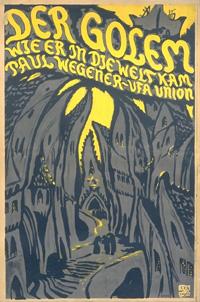
No one had listened to the original soundtrack of The Golem since its Berlin premiere in 1920 until the late 2010s. The soundtrack by Hans Landsberger was lost, and then rediscovered and reconstructed by Hans’s great granddaughter.
The story of the lost soundtrack is actually very appropriate for The Golem, as the film nearly vanished. The Golem: How He Came Into the World is the last remaining Golem film directed by Paul Wegener. It’s a great example of the style known as German Expressionism, especially with its set design by Hans Poelzig and camera work by Karl Freund. You can watch this unrestored, public domain film for free on the web.
The Golem 1920 — Movie Overview Table
| Detail | Information |
|---|---|
| Title | The Golem: How He Came into the World (Der Golem, wie er in die Welt kam) |
| Release Year | 1920 (premiered October 29, 1920, Ufa-Palast am Zoo, Berlin) |
| Country | Germany (Weimar Republic) |
| Runtime | 76–91 minutes, depending on the print and projection speed |
| Genre | Silent Horror, Fantasy, German Expressionism |
| Language | Silent (German intertitles) |
| Format | Black & White with color tints (restored versions) |
| Directors | Paul Wegener and Carl Boese |
| Screenplay | Paul Wegener and Henrik Galeen |
| Based On | The Jewish legend of Rabbi Loew and the Golem of Prague (some sources also credit Gustav Meyrink’s 1915 novel) |
| Producer | Paul Davidson |
| Cinematography | Karl Freund (Guido Seeber also credited) |
| Production Design | Hans Poelzig, with Marlene Moeschke-Poelzig and Kurt Richter |
| Costume Design | Rochus Gliese |
| Music | Hans Landsberger (original score) |
| Production Company | Projektions-AG Union (PAGU) |
| Distributors | UFA (Germany); Paramount Pictures (United States, 1921) |
| Filming | May–June 1920, Tempelhof studios, Berlin |
| Series | Third Golem film by Wegener; prequel to The Golem (1915) |
| Preservation | Digital restoration (2017) by the Friedrich-Wilhelm-Murnau-Stiftung; Kino Lorber Blu-ray (2020) |
| Rotten Tomatoes | 100% (30 reviews, 7.85/10 average) |
| IMDb Rating | [Insert current IMDb rating — tt0011237] |
| Public Domain | Yes — freely available to watch and download |
Full Cast Table — The Golem (1920)
| Actor | Role |
|---|---|
| Albert Steinrück | Rabbi Loew |
| Paul Wegener | The Golem |
| Lyda Salmonova | Miriam |
| Ernst Deutsch | Loew’s Assistant |
| Lothar Müthel | Knight Florian |
| Otto Gebühr | The Emperor |
| Hans Stürm | Rabbi Jehuda |
| Max Kronert | The Gatekeeper |
| Greta Schröder | A Lady of the Court |
| Loni Nest | Little Girl |
| Fritz Feld | A Jester |
Paul Wegener’s Third Golem — Why He Made the Story Again
Even though Paul Wegener starred in almost every fantasy film of the time, his Golem films made his career. He disliked his first Golem film, 1915’s The Golem, because he had to compromise so much during its production. He played the role again in 1917 for The Golem and the Dancing Girl, a comedy in which he tries to terrify a woman he likes while dressed as a clay monster.
Both these earlier movies are lost. The Prague Legend, as told to him when he shot 1913’s The Student of Prague, became the foundation for his 1920 adaptation. In it, Wegener focused more on showing the creation of the Golem. Consequently, this adaptation becomes a prequel to the 1915 adaptation.
In 1919, Wegener also publicized a production to be called Alraune und der Golem, and the film would have merged two different types of folklore monsters. Surviving promotional posters document the project, but the film likely never went beyond that stage. Instead, Wegener proceeded to film The Golem.
Hans Poelzig’s Prague — A Ghetto Built to Be Filmed
Production of The Golem spanned the months of May and June of 1920 at the Berlin Tempelhof studios. Set architect Hans Poelzig crafted a representation of a ghetto within the city of Prague, utilizing crooked and sloping lines and doorways as if from clay. Sets created for film should not strive to be lifelike.
Poelzig also worked with the design team on costumes for the film and worked on set design. Marlene Moeschke-Poelzig, Kurt Richter, and Rochus Gliese worked with Poelzig on the film’s set design and the film’s costumes. A Venice Biennale listing cites the design team as stating, the purpose of creating a city set, or streets for the ghetto was for the ghetto to have an air that brought the Golem to life. They did not aim for the design of the ghetto to resemble an actual city or street for the film viewers.
One of the camera cinematographers for The Golem was Karl Freund, who worked closely with Paul Wegener and Poelzig. Freund later left the German film industry and worked in Hollywood on several of the Universal Studio horror film productions of the 1930s.

Full Plot Summary — The Golem (1920)
Spoiler warning: this section describes the ending. Skip to “Where to Watch” if you plan to see the film first.
The Decree and the Clay Giant
In medieval Prague, Rabbi Loew (Albert Steinrück) reads the stars and foresees disaster for the Jewish ghetto. The next day, the Holy Roman Emperor signs a decree ordering all Jews to leave the city before the new moon. The knight Florian (Lothar Müthel) delivers it.
Florian is quickly drawn to Loew’s daughter Miriam (Lyda Salmonova), whom Loew’s assistant (Ernst Deutsch) also loves. Loew, meanwhile, builds a giant figure of clay. With his assistant, he summons the spirit Astaroth and compels it to speak the word of life. The word goes on a paper sealed in an amulet placed on the figure’s chest, and the Golem (Paul Wegener) wakes.
The Rose Festival
Florian returns with an invitation for Loew to attend a festival at the palace, and Loew brings the Golem along. The court is both terrified and fascinated. Loew projects a magical vision of Jewish history on a screen, warning the audience to stay silent, but the courtiers laugh and the palace begins to collapse.
The Golem props up the falling ceiling and saves everyone. In gratitude, the Emperor pardons the Jews and lets them stay in Prague.
Astaroth’s Revenge
Back in the ghetto, Loew notices the Golem acting strangely and learns that Astaroth will soon possess it. He removes the amulet, and the ghetto celebrates. Then the assistant discovers Miriam with Florian. Furious and heartbroken, he reanimates the Golem and orders it to remove Florian from the house.
Astaroth now controls the Golem, and it throws Florian off the roof, then sets the house on fire. The ghetto begs Loew to stop the rampage. He performs a spell that drives Astaroth out, and the Golem lets go of Miriam and walks to the ghetto gate.
The Little Girl and the Amulet
Outside the gate, the now-gentle Golem lifts a child who stayed behind while her playmates fled. Curious, she pulls the amulet from its chest. The Golem puts her down and collapses. The Jews carry it back into the ghetto in prayer, and the Star of David fills the screen.
The Golem Cult — A Hit in Berlin and New York
The film was a sensation. According to film scholar Mia Spiro, the October 29, 1920 Berlin premiere sold out, and the film played to full houses for two months. In 1921, it opened in New York at the Criterion Theater, where it ran for 16 consecutive weeks. That was the longest run in the theater that year.
Scholar Maya Barzilai links its success to what she calls the “golem cult” of 1921 New York. The film’s release set off a wave of Golem-themed media and adaptations. Even a hot summer didn’t empty the theater, and screenings ran several times a day.
Four Restorations and a Rediscovered Score
Public domain status has a downside: most free copies are poor, unrestored black-and-white prints. Several proper restorations exist, and they differ a lot:
- 1977: a German restoration scored by Karl-Ernst Sasse, which is not readily available on home video.
- 2000: a restoration by the Cineteca di Bologna and L’Immagine Ritrovata with the original tints, set to a score by Aljoscha Zimmermann. Kino Lorber released it on DVD in the US in 2002.
- 2017: a fully digital restoration from the original domestic negative by the Friedrich-Wilhelm-Murnau-Stiftung. It arrived on Blu-ray and DVD in 2019 and 2020 with three new scores.
- 2018–2020: Hans Landsberger’s lost original score is rediscovered, reconstructed, and premiered in Weimar.
If the Internet Archive copy looks rough, you aren’t seeing the film as audiences did. The 2017 restoration is the one to look for.
Where to Watch The Golem (1920) Free Online
The Golem is in the public domain and free to stream or download from the Internet Archive. Expect an unrestored print with variable image quality. For the tinted, restored version, buy the Kino Lorber Blu-ray.
| Platform | Format | Cost |
|---|---|---|
| Internet Archive | Stream + Download (multiple formats) | Free |
| Kino Lorber | Blu-ray, 2017 Murnau-Stiftung restoration, 76 minutes | Paid |
The Golem (1920) on Internet Archive:
Is The Golem (1920) in the Public Domain?
Yes. The Golem is in the public domain. That means you can stream, download, share and show all of the older versions without charge or legal consequences. Newer restorations of the Golem along with new musical scores for them, such as the Murnau-Stiftung digital restoration, have different restrictions from the old Golem, so make sure to check their terms before you try to use them again.
Critical Reception — Then and Now
When the film premiered, the reviews were overwhelmingly positive. For example, the New York Times stated that the film’s acting was “exceptional.” The sets were comparable to The Cabinet of Dr. Caligari, a film released a year prior. Both of these films serve as some of the most prominent examples of German Expressionism.
Presently, it is 100% fresh on Rotten Tomatoes with 30 reviews and a 7.85/10 average. The Association of German Cinémathèques rated the film the 16th most significant German film in 1994. Maltin described it as “a chilling, visually dazzling story of the supernatural,” giving the film three and a half stars out of four.
Critics constantly compare it to Frankenstein (1931). Maltin goes so far as to call it the forerunner to the film. British critic Leslie Halliwell described it as an influence on future films because of its performances and its sets and certain scenes. The film appears on a list of 101 Horror Movies You Must See Before You Die, and also on a list of great silent horror films by the British Film Institute.
Modern showings have live music, such as the 2014 show at Star and Shadow and the 2016 showing at the castle. Scholars still analyze the depiction of Jewish people and the legend of the Golem in this film. Mia Spiro’s essay, “Jewish Monsters” and the 1921 New York showing analyzed by Maya Barzilai are both useful places to start.
Frequently Asked Questions — The Golem 1920
Q: What is The Golem (1920) about?
In medieval Prague, Rabbi Loew creates a giant clay figure, the Golem, to protect the Jewish ghetto after the Emperor orders the Jews to leave. The Golem saves the community, but it later runs wild when the demon Astaroth possesses it.
Q: Is The Golem (1920) in the public domain?
Yes. The film is in the public domain and is freely available on the Internet Archive. Newer restorations and their scores are separate works.
Q: Who directed The Golem (1920)?
Paul Wegener and Carl Boese directed the film. Wegener also stars as the Golem and co-wrote the screenplay with Henrik Galeen.
Q: Why is it called The Golem: How He Came into the World?
The film is a prequel to Wegener’s lost 1915 film The Golem. It shows how Rabbi Loew created the Golem, which is why the German title translates as How He Came into the World.
Q: How many Golem films did Paul Wegener make?
Three: The Golem (1915), the short comedy The Golem and the Dancing Girl (1917), and The Golem: How He Came into the World (1920). Only the 1920 film survives.
Q: Did The Golem influence Frankenstein?
Critics including Leonard Maltin and Leslie Halliwell describe the film as a forerunner of Universal’s Frankenstein (1931). Cinematographer Karl Freund later worked on Universal’s 1930s horror films.
Q: How long is The Golem (1920)?
The restored version runs about 76 minutes. Other prints run from roughly 85 to 91 minutes, depending on projection speed.
Q: What is the best version of The Golem to watch?
The 2017 digital restoration by the Friedrich-Wilhelm-Murnau-Stiftung, released on Blu-ray by Kino Lorber in 2020, is based on the original domestic negative and includes new scores. Free copies online are usually unrestored.
Q: Who designed the sets for The Golem?
Architect Hans Poelzig designed the stylized ghetto sets, working with Marlene Moeschke-Poelzig and set designer Kurt Richter. Karl Freund shot the film.
Q: Where can I watch The Golem (1920) for free?
The Golem is freely available to stream and download on the Internet Archive.
Related Free Classic Horror and Silent Films
If The Golem (1920) pulled you toward German Expressionism and early monster cinema, these are the natural titles to explore next:
- Public Domain Horror Movies – Free Classic Scary Films Online
- The Death Kiss (1932) Full Movie Review, Plot, Cast & Free Lugosi Mystery Classic
- The Four Horsemen of the Apocalypse (1921) Full Movie Review, Plot, Cast & Free Rudolph Valentino Silent Epic
- Public Domain Movies List – All Free Classic Films (Complete Guide)