
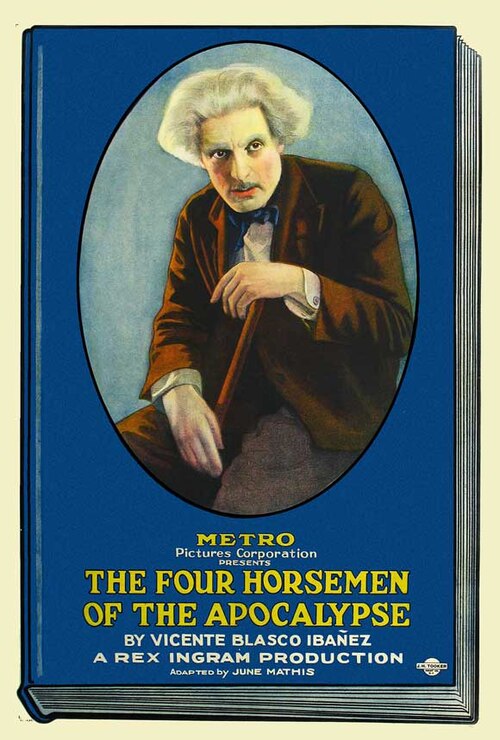
Director Rex Ingram discovered the leading man he didn’t know he needed. His soon to be star was posed in front of the Metro lot while on a horse for a publicity photo. To Ingram’s disappointment, Rudolph Valentino was heroic in his pose, but his saddle was placed backwards. After seeing the photo, Ingram started supervising all of his leading man’s photos. At the time, Valentino was only making $100 a week. Even with his low salary, this leading man would be the most famous person in the United States thanks to Ingram’s upcoming movie.
One of the greatest films in history and the film that started it all was The Four Horsemen of the Apocalypse. This film, as well as being a million dollar picture, was an accomplishment against skepticism from the studio, especially from the screenwriter, June Mathis. The National Film Registry recognized its importance in 1995. This film is free to watch online since it’s in the public domain.
The Four Horsemen of the Apocalypse 1921 — Movie Overview Table
| Detail | Information |
|---|---|
| Title | The Four Horsemen of the Apocalypse |
| Release Year | 1921 (March 1921) |
| Country | United States |
| Runtime | About 132–134 minutes (restored version); other prints run from 114 to 158 minutes |
| Genre | Silent Epic, War Drama, Romance, Anti-War Film |
| Language | Silent (English intertitles) |
| Format | Black & White with color tints and tones (restored version) |
| Director | Rex Ingram |
| Screenplay | June Mathis |
| Based On | The Four Horsemen of the Apocalypse (1916 novel) by Vicente Blasco Ibáñez |
| Producer | Rex Ingram |
| Cinematography | John F. Seitz |
| Editor | Grant Whytock |
| Art Direction | Joseph Calder and Amos Myers |
| Music | Louis F. Gottschalk (original); Carl Davis (1993 restoration score) |
| Production Company | Metro Pictures Corporation |
| Budget | Approximately $800,000 (some sources say $1 million or more) |
| Box Office | Estimates range from $4 million to $9.2 million |
| Significance | The film that made Rudolph Valentino a star |
| Preservation | National Film Registry (1995); Photoplay Productions restoration (1993); Warner Archive Blu-ray (2025) |
| IMDb Rating | 7.1/10 |
| Public Domain | Yes — freely available to watch and download |
Full Cast Table — The Four Horsemen of the Apocalypse (1921)
| Actor | Role |
|---|---|
| Rudolph Valentino | Julio Desnoyers |
| Alice Terry | Marguerite Laurier |
| Pomeroy Cannon | Madariaga, “The Centaur” |
| Josef Swickard | Marcelo Desnoyers |
| Bridgetta Clark | Doña Luisa |
| Virginia Warwick | Chichí |
| Alan Hale Sr. | Karl von Hartrott |
| Mabel Van Buren | Elena |
| Stuart Holmes | Otto von Hartrott |
| John St. Polis | Etienne Laurier |
| Mark Fenton | Senator Lacour |
| Derek Ghent | René Lacour |
| Nigel De Brulier | Tchernoff |
| Bowditch M. Turner | Argensola |
| Edward Connelly | Lodgekeeper |
| Wallace Beery | Lieutenant Colonel von Richthofen |
| Harry Northrup | The General |
| Arthur Hoyt | Lieutenant Schnitz |
June Mathis — The Woman Who Made It Happen
There is no June Mathis without this film. She was the first woman in Hollywood to have a top management role as the head of Metro’s Scenario department. Because of her spiritualism, she had an intense connection with a story of war and end times.
While most studios did not think Vicente Blasco Ibañez’s book could be adapted into a movie, Mathis managed to get Metro to buy the film rights for $20,000 plus 10 percent of the gross receipts. Once they had the rights, she then got Metro to employ Ingram, and finally, insisted that an unknown be hired to play Julio.
She also discovered Valentino and gave him his first important role, a belief that he attributed to her in her life and after her death. Because of this film, Mathis had gained so much power that she was considered Hollywood’s second most important woman, next only to Mary Pickford.
The Tango That Wasn’t in the Novel
The book doesn’t contain the most famous scene of the film. Mathis and Ingram created a role for Julio after viewing some of Valentino’s previous film work. He had performed as a taxi dancer in New York so they decided to add a tango scene and shoot it in a dive bar in Buenos Aires.
Ingram attributed the scene’s addition to himself, as well as reusing footage from a Universal picture from several years before. However, a TCM essay points out how much Mathis contributed to the film, including his creation of a new dance craze and the fad for gaucho pants. Gene Wilder spoofed the scene during the opening credits of the film The World’s Greatest Lover.
A Big Production — 12,000 Cast and Crew and 500,000 Feet of Film
Filming took 6 months from July 1920. A review from March 1921 in the New York Mirror said that the production costs of this picture, as with most of Ingram’s films, had exceeded $800,000. It also said that he worked with fourteen assistants and fourteen cameramen. More than 12,000 people were in this production.
Most of the scenes were done in excess. The film editor Grant Whytock, had to edit more than 500,000 feet of film. Valentino and Terry were also directed to speak in French to help their performances feel more natural.
The look of this film was developed by the cinematographer John F. Seitz, who developed and pioneered the technique of low-key lighting and the use of the matte shot. He went on to receive three Oscar nominations, including one for his work in the films Double Indemnity, The Lost Weekend, and Sunset Boulevard.
From $100 a Week to The Sheik
Metro paid Valentino $100 a week at the start, raised to $350 as the shoot went on. When the film exploded, he asked for a star’s salary, and the studio refused. Valentino walked to Paramount, which rushed out The Sheik (1921) and cemented his celebrity.
Valentino made nine more films before dying of peritonitis in 1926. His death caused mass hysteria and near riots among fans. Mathis buried him in her family’s crypt, a detail that links the two figures in death as in the film’s creation.
The Supporting Players — Alice Terry, Alan Hale, and Wallace Beery
Alice Terry was the billed star, a former Follies girl and Ingram’s wife. She married him the same year the film premiered. Audiences of the day knew her as a major draw in her own right.
Alan Hale Sr. plays one of the German cousins. He later became Errol Flynn’s regular sidekick and Little John in several Robin Hood films, and he fathered Alan Hale Jr., the Skipper on Gilligan’s Island. Wallace Beery appears as a German officer, a few years before he became a major star himself.
Full Plot Summary — The Four Horsemen of the Apocalypse (1921)
Buenos Aires: The Centaur and the Tango
Madariaga (Pomeroy Cannon), a harsh but popular Argentine landowner, has two sons-in-law, one French and one German. He openly favors the French family. His favorite is his grandson Julio (Rudolph Valentino), who often carouses with him in the dives of Buenos Aires’ Boca district.
In one bar, Julio cuts in on a couple dancing the tango. He knocks the woman’s partner aside and dances with her himself, to the crowd’s cheers. When Madariaga dies, the family splits, with one half returning to Germany and the other to France.
Paris: A Wastrel in Love
In Paris, Julio lives as a would-be artist and tea-dance sensation. He falls in love with Marguerite Laurier (Alice Terry), the unhappy young wife of his father’s friend Etienne (John St. Polis). When the affair comes out, Etienne agrees to a divorce, and the couple seems free to marry.
The Great War Divides Them
War breaks out. Marguerite becomes a nurse in Lourdes, and Etienne is blinded in battle and ends up in her hospital. Julio arrives, sees her caring for her husband, and enlists in the French Army out of shame over his wasted life.
Meanwhile, German troops overrun Julio’s father Marcelo’s castle in the Marne Valley and billet officers there. Marcelo’s German nephew tries to protect him, but Marcelo is arrested after a fight and sentenced to die in the morning. The French counterattack at the First Battle of the Marne saves his life.
No Man’s Land
Julio becomes famous for his courage in the trenches. During a mission in no man’s land he recognizes his German cousin, and a shell kills them both moments later. In Paris, Marguerite considers abandoning the blinded Etienne, but Julio’s ghost guides her to stay and care for him.
The film ends with both families mourning their dead. Throughout, the mystic Tchernoff (Nigel De Brulier) shows Marcelo the Four Horsemen riding through the clouds. The horsemen, the film’s anti-war symbol, are Conquest, War, Famine, and Death.
The 1993 Restoration and the 2025 Blu-ray
There were shortened versions that would get worn and would get to as low as 114 minutes. Luckily in 1993, a complete Photoplay Productions photochemical restoration was made by Gill and Brownlow with an orchestral score and tones from 1925.
There is a Blu-ray version that Warner Archive Collection made, that uses a 4K scan of that 1993 Photoplay Productions restoration. Many people agree that this version has an excellent image quality, and is the best home video version that you can buy. Silent Era would recommend that this version be bought.
Free Ways to Watch The Four Horsemen of the Apocalypse (1921)
You can legally stream and even download for free the 1921 classic film The Four Horsemen of the Apocalypse from the Internet Archive because the film has become public domain. There are multiple copies that vary greatly in terms of film print quality, film run length, and color quality, so we recommend browsing multiple versions if you are displeased with what you find.
| Platform | Format | Cost |
|---|---|---|
| Internet Archive | Stream + Download (multiple formats) | Free |
| Warner Archive Collection | Blu-ray, 2025 restoration with Carl Davis score | Paid |
The Four Horsemen of the Apocalypse (1921) on Internet Archive:
Is The Four Horsemen of the Apocalypse (1921) in the Public Domain?
The Four Horsemen of the Apocalypse is in the public domain and free to use in the United States, as it was released before 1923. That means you can legally stream, download, and share it without restriction or charge. Just a quick reminder to exercise some caution, however, as the 1993 restoration and accompanying Carl Davis score are newer works. Do not reuse that version’s audio in any of your own projects.
Critical Reception Then and Now
In its time, this film impressed many critics. IMDb has it at 7.1. Variety said, “It is stunningly large.” Life magazine said it proved films are an art form worthy of serious consideration. Picture-Play magazine admitted the project may have been a one-million dollar gamble, but also considered the result “an artistic triumph.”
A quick survey shows the critical opinion of this film is mixed at best. Encyclopedia.com says, “Today, the film is better remembered for Valentino’s star turn than for the achievement of Ingram.” Many viewers find the unintentional comedy of certain scenes in this melodrama cringey, but still value it for its visual flair and its progressive anti-war message.
See it as a cinematic marvel, as an example of early Hollywood star-making and as an example of an ingenious screenwriter’s contribution to cinema. You should allot a couple of hours for your first watch and I recommend skipping straight to the tango if you’re looking to get a jump start on the experience.
Frequently Asked Questions — The Four Horsemen of the Apocalypse 1921
Q: What is The Four Horsemen of the Apocalypse (1921) about?
An Argentine family splits between France and Germany, and its members end up on opposite sides of World War I. Julio Desnoyers, a carefree Paris playboy, enlists in the French Army after losing the woman he loves, and the war claims him and his German cousin.
Q: Is The Four Horsemen of the Apocalypse (1921) in the public domain?
Yes. The film is in the public domain in the United States and is freely available on the Internet Archive. The 1993 restoration and its Carl Davis score are separate works.
Q: Was this Rudolph Valentino’s breakout film?
Yes. The film turned Valentino from a bit player into a superstar and defined the Latin Lover image. His famous tango scene was added for the film and does not appear in the novel.
Q: Who wrote The Four Horsemen of the Apocalypse (1921)?
June Mathis wrote the screenplay from Vicente Blasco Ibáñez’s 1916 novel. She also persuaded Metro to buy the rights and cast Valentino in the lead.
Q: Who directed The Four Horsemen of the Apocalypse (1921)?
Rex Ingram directed the film. He was born in Ireland and became Metro’s top director on its success.
Q: How long is The Four Horsemen of the Apocalypse (1921)?
The restored version runs about 132 to 134 minutes. Older prints range from 114 to 158 minutes, depending on the edit.
Q: Was The Four Horsemen of the Apocalypse remade?
Yes. Vincente Minnelli directed a 1962 remake that moved the story to World War II and starred Glenn Ford and Ingrid Thulin.
Q: How much money did The Four Horsemen of the Apocalypse make?
Estimates vary. Sources cite a worldwide gross between $4 million and $9.2 million against a budget of roughly $800,000. It is generally described as one of the first Hollywood films to gross $1 million.
Q: Is The Four Horsemen of the Apocalypse in the National Film Registry?
Yes. The Library of Congress selected it for preservation in 1995 as culturally, historically, or aesthetically significant.
Q: Where can I watch The Four Horsemen of the Apocalypse (1921) for free?
The film is freely available on the Internet Archive. For the restored version with Carl Davis’s score, you can buy the 2025 Warner Archive Blu-ray.
Related Free Silent and Classic Drama Films
If The Four Horsemen of the Apocalypse (1921) pulled you toward silent epics, star-making performances, and early war drama, these are the natural titles to explore next:
- His Favorite Pastime (1914) Full Movie Review, Plot, Cast & Free Charlie Chaplin Silent Comedy
- Becky Sharp (1935) Full Movie Review, Plot, Cast & Free Technicolor Classic
- His Double Life (1933) Full Movie Review, Plot, Cast & Free Comedy-Drama Classic
- Public Domain Movies List – All Free Classic Films (Complete Guide)