
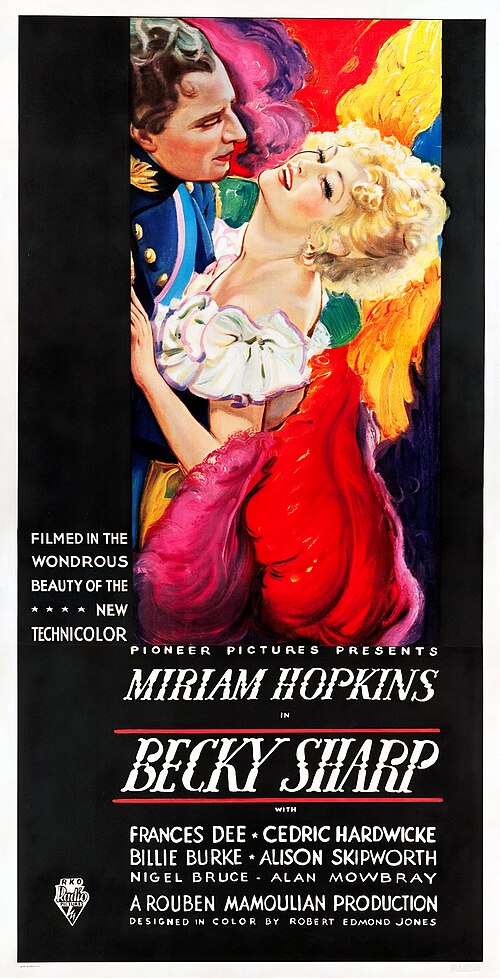
Lowell Sherman refused to abandon Becky Sharp even after his illness turned serious. The film’s original director had made it twenty-five days into production, shuttling between the punishing heat of early three-strip Technicolor lighting rigs and the cold December air outside, when double pneumonia finally forced him to stop. He died on December 28, 1934. Rouben Mamoulian was brought in immediately to finish the picture — and rather than build on what Sherman had already shot, he scrapped every foot of existing footage and started the entire film over from scratch.
The finished film that resulted carries a historical weight that has nothing to do with its plot: Becky Sharp was the first complete feature-length film ever shot in three-strip Technicolor, the true full-color process that would eventually give the world The Wizard of Oz and Gone with the Wind. Early audiences weren’t entirely dazzled — one contemporary critic memorably compared the cast’s skin tones to “boiled salmon dipped in mayonnaise,” a fair description of just how unrefined the process still was on its first full feature outing. Miriam Hopkins earned an Oscar nomination playing Thackeray’s ruthlessly ambitious social climber, in a production whose behind-the-scenes drama, oddly enough, rivals anything happening on screen. It’s in the public domain, and you can watch it free right now.
Becky Sharp 1935 — Movie Overview Table
| Detail | Information |
|---|---|
| Title | Becky Sharp |
| Release Year | 1935 (released June 13, 1935) |
| Country | United States |
| Runtime | 84 minutes |
| Genre | Historical Drama, Romance |
| Language | English |
| Format | Color (Three-Strip Technicolor) |
| Director | Rouben Mamoulian (replacing original director Lowell Sherman, who died during production) |
| Screenplay | Francis Edward Faragoh |
| Based On | Vanity Fair (1848 novel) by William Makepeace Thackeray, via the stage play by Langdon Mitchell |
| Cinematography | Ray Rennahan |
| Color Design | Robert Edmond Jones |
| Film Editing | Archie Marshek |
| Music | Roy Webb |
| Producer | Kenneth Macgowan (Rouben Mamoulian, Robert Edmond Jones, also credited as producers) |
| Production Company | Pioneer Pictures Corporation |
| Distributor | RKO Radio Pictures |
| Significance | First feature-length film shot entirely in three-strip Technicolor |
| Awards | Best Color Film, Venice Film Festival (1935); Academy Award nomination, Best Actress (Miriam Hopkins) |
| Preservation | Restored in 1992 by the UCLA Film and Television Archive under archivist Robert Gitt |
| IMDb Rating | 5.8/10 |
| Public Domain | Yes — freely available to watch and download |
Full Cast Table — Becky Sharp (1935)
| Actor | Role |
|---|---|
| Miriam Hopkins | Becky Sharp |
| Frances Dee | Amelia Sedley |
| Cedric Hardwicke | Marquis of Steyne |
| Billie Burke | Lady Bareacres |
| Alison Skipworth | Miss Crawley |
| Nigel Bruce | Joseph Sedley |
| Alan Mowbray | Rawdon Crawley |
| G.P. Huntley Jr. | George Osborne |
| William Stack | Pitt Crawley |
| George Hassell | Sir Pitt Crawley |
| William Faversham | Duke of Wellington |
| Charles Richman | Gen. Tufto |
| Doris Lloyd | Duchess of Richmond |
| Colin Tapley | Captain William Dobbin |
| Leonard Mudie | Tarquin |
| Charles Coleman | Bowles |
A Director’s Death and a Complete Restart
The production history behind Becky Sharp is genuinely dramatic even before accounting for anything that happens on screen. Lowell Sherman began filming on December 3, 1934, and the early three-strip Technicolor cameras required such intense, sustained lighting that sets became uncomfortably hot — a problem compounded by cast and crew constantly moving between those sweltering interiors and the cold winter air outside. Sherman contracted pneumonia and, per Hollywood Reporter coverage from the time, refused to abandon the picture even as his illness worsened, continuing to direct twenty-five days into production before finally succumbing on December 28, 1934.
Rouben Mamoulian, already an acclaimed director for visually inventive early sound films like Applause (1929) and Dr. Jekyll and Mr. Hyde (1931), was brought in immediately as Sherman’s replacement — and made the striking decision to discard every frame Sherman had shot, reshooting the entire story from the ground up according to trade coverage at the time. One retrospective review notes plainly that since none of Sherman’s footage survives in the finished film, whatever criticisms apply to the picture’s visual approach belong entirely to Mamoulian, who used the production instead as an opportunity to focus intensely on exploring what the new three-strip color process could actually do.
Miriam Hopkins — Nearly Recast, Then Oscar-Nominated
Miriam Hopkins almost didn’t play the role that would define her career. According to AFI trade coverage from 1934, a salary dispute between Hopkins and RKO led to her being dropped from the project entirely, with both Myrna Loy and Claudette Colbert seriously considered as replacements — Colbert reportedly turned down the offer outright, unhappy with the script. Hopkins and RKO ultimately came to terms in mid-September 1934, restoring her to the role she’d go on to make famous.
Critical consensus, then and now, agrees the gamble paid off. One retrospective review calls Hopkins “a house afire” in the role, judging her fully deserving of the Best Actress nomination she ultimately lost to Bette Davis, while another assessment praises how she captures Becky’s “scheming self-servingness in her brittle and brash high style.” Not every critic has been equally convinced — one reviewer found Hopkins’s performance “too shrill” and unconvincing — but the dominant view across decades treats her performance as the film’s clear anchor, regardless of how mixed opinion runs on the picture surrounding her.
Full Plot Summary — Becky Sharp (1935)
Becky Sharp (Miriam Hopkins) is a socially ambitious young Englishwoman navigating the years immediately following Napoleon’s defeat at Waterloo. Born to modest circumstances, she’s determined to climb as high into British society as sheer will and charm can carry her, and pursues that ambition by attaching herself in turn to a series of well-placed gentlemen: the wealthy, corrupt Marquis of Steyne (Cedric Hardwicke), the awkward colonial administrator Joseph Sedley (Nigel Bruce), dashing officer Rawdon Crawley (Alan Mowbray), and George Osborne (G.P. Huntley Jr.), fiancé to her genuinely kind friend Amelia Sedley (Frances Dee).
Rise Through Society
Becky’s scheming steadily pays off, and she rises to genuine prominence within the upper echelons of British society, using each conquest and connection to climb further while offending the sensibilities of established society ladies like the haughty Lady Bareacres (Billie Burke) along the way. Her charm proves powerful enough to extract money and favor from a string of men who each believe, at least briefly, that they hold real influence over her — when in truth it’s almost always the reverse.
Ruin and a Final Reversal
Becky’s fortunes eventually turn. After her husband dies fighting in a distant war, she attempts a career on the stage, but fails to find success there, and finds herself reduced to singing for her supper in a common beer hall — a genuinely humiliating fall from the heights of society she’d fought so hard to reach. True to her established character, though, Becky never stays down for long: an old suitor rescues her from her circumstances once more, and the film closes with the two of them planning to run away together to India, where a comparatively modest sum of money will go considerably further than it ever could in England.
The First Feature in True Technicolor — Boiled Salmon and All
Becky Sharp‘s real historical significance rests entirely on its color, not its story. Formed specifically to produce Technicolor films following the success of the 1934 short La Cucaracha — which won the inaugural Academy Award for Best Short Subject in color — Pioneer Pictures, founded by John Hay Whitney and his cousin Cornelius Vanderbilt Whitney, built Becky Sharp as their flagship feature. Earlier films had used the new three-strip process only in brief sequences or single musical numbers — MGM’s The Cat and the Fiddle, 20th Century’s The House of Rothschild, and two Warner Brothers Leon Errol shorts among them — but Becky Sharp was the first film shot entirely, start to finish, in the full process.
The results, while groundbreaking, weren’t universally flattering by 1935 standards: one contemporary critic’s assessment that the cast resembled “boiled salmon dipped in mayonnaise” has become one of the most repeated pieces of trivia associated with the film, a blunt but accurate description of just how unrefined skin tones still looked in the process’s earliest full-length application. Color designer Robert Edmond Jones and cinematographer Ray Rennahan nonetheless earned lasting praise for their work — one modern retrospective credits Mamoulian as “a master at arranging and capturing those colours,” a skill he’d refine further six years later in Blood and Sand (1941).
A Future First Lady’s Uncredited Walk-On
One of the more surprising pieces of trivia attached to Becky Sharp involves a background extra who’d go on to considerably greater fame: Pat Nixon, later First Lady of the United States as the wife of Richard Nixon, worked as a movie extra around this time and can be spotted in a walk-on appearance during the film’s ball scene. It’s a small, easily missed detail — but a genuine piece of political-cultural trivia connecting one of the earliest full-color Hollywood features to a First Lady who wouldn’t take up residence in the White House for another 34 years.
Where to Watch Becky Sharp (1935) Free Online
Becky Sharp is in the public domain and legally available across multiple platforms at no cost. Note that for many years, only a poorly reproduced 16mm print on two-color Cinecolor stock was widely circulated, inaccurately representing the film’s original three-color palette; a proper restoration exists thanks to a 1992 UCLA Film and Television Archive project, though quality still varies significantly between different public domain copies.
| Platform | Format | Cost |
|---|---|---|
| Internet Archive | Stream + Download (multiple formats) | Free |
| YouTube | Stream | Free |
| Amazon Prime Video | Stream | Free with Prime / SVOD |
Becky Sharp (1935) on Internet Archive:
Is Becky Sharp (1935) in the Public Domain?
Yes. Becky Sharp is in the public domain in the United States, and you can legally stream, download, share, and screen it without restriction or cost. Because it fell into the public domain, print quality varies significantly between sources — seek out a copy sourced from the 1992 UCLA restoration where possible for the most accurate representation of the film’s original color.
Critical Reception — Then and Now
The film holds a 5.8 out of 10 on IMDb, and critical opinion has remained remarkably consistent across nine decades: a genuine technical landmark that struggles as straightforward drama. Contemporary reviewers were blunt on this point, with Rotten Tomatoes’ aggregated historical view noting that with the exception of Hopkins, “the acting in Becky Sharp is almost violently negligible,” and that the picture generally “failed to sizzle” as narrative despite its technological achievement. Dennis Schwartz’s retrospective echoed the same verdict decades later, calling Mamoulian’s direction “unremarkable but showy” and concluding the Thackeray adaptation simply didn’t generate the dramatic heat its premise promised.
Modern reassessment, particularly following the 1992 restoration, has been considerably kinder to the film’s visual achievements specifically. One reviewer who’d previously only seen degraded, near-monochromatic public domain copies described watching the restored version as “seeing an entirely different film,” praising color use that was “striking and surprisingly well considered” and dialogue “delightfully rich” by the standards of more sophisticated 1930s cinema. Even that same enthusiastic review stops short of calling the film a masterpiece, landing on a verdict shared by nearly every assessment across the decades: visually splendid, but dramatically anaemic — a film best appreciated today as a genuine turning point in film technology first, and a Thackeray adaptation second.
Frequently Asked Questions — Becky Sharp 1935
Q: What is Becky Sharp (1935) about?
An ambitious, lower-class young woman, Becky Sharp (Miriam Hopkins), schemes her way into the upper echelons of British society in the years following the Battle of Waterloo, manipulating a series of wealthy men to her advantage before a dramatic fall from grace and an unlikely final rescue.
Q: Is Becky Sharp (1935) in the public domain?
Yes. Becky Sharp is in the public domain in the United States and is freely available on the Internet Archive, YouTube, and other public domain film platforms.
Q: Why is Becky Sharp historically significant?
It was the first feature-length film shot entirely in three-strip Technicolor, the process that would go on to define color filmmaking through classics like The Wizard of Oz and Gone with the Wind. Earlier films had only used the process in brief sequences or short subjects.
Q: What happened to the film’s original director?
Lowell Sherman began directing Becky Sharp in December 1934 but contracted pneumonia, reportedly from moving between the intense heat of Technicolor lighting rigs and cold winter air. He died on December 28, 1934, twenty-five days into production, and was replaced by Rouben Mamoulian, who reshot the entire film from scratch.
Q: Is Becky Sharp based on Vanity Fair?
Yes. The film is based on William Makepeace Thackeray’s 1848 novel Vanity Fair, adapted via a stage play of the same name by Langdon Mitchell.
Q: Did Becky Sharp win any awards?
The film won Best Color Film at the 1935 Venice Film Festival, and Miriam Hopkins received an Academy Award nomination for Best Actress, though she lost to Bette Davis.
Q: How long is Becky Sharp?
The film runs approximately 84 minutes.
Q: What did critics say about Becky Sharp?
Critics consistently praise the film’s groundbreaking use of Technicolor and Miriam Hopkins’s performance, while criticizing its uneven dramatic pacing and, in most supporting performances, relatively flat characterization.
Q: Where can I watch Becky Sharp (1935) for free?
Becky Sharp is freely available on the Internet Archive and YouTube, and can also be streamed through Amazon Prime Video. All public domain versions are legal to stream and download.
Related Free Classic Drama and Romance Films
If Becky Sharp (1935) drew you into early Technicolor cinema or Thackeray-style social-climbing dramas, these are the natural titles to explore next:
- His Double Life (1933) Full Movie Review, Plot, Cast & Free Comedy-Drama Classic
- Danger Lights (1930) Full Movie Review, Plot, Cast & Free Railroad Drama Classic
- Cause for Alarm! (1951) Full Movie Review, Plot, Cast & Free Film Noir Suspense Classic
- Public Domain Movies List – All Free Classic Films (Complete Guide)