
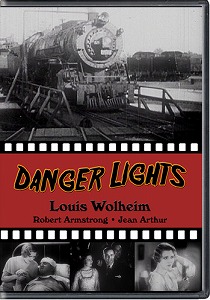
Somewhere, a lost reel of film shows Jean Arthur, Robert Armstrong, and Louis Wolheim in a format nobody would see again on American screens for over two decades. Danger Lights was shot simultaneously in two versions: the standard 35mm cut that survives today, and a widescreen 63.5mm version using a new “wide stereoscopic” process invented by George K. Spoor and P.J. Berggren, offering far greater depth and detail than the standard format of the day. It played only in Chicago and New York before the process was abandoned as commercially unworkable — and the widescreen print itself is now a lost film, meaning audiences today can only watch the picture the way most 1930 moviegoers already did, in ordinary Academy ratio.
The film’s other great point of interest has nothing to do with format and everything to do with its star. Louis Wolheim, fresh off his career-defining performance in All Quiet on the Western Front released earlier that same year, plays the hard-as-nails yard boss at the center of this railroad melodrama — and within months of the film’s release, he was dead at 50, having collapsed during a crash diet for a role that ultimately went to someone else. Danger Lights is a fairly standard love-triangle melodrama by plot, but it’s an extraordinary visual record of Depression-era American railroading, shot largely on location along the actual Milwaukee Road tracks through Montana. It’s in the public domain, and you can watch it free right now.
Danger Lights 1930 — Movie Overview Table
| Detail | Information |
|---|---|
| Title | Danger Lights |
| Release Year | 1930 (Chicago premiere November 15, 1930; wide US release December 12, 1930) |
| Country | United States |
| Runtime | 71–74 minutes (original); 55 minutes (television edit) |
| Genre | Drama, Pre-Code Romance, Railroad Film |
| Language | English |
| Format | Black & White (35mm survives; a 63.5mm widescreen “Natural Vision” version is lost) |
| Director | George B. Seitz |
| Screenplay | James Ashmore Creelman, Frederick Hugh Herbert |
| Cinematography | Karl Struss, John W. Boyle |
| Film Editing | Archie F. Marshek |
| Special Effects | Don Jahraus |
| Producer | William LeBaron (Myles Connolly, associate producer) |
| Distributor | RKO Radio Pictures |
| Filming Locations | Miles City, Montana; Sixteen Mile Canyon, Montana; additional footage in Chicago, Illinois — filmed on the Chicago, Milwaukee, St. Paul and Pacific Railroad |
| Widescreen Process | First feature filmed in George K. Spoor’s “Natural Vision” 63.5mm wide-film process; the widescreen prints are now lost |
| IMDb Rating | 6.2/10 |
| Public Domain | Yes — freely available to watch and download |
Full Cast Table — Danger Lights (1930)
| Actor | Role |
|---|---|
| Louis Wolheim | Dan Thorn |
| Robert Armstrong | Larry Doyle |
| Jean Arthur | Mary Ryan |
| Hugh Herbert | Professor / Engineer |
| Frank Sheridan | Ed Ryan |
| Robert Edeson | Tom Johnson |
| Alan Roscoe | Jim |
| William P. Burt | Chief Dispatcher |
| Jim Farley | Joe Geraghty |
Louis Wolheim — A Career Cut Short Months After Danger Lights
Louis Wolheim had, by 1930, become one of Hollywood’s most respected character actors despite — or arguably because of — a battered, unmistakably rough face, the result of a football injury during his college days at Cornell. Discovered by Lionel Barrymore, who reportedly told him “with that face you could make a fortune in the theater,” Wolheim built a substantial stage career, including originating the title role in Eugene O’Neill’s The Hairy Ape, before transitioning to film work that peaked with his performance as Corporal “Kat” Katczinsky in All Quiet on the Western Front, released just months before Danger Lights in the same year.
Wolheim’s story took a tragic turn almost immediately afterward. While preparing for the role of Walter Burns in Howard Hughes’s film adaptation of The Front Page, Wolheim embarked on a crash diet, reportedly losing around 30 pounds in under a month. He collapsed on set during rehearsals on February 4, 1931, and died just two weeks later, on February 18, 1931, from stomach cancer — his rapid weight loss having been initially misattributed to the diet itself rather than the underlying illness. He was 50 years old, and the role he never got to play went instead to Adolphe Menjou, who earned a Best Actor Oscar nomination for it. Despite his fearsome on-screen persona, Wolheim was, by every account, a genuinely warm, cultured man — fluent in four languages, and remembered by friends who, after his death, redirected funeral flower money toward feeding the hungry in his name.
Jean Arthur — Five Years Before Her Breakthrough
For Jean Arthur, Danger Lights represents a loan-out role during a stretch of her early career when she was typecast almost exclusively as the innocent ingénue — a pattern that wouldn’t break until 1935, when The Whole Town’s Talking finally gave her the opportunity to demonstrate a far wider comic and dramatic range, launching the run of classic performances she’d become best known for throughout the rest of the decade. Watching her here as Mary Ryan, caught between two rough-hewn suitors, means catching her firmly within the narrow ingénue mold five full years before Hollywood figured out what else she could do.
At least one modern reviewer has had some fun at the film’s expense regarding this exact dynamic, noting wryly that Arthur is “trapped in her own tug-o’-war between two men of such monstrous features” — Wolheim’s battered visage and Robert Armstrong’s own considerably less conventional leading-man looks — that the reviewer found themselves questioning the film’s basic casting logic even while enjoying the picture’s railroad spectacle regardless.
Full Plot Summary — Danger Lights (1930)
Dan Thorn (Louis Wolheim) is the tough, uncompromising boss of the classification yard in Miles City, Montana, a man absolutely dedicated to keeping trains running on schedule no matter the human cost. The film opens with a landslide blocking the tracks, prompting the dispatch of a repair crew — reinforced by several hobos found lounging nearby, pressed into service to help clear the line quickly.
A Hobo Turns Out to Be a Railroad Man
One of the hobos, Larry Doyle (Robert Armstrong), turns out to be a former railroad engineer who lost his previous position due to an insubordination charge. Impressed despite himself, Thorn offers Doyle a genuine new job with the railroad — a decision that sets the entire plot in motion, since Doyle quickly falls for Thorn’s own fiancée, Mary Ryan (Jean Arthur), setting the two men on an inevitable collision course.
A Love Triangle and a Fight in the Yard
Jealousy escalates steadily between the two men as both pursue Mary’s affections in earnest, each hoping to win her hand in marriage. Tensions finally boil over during a physical fight between Thorn and Doyle in the railroad yard itself — a confrontation that ends disastrously when Thorn is struck by a passing train and critically injured, leaving his survival entirely dependent on emergency surgery that only a hospital in Chicago can provide.
A Race Against Time to Chicago
With Thorn’s life hanging in the balance, it falls to Doyle — his romantic rival, and the very man he’d been fighting moments earlier — to get him to Chicago in record time, using every ounce of his skill and experience as a railroad engineer to save the life of the man whose fiancée he loves. The film’s climax hinges entirely on this race against the clock, resolving both the medical emergency and the love triangle in a single dramatic sequence built around the genuine mechanics and urgency of high-speed rail travel.
A Genuine Time Capsule of the Age of Steam
What elevates Danger Lights beyond its formulaic plot, for a substantial portion of its audience, is the sheer historical value of its railroad footage. The film features rare footage of an actual tug-of-war between two steam locomotives, genuine documentary-style shots of activities in the real Miles City railyard, and what’s believed to be the only surviving motion picture footage of a dynamometer car from the American steam railroad era — a specialized piece of equipment used to measure locomotive performance that comparable footage in MGM’s 1929 film Thunder, starring Lon Chaney, might once have also captured, had that film not since become lost.
The Montana filming locations also captured a specific, now-vanished piece of American railroad infrastructure: the electrified Rocky Mountain Division of the Milwaukee Road, with its 3,000-volt direct current trolley wire and imposing 100,000-volt alternating current “highline” plainly visible in multiple shots — even though, curiously, none of the railroad’s own electric locomotives, which the company otherwise touted heavily for their power and reliability, actually appear in the finished film. One reviewer summarized the film’s real appeal succinctly: “the real ‘star’ of the film is the railroad itself,” praising how vividly it captures the long-vanished skill and dedication required to keep Depression-era American trains running on schedule.
The Lost Widescreen Version — Hollywood’s Forgotten First Attempt at Natural Vision
Decades before The Robe (1953) or Around the World in 80 Days (1956) popularized widescreen presentation for American audiences, Danger Lights quietly attempted the same thing and was largely dismissed at the time as an interesting novelty rather than a genuine innovation. Cinematographer Karl Struss shot the film using George K. Spoor and P.J. Berggren’s new 63.5mm “wide stereoscopic” process, offering considerably greater depth and detail than standard 35mm — but financial drawbacks meant Danger Lights was the only feature film ever to use the process, and the resulting widescreen prints, which screened exclusively in Chicago and New York, are now considered lost entirely.
It’s a genuinely significant footnote in the technical history of American cinema — a legitimate widescreen experiment more than two decades ahead of the format’s eventual industry-wide adoption, undone by the same economic pressures that killed off plenty of other promising early-sound-era innovations. Modern viewers can only watch the film in the standard Academy ratio that survives, with the more ambitious version existing today only in period descriptions and technical trade coverage.
Where to Watch Danger Lights (1930) Free Online
Danger Lights is in the public domain and legally available across multiple platforms at no cost.
| Platform | Format | Cost |
|---|---|---|
| Internet Archive | Stream + Download (multiple formats) | Free |
| YouTube | Stream | Free |
| Amazon Prime Video | Stream | Free with Prime / SVOD |
Danger Lights (1930) on Internet Archive:
Is Danger Lights (1930) in the Public Domain?
Yes. Danger Lights entered the public domain in the United States in 1958, after the copyright claimants failed to renew the registration in the film’s required 28th year following publication. You can legally stream, download, share, and screen it without restriction or cost.
Critical Reception — Then and Now
The film holds a 6.2 out of 10 on IMDb, and reviews across the decades share a remarkably consistent assessment: formulaic melodrama redeemed by genuinely exceptional railroad photography. One dedicated pre-Code review site summarized it plainly: “As a film, it’s too cliched. But, man, that Wolheim could act,” praising the picture as “a lot of fun for railroad enthusiasts” and “an interesting time capsule,” even while acknowledging its story doesn’t hold up especially well on its own merits.
A Turner Classic Movies retrospective echoed the same split verdict, noting the film sits “in the grand tradition of silent era melodrama, complete with a heroine forced to choose between two men who love her and a race against time to save a life in the final reel,” before crediting Karl Struss’s cinematography for capturing “the smoky, industrial environment of railroad yards” so evocatively that it remains the picture’s real reason to watch. Rotten Tomatoes’ own capsule summary lands in nearly the same place, calling the story “not the most exciting” while still praising the “really good railroad shots” the film delivers throughout.
Frequently Asked Questions — Danger Lights 1930
Q: What is Danger Lights (1930) about?
A hard-nosed railroad yard boss, Dan Thorn (Louis Wolheim), hires a drifter, Larry Doyle (Robert Armstrong), who turns out to be a skilled former railroad engineer. Doyle falls in love with Thorn’s fiancee, Mary Ryan (Jean Arthur), and the resulting jealousy leads to a violent confrontation in which Thorn is critically injured, forcing Doyle to race him to Chicago for life-saving surgery.
Q: Is Danger Lights (1930) in the public domain?
Yes. Danger Lights entered the public domain in the United States in 1958 after its copyright was not renewed, and it is freely available on the Internet Archive, YouTube, and other public domain film platforms.
Q: Was Danger Lights filmed in widescreen?
Yes, partially. The film was shot simultaneously in standard 35mm and in a new 63.5mm widescreen process invented by George K. Spoor and P.J. Berggren. The widescreen version screened only in Chicago and New York and is now considered a lost film; only the standard version survives today.
Q: What happened to star Louis Wolheim after Danger Lights?
Louis Wolheim died on February 18, 1931, just months after the release of Danger Lights, from stomach cancer, after collapsing during a crash diet undertaken for a role in The Front Page. He was 50 years old.
Q: Where was Danger Lights filmed?
The film was shot primarily on location in Montana along the Chicago, Milwaukee, St. Paul and Pacific Railroad, including the railway yard in Miles City and the line through Sixteen Mile Canyon, with additional footage shot in Chicago, Illinois.
Q: Who directed Danger Lights?
George B. Seitz directed the film for RKO Radio Pictures, from a screenplay by James Ashmore Creelman and Frederick Hugh Herbert.
Q: How long is Danger Lights?
The original theatrical release ran between 71 and 74 minutes depending on the source; a shortened television edit runs 55 minutes.
Q: What did critics say about Danger Lights?
Critics generally describe the plot as formulaic and predictable, but consistently praise the film’s authentic railroad footage and Karl Struss’s atmospheric cinematography, along with Louis Wolheim’s performance, as the picture’s strongest assets.
Q: Where can I watch Danger Lights (1930) for free?
Danger Lights is freely available on the Internet Archive and YouTube, and can also be streamed through Amazon Prime Video. All public domain versions are legal to stream and download.
Related Free Classic Drama and Romance Films
If Danger Lights (1930) drew you into pre-Code melodrama or early-sound-era technical curiosities, these are the natural titles to explore next:
- Lonely Wives (1931) Full Movie Review, Plot, Cast & Free Pre-Code Comedy Classic
- Public Domain Cartoons
- Tombstone Canyon (1932) Full Movie Review, Plot, Cast & Free Western Mystery Classic
- Public Domain Movies List – All Free Classic Films (Complete Guide)
Movie Tags
Danger Lights 1930, Danger Lights full movie, watch Danger Lights free, Danger Lights public domain, Louis Wolheim actor, Louis Wolheim All Quiet on the Western Front, Jean Arthur early career, Robert Armstrong actor, George B. Seitz director, RKO Pictures 1930, Milwaukee Road railroad film, Montana railroad location filming, lost widescreen film history, Natural Vision 63mm process, pre-Code railroad melodrama, free classic 1930s drama online, steam locomotive documentary footage, dynamometer car footage