

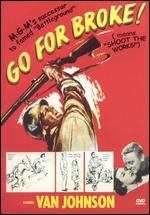
Robert Pirosh wanted to write a love story. The hero would be a young Japanese American college student, and the war would stay in the background. He dug into the past, and the love story faded for him. What showed up next was the record of the Nisei troops in the 442nd Regimental Combat Team. These men fought through Italy and France, even as their families were held in camps at home. That is how Go for Broke! came to be in 1951.
MGM released it just six years after the war. Van Johnson plays a Texas lieutenant who looks down on the men he’s been ordered to train, and real 442nd veterans play the soldiers around him. Most of them had never acted before. Pirosh’s screenplay picked up an Oscar nomination, the film made money, and it has been in the public domain in the United States since 1979. You can watch it free right now.
Go for Broke! 1951 — Movie Overview Table
| Detail | Information |
|---|---|
| Title | Go for Broke! |
| Release Year | 1951 (Hollywood premiere May 9, 1951) |
| Country | United States |
| Runtime | 90–92 minutes |
| Genre | War Drama, History |
| Language | English |
| Format | Black & White |
| Director | Robert Pirosh (his directorial debut) |
| Screenplay | Robert Pirosh |
| Producer | Dore Schary |
| Cinematography | Paul C. Vogel |
| Film Editing | James E. Newcom |
| Music | Alberto Colombo |
| Art Direction | Cedric Gibbons, Eddie Imazu |
| Production Company / Distributor | Metro-Goldwyn-Mayer |
| Subject | The Nisei soldiers of the 100th Battalion / 442nd Regimental Combat Team in World War II |
| Awards | Academy Award nomination, Best Story and Screenplay (Robert Pirosh) |
| Budget / Box Office | About $1.3 million / about $3.3 million worldwide (MGM records) |
| IMDb Rating | 6.6/10 |
| Public Domain | Yes (United States) — freely available to watch and download |
Full Cast Table — Go for Broke! (1951)
| Actor | Role |
|---|---|
| Van Johnson | Lt. Michael Grayson |
| Lane Nakano | Sam |
| George Miki | Chick |
| Akira Fukunaga | Frank |
| Ken K. Okamoto | Kaz |
| Henry Oyasato | Takashi Ohhara |
| Harry Hamada | Masami |
| Henry Nakamura | Tommy Kamakura |
| Warner Anderson | Col. Charles W. Pence |
| Don Haggerty | Sgt. Wilson I. Culley |
| Gianna Maria Canale | Rosina |
| Dan Riss | Capt. Solari |
| John Banner | German Officer |
| Jerry Fujikawa | Communications Sergeant (uncredited) |
| Richard Anderson | Lieutenant (uncredited) |
| Hugh Beaumont | Chaplain (uncredited) |
| Frank Wilcox | HQ General (uncredited) |
How a Love Story Turned Into a War Film
Pirosh first heard about the Japanese American fighting units while researching Battleground (1949), the Van Johnson war picture that won him an Oscar. The idea stuck with him. According to Densho Encyclopedia, he decided the film had to show how badly the incarceration hurt people, while still honoring what the Nisei soldiers accomplished.
Producer Dore Schary backed him all the way. Schary was known around Hollywood for pushing racial tolerance in his films, and he’d go on to produce Bad Day at Black Rock (1955), which also deals with prejudice against Japanese Americans. For Go for Broke!, Pirosh flew to Hawaii to pick veterans of the 442nd for the main roles.
Real Veterans, First-Time Actors
The casting is what makes this film stand out. Lane Nakano, George Miki, Akira Fukunaga, Ken K. Okamoto and Henry Oyasato had all served in the 100th/442nd, and none of them had acted on screen before. Henry Nakamura, who plays young Tommy, is the one lead who didn’t serve in the war.
Each man gets a clear personality. Nakano’s Sam enlists to prove his loyalty while his family sits in a camp. Miki’s Chick grumbles about everything. Okamoto’s Kaz, from Hawaii, keeps everyone’s spirits up with a ukulele. Fukunaga’s Frank is an architect who studied at the University of Southern California.
Nakano even got second billing right after Van Johnson, which was almost unheard of for a Japanese American actor in a 1951 studio film. Letterboxd reviewers still bring it up. They point out how rare it is to see so many Japanese American faces in a black-and-white Hollywood movie.
Full Plot Summary — Go for Broke! (1951)
In 1943, Lieutenant Michael Grayson, newly commissioned and played by Van Johnson, rides into Camp Shelby in Mississippi. He thought he would return to the 36th Infantry Division, the Texas National Guard unit he knew well from his time as an enlisted man.
But the Army has something else in mind. He is assigned to the 442nd. That regiment is made up of Nisei soldiers, American-born sons of Japanese immigrants.
Training a Unit He Doesn’t Want
Grayson signed up to fight the Japanese, and he can’t see these men as anything but the enemy’s face. He drills his platoon hard and follows the Uniform Code of Military Justice to the letter. Captain Solari (Dan Riss) tries to tell him the unit is loyal and good, but Grayson isn’t listening.
The soldiers have plenty to be angry about. Many have relatives behind barbed wire, and they’re training to fight for the country that put them there. Along the way, Grayson and the audience learn what the title means: a Hawaiian pidgin phrase for risking everything, like shooting the works.
Into Italy and France
Once the regiment ships out to Italy, it joins the 100th Battalion, a seasoned Nisei unit that formed in Hawaii. The newcomers lean on those veterans for advice. On the march to the front, Grayson gets left behind after spending time with a local woman. His platoon covers for him during an inspection, and Colonel Pence (Warner Anderson) never finds out.
Through the fighting in Italy and France, including Monte Cassino and Hill 140, Grayson’s bigotry starts to crack. He even gets into a fistfight with an old friend from the 36th who insults the Nisei.
The Lost Battalion
Over his objections, Grayson gets transferred back to the 36th as a liaison when the 442nd is attached to that division. Then German forces trap the 36th in the Vosges Mountains. The 442nd fights through to rescue the surrounded Texans, which is the climax of the film.
The soldiers return home and receive a Presidential Unit Citation. The film includes real footage of General Mark Clark and President Truman honoring the unit.
The Real History Behind the Story
The 442nd is often described as the most decorated unit of its kind, in both its size and how long it served. At the same time, the cost was steep, with some of the worst losses of the war.
During that period, Executive Order 9066 pushed close to 120,000 Japanese Americans into confinement. Many people later used the word internment to describe what happened.
After the war, Densho notes, both stories mostly disappeared from public conversation. Go for Broke! was a big exception. For years it stayed one of the few popular films to show Nisei military service at all.
What the Film Shows and What It Skips
Pirosh never takes you inside a camp. The incarceration comes up in conversation instead, mostly through Sam’s worries about his family. That choice helped 1951 audiences accept the film, and it also limits how far the film goes.
A few critics today feel the film does not speak out hard enough about prisons.
At the same time, others say it leans on stereotypes. They mention how it shows the soldiers as being tall, how it keeps them cheerful, and how it uses pidgin speech. Still, many historians insist the movie caused more good than harm.Watch it with all of those points in mind.
Supporting Cast: Faces You Might Know
Classic TV fans will get a kick out of the supporting cast. John Banner, later Sergeant Schultz on Hogan’s Heroes, plays a German officer. Richard Anderson, who’d become familiar from The Six Million Dollar Man, shows up uncredited as a lieutenant. Hugh Beaumont, later Ward Cleaver on Leave It to Beaver, plays an uncredited chaplain.
Italian actress Gianna Maria Canale plays Rosina, and Don Haggerty plays Sergeant Culley. There’s also an original song, “The Meaning of Love,” credited to Pirosh, composer Alberto Colombo and cast member Ken Okamoto.
A Seven-City Premiere and a Box Office Win
MGM went big on promotion, with magazine ads and lesson plans for schools. The gala premiere happened at Grauman’s Egyptian Theatre in Hollywood on May 9, 1951, and about 100 Purple Heart veterans of the 442nd attended, including the unit’s color guard.
Densho reports that the film opened in seven cities: Honolulu, Hollywood, Houston, New York, Philadelphia, Washington D.C. and Tokyo. People lined up before dawn in Honolulu and Tokyo. MGM’s records show a profit of about $761,000 on a budget around $1.3 million.
Where to Watch Go for Broke! (1951) Free Online
Go for Broke! is in the public domain in the United States. That means you can watch it online or download it for free.
The picture quality is not always the same. One upload might look clear, but another may not. If the first copy seems blurry or rough, try a different one.
| Platform | Format | Cost |
|---|---|---|
| Internet Archive | Stream + Download (multiple formats) | Free |
| YouTube | Stream | Free |
Go for Broke! (1951) on Internet Archive:
Is Go for Broke! (1951) in the Public Domain?
Yes, that is the case in the United States. MGM did not renew the copyright in the 28th year after the film was released. Because of that, the movie became public domain in 1979. That means you can stream it, download it, share it, and show it, and you do not need to pay.
Critical Reception, Then and Now
The film holds 6.6 out of 10 on IMDb. In 1951 the New York Times called it “a respectful and rousing tribute” and praised how real the Nisei soldiers felt on screen. The Los Angeles Times thought it sketchier than Battleground, but liked its good will and its focus on a little-known chapter of the Italian and French campaigns.
Variety noted that Pirosh keeps things personal and funny during the training scenes, and that the veterans add a natural feel. Audiences agreed. In an MGM preview survey, 251 of 398 viewers rated it outstanding or excellent.
Today’s reviewers are more split. Some find it a predictable old war movie with real heart. Others value it as the only Hollywood acknowledgement of the 442nd. It lost the Best Story and Screenplay Oscar to An American in Paris, but its lasting value comes from who’s on screen and whose story it tells.
Frequently Asked Questions — Go for Broke! 1951
Q: What is Go for Broke! (1951) about?
Lt. Michael Grayson (Van Johnson), a prejudiced Texan, is assigned to train the 442nd Regimental Combat Team, a unit of Japanese American soldiers. After fighting alongside them in Italy and France, he comes to respect his men, and the 442nd rescues his old Texas unit when it is surrounded by German forces.
Q: Is Go for Broke! (1951) in the public domain?
Yes, in the United States. It entered the public domain in 1979 when MGM did not renew its copyright, and it is freely available on the Internet Archive and other platforms.
Q: Were the Japanese American actors in the film real soldiers?
Largely, yes. Director Robert Pirosh cast veterans of the 100th/442nd, including Lane Nakano, George Miki, Akira Fukunaga, Ken K. Okamoto and Henry Oyasato, most of whom had never acted before. Henry Nakamura, who plays Tommy, did not serve in the war.
Q: What does Go for Broke mean?
It is a Hawaiian pidgin phrase meaning to risk everything, similar to shooting the works. It was a rallying phrase among the Nisei soldiers, and the film teaches it to Lt. Grayson and the audience.
Q: Who directed Go for Broke!?
Robert Pirosh wrote and directed the film, his directorial debut. Dore Schary produced it for MGM. Pirosh had previously won an Oscar for writing Battleground (1949).
Q: Is Go for Broke! based on a true story?
It dramatizes the real history of the 100th Battalion and 442nd Regimental Combat Team, including the rescue of the Lost Battalion in the Vosges Mountains. Lt. Grayson serves as the film’s dramatic through-line for that history.
Q: Did Go for Broke! win any awards?
Robert Pirosh received an Academy Award nomination for Best Story and Screenplay in 1951. The award went to An American in Paris.
Q: How long is Go for Broke!?
The film runs about 90 to 92 minutes, depending on the source and print.
Q: Has the film been criticized?
Some modern critics say it does not condemn the Japanese American incarceration strongly enough and that it leans on stereotypes about the soldiers. Many historians still credit it with helping bring the 442nd’s story to a wide audience.
Q: Where can I watch Go for Broke! (1951) for free?
Go for Broke! is available free on the Internet Archive and has also been posted on YouTube. Public domain copies are legal to stream and download in the United States.
Related Free Classic War and Drama Films
If Go for Broke! (1951) pulled you into classic MGM drama and wartime stories, these are good places to go next: