
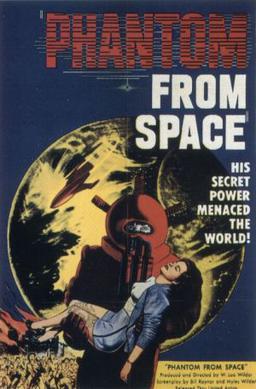
Phantom from Space (1953) is a low‑budget black‑and‑white science fiction movie about an invisible alien hunted through Southern California after a suspected UFO crash causes radio and TV interference. Now a public domain movie, it is widely available online as Phantom from Space full movie and is often enjoyed as a “so‑bad‑it’s‑good” free classic movie from the early 1950s.
Phantom From Space (1953)
Phantom from Space is an American science fiction film that was very independent in production in 1953; its director and producer was W. Lee Wilder. William Raynor and Myles Wilder were the writers of the screenplay and the movie is starred by Ted Cooper, Noreen Nash, Dick Sands and Burt Wenland. It was produced with the small production company of Wilder and published on a financing-for-distribution deal with United Artists and occasionally RKO Radio Pictures.
Movie Background
- Director / Producer: W. Lee Wilder.
- Writers: William Raynor and Myles Wilder.
- Year of release: 1953, in black and white, running about 73 minutes.
- Main cast: Ted Cooper, Noreen Nash, Dick Sands, Burt Wenland, Harry Landers, Rudolph Anders.
- Production: Independently made, using Los Angeles locations such as the Griffith Observatory for key sequences.
The book tells the adventures of government and FCC investigators who discover the weird interference to some crashed space ship and later to an unseen alien in an attempt to survive on the planet. The news spreads fear and the police set up a man hunt that resolves tragically at the Griffith Observatory.
Movie Cast Table
| Actor | Role |
|---|---|
| Ted Cooper | Lt. Hazen |
| Noreen Nash | Barbara Randall |
| Tom Daly | Charlie |
| Steve Acton | Mobile center dispatcher |
| Burt Wenland | Agent Joe |
| Lela Nelson | Betty Evans |
| Harry Landers | Lt. Bowers |
| Burt Arnold | Darrow |
| Sandy Sanders | First policeman |
| Harry Strang | Neighbor |
| Jim Bannon | Desk Sgt. Jim |
| Jack Daly | Joe Wakeman |
| Michael Mark | Refinery watchman |
| Rudolph Anders | Dr. Wyatt |
| James Seay | Major Andrews |
| Steve Clark | Bill Randall (as Steve Clark) |
| Dick Sands | The Phantom |
| |
This compact ensemble plays government officials, scientists, local residents, and the unseen alien itself, with much of the drama driven by their reactions to the invisible threat.
Full Plot Summary
The movie begins with a mysterious object which is shooting through the skies across Southern California and there is radio and television interference which is picked by the Federal Communications Commission. San Fernando Valley and Santa Monica are the regions where FCC agents and other government representatives come to examine what seems to be a downed UFO.
Shortly after the suspected crash, witnesses claim they saw an awkward looking figure in a bulky threatening spacesuit and helmet moving around the place. This figure is met by two men at a coastal place near Santa Monica and in fear of his appearance, they attack him and are killed during the fight. The killings, together with the ongoing interference make the authorities believe that something extremely strange is occurring.
On receiving the information of the TV viewers and radio operators, Lt. Hazen and his colleague Charlie start tracing the origin of the interference in the region. The trail takes them to a gas station where a second unexplained death has taken place and then on to the Huntington Beach oil fields where there is another disturbance that ends in an explosion killing a worker in the refinery. In every scene, there are witnesses who report seeing a strange looking and helmeted figure in a weird suit and surveillance cameras record high radiation levels.
The investigators, coming to the conclusion that all these events might be the work of one and the same entity, broaden their search, whereas the police officer Lt. Bowers strives to link the deaths that remain unexplained with the complaints of the people, among them Betty Evans, who has lost her husband. Bowers at first thinks of the crime as something trivial, but he goes on becoming more receptive to a miraculous explanation as he is informed about the interference patterns and the ghostly silhouette.
While being chased, the extraterrestrial takes off his helmet and suit and shows that his body is not visible to human sight. The police, without knowing the truth, take the spacesuit and helmet back and turn them over to a scientific laboratory where Dr. Wyatt and his team, including lab assistant Barbara Randall will be conducting research. The scientists conclude that the gear is super-advanced and could be used in outer space. Besides, the helmet has a special gas mixture, which leads them to the conclusion that the alien cannot breathe Earth’s oxygen and needs the helmet for a longer duration to survive.
The manhunt is now considering the possibility of an invisible intruder, while the alien, unnoticed, goes into the lab at night to get his helmet and breathing gas back. When Barbara is the only one in the lab, the door of the lab gets locked, the equipment moves, and the footprints made by the invisible creature are shown in the powder that has been spilled on the floor, which proves the presence of the alien. Barbara very coolly activates the intercom to inform the others, but when they get there, the room looks deserted, and the alien takes off with her for a short time, as she has fainted in his arms.
Based on the technology, the actions of the alien and the technology and the way the events unfold, Dr. Wyatt comes to the conclusion that the visitor is indeed a super-human species whose spacecraft had been haphazardly lured into the orbit of the earth and crashed in the ocean. He says that the killings could have been unintentional: the husband of Betty was the first to attack the alien and the blast at the oil field might have been caused by the gases in the helmets exploding not by sabotage. This creates a possibility that the alien is not evil but he is merely struggling to survive in an unfavorable atmosphere.
All night Hazen, Bowers, Major Andrews and the rest attempt to predict the actions of the alien, realizing that it will go back to the lab to be air-conditioned. Soon before the dawn the phantom appears to Barbara once more alone and the phantom gets to the lab again and starts to draw gas out of the helmet so that he can breathe. She puts out his name (via the loudspeaker); the rest of the crowd fly in and would like to talk and make the situation calm, but a flash of a camera belonging to a photographer bursts out of the blue. Shocked, the terrified alien loses the helmet, which breaks and dissolves in a moment, and leaves him with no breathing gas.
The invisible alien escapes the laboratory and now, the group in pursuit is half way by following the trail left by Venus, the dog that dr. Wyatt uses which barks and follows him. The pursuit is followed into the Griffith Observatory where the alien gets onto the top of the large space telescope. Having his human-like form, a tall muscular figure, the humans, however, are able to see him there, using ultraviolet light, and he is no longer a phantom.
The alien appears to be making a request to speak or have some form of communication but his voice is not audible to the human ear and all the dog does is to respond to the tones. With the exhaustion of his supply of his breathable gas, he starts to suffocate, stumbles, and drops off the platform, and we see his body briefly, then it disappears on the observatory floor. The researchers are standing looking at the vacant area where he disappeared, where they realise that their fear and misunderstanding have contributed towards the downfall of an unfortunate stray who might never have intended to harm them.
Due to the fact that Phantom from Space is a public domain film, this film, with its UFO panic, the use of the invisible man gimmick, and a sense of anxiety about the Cold War, is often watched online as Phantom from Space full movie or Phantom from Space 1953 movie by classics sci fi fans.
Genre and Key Themes
Phantom from Space is a science fiction movie, a light horror movie, which focuses on a mysterious alien, and an uneasy governmental manhunt. It fits well within the early 1950s UFO and invasion movies but views the visitor with a somewhat tragic and sympathetic approach instead of having a straight-forward monster.
Key themes include:
- Fear of the unknown: The authorities believe that the alien is hostile with them mainly due to his unappealing appearance and the mishaps that occur within his vicinity just like Cold War paranoia towards outsiders and the unknown.
- Miscommunication and isolation: The alien is not able to breathe our air, not able to communicate easily in the human language and is invisible, most of the story, which drives the humans to panic rather than understanding.
- Technology and unwanted damage: Radio interference, blown-up gases, and hi-tech space equipment demonstrate how technology can be disastrous when it is not comprehended by people.
- Empathy with the “invader: The resolution makes it very clear that the alien might have been mere rescue and survival, making him a tragic character instead of a villain conqueror.
These concepts render Phantom from Space 1953 film fascinating to contemporary audiences who appreciate the vintage sci-fi that was relevant to its time but nevertheless somehow human.
Phantom from Space (1953) Full Movie Watch and Download
Watch Phantom from Space (1953) on Internet Archive:
🏛️ See Also
Charlie Chaplin’s The Adventurer (1917) – Free Classic Silent Comedy Full Movie
Charlie Chaplins Police (1916) Full Movie – Classic Silent Comedy Short
A Man Betrayed (1936) – Classic Republic Crime-Drama
The Terror (1963) – A Gothic Mystery Horror Classic
Movie Review
Phantom from Space is a very low-budget, talkative, and technically limited sci-fi picture that is destined to get a very negative reception but at the same time has a certain cult appeal still especially for the devotees of the 1950’s B-movies and public domain oddities. The tempo is mainly composed of exposition and movement with the invisible, misunderstood alien character being the one that keeps the audience’s interest even if they are not very quick to respond.
- Acting: Performances are functional rather than star‑driven. Ted Cooper, Noreen Nash, and Rudolph Anders deliver straightforward work as investigators and scientists, grounding the more outlandish elements. The alien is played physically by Dick Sands, whose work is mostly suggested through footprints, props, and reactions rather than visible screen time.
- Direction and production: W. Lee Wilder makes heavy use of interiors, stock‑feeling offices, and the Griffith Observatory to stretch a very small budget. Film historian Glenn Erickson has jokingly described the movie as a “no‑budget wonder” with “endless talky scenes” and a tiny cast running back and forth in the same observatory interior, highlighting both its limitations and accidental charm.
- Atmosphere and effects: The invisibility is handled through simple practical tricks—moving objects, footprints in powder, doors opening by themselves—rather than elaborate visual effects. While rudimentary, these choices add a retro charm that many fans appreciate when watching Phantom from Space full movie today.
Overall, Phantom from Space works best as a curiosity: a short, earnest, and slightly clumsy science‑fiction film that combines UFO scares with a sad ending and a sympathetic “monster.” As a free classic movie and public domain movie, it remains popular for late‑night viewing, riffing, or anyone exploring obscure 1950s sci‑fi.
Movie Tags
Phantom from Space, Phantom from Space 1953, Phantom from Space full movie, Phantom from Space 1953 film, sci‑fi horror, science fiction movie, invisible alien film, UFO crash movie, W. Lee Wilder, Ted Cooper, Noreen Nash, Dick Sands, Rudolph Anders, early 1950s sci‑fi, Griffith Observatory movie, Cold War paranoia sci‑fi, low‑budget science fiction, cult classic, so‑bad‑it’s‑good movie, black and white sci‑fi, public domain movie, free classic movie, vintage alien invasion film, 1950s B‑movie, United Artists sci‑fi, stranded alien story.