
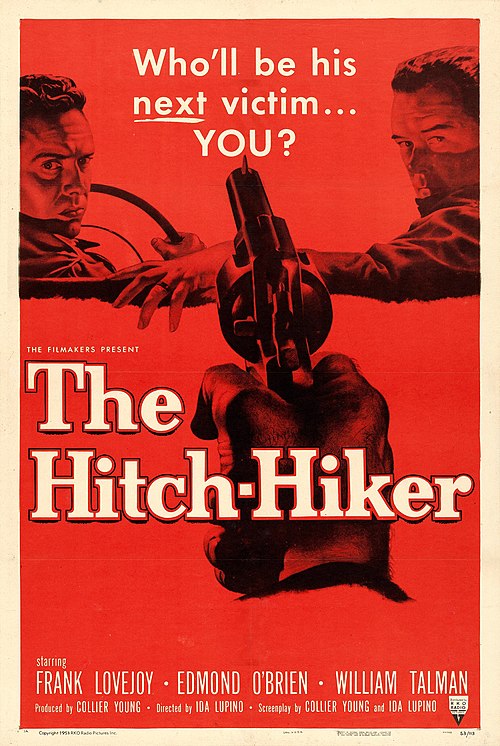
The Hitch-Hiker (1953) is a taut and lean film noir, as two friends go fishing but are, instead, thrust into a horrifying struggle to survive after they pick up the wrong stranger on a deserted highway. This public domain movie has since become a favorite on the internet where so many people view The Hitch-Hiker full movie as a tense, character-filled The Hitch-Hiker (1953), film directed by one of the few women who work behind the camera in the classic Hollywood.
The Hitch-Hiker (1953)
The Hitch-Hiker (1953) is a film noir road thriller from the United States, directed by Ida Lupino, with Edmond O’Brien, Frank Lovejoy, and William Talman in the lead roles. Besides, it is based loosely on the actual murder spree of a psychopath named Billy Cook in the 1950s and takes place during a trip when two ordinary men are kidnapped and imprisoned by a mentally ill hitchhiker on a journey down the U.S. border and deep into Mexico. It is now a film in the public domain, so it can easily be accessed as a free classic movie by those who are into either the vintage noir or the early crime films directed by women.
Movie Cast Table
| Actor | Role |
|---|---|
| Edmond O’Brien | Roy Collins |
| Frank Lovejoy | Gilbert Bowen |
| William Talman | Emmett Myers |
| José Torvay | Captain Alvarado |
| Wendell Niles | Himself |
| Jean Del Val | Inspector General |
| Clark Howat | Government Agent |
| Natividad Vacío | Jose |
| Rodney Bell | William Johnson |
| |
Collier Young, Lupino’s husband and co‑writer, also appears briefly and uncredited as a Mexican peasant, a small inside detail that film buffs enjoy pointing out.
Full Plot Summary
The Hitch-Hiker (1953 film) starts with a semi-documentary introduction, which shows the reports and the places where the crimes have been done and they are all connected to a hitchhiker who has been performing murders across the highways of the American Southwest. This killer is called Emmett Myers and he is a wanderer who takes the rides, murders his victims, and moves on before the cops can catch him.
Roy Collins and Gilbert Bowen, two Californian working-class friends meanwhile are going south on a long-awaited fishing trip. They just switch their destinations without informing their families on where they are going to and this makes them more difficult to trace by the authorities later. One evening, they come across a man on the desert road in a lonely spot and they stop, an action that most people would have done in that moment.
The person who is not known is Emmett Myers. He sits for a brief moment in the back seat, then takes out a pistol and says who he is and that they are already under his command. From this point on, the plot of The Hitch-Hiker (1953) becomes a tense three person story, with Myers compelling Roy and Gilbert to take him to the Mexican border while he connects to the radio and follows the updates on the manhunt.
The stranger is Emmett Myers. Having sat in the back seat a moment, he draws a gun and informs the men of who he is and that they are under his care. Ever since that point, The Hitch-Hiker (1953) becomes a two-plus-one-person narrative, as Myers compels Roy and Gilbert to drive him to the Mexican border as he hears radio reports regarding the manhunt.
Myers is a cruel and fickle character. He mocks the men, takes their fear as a joke, and tells them that when they are no more helpful he can kill them just like he did with his past victims. However, there is a strange physical feature that makes the escape even more difficult: one of Myers’ eyes will always be half-open because of a broken eyelid, which makes it impossible for Roy and Gilbert to determine whether he is really sleeping or just pretending.
The Hitch-Hiker (1953 film) develops a lot of tension out of these minor displays of opposition, and out of the psychological games with Myers. In one particularly horrifying scene, Myers commands Roy to step aside with a tin can in his hand and Gilbert is made to fire at the can as a sadistic experiment to entertain him when in fact, they are friends. Much later when the men attempt to flee in rocky terrain, Roy severely sprains his ankle, the men are re-captured and Myers scowlists that they had missed opportunities to get away before because they were not selfish enough to expose the other.
Parallel scenes show police in the U.S. and Mexico tracking Myers. They compare evidence from multiple murder sites, follow reports, and eventually pick up the trail of the two missing fishermen when Roy’s ring and other clues are found. Slowly, they build a picture of Myers’s route as he pushes his captives toward the coast.
Finally, Myers smuggles Roy and Gilbert to the port city of Santa Rosalía situated on the Baja California peninsula. To make matters difficult for anyone who might be tracking them, he has Roy wear his outfit, thus at first sight the men’s identities appear to be interchanged. Upon learning that the normal ferry service to Guaymas has been suspended, he bribes a fisherman to ferry them over the gulf instead, believing by this that he is still ahead of them by a move.
Nonetheless, the municipality has already sighted. The inhabitants have listened to the radio narratives of the murderer and his prisoners, and one person acknowledges the case, subtly informing the police. In the last part of The Hitch-Hiker (1953 full movie), police and military are positioned around the wharf while the three are about to get on the ferry. The officers are momentarily puzzled due to the mix-up of clothes, but they quickly sort out who the genuine Myers is, take away his weapon, and after a brief altercation, arrest him.
The moment the killer’s weapon is taken away from him and he finds himself in a circle of police officers, he who has been bragging and intimidating during the entire film, looks tiny and frightened. Roy and Gilbert, tired but still living, conclude to talk to the cops, and they are allowed to return home after a nightmarish experience that started with just one simple offer to ride.
Genre and Key Themes
The Hitch-Hiker (1953) is a minimalistic film noir that also serves as a road-movie and a kidnapping adventure. It is not reliant on a big urbanized setting or elaborate side stories, it simply keeps the attention fixed to the three men and a car and the huge, merciless desert surrounding them.
Some of the main themes include:
- Random violence and insecurity The film exploits the fear that one can never be sure how safe they are in their daily lives, and that even a simple act such as assisting a stranger may lead to being a victim of a murderer.
- Power, manhood, and control- Myers continuously assaults Roy and Gilbert over their manhood to attempt to demonstrate that fear always prevails and they find it hard to be brave without committing suicide.
- Friendship and loyalty – Although it may seem easier to save self at the expense of the other, the two friends do not do it and are in sharp contrast to the selfish worldview of Myers.
- Legal and interstate collaboration – The Hitch-Hiker (1953) depicts cooperation between the U.S. and Mexican authorities to eliminate the killer unlike other noirs that concentrate on corrupted and inefficient police.
The fact that the themes are still very up-to-date, such as trusting people in the street, random threat, loyalty even in stressful situations, makes the movie still interesting to watch by those who find The Hitch-Hiker full movie today.
The Hitch-Hiker (1953) Full Movie Watch and Download
Watch The Hitch-Hiker (1953) on Internet Archive:
🏛️ See Also
Charlie Chaplin’s The Adventurer (1917) – Free Classic Silent Comedy Full Movie
Charlie Chaplins Police (1916) Full Movie – Classic Silent Comedy Short
A Man Betrayed (1936) – Classic Republic Crime-Drama
The Terror (1963) – A Gothic Mystery Horror Classic
Movie Review
The Hitch-Hiker (1953 film) has been widely acclaimed regarding the extent that it accomplishes due to its brief length and a modest budget. There is hardly any filler at approximately 70 minutes; the majority of the scenes either develop the suspense or say something new about the three main characters.
Frank Lovejoy and Edmond O Brien base the film on Roy and Gilbert as men, not movie heroes who respond with fear, anger and frustration. William Talman plays a truly chilling role in the role of Emmett Myers with his half-shut eye, flat voice, and abrupt outbursts of sadism, the role has remained genuinely frightening decades later.
The direction of Ida Lupino is unpretentious. In collaboration with cinematographer Nicholas Musuraca, she employs sunshine, bare hills and interiors shots on the car to give the impression of being stranded in openness- a sort of daytime noir which is uncharacteristic yet quite successful. It might not seem like a complex story in contrast with contemporary thrillers, and many critics say that it is the strong point of the story there is no distraction, just the constant concentration on fear, power, and survival.
Consequently, The Hitch-Hiker (1953 full movie) remains stinging and contemporary in terms of the psychological tension. It is a real filmmaking powerhouse instead of a historical interest among the free classic film and public domain film.
Movie Tags
The Hitch-Hiker 1953, The Hitch-Hiker full movie, The Hitch-Hiker 1953 film, Ida Lupino movie, Edmond O’Brien, Frank Lovejoy, William Talman, Billy Cook killer story, film noir, road movie, kidnapping thriller, desert thriller, Mexico border film, Nicholas Musuraca cinematography, 1950s crime drama, classic suspense film, psychological thriller, black and white movie, National Film Registry, women directors in film noir, RKO Pictures, public domain movie, free classic movie, vintage noir, classic cinema, hitchhiker killer story.