
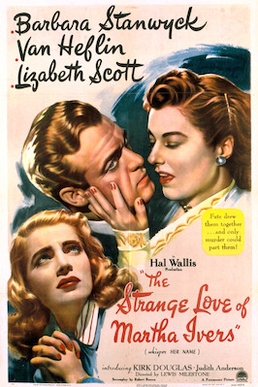
Somewhere between a killing that took eighteen years to catch up with everybody involved and a first picture that launched one of Hollywood’s most durable careers, The Strange Love of Martha Ivers (1946) turned into one of those defining documents of American film noir . Barbara Stanwyck , Van Heflin, Lizabeth Scott. And a first-time screen performer named Issur Demsky—yes, the one you know as Kirk Douglas— in a part that announced his arrival so loudly that Hollywood itself didn’t really stay the same, not after that. It’s 115 minutes of blame, mental entrapment, and mistaken affection in its most carefully arranged form. It slid into the public domain in 1974 , so it has been easy to watch ever since. Still, most people haven’t seen it, that’s a fixable situation though.
The Strange Love of Martha Ivers 1946 — Movie Overview Table
| Detail | Information |
|---|---|
| Title | The Strange Love of Martha Ivers |
| Release Year | 1946 |
| Country | United States |
| Runtime | 115 minutes |
| Genre | Film Noir, Drama |
| Language | English |
| Format | Black & White |
| Director | Lewis Milestone |
| Producer | Hal B. Wallis |
| Screenplay | Robert Rossen (Robert Riskin, uncredited) |
| Based On | “Love Lies Bleeding” by John Patrick (as Jack Patrick) |
| Studio | Paramount Pictures |
| Film Score | Miklós Rózsa |
| Festival | 1947 Cannes Film Festival |
| Public Domain | Yes — entered public domain in 1974 |
| Notable | Kirk Douglas’s film debut; Blake Edwards uncredited bit part |
Full Cast Table — The Strange Love of Martha Ivers (1946)
| Actor | Role |
|---|---|
| Barbara Stanwyck | Martha Ivers |
| Van Heflin | Sam Masterson |
| Lizabeth Scott | Antonia “Toni” Marachek |
| Kirk Douglas | Walter O’Neil (film debut) |
| Roman Bohnen | Mr. O’Neil |
| Judith Anderson | Mrs. Ivers |
| Janis Wilson | Young Martha Ivers |
| Darryl Hickman | Young Sam Masterson |
| Mickey Kuhn | Young Walter O’Neil |
| Blake Edwards | Sailor (uncredited bit part) |
Why The Strange Love of Martha Ivers Still Matters
Noir expert Spencer Selby called it a “significant noir melodrama focusing on provocative, intermingling relationships of neurotic love, guilt and fear.” That description is kind of exact… still, it doesnt quite show you how structurally ambitious the film is, like how many separate psychological traps it sets up at once and then how carefully it springs each of them, one by one, almost silently.
Martha Ivers isnt just a noir protagonist. She’s a woman whose whole adult life—her wealth her marriage her power—sits on the foundation of one violent act she committed as a child. And that act, it was witnessed , weaponized, and ever since it has been working its way through her, eroding her , bit by bit. So no, it isnt only a simple femme fatale setup. It feels more like a psychological portrait with real depth, and Stanwyck brings each layer forward with this steady control, even when the character is falling apart.
The movie was entered into the 1947 Cannes Film Festival, which usually makes people blink because they only know it by reputation, not by actually seeing it. But it belongs there.
The Production — Hal B. Wallis and the Rossen Screenplay
Producer Hal B. Wallis had just left Warner Bros, after a long and extraordinarily productive tenure. You know, his independent productions in the mid 1940s really do feel like some of the most carefully assembled commercial filmmaking of the decade. He brought Robert Rossen in , to adapt John Patrick’s short story “Love Lies Bleeding” and Rossen, who would later direct All the King’s Men (1949) and The Hustler (1961), gave the whole thing a kind of structural sturdiness that lifts it well above its pulp beginnings.
Robert Riskin added to the screenplay without receiving a credit , and Lewis Milestone directed with that controlled visual intelligence he had already shown since All Quiet on the Western Front (1930). The score came from Miklós Rózsa one of the most distinctive voices in Hollywood film music— and his work here amplifies the psychological tension without ever really making a big announcement.
Full Plot Summary — The Strange Love of Martha Ivers (1946)
The movie starts in 1928, in Iverstown , Pennsylvania. It’s this factory town, named after the wealthy family that pretty much owns it. Martha Ivers is young, and honestly she’s hungry for a way out—out of her aunt’s guardianship, which feels so stern and controlling it might as well be the weather. There’s this rainy night, and she tries to bolt with Sam Masterson, a street-smart kid from the rougher side of town. They get caught, of course. Then they try again, with that same restless kind of stubbornness, like maybe the city will finally blink first.
When Martha’s cat gets loose in the house during their second attempt, Sam goes back for it. The aunt hears the commotion, finds the cat on the staircase, and attacks it with her cane. Martha intervenes. In the struggle, she unintentionally kills her aunt. Watching from the doorway is Walter O’Neil — the young son of Martha’s tutor — who witnesses everything.
The Lie That Shapes Everything — The Cover-Up
Martha lies. She tells Mr. O’Neil, Walter’s father, that an intruder killed her aunt. Walter corroborates her story. Mr. O’Neil suspects the truth but sees an opportunity — he presents Martha’s version to the police, forces her to testify against an innocent man (who is subsequently executed), and then uses his knowledge of what actually happened to blackmail Martha. He takes control of her life. He forces her to marry his son Walter.
That opening sequence — twenty minutes of carefully escalating catastrophe — establishes every pressure point the film will spend its remaining ninety-five minutes pressing on. By the time the credits place you eighteen years later, you already understand exactly how trapped every character in this story is.
Eighteen Years Later — Sam Returns
Walter O’Neil (Kirk Douglas) is now Iverstown’s district attorney. Martha (Barbara Stanwyck) has used her inheritance to build a significant business empire. Their marriage is a study in asymmetry: he loves her with an intensity that borders on obsession; she does not love him at all and never has.
Sam Masterson (Van Heflin) drifts back into Iverstown entirely by accident — he crashes his car and has to wait for repairs. At his old home, now a boarding house, he encounters Toni Marachek (Lizabeth Scott), recently released from prison and already in trouble with her probation conditions. Sam goes to Walter, hoping to use his influence to help Toni. That visit triggers everything.
The Triangle of Fear — Walter, Martha, and Sam
Walter immediately assumes Sam has returned to blackmail them. Martha’s visible joy at Sam’s reappearance gives Walter a second motive — jealousy layered over paranoia. He forces Toni to set Sam up. Sam is beaten and driven out of town.
He comes back. Sam is not the kind of man who answers intimidation by simply leaving, and that stubbornness — you know, the thing that makes him the film’s moral center — ends up being the lever that sort of cracks open everything, everybody has kept shut for eighteen years. When Walter makes this half-hearted attempt to finish Sam himself, and then gets easily disarmed, Martha kind of blurts out, without meaning to, the actual size of their terror. Sam’s reaction disarms her in a totally different way: he tells her he never saw the death. He didn’t know what they’d been guarding against.
Martha falls apart. She tells Sam he left without her — that when he vanished that night, he took with him the only shot she ever had at love and freedom. It’s one of Stanwyck’s best scenes , really in a career packed with good moments: a woman breaking herself down in front of the one person she couldn’t, absolutely couldn’t afford to let in on it .
The Ending — Noir Logic Carried to Its Full Conclusion
The film’s final sequence is one of the most precisely constructed endings in American noir. Walter arranges a meeting with Sam to settle matters. He gets drunk waiting. Martha finds out about the meeting. Walter falls down the stairs and is knocked unconscious. Martha urges Sam to kill him. Sam refuses — and revives Walter instead.
Martha pulls out a gun and threatens to shoot Sam as an intruder. Sam gambles that Walter won’t back her story. He turns his back on her and walks out. He’s right.
What follows is one of noir’s most haunting final images. Walter embraces Martha, then presses the gun against her. She puts her hand over his on the trigger and presses it herself. Dying, she tells him her name is not Martha Ivers — it’s Martha Smith. Outside, Sam hears the shot, runs back, and watches Walter, holding Martha’s body, shoot himself. Sam and Toni drive away from Iverstown together. The town that consumed two lives to protect a secret that turned out to be unnecessary stays behind them.
Barbara Stanwyck — The Performance That Anchors Everything
Stanwyck had already delivered Double Indemnity (1944) by the time this film went into production. Martha Ivers gave her something different from Phyllis Dietrichson — not a predator who chooses her crime, but a woman whose crime chose her at fourteen and has been defining her ever since.
The complexity Stanwyck builds into Martha across 115 minutes is remarkable. She plays a woman simultaneously powerful and imprisoned — capable of enormous cruelty when cornered, genuinely capable of love when she allows herself to be, and absolutely certain that those two things can never coexist in her life. The scene where she confesses to Sam what his disappearance cost her is not the performance of a villain. It’s the performance of someone who has been living inside a punishment she never formally received.
Stanwyck received no Oscar nomination for this work. That remains one of the more inexplicable oversights in the Academy’s mid-century record.
Kirk Douglas — A Film Debut That Changed Hollywood
The story of how Kirk Douglas got this role is one of Hollywood’s better casting anecdotes. Producer Hal B. Wallis was on his way to New York to search for new talent when Lauren Bacall suggested he look up her old drama school classmate — a young actor then going by his birth name, Issur Demsky. Wallis looked him up. He cast him. The rest belongs to film history.
Walter O’Neil is not a simple role for a debut. He’s a man whose love for his wife has curdled into something close to pathological — a district attorney who uses his office as a personal weapon, who is simultaneously the most powerful man in town and the most emotionally helpless person in every room he enters. Douglas makes all of that legible from his first scene.
Van Heflin was reportedly helpful to Douglas on set during production — this was Douglas’s first time on a film set, and Heflin’s steadiness gave him something to work against and learn from. The mentorship shows in the scenes they share: Douglas holds his ground with a veteran performer in a way that suggests someone who understood instinctively what the camera needed from him.
The intensity that would define Douglas’s career for the next five decades — the barely-contained energy, the jaw-set determination, the ability to make intelligence look dangerous — is all present here, fully formed, in his first film.
Van Heflin and Lizabeth Scott — The Film’s Moral Counterweight
Van Heflin plays Sam Masterson , the film’s conscience in a way that kind of refuses to be neat. He’s a drifter with no illusions , but still somehow he’s got this genuine loyalty in him , and yes real love. He’s not a hero , not like the old fashioned kind. More like a gambler, one of those fellows who reads people well and places his bet on what he thinks he’s seeing. The gamble he makes at the film’s end, turning his back on a woman who’s holding a loaded gun on him, is probably the clearest character beat in the whole picture. It shows a man who correctly measures that Walter O’Neil’s love for his wife is stronger than his instinct for self-protection.
Lizabeth Scott as Toni Marachek provides something the film needs badly — warmth that isn’t complicated by history. Toni betrays Sam under pressure and then has to live with having done it. Scott plays her recovery from that moment with a quietness that earns the film’s closing image of Sam and Toni driving away together. You believe they’re going somewhere better because Scott makes you believe Toni deserves to.
Blake Edwards — An Uncredited Debut Before His Own Career Began
Future director and producer Blake Edwards turns up in a kind of uncredited little bit as a sailor who sort of hitch a ride with Sam. Edwards later does Breakfast at Tiffany’s (1961), the Pink Panther series , and 10 (1979) — so his directing career ends up long and varied, almost like any other in Hollywood really. Here he’s mostly a footnote but it’s a footnote of that special sort, the one that makes rewatching feel rewarding, even when you think you already caught it.
The Public Domain Story — How Martha Ivers Became Free to Watch
In 1974, The Strange Love of Martha Ivers kind of entered the public domain in the United States, kinda. Under the copyright rules that were in force then, the copyright owners had to renew their registration in the 28th year after it was published. But the copyright holder simply did not. Because of that, the film basically went into the public domain , so it became free for every viewer, and it has stayed in view while other films from that same period, that were more carefully guarded, have gotten harder to find.
That public domain status is also why you can watch it for free, right now, in its entirety, on the Internet Archive, and on YouTube too . It’s a Paramount Pictures film noir, starring Barbara Stanwyck , and it includes Kirk Douglas’s first screen performance. It even showed up at Cannes, which means it was already treated as notable, and then later made available to anyone with an internet connection.
Where to Watch The Strange Love of Martha Ivers (1946) Free Online
The Strange Love of Martha Ivers is in the public domain and legally available across multiple platforms at no cost.
| Platform | Format | Cost |
|---|---|---|
| Internet Archive | Stream + Download (multiple formats) | Free |
| YouTube | Stream | Free |
| Public Domain Movies | Stream | Free |
The Strange Love of Martha Ivers (1946) on Internet Archive:
Is The Strange Love of Martha Ivers in the Public Domain?
Yes. The film entered the public domain in 1974 when its copyright owner failed to renew the copyright registration in the required 28th year after publication. You can legally stream, download, share, and screen it in educational contexts without restriction or payment.
Critical Reception — Then and Now
The film screened at the 1947 Cannes Film Festival — the clearest contemporary signal of how seriously the industry took it at the time. Modern noir scholarship consistently places it among the essential titles of the American noir cycle, particularly for its treatment of guilt as something structural rather than incidental: these characters aren’t haunted by what they did so much as they’ve built their entire lives on top of it.
The performances draw consistent praise from viewers who find the film. Stanwyck in particular gets recognized for delivering one of her career’s most psychologically complete portrayals — a woman who is simultaneously the film’s most powerful figure and its most trapped one. Douglas’s debut provokes the specific reaction great debut performances always generate: the feeling that this person could not possibly have not been doing this their whole life.
If you’ve already worked through the canonical noir titles — Double Indemnity, Out of the Past, Laura — The Strange Love of Martha Ivers belongs in that same conversation. It’s not a footnote to the genre. It’s one of its pillars.
Frequently Asked Questions — The Strange Love of Martha Ivers 1946
Q: What is The Strange Love of Martha Ivers about?
A woman who accidentally killed her domineering aunt as a child — and allowed an innocent man to be executed for it — has built her entire adult life on suppressing that secret. When her childhood friend drifts back into town eighteen years later, the fragile structure she and her husband have built around that buried truth begins to collapse. The film follows the psychological fallout for all four principal characters.
Q: Is The Strange Love of Martha Ivers in the public domain?
Yes. It entered the public domain in 1974 when the copyright owner failed to renew the registration in the required 28th year after publication. You can legally stream, download, and share it for free.
Q: Was this Kirk Douglas’s first film?
Yes. The Strange Love of Martha Ivers is Kirk Douglas’s screen debut. Producer Hal B. Wallis cast him on Lauren Bacall’s recommendation — she suggested Wallis look up her old drama school classmate Issur Demsky, the birth name Douglas later changed. Van Heflin helped Douglas navigate his first experience on a film set during production.
Q: Who directed The Strange Love of Martha Ivers?
Lewis Milestone directed the film. Robert Rossen wrote the screenplay — based on the short story ‘Love Lies Bleeding’ by John Patrick, writing as Jack Patrick — with Robert Riskin contributing uncredited work. Hal B. Wallis produced.
Q: Was The Strange Love of Martha Ivers shown at Cannes?
Yes. The film was entered into the 1947 Cannes Film Festival — a significant recognition of its quality from the international film community at the time of its release.
Q: Who composed the score for The Strange Love of Martha Ivers?
Miklós Rózsa composed the film score. Rózsa was one of Hollywood’s most distinctive voices in film music, and his work on Martha Ivers reinforces the psychological tension of the narrative without ever overwhelming it.
Q: Does Blake Edwards appear in The Strange Love of Martha Ivers?
Yes. Future director Blake Edwards — who would go on to make Breakfast at Tiffany’s (1961) and the Pink Panther series — appears in an uncredited bit part as a sailor who hitches a ride with Sam.
Q: Where can I watch The Strange Love of Martha Ivers for free?
The film is freely available on the Internet Archive, YouTube, and Public Domain Movies. All versions are legal to stream and download under public domain status.
Q: Is The Strange Love of Martha Ivers a film noir?
Yes — it’s one of the genre’s essential titles. The film combines the structural elements of classic noir (guilt, paranoia, destructive romantic entanglement, moral ambiguity) with an unusually specific psychological portrait of what long-term secret-keeping does to every person caught inside it.
Q: What is the short story The Strange Love of Martha Ivers is based on?
The film is based on ‘Love Lies Bleeding,’ a short story by playwright John Patrick writing under the pseudonym Jack Patrick. Robert Rossen adapted it into the screenplay, with uncredited contributions from Robert Riskin.
Related Free Classic Film Noir and Drama
If The Strange Love of Martha Ivers (1946) sent you deeper into classic noir and public domain drama, these are the titles worth exploring next:
- Public Domain Horror Movies – Free Classic Scary Films Online
- Public Domain TV Shows – Watch Free Classic Television Online
- Public Domain Cartoons
- Public Domain Movies List – All Free Classic Films (Complete Guide)
Movie Tags
Strange Love of Martha Ivers 1946, Strange Love of Martha Ivers full movie, watch Strange Love of Martha Ivers free, Martha Ivers public domain, Barbara Stanwyck film noir, Kirk Douglas first film, Kirk Douglas debut 1946, Van Heflin noir, Lizabeth Scott actress, Lewis Milestone director, Hal B Wallis producer, Robert Rossen screenplay, Miklós Rózsa film score, Blake Edwards uncredited appearance, 1946 film noir, classic film noir public domain, Cannes 1947 film, Paramount Pictures noir, free classic noir online, Pennsylvania noir film