
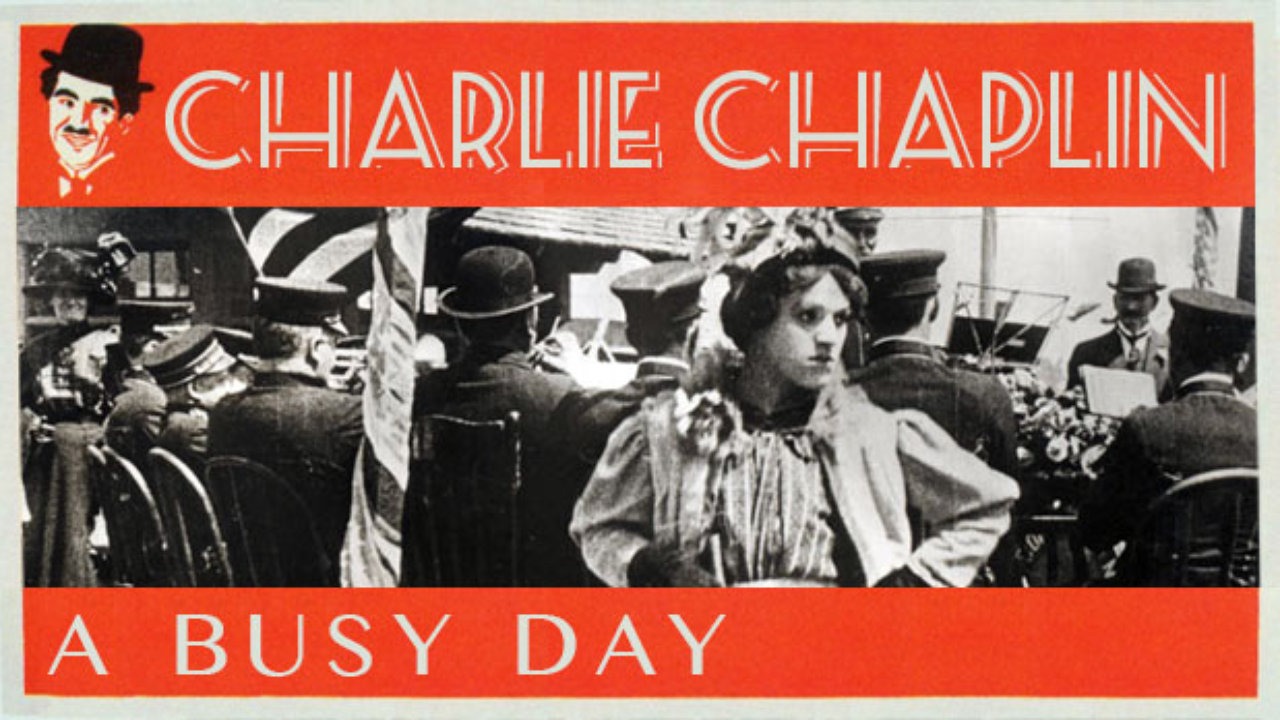
In the spring of 1914, Charlie Chaplin was twenty-five, about four months deep into his film career, and already turning out pictures faster than most folks could really watch them. Keystone Studios, under Mack Sennett, ran a production schedule that kinda treated films like they were, a perishable sort of thing— crank them out, get them to theatres, then move on. Chaplin had already delivered thirteen films before A Busy Day finally hit screens on May 7th.
He was still trying to find his footing , though. But what he was doing quietly, on the side, was testing something that almost nobody else in early cinema had the nerve to even try: playing a woman, yes, that’s it. Not in the sentimental Victorian tradition, not as a gag costume — as a full physical character, jealous and violent and completely committed.
The film runs about eight minutes. It is set against a real military parade in Los Angeles, shot guerrilla-style with an actual crowd of bystanders. Chaplin plays the wife. Mack Swain plays the husband. Mack Sennett himself plays a film director who gets knocked flat. The kicking and slapping is, per the original production notes, judicious. What the film actually is, in 1914 terms, is a short piece of controlled mayhem starring a man in a dress who moves better than almost anyone else in the shot — and it has been in the public domain long enough that you can watch it right now for free.
A Busy Day 1914 — Movie Overview Table
| Detail | Information |
|---|---|
| Title | A Busy Day |
| Release Date | May 7, 1914 |
| Country | United States |
| Runtime | Approx. 8–9 minutes |
| Genre | Silent Comedy, Short Film |
| Language | Silent (English intertitles) |
| Format | Black & White, Silent |
| Director | Charlie Chaplin |
| Producer | Mack Sennett |
| Production Studio | Keystone Studios |
| Distribution | Mutual Film Corporation |
| Chaplin’s Film Number | 14th film released |
| Notable Detail | Chaplin plays a woman — one of his rare cross-dressing roles |
| Filming Location | Shot on location during a real military parade, Los Angeles |
| IMDb | Listed under tt0003733 |
| Public Domain | Yes — freely available to stream and download |
Full Cast — A Busy Day (1914)
| Actor | Role |
|---|---|
| Charlie Chaplin | The Wife |
| Mack Swain | The Husband |
| Phyllis Allen | The Other Woman |
| Mack Sennett | Film Director |
| Billy Gilbert | Police Officer |
The Film Chaplin Made Before Anyone Knew Who Chaplin Was
By May 1914, Chaplin had been at Keystone for roughly four months. He had arrived from the Fred Karno music hall company in England the previous year — already a skilled physical comedian with years of stage experience — and immediately found himself in friction with Sennett’s chaotic production style. Keystone’s method was speed: fast setups, fast shooting, fast delivery to distributors. Chaplin wanted more control. He wanted more time. He wanted, specifically, to direct.
A Busy Day was one of his early directing credits, and it shows something important about what Chaplin was already working out: that the comedy he was interested in wasn’t just falling down and getting hit. It was character-driven. Even in eight minutes, even in drag, even in a film shot at an actual parade with real bystanders wandering into the frame, there is a recognizable psychology to the wife he plays — jealousy, aggression, the particular energy of someone who has absolutely nothing to lose.
The setting wasn’t a studio construction. The military parade sequence was filmed on real Los Angeles streets with a real crowd. Chaplin and the Keystone crew shot around actual bystanders. You can see genuine onlookers watching the action in several frames — civilians who had come out to watch a military procession and found themselves instead watching a man in women’s clothing assault a film director. 1914 Los Angeles had stranger mornings.
Chaplin in Drag — Why This Role Matters in His Career
Chaplin played women only a small number of times on film. A Busy Day is the most complete example — not a quick costume gag but a sustained characterisation running the full length of the film. The choice is worth pausing on , because it isn’t what youd expect from a comedian still establishing his screen identity , like the whole thing is slightly shaky , right at the start.
That Tramp style persona, which would end up defining Chaplin’s career for the next two decades, was already taking shape by early 1914 — first showing up in Kid Auto Races at Venice in February of that year. A Busy Day sits right in the middle of that forming stretch , and that makes it kind of oddly revealing. Without the Tramp costume to act like an anchor, Chaplin has to build the comedy almost purely through physical business and character logic. The wife works as a figure too, because Chaplin treats her jealousy like an actual condition, not as a punchline that’s just waiting there, ready to trigger.
More Read
She’s furious in that particular way where someone is furious when they are being sidestepped by a person who is supposed to belong to them. It’s a pretty recognizable emotional reality, and Chaplin plays it pretty straight , so the slapstick violence lands harder for it. The kicks and slaps aren’t just chaos — they’re the physical expression of someone who has run out of any other way to be heard. Eight minutes, 1914, and already doing character work.
Full Plot Summary — A Busy Day (1914)
A wife (Chaplin) accompanies her husband (Mack Swain) to a military parade in the city. The husband is immediately and conspicuously more interested in another woman in the crowd (Phyllis Allen) than in the parade, the wife, or any combination of the two. The wife notices. The wife does not take it quietly.
The Parade, the Director, and the Pier
On her way through the crowd to confront the husband and the other woman, the wife charges directly through a film shoot happening nearby — knocking over the film director (Mack Sennett, playing himself with what appears to be genuine surprise) and flattening a police officer (Billy Gilbert) in the process. Neither interruption slows her down. The crowd, some of whom are actual bystanders caught on film, watches with varying degrees of alarm.
The confrontation happens. The kicking and slapping is distributed broadly and without obvious favouritism. The film’s final resolution is direct and cold: the husband, apparently done with the situation, pushes the wife off a pier into the harbour. She sinks. The film ends. There is no reconciliation. There is no rescue shown. It is a Keystone comedy from 1914 — sentiment was not the house specialty.
Keystone Studios and the Factory That Made Chaplin
Mack Sennett’s Keystone Studios was, in 1914, kinda the dominant force in American film comedy. It made shorts at a rate that would be, honestly, hard to believe now—dozens of films per year, released weekly, watched and then pretty much tossed aside by audiences who wanted fresh stuff all the time. The Keystone Kops were the studio’s signature deal: organised mayhem, broadly played, with little to no interest in psychological layering or narrative continuity.
Chaplin did fit the studio’s output needs, yes but not really its vibe. He was quicker and more exact than most of the people orbiting him, and he had this pretty clear idea for what makes something funny, which not always lined up with Sennett’s instinct for plain chaos. That creative friction between Chaplin’s ambitions and Keystone’s production culture is visible in things like A Busy Day—character work is Chaplin’s, the speed and the actual “punching” are Keystone’s, and yet somehow both show up inside the same eight minutes.
He departed Keystone at the end of 1914, went to Essanay, where he talked his way into more creative control and a bigger salary bump. By the time he reached Mutual in 1916, he was, basically, the most famous film performer on the planet. A Busy Day is one of the documents of the period before that happened — while the Tramp was forming and the constraints were still real.
Mack Swain — The Husband Who Gets Away With It
Mack Swain is kinda one of the most under appreciated faces in early Chaplin comedy and people rarely talk about him. He was, like, a big physically imposing actor with a real gift for acting as if he is totally oblivious, you know. He showed up with Chaplin at Keystone and later too, again and again, even if it was a little less noticed each time. Probably the most memorable spot is The Gold Rush (1925) , where he played Big Jim McKay. The dynamic in A Busy Day anticipates that later collaboration: Swain’s bulk against Chaplin’s energy, the imbalance itself generating most of the physical comedy.
As the Husband, Swain plays the kind of cheerful, oblivious infidelity that Keystone comedies treated as essentially neutral behaviour. He is interested in the other woman, entirely unconcerned about his wife’s reaction, and matter-of-fact about ending the situation when it becomes inconvenient. That the film doesn’t ask you to find this troubling is part of what makes it a specific historical document — 1914 comedy conventions and 2025 viewing sensibilities are having a quiet conversation across the entire runtime.
Where to Watch A Busy Day (1914) Free Online
A Busy Day is in the public domain and freely available across multiple platforms. Print quality varies across uploads — the film is over a century old and surviving materials reflect that age.
| Platform | Format | Cost |
|---|---|---|
| Internet Archive | Stream + Download (multiple formats) | Free |
| YouTube | Stream (multiple uploads; quality varies) | Free |
| Tubi | Stream (with ads; often bundled in Chaplin collections) | Free |
| Public Domain Movies | Stream | Free |
A Busy Day (1914) on Internet Archive:
Is A Busy Day (1914) in the Public Domain?
Probably yes. In the United States, “A Busy Day” from 1914 is in the public domain, so you can stream it, download it, share it, or even watch it on repeat without paying anyone or getting permissions. A lot of Keystone-era Chaplin shorts from that same year are considered public domain too, which is why you’ll see them sitting on dozens of sites, in wildly different conditions and clarity levels.
If you want the easiest path, the Internet Archive usually has the most dependable copy for downloading and reusing.
Critical Reception — Then and Now
In 1914, A Busy Day was a product item — one entry in Keystone’s relentless weekly release schedule, consumed and largely unremarked upon. Trade publications noted Chaplin’s growing popularity as a general phenomenon rather than reviewing individual shorts with any analytical depth. The critical apparatus for evaluating silent comedy shorts simply didn’t exist yet in the way it would for feature-length work.
Modern reassessment places it firmly in the category of historically significant minor work — not a masterpiece, but a useful document. Film historians value it for the cross-dressing performance, the on-location shooting, and what it reveals about Chaplin’s physical technique at the moment his screen identity was solidifying. You can see the precision of his movement here in a way that the chaos of some other Keystone shorts obscures.
What holds up, a hundred and eleven years later, is the physical performance itself. The comedy of someone in women’s clothing throwing a full-commitment tantrum through a military parade hasn’t aged out — it just reads differently now than it did then. The transgression Keystone was selling in 1914 has dissolved completely, leaving only the performance, which turns out to have been the durable part all along.
Frequently Asked Questions — A Busy Day (1914)
Q: What is A Busy Day (1914) about?
A jealous wife (played by Charlie Chaplin in drag) follows her husband to a military parade, discovers him paying attention to another woman, and responds with extended physical violence — knocking over a film director and a police officer along the way. The husband ultimately pushes her off a pier into the harbour. It is an 8-minute Keystone slapstick short, notable for Chaplin playing a female character with full physical commitment.
Q: Is A Busy Day (1914) in the public domain?
Yes. A Busy Day (1914) is in the public domain in the United States. All Keystone Studios Chaplin films from 1914 are freely available to stream, download, and share. The Internet Archive, YouTube, and Tubi all carry the film at no cost.
Q: Why does Charlie Chaplin play a woman in A Busy Day?
Cross-dressing as a comedic device had a long history in vaudeville and music hall performance — the tradition Chaplin came from before entering film. At Keystone, gender-swap roles appeared occasionally as a quick source of visual comedy. Chaplin’s version is unusual because he sustains it as a full character rather than a single gag, suggesting genuine interest in the performance possibilities rather than just the joke of the costume.
Q: Who directed A Busy Day (1914)?
Charlie Chaplin directed A Busy Day. It was among his early directing credits at Keystone Studios, where he had been working since January 1914. Mack Sennett produced the film and also appears in it as a film director who gets knocked over during the parade sequence.
Q: What number film was A Busy Day in Chaplin’s career?
A Busy Day was Charlie Chaplin’s 14th released film, coming out on May 7, 1914. Chaplin had joined Keystone in January of that year and was producing films at a rapid pace under the studio’s high-volume release schedule.
Q: Was A Busy Day filmed at a real parade?
Yes. The military parade sequences were filmed on location in Los Angeles during an actual public event, with real crowd members visible in the footage. Keystone frequently used real locations and genuine public settings to reduce production costs and add visual energy to their shorts.
Q: Who else is in the cast of A Busy Day (1914)?
The cast includes Mack Swain as the Husband, Phyllis Allen as The Other Woman, Mack Sennett as a Film Director, and Billy Gilbert as a Police Officer. Mack Swain would later appear with Chaplin in The Gold Rush (1925).
Q: How long is A Busy Day (1914)?
A Busy Day runs approximately 8 to 9 minutes. It is a short film, typical of Keystone Studios’ output in 1914, when the studio produced and distributed comedy shorts on a weekly release schedule.
Q: Where can I watch A Busy Day (1914) for free?
A Busy Day (1914) is freely available on the Internet Archive, YouTube, Tubi, and various public domain film platforms. All versions are legal to stream and download under public domain status in the United States.
Q: What is the historical significance of A Busy Day?
The film is a document of Chaplin’s early development as a performer and director at Keystone Studios, made during the same months he was developing the Tramp persona. It demonstrates his physical precision and commitment to character-based comedy in a period when most Keystone output prioritised chaos over characterisation. It also stands as one of the clearest examples of Chaplin performing a sustained female role on film.
Related Free Classic Silent and Comedy Films
If A Busy Day (1914) sent you further into early Chaplin and silent comedy, these are the natural places to keep going:
- Public Domain Cartoons
- Public Domain Horror Movies – Free Classic Scary Films Online
- Bird of Paradise (1932) Full Movie Review, Plot, Cast & Free Classic Romance Film
- Public Domain Movies List – All Free Classic Films (Complete Guide)
Movie Tags
A Busy Day 1914, A Busy Day Charlie Chaplin, watch A Busy Day free, A Busy Day public domain, Charlie Chaplin 1914, Charlie Chaplin Keystone Studios, Charlie Chaplin early films, Charlie Chaplin silent comedy, Charlie Chaplin in drag, Mack Sennett director, Mack Swain actor, Keystone Studios 1914, silent short film comedy, public domain silent film, free Charlie Chaplin movies online, early slapstick comedy, pre-Tramp Chaplin, silent film public domain, 1914 silent comedy short, Charlie Chaplin full movie free