
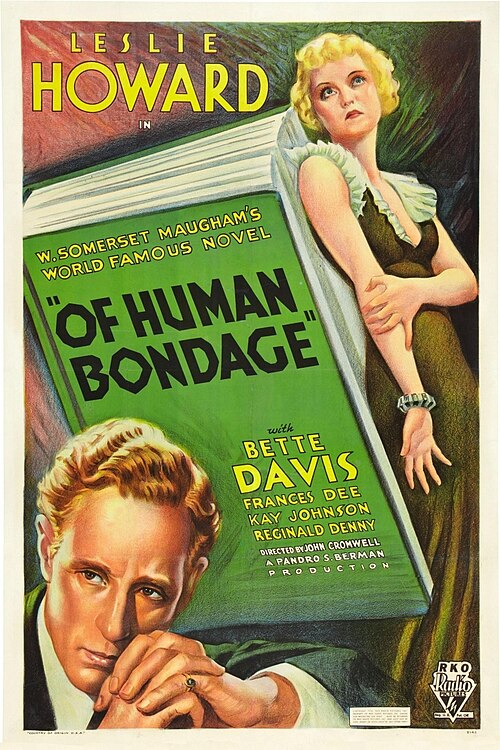
In the summer of 1934, Bette Davis was a Warner Bros. contract player who had spent three years making mediocre pictures for a studio that didn’t know what to do with her. She had to beg Jack L. Warner to loan her to RKO for a role she knew was going to define her or destroy her. Warner Brothers let her go, quietly assuming the role would destroy her. She played Mildred Rogers — a slatternly Cockney waitress whose cruelty toward a club-footed man who loves her is presented without mitigation or excuses — and convinced the Academy of Motion Picture Arts and Sciences to temporarily change its voting rules to accommodate the write-in campaign her non-nomination triggered.
Warner Brothers then tried to prevent their own contract player’s name from appearing in publicity about the film they’d loaned her out for. The film is in the public domain. It is 83 minutes. It is the performance that kind of made Bette Davis a star, in a role that no other actress at her studio would really want, for a rival studio that had the rights her own studio wouldn’t buy. And the Academy, well it gave the Oscar that year to Claudette Colbert for It Happened One Night, anyway.
Of Human Bondage 1934 — Movie Overview Table
| Detail | Information |
|---|---|
| Title | Of Human Bondage |
| Premiere | June 28, 1934 — Radio City Music Hall, New York |
| General Release | July 20, 1934 |
| Country | United States |
| Runtime | 83 minutes |
| Genre | Drama, Romance |
| Language | English |
| Format | Black & White |
| Director | John Cromwell |
| Producer | Pandro S. Berman |
| Screenplay | Lester Cohen; dialogue by Ann Coleman |
| Based On | Of Human Bondage, 1915 novel by W. Somerset Maugham |
| Cinematography | Henry W. Gerrard |
| Editor | William Morgan |
| Music | Max Steiner (original score replaced after preview; new score with character motifs commissioned) |
| Art Direction | Carroll Clark, Van Nest Polglase |
| Costumes | Walter Plunkett |
| Production / Distribution | RKO Radio Pictures |
| Budget | $403,000 |
| Box Office | $592,000 |
| Oscar Context | Davis not nominated; write-in campaign triggered temporary Academy rule change |
| Lost Film Status | Believed lost for many years; prints eventually discovered |
| Notable Remakes | 1946 (Paul Henreid, Eleanor Parker); 1964 (Kim Novak, Laurence Harvey) |
| IMDb Rating | 7.0/10 |
| Public Domain | Yes — freely available to watch and download |
Full Cast Table — Of Human Bondage (1934)
| Actor | Role |
|---|---|
| Bette Davis | Mildred Rogers |
| Leslie Howard | Philip Carey |
| Frances Dee | Sally Athelny |
| Kay Johnson | Norah |
| Reginald Denny | Harry Griffiths |
| Alan Hale Sr. | Emil Miller |
| Reginald Owen | Thorpe Athelny |
| Reginald Sheffield | Cyril Dunsford |
| Tempe Pigott | Agnes Hollet (Philip’s landlady) |
How Bette Davis Got a Role Warner Brothers Didn’t Want Her to Have
The path toward Of Human Bondage starts with director John Cromwell, watching a print of Michael Curtiz’s The Cabin in the Cotton (1932) , not because he was especially into the film, but because he was weighing its star Richard Barthelmess for a project he was getting ready. Cromwell watched the film and forgot about Barthelmess. He became entirely focused on a supporting performance by a young actress in a femme fatale role that reminded him immediately of Mildred Rogers: the slatternly waitress in W. Somerset Maugham’s 1915 novel whose cruelty toward the man who obsessively loves her drives the story’s central tragedy. That actress was Bette Davis.
Cromwell knew that producer Pandro S. Berman at RKO had purchased the rights to Maugham’s novel specifically for Leslie Howard — Howard had proposed the rights purchase himself during a stay in England in 1933, to RKO’s considerable surprise. When Cromwell suggested Davis as co-star, Berman agreed. The problem was that Davis was under contract to Warner Brothers, who had first claim on her time and no particular reason to send her to a rival studio for a career-making role.
Davis asked Jack L. Warner personally to loan her to RKO. She knew the Maugham novel, knew the role, and understood with complete clarity that Mildred Rogers was the performance that could change everything. Warner, who had spent two years casting her in forgettable pictures without much success, agreed. He apparently expected the role to harm her — Mildred was not the kind of character studios believed audiences wanted their actresses playing. Davis went to RKO. She played Mildred. Warner Brothers was wrong about nearly everything.
W. Somerset Maugham’s Novel — The Autobiographical Source
Maugham put out Of Human Bondage in 1915, and it kinda immediately became one of those defining novels of the time period—like a 700 page semi autobiographical sort of account, of creative yearning, erotic fixation, and that particular cruelty you get when you’re in love with someone who really, simply does not love you back.
The autobiographical elements are specific and displaced. Maugham had a stammer rather than a club foot — but the social experience of stigma, the constant awareness of difference, and the psychological damage of a childhood defined by physical vulnerability are the same. He lost both parents young and was sent to live with an aunt and uncle, as Philip does.
There is this, uh, artistic failure in Paris that kind of mirrors Maugham’s own earlier missteps before he discovered his true literary voice. The screenplay, done by Lester Cohen, takes only a part of the novel’s broader scope , focusing mostly on the Mildred relationship and its aftermath, but it keeps the emotional heart that made the original material matter.


Full Plot Summary — Of Human Bondage (1934)
Philip Carey (Leslie Howard) is an Englishman who has spent four years in Paris, studying painting. His art teacher gives a judgement that is both specific and crushing: Philip’s work is mediocre, second-rate, and it shows no real promise. He has dedication but not talent, and dedication without talent produces nothing of value. Philip accepts this without argument and returns to London to study medicine — a more practical ambition, though his older age and his tendency toward brooding introspection make the academic work harder than it should be.
In London, Philip encounters Mildred Rogers (Bette Davis), a Cockney tearoom waitress. She is not kind to him. She is not particularly interested in him. She is dismissive of his club foot, contemptuous of his sensitivity, and already involved with another man. Philip becomes infatuated. Then obsessed. He pursues her past every rational stopping point, spending money he doesn’t have, sacrificing opportunities he can’t afford to lose, returning to her after she has humiliated him, abandoned him, and married someone else.
Mildred’s Arc — Villainess, Victim, and Something Worse Than Either
Mildred leaves Philip to marry another man. The marriage fails. She returns to Philip with a child that isn’t his, asking for support. He provides it, out of something that is neither love nor pity exactly but the particular compulsion that the title names. When Philip finally begins to disentangle himself — when he meets Sally Athelny (Frances Dee), a genuine relationship with a woman who actually cares for him — Mildred returns once more. Rejected this time, she systematically destroys Philip’s apartment, burning his belongings and tearing his carefully preserved art before leaving.
The film’s final movement follows Mildred’s deterioration: poverty, illness, the final stages of tuberculosis that Davis insisted on rendering without cosmetic mitigation. Her last appearance — ravaged, unrecognizable as the woman who had dismissed Philip’s attention years earlier — is the film’s most direct confrontation with what the obsession has been about. Mildred’s decline is not punishment for her cruelty. It’s simply what happens to people without Philip’s education, family connections, and eventual professional stability. The film is too honest to make her suffering feel like justice.
Bette Davis as Mildred — The Performance That Changed an Industry
Davis made two decisions about Mildred Rogers that were, in 1934, genuinely radical. The first was to play her Cockney accent and working-class mannerisms with complete commitment rather than softening them for the RKO audience. The second was to play her physical deterioration in the final act with documentary realism rather than glamorous decline. Both decisions were hers. Both decisions were resisted, implicitly, by a studio culture that believed audiences wanted their actresses to remain beautiful even when dying.
Davis wrote about the second decision in terms that remain the clearest statement of her approach to the role: “I made it very clear that Mildred was not going to die of a dread disease looking as if a Debutante had missed her noon nap. The last stages of tuberculosis, poverty and neglect are not pretty and I intended to be convincing-looking. We pulled no punches and Mildred emerged as starkly real as a pestilence.”
The performance operates on two registers simultaneously — the broad theatrical energy of Mildred at her most contemptuous and cruel, and a subtler quality in the quiet scenes that reveals the damage underneath the cruelty. Davis understood, and wrote about her understanding, that Mildred’s vileness was not incomprehensible: “My understanding of Mildred’s vileness — not compassion but empathy — gave me pause. I barely knew the half-world existed. I was still an innocent. And yet Mildred’s machinations I miraculously understood when it came to playing her. I was often ashamed of this. I suppose no amount of rationalization can change the fact that we are all made up of good and evil.”
The New York Times’s Mordaunt Hall described her as “enormously effective.” Motion Picture magazine called her “devastatingly perfect.” The Toronto Film Society’s retrospective assessment is precise: “her work was so strong she was responsible for a momentary change in Oscar rules, allowing Academy members to write-in votes when she wasn’t officially nominated.”
Leslie Howard — The Performance That Made Space for Davis
Leslie Howard was already a significant star when he proposed the rights purchase to RKO in 1933 — a theatrical reputation that had translated successfully to film, and an English quality that American audiences found compelling. His Philip Carey is the film’s emotional center and its most difficult acting challenge: a man whose intelligence is not in question, who understands clearly that his obsession is destroying him, and who continues anyway.
The New York Times’s Mordaunt Hall assessed his performance as exceeding any he had previously given: “No more expert illustration of getting under the skin of the character has been done in motion pictures.” The Motion Picture magazine review captured the specific quality his performance contributes: “as the thwarted medical student agonizingly aware of his clubfoot, who dreams of dancing like other men, Howard gives a performance that makes one ache with sympathy.”
What Howard provides that the film requires is a quality of visible suffering that never tips into self-pity — which is the precise quality Maugham’s Philip demands and that lesser actors in two subsequent remakes struggled to supply. Philip must be sympathetic enough to make the obsession comprehensible and limited enough to make it tragic. Howard achieves both simultaneously throughout 83 minutes.
The Max Steiner Score — Rejected and Replaced
Max Steiner composed the original score for Of Human Bondage, and it ended up being a bit of a surprise problem that nobody had fully anticipated. The preview crowd in Santa Barbara, they actually laughed at it and not in the way anyone wanted. RKO executives then watched the film a few times, kind of trying to diagnose what was happening in there, until they decided the score was pushing the audience toward the wrong emotional cue and they told Steiner to start over , so he did, wrote another score and this time he gave each main character its own musical motif. Years later, those choices, would end up shaping how his work sounded in Gone with the Wind (1939) and Casablanca (1942) , more or less.
Steiner’s character motif method — the idea that each key figure in a drama should be paired with a specific recurring musical theme — was still in the making when he used it for Of Human Bondage.The film is, among other things, an early document of that technique’s development: the approach that would become standard practice in Hollywood scoring was being refined specifically for this production, in response to a preview audience’s unintended laughter at the first attempt.
The Oscar Snub — Davis, Write-Ins, and the Academy’s Rule Change
At the 7th Academy Awards ceremony , which was about films from 1934 , the Academy Award for Best Actress went to Claudette Colbert for It Happened One Night. The people nominated were Colbert, Grace Moore with One Night of Love, and Norma Shearer for The Barretts of Wimpole Street. But Bette Davis wasn’t included, not this time, not among them.
The omission generated a response the Academy had not anticipated. Voters who believed Davis’s performance was the most significant acting achievement of the year ignored the official nominees and wrote her name in on their ballots. The write-in campaign reached sufficient scale that the Academy temporarily modified its rules to accommodate the votes — the first and most dramatic instance in Oscar history of a non-nominated performance generating enough support to require institutional accommodation.
Davis did not win. The Toronto Film Society’s retrospective assessment draws the logical conclusion: “Many believe that her loss that year was the reason she ended up winning the year after for a much lesser performance” — the Oscar for Dangerous (1935) is widely understood as compensatory recognition for the snub the previous year. This dynamic — an outstanding performance passed over, then compensated for with a lesser film in the following cycle — is one of the more candid admissions in Hollywood awards history, made more candid by the fact that no one involved has ever denied it.
Warner Brothers’ response to the film’s rave reviews added a final indignity: the studio was embarrassed that their contract player was being acclaimed for a film made at a rival studio, and actively attempted to prevent the film’s title from appearing in any publicity about Davis. The studio that had considered her expendable enough to loan to a competitor now found itself competing with that competitor’s success for credit in their own star’s career narrative.
A Film Believed Lost — The Survival Story
For many years, Of Human Bondage was believed to be a lost film — one of the many early sound pictures that survived in no known archive or that had deteriorated beyond recovery. The public domain status that eventually allowed free distribution also meant the film had no commercial incentive for preservation, and preservation decisions in the studio era were made almost entirely on commercial grounds.
Prints were eventually discovered and the film, since then has been pretty widely distributed in the public domain, though the available copies vary a lot in quality, reflecting both the age of the surviving materials and that there was no single authorized restoration. The whole thing that a performance widely seen as one of the most significant in early sound cinema came really close to permanent loss is kind of a useful reminder that film history is, honestly, fragile.
Where to Watch Of Human Bondage (1934) Free Online
Of Human Bondage is in the public domain and legally available across multiple platforms at no cost. Print quality varies; the best currently available version is recommended over lower-quality uploads.
| Platform | Format | Cost |
|---|---|---|
| Internet Archive | Stream + Download (multiple formats; quality varies by upload) | Free |
| YouTube | Stream (multiple uploads; quality varies) | Free |
| Tubi | Stream (with ads) | Free |
| Public Domain Movies | Stream | Free |
Of Human Bondage (1934) on Internet Archive:
Is Of Human Bondage (1934) in the Public Domain?
Yes. Of Human Bondage (1934) is in the public domain in the United States. You can legally stream, download, share, and screen it without restriction or payment. Print quality across different online sources varies significantly — the film was believed lost for many years, and the surviving prints reflect the survival circumstances of early public domain material rather than a controlled restoration process.
Critical Reception — Then and Now
The film lands at 7.0 out of 10 on IMDb, which is the second-highest rating in this public domain series, after House on Haunted Hill, kind of showing how everyone kept it in mind for ninety years. And yeah the general agreement pretty much stays steady when you look at the 1934 reviews as well as the later , modern reappraisals: Leslie Howard turns in one of the strongest performances of his career, Davis gets the breakthrough performance, and the movie kinda refuses to flatter either its protagonist or the central object of obsession in a way thats usually, well , conventionally sympathetic. That refusal is a big part of why it stays alive.
The IMDb consensus, honestly, nails the film’s spot back then: “Coming shortly before the imposition of a morality code darkened the spirits of writers, directors and actors, the first film adaptation of W. Somerset Maugham’s ‘Of Human Bondage’ titillated countless moviegoers. It has no shock value today, just fine acting.”
So the lack of shock value isn’t a downfall. The Pre-Code stuff that felt genuinely provocative in 1934 ends up reading like just everyday realism now, and that shift doesn’t erase what mattered. It just confirms that the significance was always the performances, not some kind of transgression. The performances hold.
Frequently Asked Questions — Of Human Bondage 1934
Q: What is Of Human Bondage (1934) about?
A club-footed English artist turned medical student becomes obsessively infatuated with a contemptuous Cockney tearoom waitress who does not love him, repeatedly returns to her past every rational stopping point, and watches his career and finances deteriorate before finally disentangling himself — at which point he witnesses her own deterioration from poverty and tuberculosis. Based on W. Somerset Maugham’s 1915 semi-autobiographical novel.
Q: Is Of Human Bondage (1934) in the public domain?
Yes. Of Human Bondage (1934) is in the public domain in the United States. It is freely available on the Internet Archive, YouTube, Tubi, and Public Domain Movies. Print quality varies across sources due to the film’s survival history — it was believed lost for many years before prints were discovered.
Q: Why was Bette Davis not nominated for an Oscar for Of Human Bondage?
Her omission from the 1934 Best Actress nominees remains one of the most discussed oversights in Oscar history. The nominees were Grace Moore (One Night of Love), Norma Shearer (The Barretts of Wimpole Street), and eventual winner Claudette Colbert (It Happened One Night). Angry voters wrote Davis’s name in on their ballots in sufficient numbers that the Academy temporarily modified its rules to accommodate the write-in campaign — the first instance of this in Oscar history. Davis won the following year for Dangerous (1935), widely understood as compensatory recognition.
Q: How did Bette Davis get the role of Mildred Rogers?
Director John Cromwell spotted Davis in Michael Curtiz’s The Cabin in the Cotton (1932) and recognized in her femme fatale performance the exact quality Mildred Rogers required. He suggested her to RKO producer Pandro S. Berman, who agreed. Davis was a Warner Brothers contract player who had to personally ask studio head Jack L. Warner to loan her to a rival studio for the role.
Q: How did Warner Brothers respond to Of Human Bondage’s success?
With embarrassment. Warner Brothers executives were ashamed that their contract player was being acclaimed for a film made at a rival studio and actively attempted to prevent the title Of Human Bondage from appearing in any publicity about Davis. The studio had considered her expendable enough to loan to a competitor and now found itself competing with that competitor’s success for credit in their own star’s career.
Q: Why was the Max Steiner score replaced before release?
The original Steiner score caused laughter at a preview screening in Santa Barbara. After watching the film multiple times, RKO executives concluded the score was generating the wrong emotional response and commissioned a replacement. Steiner wrote a new score with distinct musical motifs for each principal character — an early application of the character-motif technique he would later use on Gone with the Wind (1939) and Casablanca (1942).
Q: Is Of Human Bondage based on a true story?
It is based on W. Somerset Maugham’s 1915 semi-autobiographical novel. Maugham had a stammer rather than a club foot, but the experiences of parental loss, childhood stigma, early artistic failure in Paris, and obsessive romantic entanglement are believed to reflect his own life. The novel is widely considered one of the great semi-autobiographical works in English literature.
Q: Has Of Human Bondage been remade?
Yes. A 1946 version starred Paul Henreid and Eleanor Parker. A 1964 version starred Kim Novak and Laurence Harvey. Neither remake achieved the critical recognition of the 1934 original, and both are less frequently screened and discussed. The Davis-Howard version remains the definitive adaptation.
Q: Was Of Human Bondage a lost film?
For many years, yes — it was believed to be a lost film. Prints were eventually discovered and the film has since been widely distributed in the public domain. The survival circumstances explain why available prints vary considerably in quality.
Q: Where can I watch Of Human Bondage (1934) for free?
Of Human Bondage (1934) is freely available on the Internet Archive, YouTube, Tubi, and Public Domain Movies. All versions are legal to stream and download under public domain status.
Related Free Classic Drama and Pre-Code Films
If Of Human Bondage (1934) drew you into Pre-Code Hollywood and classic dramatic performances, these are the natural titles to explore next:
- Public Domain Cartoons
- Public Domain Horror Movies – Free Classic Scary Films Online
- Bird of Paradise (1932) Full Movie Review, Plot, Cast & Free Classic Romance Film
- Public Domain Movies List – All Free Classic Films (Complete Guide)
Movie Tags
Of Human Bondage 1934, Of Human Bondage full movie, watch Of Human Bondage free, Of Human Bondage public domain, Bette Davis 1934, Bette Davis first great role, Bette Davis Mildred Rogers, Bette Davis Oscar snub 1934, Leslie Howard actor, John Cromwell director, Pandro S. Berman producer, Lester Cohen screenplay, Max Steiner film score, Somerset Maugham adaptation, RKO Radio Pictures 1934, Pre-Code Hollywood drama, Warner Brothers loan out, Bette Davis write-in Oscar campaign, Claudette Colbert It Happened One Night, free classic drama movie online